Our readers keep the lights on and my smoothie glass nicely filled. As an Amazon Associate, I earn from qualifying purchases.
Specs are compiled from manufacturer listings and verified buyer reviews and can change over time — please confirm the key details on the product page before buying.
A leaky metal roof can cause sleepless nights and costly damage. The right coating transforms rust, failed seals, or high cooling bills into a durable, waterproof, heat-reflective surface. This guide compares five top-rated coatings by specs and real customer feedback to help you choose a lasting solution.
I’m Mohammad Maruf — the founder and writer behind WellFizz. This guide is built by comparing the manufacturers’ published specifications and the patterns across verified customer reviews, so you get each pick’s real strengths and trade-offs instead of marketing spin.
You will find the honest answer to what makes a great coating for metal roof, backed by specific numbers on coverage, drying time, and durability so you can buy with confidence.
Our Picks at a Glance

How To Choose The Best Coating For Metal Roof
Choosing a roof coating requires matching chemistry to your roof material and climate. The wrong coating can peel, crack, or fail within a single season. Match the coating’s chemistry to your roof material, climate, and desired lifespan.
Acrylic vs Silicone vs Rubber: Which base is best?
Acrylic coatings, like the Dicor RP-MRC-1, are affordable and reflect heat well, but they need to stay dry while curing and can degrade under standing water. Silicone coatings, like the Liquid Rubber Silicone option, are excellent for ponding water and expand more with temperature swings, though they cost more and can be tricky to recoat later. Rubber-based coatings, like the Rust-Oleum 750 Elastomeric, offer a thick, flexible membrane that feels like a shoe sole and handles harsh weather well.
Reflectivity and energy savings
The “cool roof” number you want is reflectivity — a percentage that tells you how much solar energy the coating bounces away. A coating with 83% reflectivity, like the Rust-Oleum 750, can keep your roof significantly cooler, which buyers report translates directly to lower interior temperatures and reduced cooling costs.
Coverage and number of coats
Accurately measure your roof area and plan for at least two coats to avoid running short. Some products, like the Liquid Rubber MetalSafe, recommend 4-5 heavy coats for flat surfaces covering only 15 sq ft per gallon. Others, like the Rust-Oleum, cover 100 sq ft per gallon for the first coat. Measure your roof, plan for two coats minimum, and buy extra — running short mid-project is a common buyer frustration.
Quick Comparison
| Model | Best For | Base Type | Coverage per Gal | Dry Time | Amazon |
|---|---|---|---|---|---|
| Rust-Oleum 750 (2 Pack)★ Best Overall | Overall best value and heat reflection | Elastomeric Rubber | 100 sq ft (1st coat) | 24 hrs full cure | Amazon |
| Dicor RP-MRC-1RV Specialist | RV metal roofs specifically | Acrylic Elastomeric | 200 sq ft | 5-6 hrs to surface dry | Amazon |
| Liquid Rubber MetalSafe | Rusted or corroded metal | Rubber | 15-30 sq ft (multi-coat) | Fast drying (avoid dew) | Amazon |
| Liquid Rubber Silicone | Standing water areas | Silicone | 50 sq ft | ~1-2 hrs tack-free | Amazon |
| White Siliconized (5 Gal) | Budget-friendly large jobs | Acrylic/Siliconized | — | Fast drying formula | Amazon |
In‑Depth Reviews
1. Rust-Oleum 750 Elastomeric Roof Coating (2 Pack)
Our pick — over 4.5★ from 550+ verified ratings; the strongest balance of quality and price.
The 2-gallon workhorse that drops your roof temp and seals for over a decade.
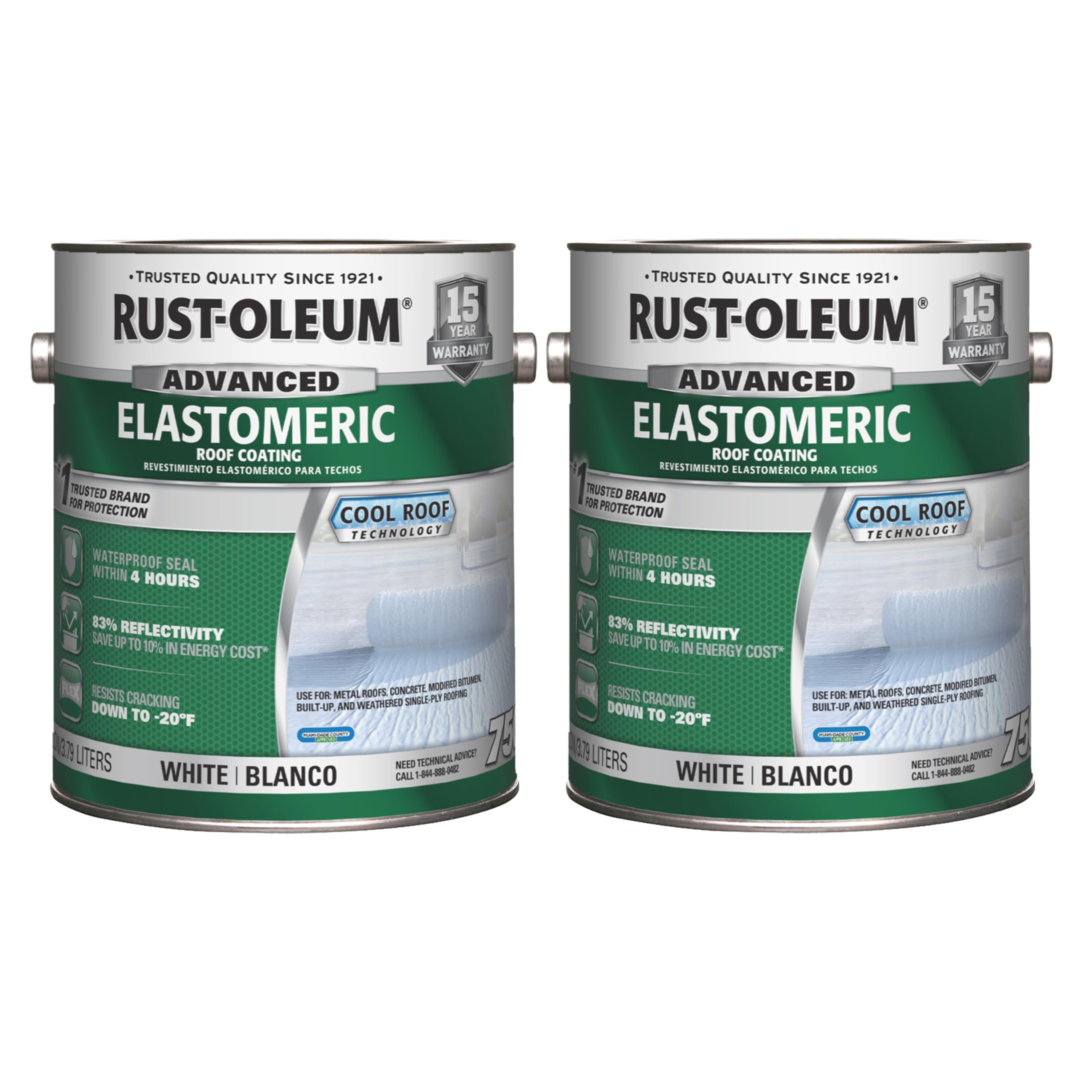
This thick, rubberized coating dries to a durable, shoe-sole-like finish that buyers praise. The standout spec is the Cool Roof Technology with 83% reflectivity, which means it bounces most of the sun’s heat away rather than absorbing it. One reviewer on a DC rowhouse noted their roof is now roughly 50°F cooler, and the top floor stays noticeably more comfortable. You get 2 gallons total in the pack, and at 1.5 gallons per 100 sq ft for each coat, that is enough for a modest roof.
It resists cracking down to -20°F and carries a 15-year warranty — numbers that beat the Dicor below on both cold tolerance and warranty length. The catch is honest patience: owners mention that thick coats take 2+ days to dry fully and rain can wash off fresh application, so you need a clear forecast window. It covers a small standalone structure with room to spare compared to the 1-gallon can of the Liquid Rubber Silicone.
Why it wins
- 83% reflectivity keeps roof visibly cooler
- Flexible enough to seal at -20°F without cracking
- Comes as a convenient 2-pack for medium jobs
The trade-off
- Thick coats take over 2 days to fully cure
- Rain can wash off fresh application before it dries
Your best bet if: you want the strongest warranty, the best heat reflection, and a proven rubberized seal that lasts years on your metal roof.
Hold off if: you need a one-day job — this coating demands a dry, patient cure window of 18-48 hours.
2. Dicor RP-MRC-1 Acrylic Elastomeric Coating
The RV owner’s go-to for knocking down interior heat on a metal roof.
This acrylic coating is purpose-built for metal RV roofing, and the coverage is generous: 200 sq ft per gallon, which is twice the 100 sq ft first-coat rate of the Rust-Oleum. One long-term reviewer on an overlanding rig reported a re-coat after 6 years due to small leaks and peeling — a realistic lifespan for a mobile roof facing constant vibration and sun. After two coats of conditioner and two coats of this product, they had a no-leak month.
The heat deflection is the main selling point: customers note an aluminum roof that used to burn to the touch now feels cool after a couple of thin coats, even on a 90°F day. The catch is that it needs at least 2 hours of sun to cure, and one reviewer on an 80°F day found it cured too slowly, causing the coating to run down the RV sides. Unlike the Liquid Rubber Silicone, this acrylic is not recommended for standing water situations, so keep that in mind for flat-roof sections.
Real-world trade-off: It is a proven, affordable cooler for RV metal roofs, but the cure time is finicky, and it is not meant for EPDM or TPO — metal only.
Reach for this if: you are coating an RV or camper metal roof and want noticeable heat reduction at a budget-mid price point.
Think twice if: your roof has low slope or standing water — acrylic does not handle ponding as well as silicone options.
3. Liquid Rubber MetalSafe Sealant
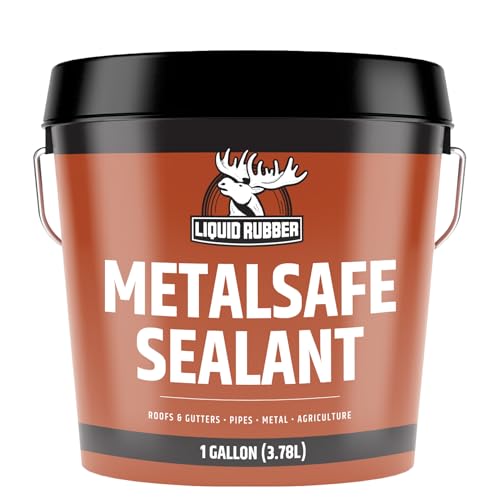
The thick black membrane that welds itself to rusted metal and stops leaks immediately.
This is the specialist when corrosion is your enemy. Unlike the white acrylics above, the MetalSafe comes in black and is built to apply directly over lightly rusted surfaces without extensive prep. The coverage is heavy — you use 1 gallon per 15-30 sq ft depending on surface type, meaning it goes on thick. One buyer who brushed it around pole barn screws reported they have not had a leak in any area since applying it, which is about as definitive an endorsement as you get.
You need to follow temperature rules: apply above 50°F and avoid direct intense sunlight or dew forecasts. It is a rubber-based formula that delivers a 30 mil (0.76 mm) membrane with 2-3 heavy coats on vertical surfaces or a 60-80 mil (1.5-2 mm) membrane with 4-5 coats on flat surfaces. That is a much thicker build per coat than the Dicor’s thin acrylic layers. One warning from a buyer — it is messy to work with, so gloves and drop cloths are non-negotiable.
The standout: The ability to seal over rusted metal without heavy sanding is rare, and the ultra-high corrosion protection makes this the long-term fix for barns and sheds.
Best for: metal barn roofs, horse trailers, or any corrugated metal with rust spots that you want to seal for years.
Not for: large flat roofs where you want white reflectivity — this is a black coating, so it absorbs more heat.
4. Liquid Rubber Silicone Roof Coating

The one-coat silicone that stretches like rubber and survives constant expansion.
If your metal roof expands and contracts a lot through the seasons, this silicone coating is your best friend. The spec that matters here is over 237% elongation — that means the dried membrane can stretch more than double its length before cracking, which beats the rubber-based Rust-Oleum and the acrylic Dicor for flexibility. One buyer who used it on a DIY micro camper noted it was waterproof after just a few hours and held up to a huge rain storm with no drips.
It covers 50 sq ft per gallon and needs no primer, which simplifies application compared to the multiple-step process the Dicor requires. It is also safe with ultra-low VOCs and no solvents, so you can use it indoors without a respirator. The flip side is stickiness: buyers warn it is very messy in wind and requires rubber gloves. For standing water on flat roofs, this outperforms the acrylic options significantly, but the price per gallon is higher than both the Rust-Oleum and Dicor.
The advantage
- 237% elongation prevents cracking from thermal expansion
- Waterproof and UV stable — no degradation from sun
- No primer needed; safe, low-VOC formula
The downside
- Very sticky and messy to apply, especially in windy conditions
- Higher cost per gallon than acrylic or basic rubber options
Pick this if: you have a roof that expands a lot with temperature swings, or you need a white silicone that handles standing water better than acrylic.
Look elsewhere if: you are on a tight budget — the value picks above cover more area for less.
5. White Siliconized Roof Coating (4.75 Gallon)
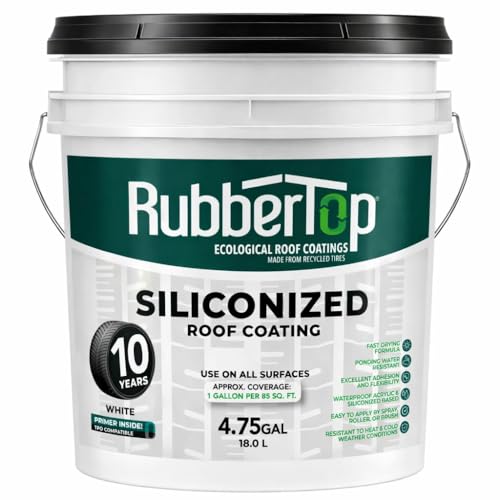
The bulk pail that cools your roof 25°F but has some durability questions.
For the largest jobs, this 4.75-gallon pail offers the most material in one container — outpacing the Rust-Oleum 2-pack by volume. The maker claims it lowers interior temperatures up to 25°F, and buyers who used it on RV roofs say it stopped every leak and was super easy to apply with a roller. At 42 pounds, this is a serious bucket of material.
However, the reviews are mixed compared to the other picks. One buyer in Phoenix reported a poor experience: after 6+ coats in extreme heat, the coating peeled up and stuck to their feet, requiring a redo. Another noted the shelf life is not very long. That is a stark contrast to the glowing feedback on the MetalSafe and the Liquid Rubber Silicone. The fast-drying formula is a plus, but the chemistry may not hold up as well on camper roofs exposed to intense sun and foot traffic.
Value call: The price per gallon is low, making it tempting for big projects, but the mixed reviews — especially the peeling report from a buyer in hot weather — are a real risk.
Good for: large budgets and forgiving climates where you can test a small area first and wait for ideal conditions.
skip it if: your roof gets extreme Phoenix-style heat or you need bulletproof durability — the Liquid Rubber MetalSafe is a safer bet for rough conditions.
Understanding the Specs
Reflectivity (Solar Reflectance)
This percentage tells you how much of the sun’s energy the coating bounces back into the air instead of soaking into your roof. A figure like 83% on the Rust-Oleum 750 is excellent — it means your roof stays much cooler in summer, which can cut your air conditioning use. Look for this number if keeping your building temperature down is a priority.
Elongation Percentage
This measures how much the dried coating can stretch before it cracks. The Liquid Rubber Silicone’s 237% elongation means it moves with your roof as it expands and contracts with the weather. A higher number matters more in climates with big temperature swings from night to day. Lower numbers (like basic acrylics) can crack in those conditions.
FAQ
Can I apply a coating over an old, rusted metal roof?
How long does a coating for a metal roof last?
What is the difference between acrylic and silicone roof coatings?
How many coats do I need for a metal roof?
Will a white coating really make my building cooler?
Can I use a metal roof coating on an RV or camper?
How long does it take for the coating to dry?
Is it safe to apply the coating indoors or in a garage?
Does the roof need to be primed before applying the coating?
Final Thoughts: The Verdict
For most buyers, the coating for metal roof winner is the Rust-Oleum 750 because it combines the best reflectivity, a thick rubberized seal, a long warranty, and the convenience of a 2-pack. If you need the ultimate flexibility for a roof that expands a lot, grab the Liquid Rubber Silicone. And for a corrosion-covered barn roof that needs a thick rust-stopping membrane, the standout is the Liquid Rubber MetalSafe.
How We Picked
We do not accept paid placement. Every pick is matched to a real buyer and a real use-case; we do not hands-on test units.
Sources & Methodology
Specifications: manufacturer listings and product documentation. Review insights: verified customer reviews, as of July 2026. Pricing: not shown on this page (it changes often); check the current price via the retailer link.
As an Amazon Associate, WellFizz earns from qualifying purchases. This does not affect which products we feature.
Related Guides

Mo Maruf
I created WellFizz to bridge the gap between vague wellness advice and actionable solutions. My mission is simple: to decode the research and give you practical tools you can actually use.
Beyond the data, I am a passionate traveler. I believe that stepping away from the screen to explore new environments is essential for mental clarity and physical vitality.