You know that foggy-headed, sluggish feeling in a stuffy room? That almost certainly comes from high CO₂ levels messing with your focus, sleep, and energy. A CO₂ monitor is the only way to see this invisible problem so you can fix it by cracking a window. This guide breaks down the five best CO₂ monitors on Amazon right now, helping you pick the one that actually fits your home, office, or grow space.
I’m Mohammad Maruf — the co-founder and writer behind WellFizz. This guide is built by comparing the manufacturers’ published specifications and the patterns across verified customer reviews, so you get each pick’s real strengths and trade-offs instead of marketing spin.
If you are a remote worker fighting brain fog or a plant parent tuning your grow tent, finding the best co2 monitor comes down to accuracy, battery life, and smart alerts. The reviews below show exactly how each model delivers on those fronts.
How To Choose The Best CO₂ Monitor
Picking the right CO₂ monitor is not complicated once you know three things: the sensor type, how it powers on, and what alerts actually help you. Here is the short version of what matters.
NDIR Sensor: The Only Type Worth Buying
Every monitor on this list uses an NDIR sensor (non-dispersive infrared — a method that shines a specific light through the air to measure CO₂ precisely). Non-NDIR sensors drift and give wildly inaccurate readings, so skip any monitor that does not say “NDIR” in the specs. NDIR sensors stay stable across months of use, need no maintenance, and respond within seconds when CO₂ levels change.
Battery vs. Wired Power: Where You Use It Matters
If you plan to move the monitor between rooms or take it on trips, pick a model with a built-in rechargeable battery (look for 2400mAh to 2500mAh — that gives you a full day of use on one charge). If the monitor sits in one spot like a nursery, office desk, or grow tent and you never want to think about charging it, go with an AC-powered (plugged into the wall) unit that runs 24/7 without interruption.
Alert Systems: Not All Alarms Are Useful
A good CO₂ monitor gives you visual alerts (a color-changing light or screen) and audible alerts (a beep when levels rise above a threshold you set). The most useful models let you adjust the alarm point — so you can set it to 1000 ppm (parts per million — the point where most people start feeling drowsy, and some buyers report headaches) instead of the default 1500 ppm. App-based push notifications are a bonus if you want to see a chart of your air history.
Quick Comparison
On smaller screens, swipe sideways to see the full table.
| Model | Category | Best For | Key Spec | Amazon |
|---|---|---|---|---|
| LifeBasis 11-in-1 | All-in-One | Comprehensive air monitoring | 2500mAh battery | Amazon |
| INKBIRD INK-CO2W | WiFi + Smart | Smart home & grow tents | WiFi enabled | Amazon |
| GoveeLife H5140 | Sleep & Office | 24/7 fixed placement | AC powered | Amazon |
| GZAIR SA-1200P | Data Logger | Trend tracking & plant care | 7-day data log | Amazon |
| Gain Express A017755 | Pro Handheld | Portable field surveys | 0-9999 ppm range | Amazon |
In-Depth Reviews
1. LifeBasis 11-in-1 Air Quality Monitor

The LifeBasis 11-in-1 packs an NDIR sensor, a 2500mAh battery, and manual calibration into one device — making it the top choice for most homes because it tracks 11 air quality metrics without needing a smartphone or app. Buyers call the manual calibration a “rare, useful feature,” and reports confirm the CO₂ reading drops from roughly 950 ppm to 450-500 ppm within minutes of opening a window, showing the sensor is genuinely responsive.
So you get CO₂ readings alongside PM2.5 (fine particles), TVOC (total volatile organic compounds — the stuff from paint and cleaners), temperature, and humidity on one screen. The LCD shows each metric with a color grade (green, yellow, orange, red), and a ticking alert sound goes off when any reading enters the warning zone. It does all this without WiFi, Bluetooth, or an app — pure local monitoring you glance at directly.
The honest trade-off is zero smart-home connectivity: no app, no voice commands, no remote viewing. You just look at the screen. At 6.1 ounces and 0.95 inches thick, it is easy to carry between rooms, and you get 11-12 hours of continuous monitoring from a full Type-C charge. If you need a broad sensor suite on a budget, skip the LifeBasis only if you must have app-based logging or WiFi integration — those buyers should pick the GoveeLife H5140 instead.
Why it’s great
- Covers 11 air quality metrics from one NDIR sensor
- Portable with a 2500mAh battery lasting 11-12 hours
- Manual CO₂ calibration for reliable baselines
Good to know
- No WiFi, Bluetooth, or app connectivity
- Produces a faint fan hum, per some owners
2. INKBIRD INK-CO2W WiFi Air Quality Monitor
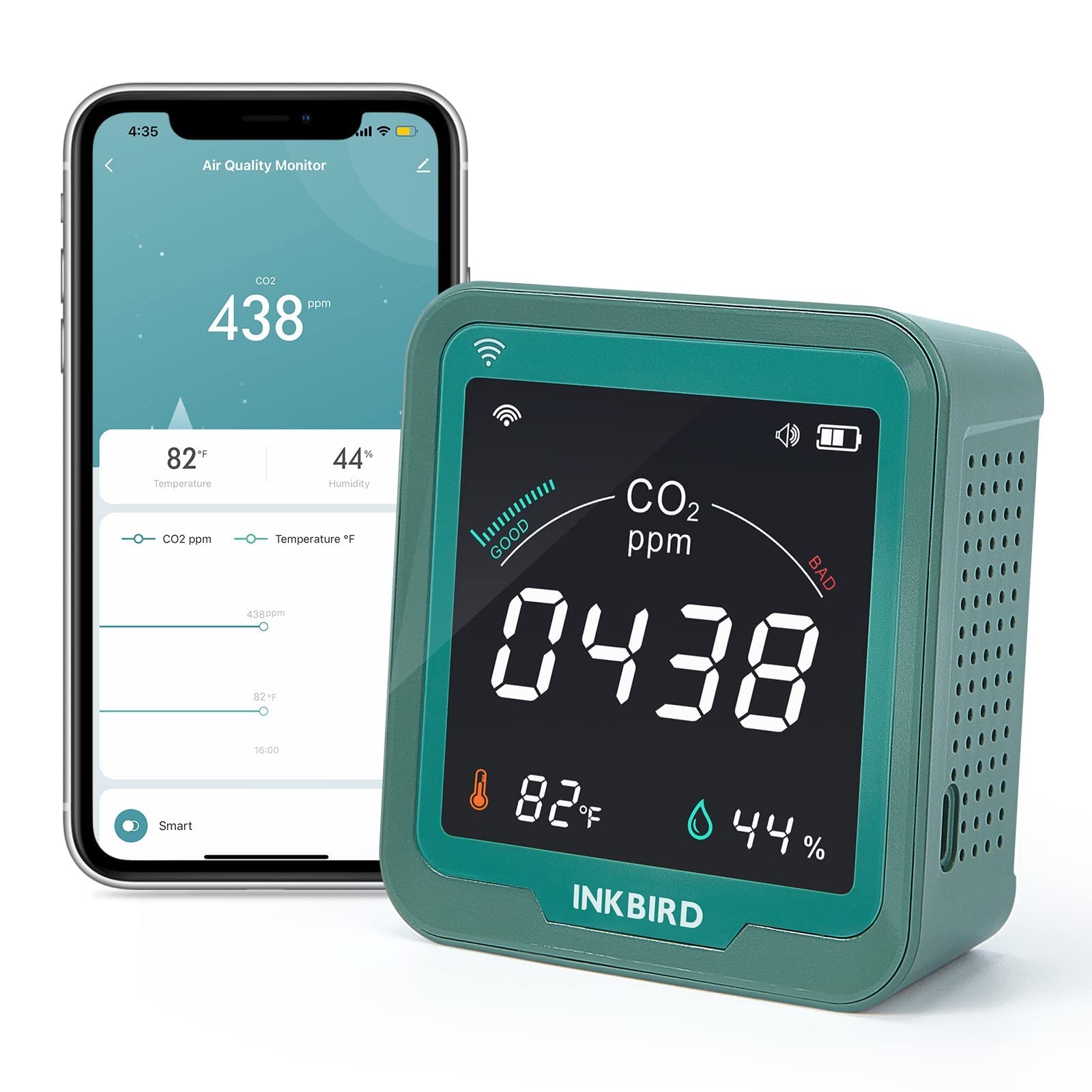
Where the LifeBasis beats it on breadth (11 metrics vs. 3 here), the INKBIRD wins on smart connectivity — WiFi lets you check CO₂ readings from your phone and get push notifications when levels climb. Its 2400mAh battery is 4% smaller than the LifeBasis’s 2500mAh, and some owners mention that after three months, the WiFi disconnects and random shutdowns may require a replacement.
This monitor serves two very different audiences: home office workers who want app-based alerts and grow tent growers who need to track CO₂ for plant respiration. The NDIR sensor delivers ±5% accuracy (range 400-5000 ppm) and a three-level alert system (normal at 400-700 ppm, warning at 700-1500 ppm, danger above 1500 ppm) with an auto alarm that triggers at the highest level. The screen is bright with large numbers, but customers note the LCD is optimized for a top-down view and can be harder to read straight-on.
Pick the INKBIRD over the LifeBasis if you must have smartphone notifications and WiFi logging to track CO₂ trends remotely. Just expect a larger, heavier unit that needs to stay near a wall outlet for continuous use, and note the app connectivity may occasionally need a reset. For grow tent use, the wall-mountable design and precise CO₂ and humidity data make it a solid specialized choice — but skip it if you want a portable device to carry between rooms.
Where it shines
- WiFi connectivity for remote viewing and app notifications
- NDIR sensor with ±5% accuracy in the critical 400-5000 ppm range
- Wall-mountable design for grow tents or offices
Worth noting
- Some buyers experience WiFi disconnects after a few months
- Larger and heavier than portable competitors
3. GoveeLife H5140 Smart Air Quality Monitor
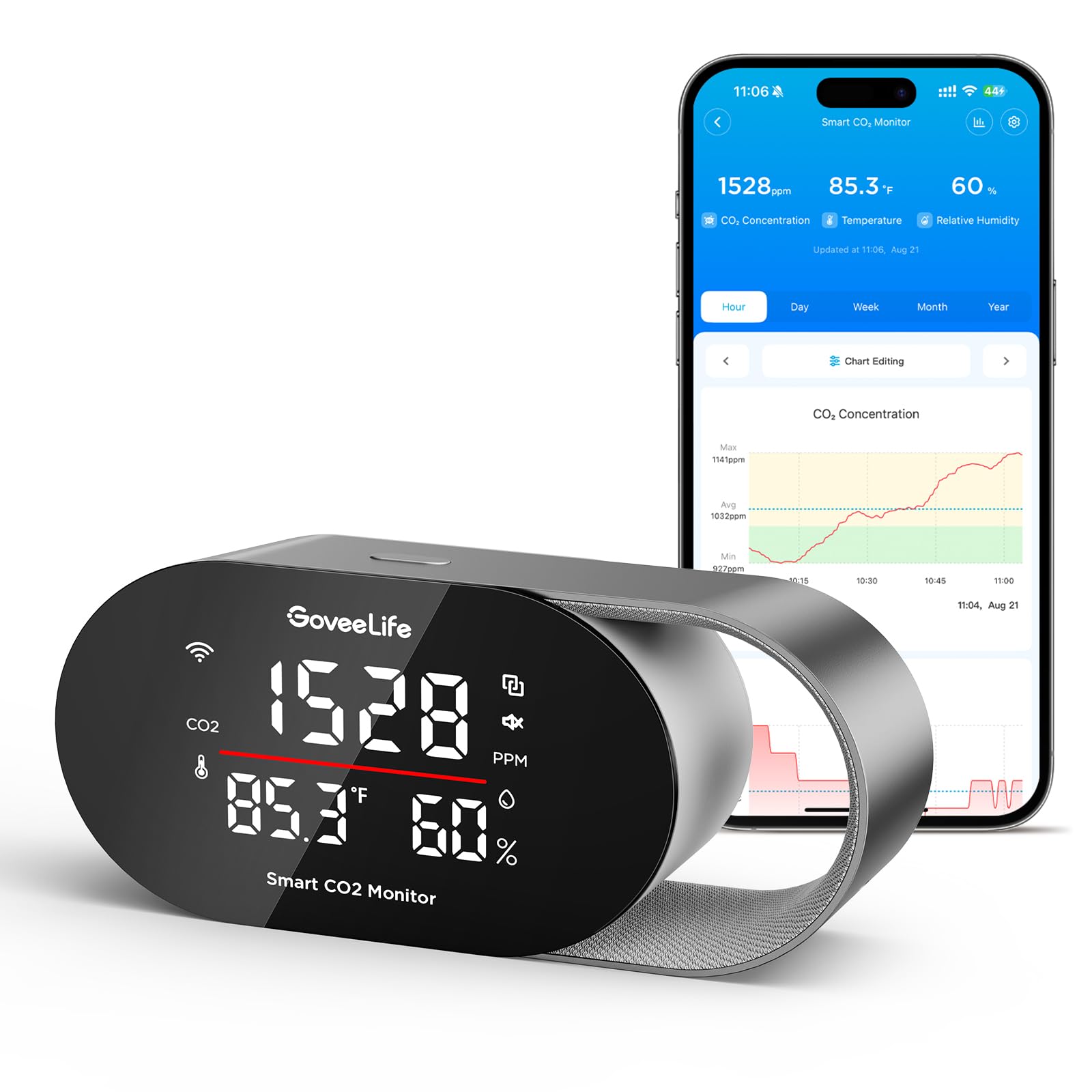
If your main concern is the bedroom, this is the one to buy. The GoveeLife H5140 runs on AC power (plugged into the wall 24/7 with no battery to recharge) and uses a photoacoustic NDIR sensor (a laser-based variation that refreshes every 5 seconds) to catch CO₂ spikes faster than standard NDIR sensors — meaning it can trigger an alert about 10-25 seconds quicker than the INKBIRD’s standard NDIR. One reviewer captured the impact: “Above 1000 ppm causes drowsiness, headaches,” and this monitor alarms you at that exact customizable threshold via a built-in buzzer, app push notifications, and even email alerts.
The programmable tri-color LED light bar and screen brightness auto-adjust based on a day/night schedule you set in the app, so it won’t blast blue light into your nursery or bedroom at 3 AM. It tracks CO₂, temperature, humidity, and a built-in clock (after app connection), and you can export up to two years of historical data as a CSV spreadsheet — useful for showing a doctor whether your child’s sleep environment is triggering headaches. Buyers consistently praise its accuracy and call it “a must have for WFH life” because the real-time display makes them feel the cognitive improvement of simply ventilating.
The catch? It is strictly a fixed-position device — no battery means you cannot carry it from room to room. And it measures CO₂ only, not PM2.5 or VOCs, so it does not offer the all-in-one breadth of the LifeBasis. But for uninterrupted sleep monitoring with deep Govee smart-home integration (works with Alexa, Google Assistant, and Govee humidifiers/fans), this is the pick for anyone who wants “set it and forget it” CO₂ sleep protection with a polished app.
What stands out
- Photoacoustic NDIR sensor with 5-second refresh rate
- AC powered for uninterrupted 24/7 monitoring
- Customizable LED auto-dims for nighttime use
The trade-offs
- AC power only — not portable between rooms
- Does not measure PM2.5 or VOCs
4. GZAIR SA-1200P CO2 Monitor with Data Logger

The number 7 defines this pick — the built-in data logger stores continuous CO₂, temperature, and humidity readings for up to 7 days, with a trend graph on the screen showing Max/Min values for each metric. That matters if you want to see exactly when your room’s CO₂ peaks during the night or after you close the door for a long meeting, rather than just seeing the current number.
The downside is that this is a purely local wired device — no WiFi, no app, no smartphone integration. It needs a 5V/2A USB power adapter and a cable long enough to reach your chosen spot, and buyers warn the initial reading may drift (one reviewer saw erratic swings from 300 to 1600 ppm) before the auto-calibration stabilizes after a day or two. It does support manual calibration outdoors if you want to double-check accuracy, and the two user modes (“Human” for indoor comfort, “Plant” for greenhouse care) make it versatile for dual use.
For the price, this monitor does exactly one thing deeply — logging CO₂ trends over a full week with no connectivity hassle. It suits anyone who wants a set-and-forget workstation or grow tent monitor and is willing to accept a small screen and wired power for the benefit of reliable historical data without an app subscription. Buyers who use it alongside a cheap temp/humidity gauge call the GZAIR a sensible upgrade path, but pass on it if you crave smartphone alerts — the GoveeLife H5140 or INKBIRD serve that need better.
The upsides
- Internal data log stores 7 days of continuous trend data
- Human and Plant modes for versatile placement
- Auto and manual calibration for long-term accuracy
Keep in mind
- Wired USB power only — no battery option
- Initial readings may drift before auto-calibration stabilizes
5. Gain Express A017755 Portable CO2 Meter

What you actually get at this lower price is the widest measurement range in this lineup — 0 to 9999 ppm CO₂ with a stated accuracy of ±50 ppm or ±5% up to 2000 ppm — packed into a handheld meter that looks like it came from a 1980s lab. That extra range matters if you deal with extreme environments like basement workshops, greenhouses with CO₂ enrichment, or spaces using kerosene heaters where CO₂ can spike far beyond what consumer monitors can read.
What you give up for that range is polish: the interface is cryptic without the manual, the buttons feel unresponsive, and there is no phone logging — just a legacy RS232 port (a serial connector from the pre-USB era) that essentially nobody uses anymore. Buyers who have owned these for years call them “workhorses” that are “accurate and consistent,” and a single charge on the included batteries lasts an exceptionally long time. The device reads CO₂ within 30 seconds of powering on, though humidity readings take 10-15 minutes to stabilize.
This is the pick for the serious hobbyist, the greenhouse operator, or the public building surveyor who needs a rugged handheld tool with a proven track record and does not care about phone apps or modern design — the exact budget buyer it is perfect for is someone who wants to diagnose CO₂ in multiple spaces throughout the day (office, classroom, factory, car) and values the 0-9999 ppm ceiling for safety margin, but it’s not for you if you want a simple screen readout with app integration, as even the budget LifeBasis offers an easier daily experience.
Why we’d pick it
- Measures CO₂ from 0 up to 9999 ppm — widest range on the list
- Long-lasting battery life, praised by repeat buyers
- Handheld design with easy manual calibration
A few caveats
- Interface is cryptic without the manual
- No app or WiFi — uses outdated RS232 port for data transfer
Understanding the Specs
NDIR Sensor vs. Photoacoustic NDIR
Both are legitimate CO₂ measurement technologies, but they work differently. Standard NDIR (non-dispersive infrared) shines an infrared light through the air and measures how much gets absorbed by CO₂ molecules — it is proven, reliable, and found in most monitors on this list. Photoacoustic NDIR (used in the GoveeLife H5140) uses a pulsed laser that heats CO₂ molecules, creating a tiny pressure wave that a microphone detects — it refreshes faster (every 5 seconds vs. every 10-30 seconds on standard NDIR) and is less affected by dust or temperature changes. For a home user, both types deliver trustworthy readings; the photoacoustic version gives you quicker response time, so you see the effect of opening a window almost immediately.
PPM: Parts Per Million Explained
PPM (parts per million) is the unit CO₂ monitors use to tell you how many CO₂ molecules exist in every million air molecules. Outdoor air typically sits around 400-420 ppm (that is the baseline). At 1,000 ppm, many people start feeling drowsy or struggling with focus — reviewers point out “headaches” and “brain fog” at this level. Above 2,000 ppm, cognitive performance drops significantly, and sustained levels over 5,000 ppm become a health concern. A good monitor lets you set your own alarm threshold — most people choose 1,000 ppm or 1,500 ppm as their “time to open a window” warning.
FAQ
Do I need a CO₂ monitor if I already have an air purifier?
How often do I need to calibrate my CO₂ monitor?
Can a CO₂ monitor help with plant growth?
Final Thoughts: The Verdict
For most people, the best co2 monitor winner is the LifeBasis 11-in-1 because it packs the broadest sensor suite and a long-lasting 2500mAh battery into one portable, well-built unit without requiring a smartphone or app to function. If you want smart-home integration with a polished app experience for the bedroom, grab the GoveeLife H5140. And for extreme-range handheld reliability that professional users trust across years, the Gain Express A017755 is a proven workhorse despite its retro interface.

Mo Maruf
I created WellFizz to bridge the gap between vague wellness advice and actionable solutions. My mission is simple: to decode the research and give you practical tools you can actually use.
Beyond the data, I am a passionate traveler. I believe that stepping away from the screen to explore new environments is essential for mental clarity and physical vitality.