Our readers keep the lights on and my smoothie glass nicely filled. As an Amazon Associate, I earn from qualifying purchases.
Specs are compiled from manufacturer listings and verified buyer reviews and can change over time — please confirm the key details on the product page before buying.
You walk into a hotel room, a rental car, or a stuffy conference hall and instantly feel that foggy, tired head — that is CO₂ building up in a sealed space. A portable CO₂ detector gives you a real-time number so you know exactly when to crack a window or step outside for fresh air. You get three battery-powered, luggage-friendly picks here that each take a different approach to keeping you informed on the road.
I’m Mohammad Maruf — the founder and writer behind WellFizz. This guide is built by comparing the manufacturers’ published specifications and the patterns across verified customer reviews, so you get each pick’s real strengths and trade-offs instead of marketing spin.
If you spend nights in hotels, work from a van, or just want to know the air quality in any room you walk into, the right co2 detector for travel fits in your bag and runs on battery for weeks without needing a wall outlet.
Our Picks at a Glance

How To Choose The Best CO2 Detector For Travel
A travel CO₂ detector is different from the plug-in unit you stick in your living room. You need something that runs on batteries, fits in a carry-on, and gives you clear readings without a phone or app. Here are the three specs that separate a good travel companion from a desk ornament.
Sensor Type — NDIR Is Non‑Negotiable
The only sensor technology that delivers accurate, drift-free CO₂ readings is NDIR (non-dispersive infrared) — it shines an infrared light through an air sample to measure CO₂ absorption. Cheaper electrochemical sensors drift after a few weeks and need frequent recalibration. Every pick in this guide uses a Swiss-made NDIR sensor, which means you get trustworthy real-time numbers from 400 to 5000 or 9000 ppm without babying the device.
Power Source — Battery Life Matters
If a detector needs to stay plugged into USB to work, it is not a travel device. Look for units that run on standard AA batteries or have a rechargeable battery that lasts for days or months of continuous monitoring. A detector that dies mid-trip is worse than no detector at all.
Portability and Display
The best travel CO₂ detector is the one you actually bring with you. Look for a weight under 5 ounces and dimensions small enough to slip into a laptop bag or jacket pocket. A clear, readable display — preferably with color alerts so you can glance from across a hotel room — saves you from squinting at tiny numbers.
Quick Comparison
| Model | Best For | Sensor Type | Weight | CO2 Range | Amazon |
|---|---|---|---|---|---|
| Temtop C1★ Best Overall | Best value & compact travel | Swiss NDIR | 4.96 oz | 400–5000 ppm | Amazon |
| SwitchBot Meter Pro CO2 | Premium accuracy & smart features | Swiss NDIR | 4.8 oz | 400–9000 ppm | Amazon |
| AccUnni Au01 | Budget-friendly & simple | NDIR | 3.17 oz (0.09 kg) | 400–5000 ppm | Amazon |
In‑Depth Reviews
1. Temtop CO2 Monitor C1
Our pick — over 4★ from 600+ verified ratings; the strongest balance of quality and price.
Accurate Swiss NDIR in a slim metal build that is light enough for any carry-on.
The Temtop C1 packs a Swiss-engineered NDIR sensor with ±40 ppm +5% of reading accuracy at the critical 400–2500 ppm range, compared to the SwitchBot’s ±50 ppm +5% of reading. The 5-second refresh rate is fast enough to catch changes when you open a window or walk into a crowded room. At 4.96 ounces (the SwitchBot is 4.8 ounces), but the metal and plastic enclosure feels more solid in hand than the AccUnni. The CO₂ range covers 400 to 5000 ppm — wide enough for any normal indoor space. Owners mention that the device is accurate within 18 points compared to a professional-grade CO₂ meter, which is remarkable at this price point.
The slim dimensions — 5.51 x 1.26 x 4.09 inches — let it slide into a laptop sleeve easily. But the display is low contrast and has no backlight, so reading it in a dark hotel room is hard. If you need to see CO₂ levels at night without turning on a light, the SwitchBot’s larger, brighter screen is better. The Temtop runs on a rechargeable battery (USB cable included), and customers note it holds a good charge. However, one reviewer warned that after a few weeks of use the CO₂ reading stopped updating automatically and only changed when the button was pressed — a bug that requires a return if it happens to you.
Unlike the AccUnni which needs a 1-minute manual calibration outdoors, the Temtop works from the start with no setup. The customizable alerts let you turn off both the buzzer and the display illumination for undisturbed sleep. Think of this as the Swiss-Army-knife travel monitor: it also tracks temperature and humidity, and the temp range goes from -10°C to 60°C — handy if you are storing gear in a hot car or cold campsite.
Tight accuracy, low setup
- ±40 ppm Swiss NDIR sensor
- Rechargeable battery holds charge well per reviews
- Customizable alerts — disable both sound and display light for sleep
- Also measures temperature and humidity with wide range
Display & durability quirks
- No backlight — hard to read in low light
- One buyer mentioned sensor stopped updating automatically after weeks
- Display is low-contrast compared to the SwitchBot’s bright screen
Best for: budget-minded travelers who prioritize accuracy specs over a bright screen and want a rechargeable unit they can plug in at night.
Look elsewhere if: you need clear visibility in a dark room — the backlight-less display will frustrate you in a hotel at night.
2. SwitchBot Meter Pro CO2

The most accurate travel CO₂ detector you can buy without spending Aranet4 money.
Your health and focus start with knowing exactly what you are breathing, and the SwitchBot delivers that with a Swiss-made NDIR sensor (non-dispersive infrared) that measures CO₂ every single second — at a 1-second refresh, while Temtop refreshes every 5 seconds and AccUnni every 10 seconds, so you see changes instantly. The accuracy is rated at ±50 ppm + 5% of reading across a huge 400–9000 ppm range, so even in a sealed hotel room after a long night, the number stays trustworthy. The 4.8-ounce weight is nearly identical to the Temtop (just 0.16 ounces lighter), but the real win for travelers is the built-in battery that the maker claims lasts up to 12 months — no plugging in required. The 92mm display shows CO₂, temperature, humidity, time, and date all at once, and the adjustable bracket lets you prop it on a hotel desk or wall-mount it in a van.
Buyers report that an outdoor test showed a reading of roughly 400–450 ppm, confirming the sensor baseline is spot-on. One reviewer noted the detector matches the accuracy of their Aranet 4. The catch is that serious smart features — like app push notifications — require a separate SwitchBot Hub, and some users noted that plugging the unit in for power caused random reading freezes that last for hours. On battery alone it is rock-solid.
The SwitchBot also matches the Temtop in being a compact travel companion, but it adds a modern minimalist look that blends into a hotel nightstand or greenhouse shelf without looking like lab equipment. The sensor does need occasional cleaning as one buyer pointed out, but that is a minor trade-off for this level of precision on the go.
Field‑tested accuracy
- ±50 ppm Swiss NDIR sensor reads every 1 second
- Up to 12 months battery life on AA cells
- Large 92mm display shows CO₂, temp, humidity, time, and date
- Matches Aranet 4 performance per multiple reviewers
Smart‑feature gotchas
- App notifications need a optional SwitchBot Hub
- Plugging in for power can cause random reading freezes
- Battery checks CO₂ every 5 minutes by default, not 1 second
Reach for this if: you want the most reliable CO₂ readings and don’t mind skipping the app ecosystem — on battery alone it is a superb travel companion.
The trade-off you should know: you trade a low price and direct USB power for Swiss-sensor precision and a 12-month battery life.
3. AccUnni Au01 CO2 Monitor
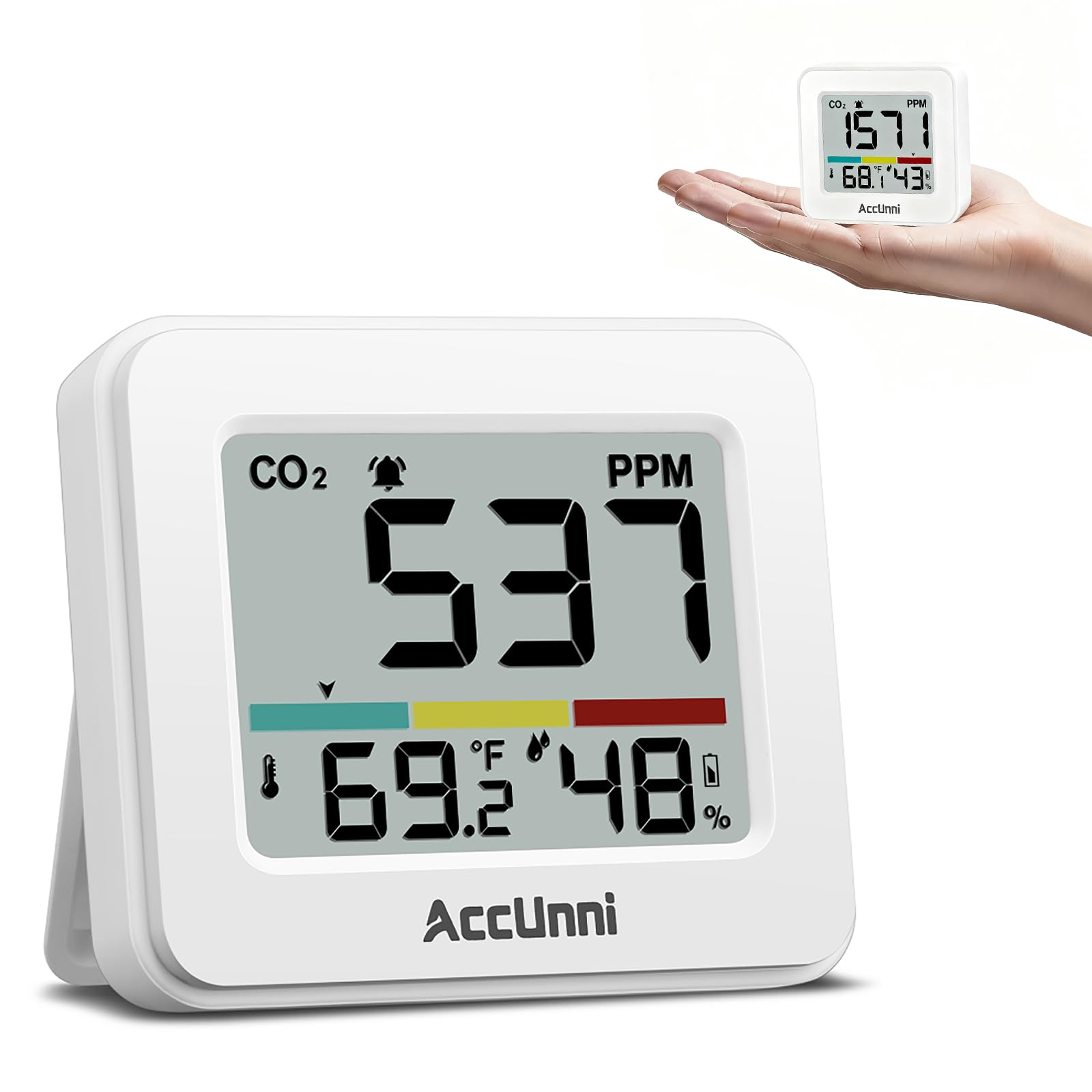
The lightest CO₂ detector here at 3.17 oz, but you calibrate it yourself.
The AccUnni Au01 is the featherweight of the group — at 0.09 kg (3.17 ounces) it is noticeably lighter than both the SwitchBot and the Temtop. The white plastic body is thin and simple, with a clear display and a foldable stand that works on any flat surface. It uses an NDIR sensor to measure CO₂ from 400 to 5000 ppm, with a quoted accuracy of ±5% plus 100 ppm — a looser spec than both the SwitchBot and Temtop. The temperature sensor is accurate within ±0.72°F and humidity within ±3% RH, so it is a capable triple-purpose monitor for the road. Reviewers point out that the portable CO₂ meter updates every 10 seconds and stores 24 hours of high and low readings, which gives you a quick look at how bad the air got overnight.
The biggest difference with the AccUnni is the calibration procedure. You need to perform a manual calibration in a 400 ppm environment — typically fresh outdoor air — by taking the device outside for 1 minute. After that, it self-calibrates automatically at the lowest CO₂ reading it detects over 7 continuous days. Some buyers received units that were stuck at 1500 ppm and would not adjust, which suggests the initial calibration is critical and some units are defective from the start. One reviewer compared it unfavorably to an Aranet 4, saying “you really do get what you pay for.”
The three-color visual alert and three-level sound alarm are effective for knowing when to open a window. You can turn the sound off at night and rely on the color indicator alone. For the price, this is a usable travel monitor if you are willing to follow the calibration steps carefully. But unlike the Temtop and SwitchBot — which both use Swiss NDIR sensors with better drift control — the AccUnni’s reliability is more variable based on buyer reviews.
Ultra‑light & simple
- Only 3.17 oz — the lightest of all three picks
- Clear display with three-color visual and three-level sound alerts
- Stores 24h of high/low CO₂ readings
- Battery powered, no cord needed
Calibration & consistency risks
- Requires manual outdoor calibration — skip it and readings may be stuck
- Accuracy spec is looser (±5% + 100 ppm) vs Temtop (±40 ppm) and SwitchBot (±50 ppm)
- Some buyers received units that never calibrated and stayed at 1500 ppm
Pick this if: you travel ultralight and want the absolute smallest, lightest CO₂ sensor in your bag, and you are fine with a manual calibration step.
skip it if: you want guaranteed plug-and-play accuracy — the calibration gamble makes the Temtop or SwitchBot the safer travel choice.
Understanding the Specs
NDIR Sensor — The Heart of Accuracy
NDIR stands for non-dispersive infrared. It is the same technology used in professional-grade CO₂ meters that cost hundreds of dollars. An NDIR sensor shines an infrared light through an air sample and measures how much of that light is absorbed by CO₂ molecules. That absorption amount translates directly into a ppm (parts per million) number. Swiss-engineered NDIR sensors — the kind used in the SwitchBot and Temtop — resist drift over time, meaning the device stays accurate for months without manual recalibration. Cheaper chemical sensors lose their calibration within weeks.
CO₂ Range and PPM — What the Numbers Mean
Outdoor air normally sits around 400–450 ppm. Indoor spaces with good ventilation stay below 800 ppm. Once the reading climbs above 1000 ppm, most people start feeling drowsy or unfocused. Above 2000 ppm, headaches and sluggishness are common. A good travel detector covers from 400 ppm up to at least 5000 ppm so you can see the full range of air quality in sealed rooms, long flights, or poorly ventilated hotel rooms.
FAQ
Can I use a home CO2 detector for travel?
How often do I need to calibrate a portable CO2 detector?
Will a CO2 detector work on an airplane?
What is the difference between a CO detector and a CO2 detector?
How long does the battery last on each travel detector?
Do I need an app or smartphone connection to use these?
What is a safe CO2 level for sleeping?
Can these detectors withstand humidity or rain?
Is a reading of 500 ppm good or bad?
Final Thoughts: The Verdict
For most travelers, the best co2 detector for travel is the SwitchBot Meter Pro CO2 because it combines a high-precision Swiss NDIR sensor with up to 12 months of battery life and a large, readable display — all in a 4.8-ounce package. If you want the same Swiss-sensor pedigree at a lower price, grab the Temtop C1 for its ±40 ppm +5% of reading accuracy and rechargeable battery. And if you are counting every gram in your backpack and are willing to do a manual calibration, the AccUnni Au01 is the lightest option at just 3.17 ounces.
How We Picked
We do not accept paid placement. Every pick is matched to a real buyer and a real use-case; we do not hands-on test units.
Sources & Methodology
Specifications: manufacturer listings and product documentation. Review insights: verified customer reviews, as of July 2026. Pricing: not shown on this page (it changes often); check the current price via the retailer link.
As an Amazon Associate, WellFizz earns from qualifying purchases. This does not affect which products we feature.
Related Guides

Mo Maruf
I created WellFizz to bridge the gap between vague wellness advice and actionable solutions. My mission is simple: to decode the research and give you practical tools you can actually use.
Beyond the data, I am a passionate traveler. I believe that stepping away from the screen to explore new environments is essential for mental clarity and physical vitality.