Our readers keep the lights on and my smoothie glass nicely filled. As an Amazon Associate, I earn from qualifying purchases.
Cooperative card games turn the table on competition, replacing the “everyone for themselves” grind with shared goals and tactical team decisions. Whether you are racing against a sinking island, surviving a dungeon timer, or navigating Middle-earth as the Fellowship, the best titles deliver tension, laughter, and a real sense of shared victory. The difference between a good night and a great one often comes down to the game’s core loop — how well it makes every player feel essential to the mission.
I’m Mohammad Maruf — the founder and writer behind WellFizz. I’ve spent countless hours analyzing game mechanics, card quality, and replay value across the cooperative card game space to build a guide that cuts through the noise and points you toward the most rewarding team experiences available today.
The games reviewed here cover a wide range of difficulty, player counts, and themes, so you can find the ideal match for your group. This guide to the best co-op card games focuses on titles that make teamwork the star rather than an afterthought.
How To Choose The Best Co-Op Card Games
Finding the right cooperative card game starts with understanding your group’s size, preferred pace, and tolerance for complexity. A fast, chaotic timer game might energize some groups while overwhelming others who prefer calm, strategic deliberation.
Player Count and Scalability
Many co-op card games are optimized for a specific player count. Games like Sail are strictly two-player, making them ideal for couples or duo sessions but useless for game nights with four or five. Broader titles like Forbidden Island or 5-Minute Dungeon play well at higher counts, so check the supported range before buying.
Mechanic Depth: Trick-Taking vs. Action-Matching
Trick-taking games (like The Lord of the Rings: Fellowship and Sail) require each player to track suit, rank, and partner moves, rewarding careful planning. Action-matching games (like 5-Minute Dungeon) rely on speed and pattern recognition. Choose based on whether your group prefers cerebral tension or frantic energy.
Replayability Through Variable Difficulty
Games with scalable difficulty, multiple scenarios, or adjustable starting conditions (like Forbidden Island’s water level or Sail’s tutorial-to-challenge missions) offer longer shelf lives. A single fixed scenario can feel stale after two plays, so multi-mission or variable-setup games deliver better value over time.
Quick Comparison
On smaller screens, swipe sideways to see the full table.
| Model | Category | Best For | Key Spec | Amazon |
|---|---|---|---|---|
| Forbidden Island | Survival Co-op | Family gateway games | 30-min playtime, 2-4 players | Amazon |
| LOTR Fellowship Trick-Taking | Narrative Trick-Taking | Fans of themed strategy | 144 cards, 1-4 players | Amazon |
| Sail | 2-Player Trick-Taking | Pairs wanting deep decisions | 20-min playtime, 2 players | Amazon |
| 5-Minute Dungeon | Real-Time Chaos | Fast-paced families | 275 cards, 2-5 players | Amazon |
| Why Don’t We Laugh Together | Couples Social Card Game | Romantic date nights | 200 cards, 2 players | Amazon |
In‑Depth Reviews
1. Gamewright Forbidden Island
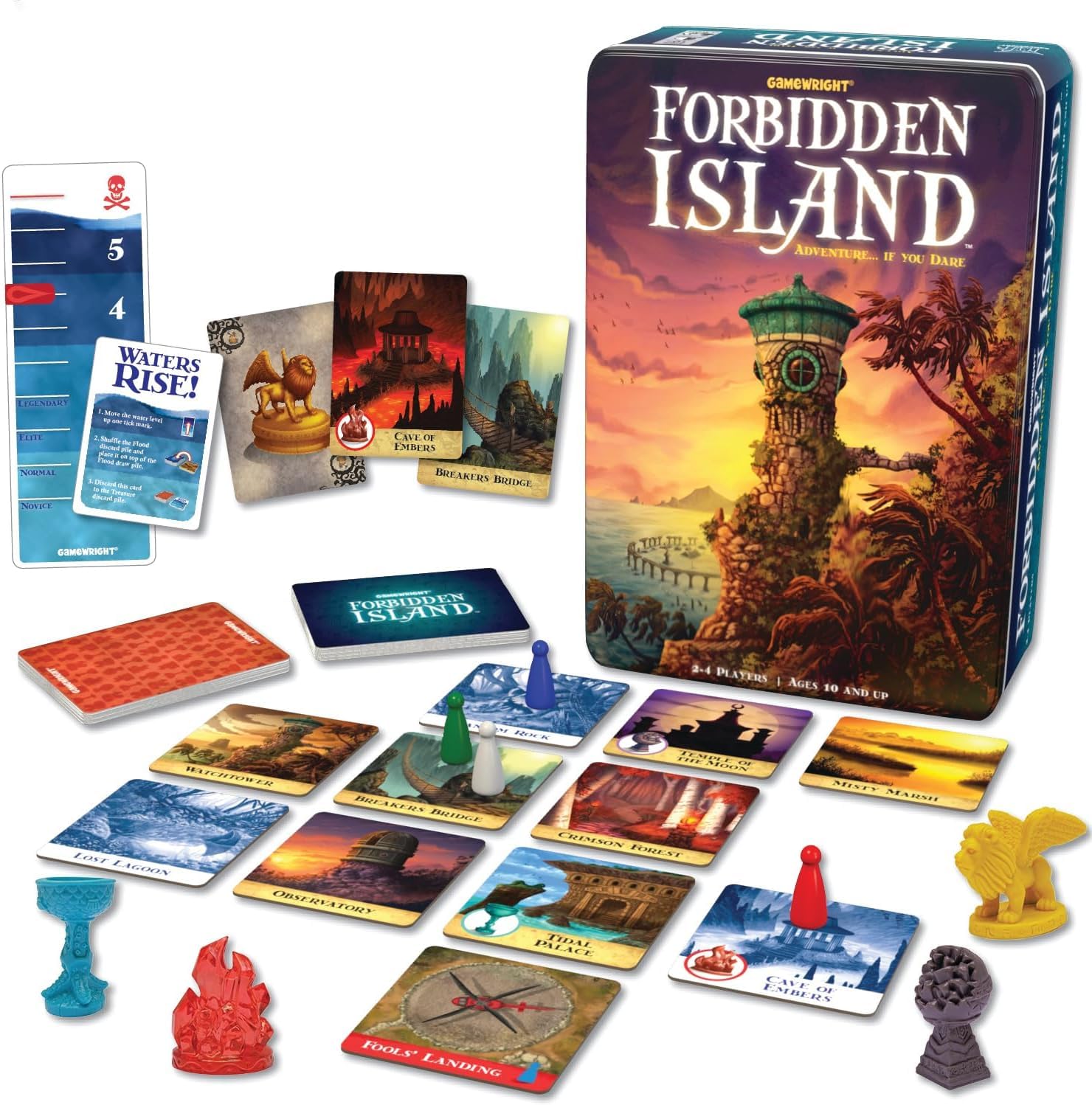
Forbidden Island wraps a simple action system into a tense survival package where players race to collect four treasures before the island sinks tile by tile. Each turn you move, shore up sinking tiles, or exchange treasure cards, while the water level rises and floods more terrain. The 2010 Mensa Favorite Brainy Games Winner uses a modular board and a variable starting water level, giving solid replayability right out of the box.
Component quality stands out at this price tier — thick cardboard tiles, durable plastic treasure pieces, and a sturdy metal tin that doubles as storage. The cards are thin but functional, and the rulebook gets a full game going within five minutes. With four unique roles (Pilot, Engineer, Navigator, Diver), each player feels ownership over a distinct part of the strategy, preventing quarterbacking from the most experienced player.
The 30-minute playtime works perfectly for families with younger audiences (rated 10+, but playable with adults and kids as young as five with guidance). Difficulty adjusts cleanly through the water level, so novice teams can survive and veteran groups can raise the stakes. It is the closest thing to a universal entry point for cooperative tabletop play.
Why it’s great
- Excellent component quality with a metal tin box
- Variable water level makes difficulty scalable
- Role-based abilities prevent a single quarterback from dominating
Good to know
- Cards can feel thin compared to modern premium decks
- Simple mechanics may feel too light for veteran strategy groups
2. Asmodee The Lord of The Rings The Fellowship Trick-Taking Game

This trick-taking adaptation follows the Fellowship’s journey from the Shire to the Breaking, matching each chapter with specific card-play conditions that the team must meet cooperatively. If you already understand basic trick-taking (Hearts, Spades), the core loop takes two minutes to learn, but the narrative constraints and character power-ups introduce real strategic tradeoffs. Players must decide whether to win or lose tricks intentionally to advance the story without taking too much damage.
The stained-glass artwork across all 144 cards is genuinely striking — each character and scene pops with a vibrant, illuminated look that justifies the premium feel. Wooden tokens and a compact box keep setup minimal, though sleeving all the cards makes the box slightly tighter to close. The rulebook includes multiple game modes, including a solo variant and a more challenging campaign, which extends replay value well beyond the first few sessions.
Best results come with three to four players, but the two-player mode still works because the structure forces each player to control multiple characters. The 20-minute playtime delivers a satisfying arc without dragging. For LotR fans who appreciate novel-inspired storytelling and conditional puzzle-solving, this is the most narratively rich cooperative trick-taker on the list.
Why it’s great
- Stained-glass art is beautiful and elevates every card
- Narrative progression adds variety beyond raw trick-taking
- Fast 20-minute rounds suit short game nights
Good to know
- Box is tight when cards are sleeved
- Players unfamiliar with trick-taking may need a warm-up round
3. ALLPLAY Sail Cooperative Strategy 2 Player Game

Sail rewrites the two-player cooperative rulebook by applying a silent communication limit — players must coordinate trick-winning and trick-losing moves without talking about their hands. The pirate ship theme ties directly to the mechanic: winning a trick moves your ship forward, losing one sets you back, and every decision must account for your partner’s unknown cards. The asymmetrical player powers add another layer, giving each pirate a special ability that can break a tie or salvage a bad hand.
The components punch above the small box size — thick cards, a wooden ship token, and a lay-flat board fit inside a 5x5x2 package that travels easily to breweries, camping trips, or coffee shops. Multiple scenarios escalate from a tutorial to a brutal Kraken-level challenge, so the difficulty scales as the duo improves. The 20-minute playtime means you can cycle through several scenarios in an hour without burnout.
This is the tightest two-player experience among the picks because the communication restriction forces genuine partnership rather than parallel solitaire. Some groups may find the silence frustrating at first, but that friction is exactly what makes the breakthrough wins so satisfying. It is a hidden gem for couples or friends who want a brain-burning 20 minutes that demands mutual trust.
Why it’s great
- Silent communication mechanic creates unique partnership depth
- Small box and wooden components travel effortlessly
- Multiple scenarios provide excellent challenge scaling
Good to know
- Strictly two-player with no solo mode
- Broken ship tip reported in some units
4. Wiggles 3D 5-Minute Dungeon

5-Minute Dungeon abandons turn-based deliberation entirely, dropping players into a real-time frenzy where everyone simultaneously slaps down cards matching dungeon symbols to clear obstacles before the timer runs out. Each of the ten heroes (on five double-sided mats) has a unique special ability that changes how the team approaches each dungeon. The new Final Form boss and 25 extra cards from the latest edition mean even returning players face a fresh challenge.
The physical quality is unmistakable — thick hero mats, double-sided boss mats with striking art, and a deck of 275 cards that handle shuffling aggression well. A free timer app narrates each round with six different themed voices, turning the countdown into a theatrical experience. The chaos means rounds rarely play the same way twice, so the game stays unpredictable across dozens of runs.
Rated for ages 8 and up, the speed-based matching makes it accessible to younger players while still engaging adults who appreciate fast reflexes and split-second team coordination. The trade-off is that the furious pace makes it hard to stop and plan, which can overwhelm analytical groups. For families or parties that thrive on noise, laughter, and yelling at each other to play faster, this is the perfect pressure cooker.
Why it’s great
- Real-time matching creates high-energy, chaotic fun
- Excellent component thickness and vivid artwork
- Free timer app with multiple narrators adds production value
Good to know
- Zero downtime — not suitable for tactical, slow gameplay
- Artwork is gorgeous but too fast to appreciate during play
5. Why Don’t We Laugh Together

Why Don’t We Laugh Together shifts the co-op dynamic away from dungeon-punching and toward shared vulnerability, with 180 cards spanning talents, drawing challenges, singing prompts, and trivia designed for couples. Rather than surviving a threat, partners earn “prize” cards that reward real-world benefits like skipping chore duty or planning a dream date, blending gameplay with relationship reinforcement. The included dice and pen expand the variety beyond pure card matching.
The compact box (4x4x3 inches) makes it easy to pack for weekend trips or date nights out, and the paper cardstock feels adequate for the occasional shuffle. Setup takes under a minute because the rules are minimal — draw a card, perform the task, laugh together. Some players have noted that the novelty may fade after one playthrough, so this works best as a rotating option alongside deeper mechanical games rather than a weekly staple.
This is the most socially focused entry on the list, suited specifically for partners who prioritize interaction over competition. The prize mechanic transforms the game into a light negotiation tool that couples can revisit between sessions. If your group expects tight strategy or high stakes, this will feel too simple, but for its target audience of two people wanting to connect and laugh, it delivers exactly what the title promises.
Why it’s great
- Prize system creates fun real-world incentives
- Ultra-portable box fits in a small bag or purse
- No complex rules — start playing in 60 seconds
Good to know
- Replayability may be limited after several sessions
- Light strategy — not for hardcore tabletop groups
FAQ
Which co-op card game works best for two players?
How long does a typical round of 5-Minute Dungeon actually take?
Final Thoughts: The Verdict
For most users, the best co-op card games winner is the Gamewright Forbidden Island because it balances accessible rules, excellent component quality, and adjustable difficulty that works for both families and adult groups. If you want a deep two-player partnership game, grab the ALLPLAY Sail for its silent communication mechanic and challenging scenarios. And for a high-energy, laugh-filled family session, nothing beats the Wiggles 3D 5-Minute Dungeon.

Mo Maruf
I created WellFizz to bridge the gap between vague wellness advice and actionable solutions. My mission is simple: to decode the research and give you practical tools you can actually use.
Beyond the data, I am a passionate traveler. I believe that stepping away from the screen to explore new environments is essential for mental clarity and physical vitality.