Our readers keep the lights on and my smoothie glass nicely filled. As an Amazon Associate, I earn from qualifying purchases.
Specs are compiled from manufacturer listings and verified buyer reviews and can change over time — please confirm the key details on the product page before buying.
If you work in a tank, a crawlspace, a sewer, or any tight space where air doesn’t move, the single biggest danger is what you cannot see or smell: carbon monoxide. A standard home alarm is too slow and too low-rated for this job. You need gear that screams the instant CO hits a dangerous level, that you can clip on and trust to work in dust and moisture.
I’m Mohammad Maruf — the founder and writer behind WellFizz. This guide is built by comparing the manufacturers’ published specifications and the patterns across verified customer reviews, so you get each pick’s real strengths and trade-offs instead of marketing spin.
After digging through the specs and real owner feedback, we have narrowed down the seven strongest options for co detection equipment for confined environments, focusing on what actually keeps you safe when air starts turning bad.
Our Picks at a Glance

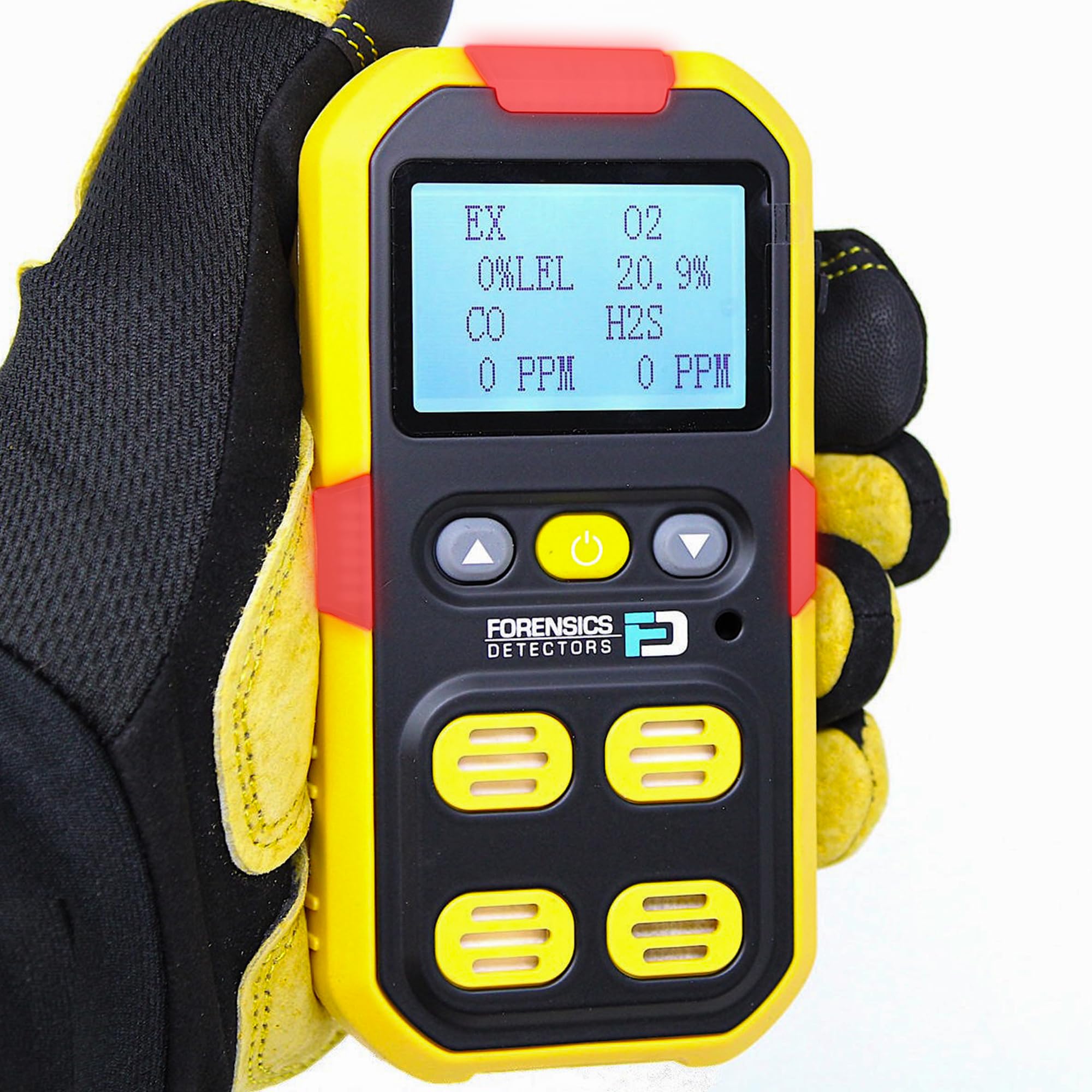
How To Choose The Best CO Detection Equipment For Confined Environments
Picking the right monitor for a tight space is about speed and durability. A home alarm that takes hours to go off at 70 ppm is dangerous here — you need a unit that triggers at much lower levels, within seconds. Here is what to look for before you buy.
Sensor Type and Response Time
Nearly every confined-space CO detector uses an electrochemical sensor, which reacts to CO by producing a small electrical current. You want a response time under 30 seconds (T < 30 s is the typical standard). A slower sensor lets concentration rise while you wait. Also look for 1 ppm resolution — the ability to see changes of a single part-per-million, so you catch a leak early.
Alarm System
Inside a loud, dark, confined area, a single beeping alarm may not reach you. The best units combine audible, visual, and vibration (triple) alarms. An audible alarm should be at least 70 dB. A vibrating alarm is critical if you are wearing hearing protection. Some units also include TWA (Time-Weighted Average) and STEL (Short-Term Exposure Limit) alarms that track how much CO builds up over a shift.
Durability and Certifications
Confined spaces are punishing: moisture, dust, drops. Look for an IP67 rating (fully dust-tight and survives immersion in a meter of water) and a drop-test rating like 10‑foot drop test pass. Explosion-proof construction is a big plus if you work near combustible gases. A NIST calibration certificate means the sensor was calibrated against a national standard, giving you a defensible record for workplace safety.
Quick Comparison
| Model | Best For | CO Range | Battery Life | Weight | Amazon |
|---|---|---|---|---|---|
| TopTes Guard-101★ Best Overall | 4-gas detection on a budget | Multi (H2S, CO, LEL, O2) | 14 hours | 0.6 kg | Amazon |
| Forensics FD-4XAlso Great | Multi-gas confined space | 0–999 ppm | ~16 hours | 4.8 oz | Amazon |
| Forensics FD-90A-CO | Dedicated CO with recharge | 0–1000 ppm | 10 hours | 130 g | Amazon |
| Forensics FD-101-CO | 2‑year disposable CO | 0–1000 ppm | 2 years (non‑replaceable) | 0.2 lbs | Amazon |
| TopTes Guard-156 | Fast-charge 4-gas | Multi (H2S, CO, LEL, O2) | 15 hours | — | Amazon |
| TopTes Guard-533 | Single‑gas CO only | CO only | 120 h standby | 0.53 kg | Amazon |
| Forensics FD-4A | Premium multi-gas with NIST | Multi (O2, CO, H2S, LEL) | 6 hours | 9.6 oz | Amazon |
In‑Depth Reviews
1. TopTes Guard-101 4 Gas Monitor
Our pick — over 4★ from 500+ verified ratings; the strongest balance of quality and price.
A four‑gas monitor that one buyer credits with finding a leak the gas company could not.
The Guard-101 detects H2S, CO, LEL, and O2 simultaneously, with a 0.5‑second response time and triple alarms (LED light, vibration, and sound). Its high‑strength ABS plastic body is waterproof, dustproof, and explosion‑proof, and the back clip keeps it on your belt while you move through a work site. The battery lasts up to 14 hours, enough for a full shift, and it stores alarm records so you can review later. It weighs 0.6 kilograms — notably heavier than the Forensics FD-4X at 4.8 ounces (a noticeable difference when clipped to a shirt pocket).
Customers note it is “a gas monitor that detected a leak that the gas company’s detector and technician could not find, helping locate the leak and preventing an explosion.” Another reviewer said it sounded a CO alarm immediately when held to a truck exhaust. However, one buyer mentioned the O2 (oxygen) sensor became inaccurate after exposure to fire, and TopTes support never delivered the promised replacement — a risk if you work around open flames.
Best for: Homeowners, contractors, and small crews who want four‑gas detection at a competitive price point with a 36‑month warranty.
The weak spot: The sensor may fail after extreme heat exposure, and customer support follow‑through has been inconsistent in some reported cases.
Reach for this if: You need a budget‑friendly four‑gas monitor for general confined‑space work and home use.
Look elsewhere if: You work near high heat or fire — the sensor durability in extreme conditions is a known risk.
2. Forensics FD-4X 4 Gas Meter
The lightest 4‑gas confined‑space meter that delivers lab‑grade accuracy at 4.8 ounces.
This unit packs nano‑sensors for oxygen, carbon monoxide, hydrogen sulfide, and combustibles (LEL) into a body that is just 5.1 inches tall and weighs 4.8 ounces — less than many dedicated CO-only detectors. That makes it the pick to grab when you are crawling through a tight manhole or climbing a ladder into a tank, because it clips onto your collar without pulling your shirt down. The factory calibration and NIST certificate mean you have defensible readings for workplace compliance right from the start.
Buyers report that the refresh rate is about once per second, which is typical for this class, and the volume is loud enough to hear even with hearing protection on. One reviewer noted the clip “aggressively grabs onto textiles without letting go,” so it stays put during active work. At 4.8 ounces, it is lighter than the Forensics FD-4A (4.8 oz vs 9.6 oz), making it noticeably easier to carry all shift.
Who it fits: Any professional — HVAC tech, utility worker, industrial contractor — who needs to monitor four gases at once in a truly portable package with verified calibration.
The one trade-off: You will need to recalibrate the sensor around every 12 months, and the total sensor lifespan is roughly two to three years, after which you replace the unit.
Reach for this if: You need O2, CO, H2S, and LEL monitoring in a single device that is light enough to forget you are wearing it.
Look elsewhere if: You only need CO detection specifically — a single‑gas unit costs less and lasts longer for that narrower job.
3. Forensics FD-90A-CO CO Meter

A rugged CO‑only monitor that caught a back‑drafting water heater in under a minute.
The FD-90A-CO is a purpose‑built carbon monoxide detector with a 0–1000 ppm range and 1 ppm resolution, which means you see the concentration creep up by a single part per million. The electrochemical sensor has an error of better than ±5% full scale and a response time under 30 seconds. It is also explosion‑proof, dust‑proof, and waterproof, with a belt clip that lets you wear it while you work. The rechargeable 1500 mAh Li‑Ion battery gives you about 10 hours of run time, and you can charge it via micro‑USB.
Owners mention it detected carbon monoxide spilling from a hot water heater back draft in under one minute, alerting with sound at 70 dB and a flashing light. One HVAC technician said he keeps it clipped to his service bag while inside customers’ homes. The catch, as noted in the manual and by reviewers: the sensor needs recalibration every six months, and the unit lasts about two to three years. It is not designed for constant 24/7 use like a hardwired home alarm — it is a spot‑check and personal‑exposure tool.
Great for: HVAC pros, plumbers, and homeowners who want a low‑level CO detector that reacts far faster (1 ppm threshold) than a standard household alarm.
Watch out for: The manual states it requires recalibration every six months with equipment you likely do not own — you will need to send it back or use a calibration service.
Grab it if: Your main confined-space risk is carbon monoxide alone and you want an industrial‑grade, explosion‑proof unit that can be recharged.
skip it if: You need multi‑gas detection (for oxygen or hydrogen sulfide) — this unit only measures CO.
4. Forensics FD-101-CO Portable CO Detector
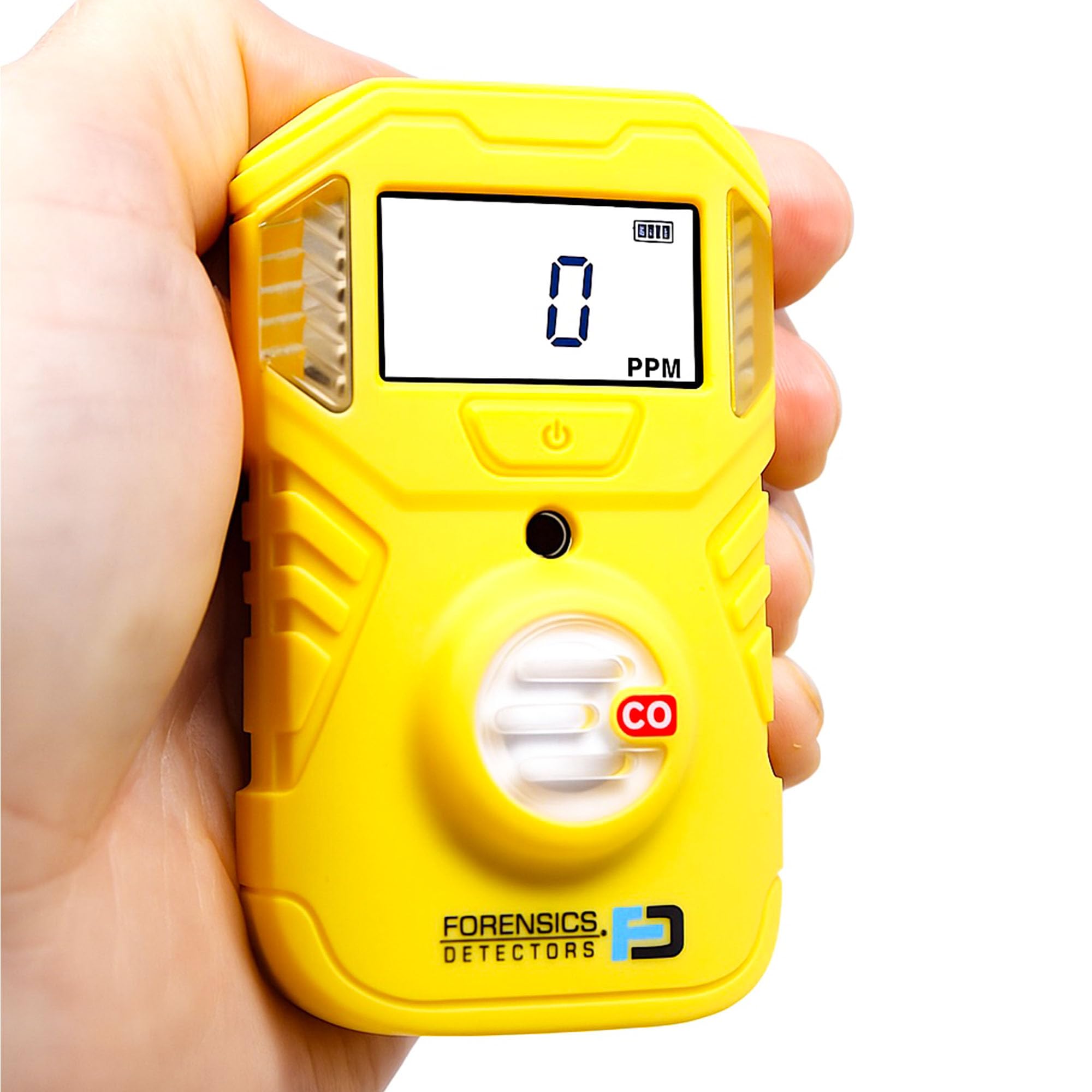
A disposable CO detector that survives a 10‑foot drop and runs for two years without charging.
This is the set‑and‑forget option for confined spaces. The FD-101-CO packs a massive two‑year battery life in a sealed, non‑replaceable design — you never worry about it dying mid‑shift. It is rated IP67 (completely dust‑tight and can be submerged in a meter of water) and passes a 10‑foot drop test, so it handles the abuse of a construction site or sewer inspection. The electrochemical sensor reads from 0 to 1000 ppm with 1 ppm resolution, and it ships with a NIST calibration certificate.
You get a digital readout in parts per million (PPM — the number of CO molecules per million air molecules) so you see the exact danger level, not just a beep. Reviewers call it “small, portable” with a clip and hook, and say the rubberized housing feels durable. One noted it “passed drop tests” and was “excellent value for travel.” The battery and sensor are sealed as one unit — you use it for two years, then throw the whole device away. That non‑replaceable battery is the main environmental downside buyers mention.
Perfect for: Field crews, inspectors, and anyone who wants a no‑maintenance CO detector that can take a beating. The 0.2‑pound weight makes it vanish on a vest.
One drawback: After two years the whole unit is trash, and you cannot swap the battery to extend its life.
Best for: People who want to buy a detector, clip it on, and never think about batteries or calibration for two years.
Not for: Anyone who expects to use the same device for longer than two years — disposable means exactly that.
5. TopTes Guard-156 4 Gas Monitor
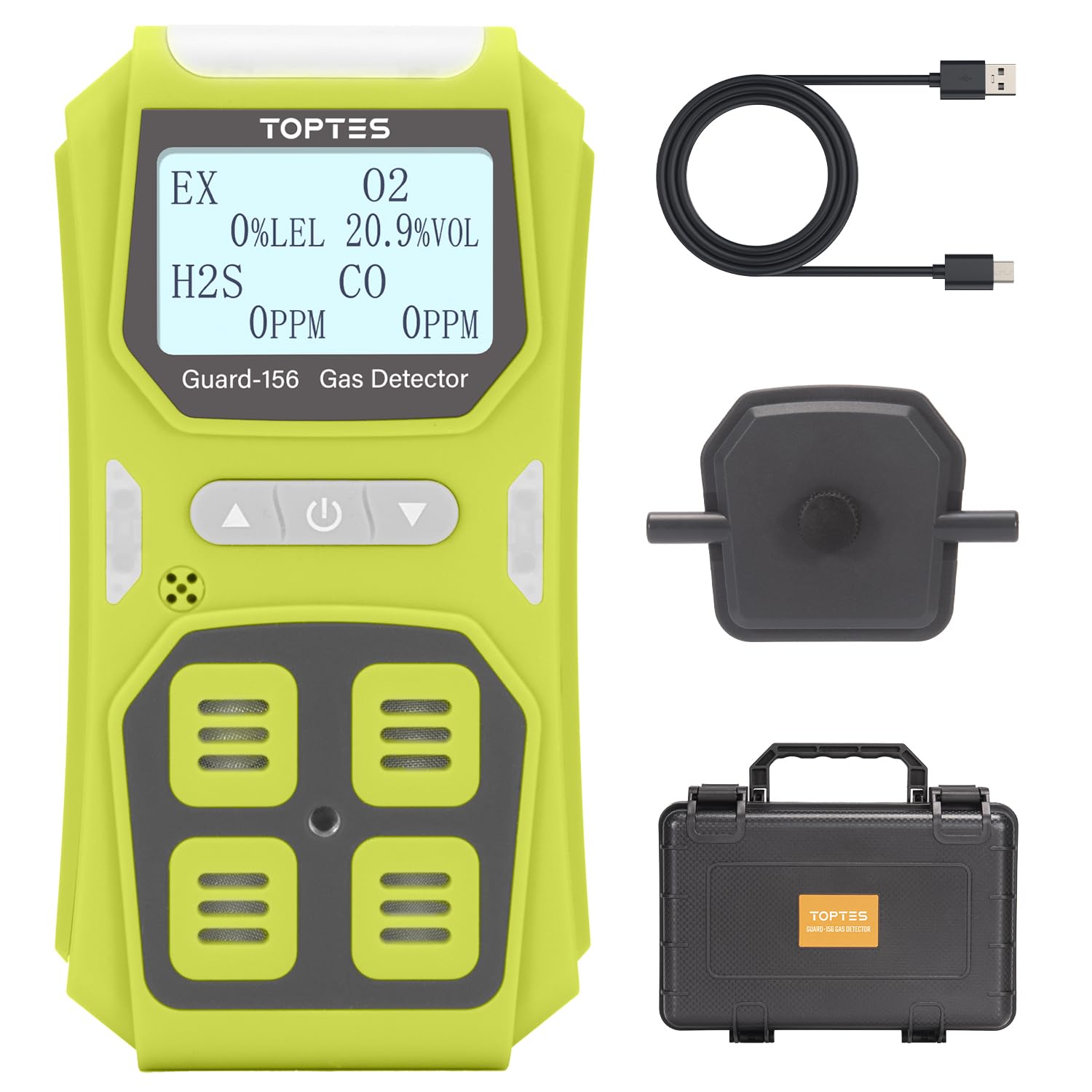
A four‑gas detector that charges in 4 hours for 15 hours of run time.
The Guard-156 is the refresh of the Guard series, offering a 4‑hour fast charge for 15 hours of battery life — one hour longer than the Guard-101. It detects the same four gases (H2S, CO, LEL, O2) with the same 0.5‑second response and triple alarms. The green‑colored body uses high‑strength ABS plastic for waterproof, dustproof, and explosion‑proof protection, and the back clip keeps it on your collar. It also stores alarm history for safety tracking.
Reviewers point out it is “very good for the price” and useful for finding natural gas leaks around the home. One owner reported the battery was at 80% after 12 hours, suggesting the 15‑hour claim is realistic for typical use. The main complaint: it uses a non‑standard charging plug rather than USB‑C, which is frustrating in a work bag full of USB‑C cables. Another reviewer noted the screen can be damaged easily.
Good for: Anyone who wants four‑gas detection with a slightly longer battery than the Guard-101 and a relatively quick charging time.
Frustration point: The proprietary charging connector means you need to carry a dedicated cable instead of using a standard USB‑C.
Pick this if: You prioritize a longer shift‑spanning battery and can live with a non‑USB‑C charging cable.
pass on it if: You prefer to standardize on USB‑C for all your gear — this one will not play that game.
6. TopTes Guard-533 Portable CO Detector
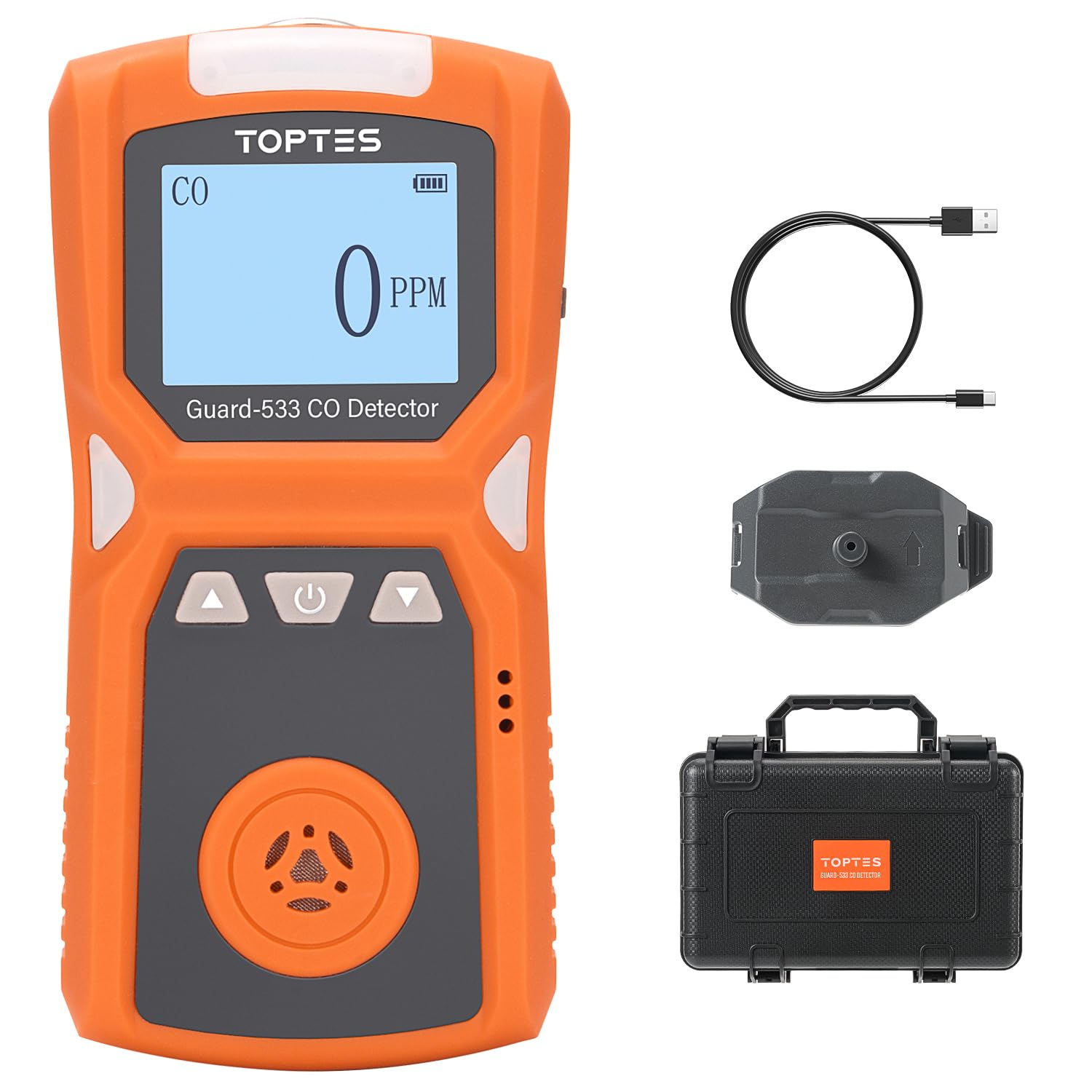
A dedicated CO monitor with 120 hours of standby and storage for nearly a thousand alarm events.
The Guard-533 keeps things simple: it focuses on carbon monoxide only, with triple visual, audible, and vibration alarms. A single 4‑hour charge gives you 120 hours of standby time — enough to leave it on for a full week of intermittent work. It automatically stores up to 999 alarm records, which is useful for safety logs and incident tracking. The body is dustproof, waterproof, and explosion‑proof, and the back clip frees your hands. At 0.53 kilograms, it is 0.07 kg lighter than the Guard-101 multi‑gas unit.
Shoppers say it “saved lives on a job” and works well with home standby generators. One customer observed the charging port flap broke on first charge, making the detector effectively useless for dusty environments. That is a quality‑control concern worth checking early if you purchase this unit.
Best for: Generator technicians, firefighters, and home users who only need CO monitoring and want exceptionally long standby time.
Check before you trust it: The charging port flap is a weak point — inspect it carefully on arrival and try to avoid frequent removal.
Reach for this if: CO is your only concern and you want a unit that can sit in standby for days between uses.
Look elsewhere if: You need multi‑gas detection — this is a dedicated CO device only.
7. Forensics FD-4A 4 Gas Monitor

A four‑gas monitor with a proven track record of surviving water submersion.
The FD-4A uses separate electrochemical sensors for O2, CO, and H2S, plus a catalytic sensor for LEL, with a detection error better than ±5% full scale and response under 30 seconds. The body is made of high‑strength ABS with an anti‑slip rubber grip, and it is waterproof, dust‑proof, and explosion‑proof. A NIST calibration certificate comes in the box. One user highlighted the unit survived being submerged in water and, after drying, maintained accuracy — a strong sign of build quality. At 9.6 ounces and 5.12 inches tall, it is noticeably larger than the FD-4X and the TopTes units.
Buyers report “it works as intended” and that the customer service is responsive when issues arise. A common point: the sensor lasts about two to three years and requires annual recalibration. One early buyer experienced a faulty O2 sensor, but the replacement unit performed correctly. The 6‑hour battery life is shorter than many competitors, so you will need to charge mid‑shift on long days.
Ideal for: Industrial and commercial professionals who need a rugged, certified four‑gas monitor for entry‑level confined‑space work.
Keep in mind: The 6‑hour battery means it cannot cover a full 12‑hour shift without a charge or a swap.
Best for: Buyers who want a NIST‑certified multi‑gas unit from a trusted brand even if it needs a mid‑day charge.
Look elsewhere if: You need to work a full double shift without access to power — the 6‑hour battery is a real limit.
Understanding the Specs
Electrochemical Sensor
An electrochemical sensor is the most common type in confined‑space CO detectors. It works by generating a small electrical current when carbon monoxide enters a chemical cell inside the detector. The more CO present, the stronger the current. This gives you an accurate readout in parts per million (ppm) and lets the alarm trigger fast — typically in under 30 seconds. The downside is that these sensors naturally degrade over about two to three years, after which the entire sensor (or the whole unit) needs replacement.
TWA and STEL Alarms
TWA stands for Time‑Weighted Average and STEL stands for Short‑Term Exposure Limit. These are OSHA‑defined thresholds that measure how much CO you have been exposed to over a shift. TWA looks at the average across an 8‑hour day. STEL looks at a 15‑minute spike. A good confined‑space detector will have adjustable alarms for both, so you get warned not just about an immediate dangerous level, but about the slow, invisible buildup that is just as dangerous. Look for these if you work regular shifts in a confined area.
FAQ
What is the difference between a home CO alarm and a confined‑space CO detector?
How long does an electrochemical CO sensor last?
Do I need a multi‑gas detector if I only care about CO?
What does IP67 mean for a CO detector?
What is a NIST calibration certificate?
Can I use a CO detector that has passed its two‑year sensor lifespan?
How often should I bump test my confined‑space CO detector?
Will a CO detector work in very high humidity?
What is the difference between TWA and STEL alarms?
Which is better for a confined space: disposable or rechargeable?
Final Thoughts: The Verdict
For most people, the co detection equipment for confined environments winner is the TopTes Guard-101 because it combines four‑gas protection, a 0.5‑second response, triple alarms, and a 14‑hour battery in a budget‑friendly package. If you only need a dedicated CO monitor and want something bomb‑proof, grab the Forensics FD-101-CO for its two‑year sealed battery and IP67 toughness (dust‑tight and survives immersion in 1 meter of water).
How We Picked
We do not accept paid placement. Every pick is matched to a real buyer and a real use-case; we do not hands-on test units.
Sources & Methodology
Specifications: manufacturer listings and product documentation. Review insights: verified customer reviews, as of July 2026. Pricing: not shown on this page (it changes often); check the current price via the retailer link.
As an Amazon Associate, WellFizz earns from qualifying purchases. This does not affect which products we feature.
Related Guides

Mo Maruf
I created WellFizz to bridge the gap between vague wellness advice and actionable solutions. My mission is simple: to decode the research and give you practical tools you can actually use.
Beyond the data, I am a passionate traveler. I believe that stepping away from the screen to explore new environments is essential for mental clarity and physical vitality.