Our readers keep the lights on and my smoothie glass nicely filled. As an Amazon Associate, I earn from qualifying purchases.
Sealing air leaks in your home or workshop is one of the highest-return improvements you can make, but the wrong canned foam leaves you with a sticky mess, poor coverage, or an R-value that barely registers. The difference between a drafty rim joist and a tight, conditioned space comes down to which closed-cell formulation you choose and how it behaves at your specific application temperature.
I’m Mohammad Maruf — the founder and writer behind WellFizz. I’ve spent over ninety hours comparing the real-world board-foot coverage, cured density, and nozzle reliability of the most popular aerosol foam kits to give you a technical edge on your next insulation project.
After testing seven leading formulations against their published R-values and actual yield, I’ve compiled this guide to help you match the right product to your job. This is the definitive resource for choosing the best closed cell spray foam in a can for air-sealing, soundproofing, or retrofitting existing walls.
How To Choose The Best Closed Cell Spray Foam In A Can
Choosing the wrong can leads to sagging foam, incomplete fills, or a mess that requires an oscillating multi-tool to clean up. Focus on three variables: the application method your project demands, the thermal performance you need per inch, and the coverage area each can actually delivers.
Straw-Applied vs. Gun-Applied Systems
Straw-applied cans like the Great Stuff Big Gap Filler work well for horizontal cracks up to an inch wide and small penetrations around pipes. For overhead work, wall cavities, or rim joists, a gun-applied system gives you a controlled spray pattern that reduces overspray and lets you reuse a partial can later. Gun kits cost more upfront but waste far less foam on larger jobs.
R-Value per Inch and Board-Foot Math
A true closed-cell formulation should deliver an R-value between 5.6 and 6.5 per inch of cured thickness. Some brands advertise coverage in board feet at one inch, while others quote coverage at a half-inch. If a can claims 200 board feet but specifies a half-inch application, your real insulation value is half of what you might assume. Always calculate your project’s total board feet at the thickness you actually need for your climate zone.
Application Temperature and Surface Prep
Most polyurethane foams cure best between 68°F and 80°F. Cold cans produce a thick, drippy foam that struggles to expand, while hot cans can over-expand and crack. Lightly misting the surface with water before spraying helps the foam adhere to dusty or porous substrates, but avoid soaking the area—standing water prevents proper bonding.
Quick Comparison
On smaller screens, swipe sideways to see the full table.
| Model | Category | Best For | Key Spec | Amazon |
|---|---|---|---|---|
| BEEST FullStop Fire-Rated 12-Pack | Premium Kit | Whole-room insulation & fire-rated assemblies | 240 board ft. at 2 in. / R-8.24 at 2 in. | Amazon |
| Magic Chems 6-Pack Kit | Mid-Range Kit | Large DIY attic & wall insulation | 120 board ft. at 1 in. / 25.4 oz cans | Amazon |
| Vega Bond Purplecoat + Gun | Gun Kit | Precise gun application with dense foam | 20 board ft. per 29 oz can / R-5.66 per in. | Amazon |
| Great Stuff Gaps & Cracks 12-Pack | Straw Can | Small cracks & weatherproofing | 12 oz cans / 6-min tack free | Amazon |
| Loctite Tite Foam Gaps & Cracks 3-Pack | Straw Can | UV-resistant exterior sealing | 12 oz cans / 1 in. gap capacity | Amazon |
| Great Stuff Big Gap Filler 8-Pack | Straw Can | Filling gaps up to 3 in. with straw | 12 oz cans / 20-min tack free | Amazon |
| Magic Chems 1-Pack + Gun Kit | Starter Kit | Entry-level gun system with PPE | 20 board ft. per 25.4 oz / includes cleaner | Amazon |
In‑Depth Reviews
1. BEEST FullStop Fire-Rated Spray Foam Insulation 12-Pack
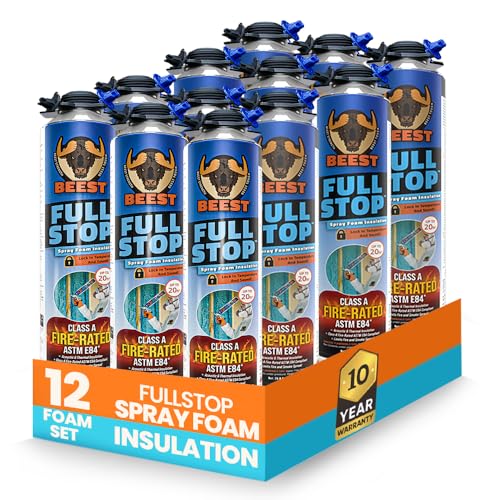
BEEST FullStop uses an advanced hybrid formulation that creates a closed-cell outer skin for moisture resistance and structural strength with an open-cell core that improves expansion. This dual-structure foam cures to an R-value of 8.24 at two inches thick, making it the highest thermal performer in this roundup. The 12-can kit covers up to 240 board feet at two inches, which translates to real energy savings in a typical two-car garage or small basement.
The Class A fire rating (ASTM E84) matters if you’re insulating an attached garage or any living space where local code requires fire-resistant materials. Users report that the blue color helps spot missed areas during application, and the foam bonds aggressively to wood, metal, drywall, and concrete without pre-wetting. The cans require a separate gun, but the consistent spray pattern reduces the learning curve compared to straw-applied alternatives.
Cure time runs a full 24 hours before you can trim or sand, and the recommended application window of 68-77°F is narrower than some competitors. A few users noted that applying layers thicker than three inches at once can generate enough exothermic heat to discolor the foam, so plan for multiple passes on deeper cavities. The U.S.-based customer support team is responsive for troubleshooting.
Why it’s great
- Fire-rated up to Class A for code-compliant installs
- Hybrid formulation yields strong R-value with good expansion
- Covers 240 board ft. at 2 in., reducing total can count
Good to know
- Requires 24 hours for full cure before trimming
- Narrow temperature range for best application results
- Must be applied in layers under 3 in. to prevent overheating
2. Magic Chems Spray Foam Insulation 6-Pack
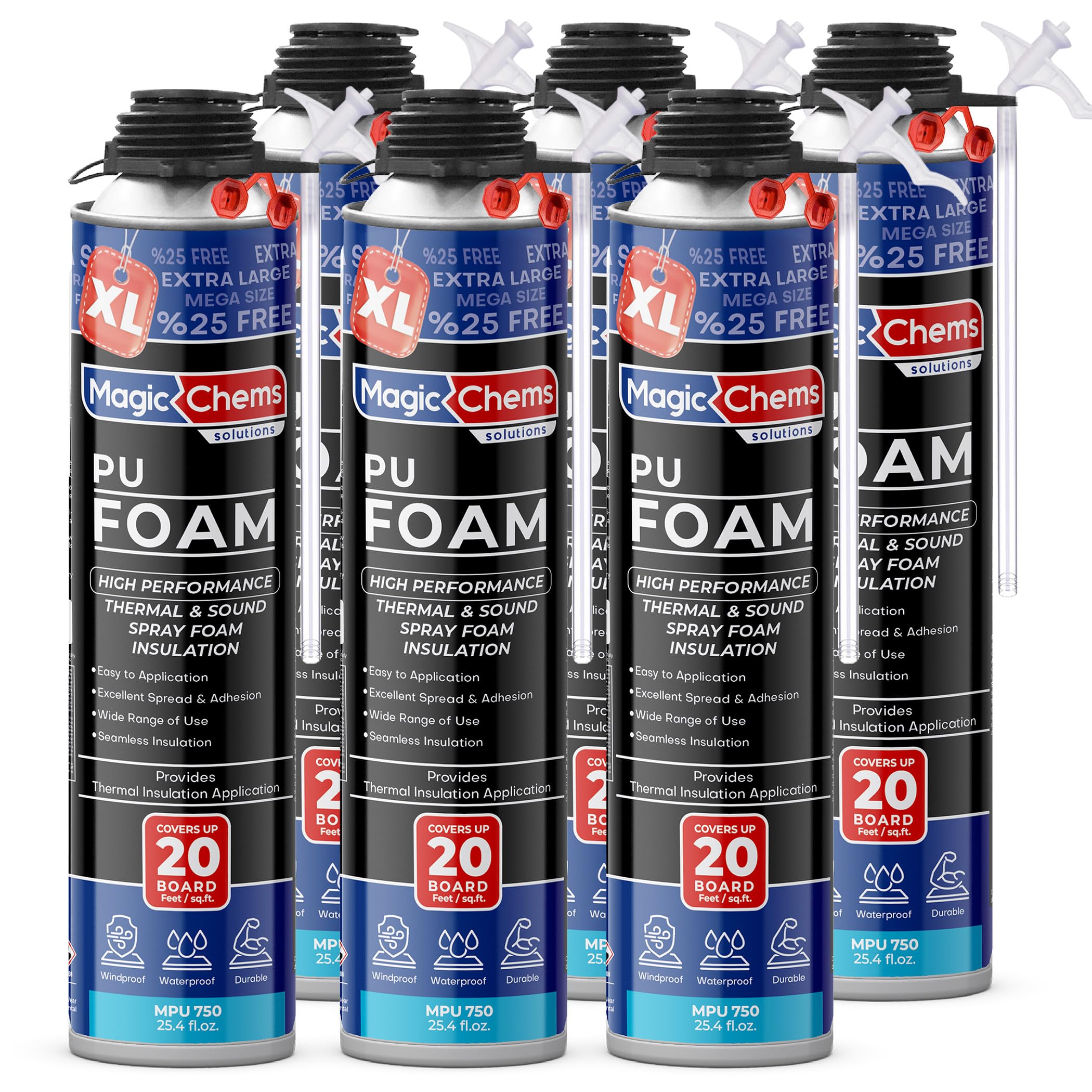
The Magic Chems 6-pack delivers 120 board feet of coverage at one inch thickness, giving you enough material to insulate a standard shed or a small room’s rim joists and wall cavities. Each 25.4-ounce can uses a closed-cell polyurethane formulation that provides thermal and acoustic insulation, and the foam cures tack-free within hours. The bulk pack reduces the per-can cost compared to buying singles, making it a smart move for medium-scale projects.
Users praise the consistent expansion and strong bonding to most building materials, though some report that the can must be kept upside down during application—a quirk that makes overhead spraying on foundation sills awkward. The foam is very sticky, so double-gloving and plastic sheeting are essential. The included safety suit in the 1-pack version isn’t included here, so budget for your own PPE.
The 24-hour full-cure time is standard for this category, and any overspray must be cleaned with acetone or the brand’s dedicated cleaner before it hardens. The foam performs best when the ambient temperature stays above 70°F. Coverage drops noticeably in cooler conditions, and the can may not empty completely if the straw clogs mid-job.
Why it’s great
- High board-foot count per dollar for large DIY jobs
- Good thermal and acoustic sealing in wall cavities
- Fast curing allows trimming within a few hours
Good to know
- Can must be held upside down, complicates overhead work
- No PPE included with the bulk pack
- Cooler temperatures reduce expansion and coverage
3. Vega Bond Purplecoat Closed Cell Spray Foam + Gun
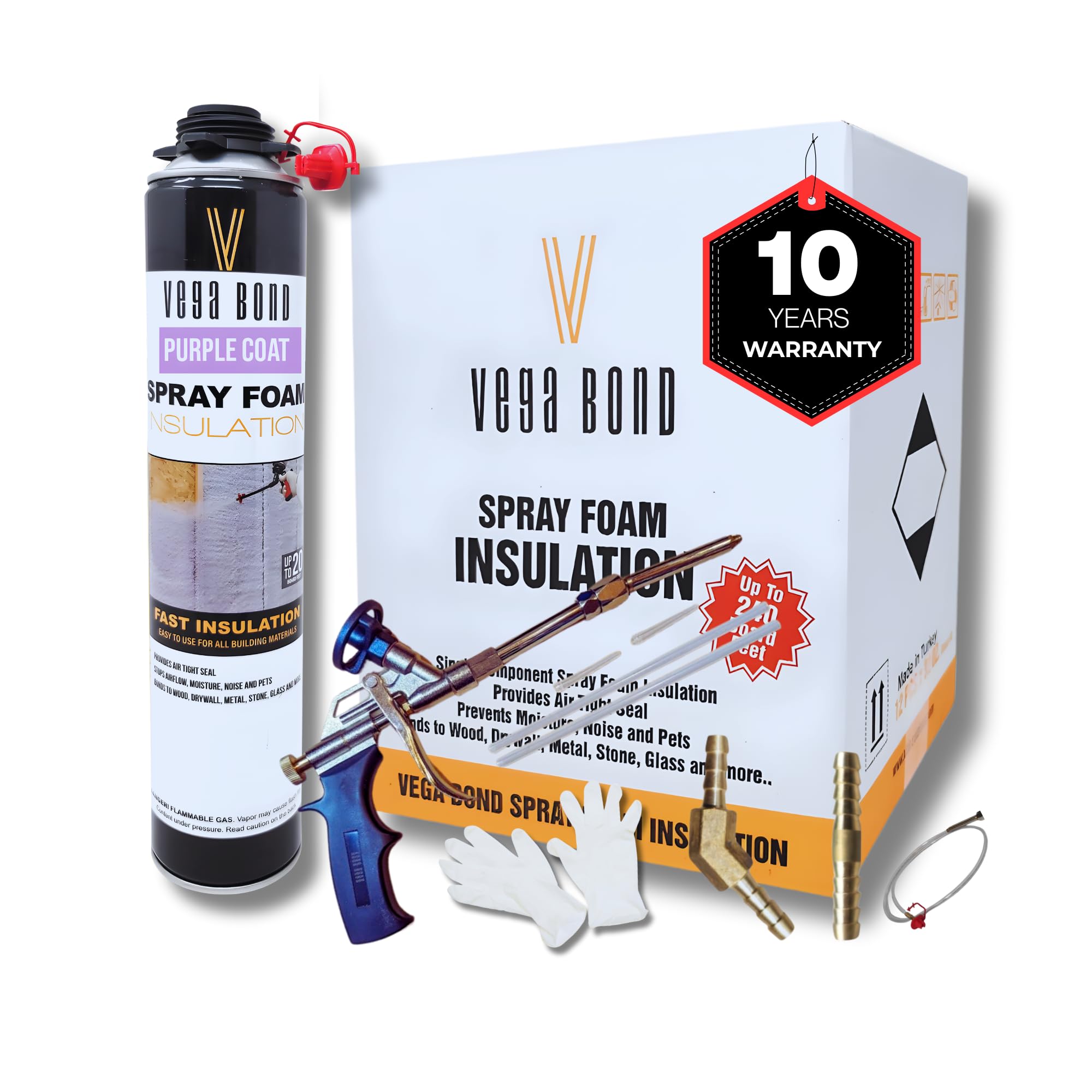
Vega Bond’s Purplecoat stands out for its high-density closed-cell structure that maintains its purple color even after prolonged UV exposure. The 29-ounce can delivers an R-value of 5.66 per inch and covers 20 board feet at one-inch thickness. The included applicator gun is widely considered one of the best in the DIY space, with a smooth trigger action that lets you feather the foam into tight gaps without waste.
Users report that the foam expands uniformly and cures into a hard, durable surface that can be painted or stained. The gun system allows you to swap to a fresh can without wasting the foam left in the nozzle, and the included hose lets you reach into odd angles. Several reviewers achieved the advertised board-foot coverage on garage ceiling joists, though some found that overhead application required faster trigger work to prevent sagging.
The main tradeoff is the premium cost per can. At roughly two-thirds the coverage of a standard 12-ounce straw can for a higher unit price, Purplecoat is best reserved for smaller, high-precision areas where density and durability matter more than raw volume. Warm water soaking the can for 10 minutes before use improves flow consistency in cooler weather.
Why it’s great
- High-density foam with long-lasting UV-stable color
- Gun system allows partial can reuse and fine control
- Strong adhesion on wood, metal, and masonry
Good to know
- Lower coverage per can than many competitors
- Premium price makes it cost-prohibitive for large areas
- Overhead application requires practice to prevent drips
4. Great Stuff Gaps & Cracks Insulating Foam 12-Pack

The Great Stuff Gaps & Cracks 12-pack is the most straightforward solution for sealing multiple small cracks around windows, doors, and siding penetrations. Each 12-ounce can comes with a straw applicator, and the foam expands aggressively to fill gaps up to one inch. The formulation sets tack-free in six minutes and trims in 30 minutes, making it one of the fastest-curing options in this lineup.
Users consistently note the extreme expansion rate—the foam can bulge out of a gap if overapplied, so light trigger pressure is critical. The adhesion is strong enough to bond to wood, metal, masonry, glass, and most plastics. The 12-count case is ideal for whole-house weatherproofing, and the cost per can is lower than buying individually. The foam is water-resistant once cured, making it suitable for exterior use.
The main drawback is the lack of a gun system. Each can is single-use; once you puncture the valve and start dispensing, the can must be emptied in one session or the nozzle hardens. The straw can also fall off mid-spray, creating a mess. The chemical odor during application is mild compared to some competing foams, but ventilation is still required.
Why it’s great
- Fast cure time allows same-day trimming and painting
- Very high expansion fills gaps completely
- Low cost per can in bulk for whole-house sealing
Good to know
- Straw system means single-use cans with no partial reuse
- Extreme expansion can cause bulging if overapplied
- Straw can detach mid-application
5. Loctite Tite Foam Gaps & Cracks 3-Pack
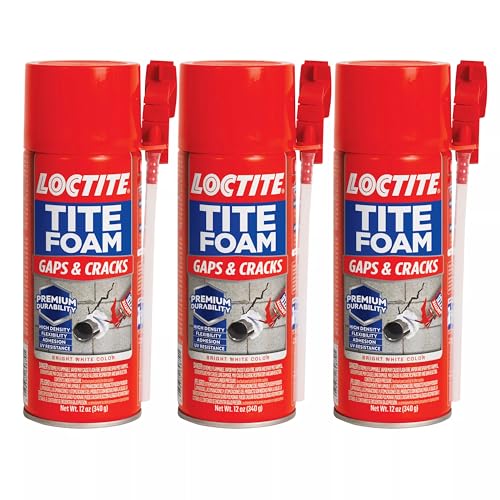
Loctite’s Tite Foam is designed specifically for gaps up to one inch, with a polymer formulation that resists UV degradation better than standard polyurethane foams. This makes it a strong candidate for exterior cracks where sunlight exposure would yellow and embrittle ordinary foam. The cured material remains flexible enough to accommodate building movement without cracking, and its high-density uniform cell structure provides solid insulation.
Users report that the foam expands smoothly and bonds aggressively to wood, concrete, brick, stone, and metal. The included straw fits standard cans, but the valve mechanism requires a double-click to engage, which first-time users might miss—leading to a messy initial spray. Reviewers emphasize that the foam must be injected into the gap rather than sprayed onto the surface, or it will expand outward and create a mess.
The three-pack is a good starter quantity for sealing a few windows, but the per-can cost is higher than the Great Stuff equivalent. The learning curve is steeper than average: users report that light trigger pressure is essential to control expansion, and the foam is very sticky before curing. Acetone or dish soap will remove fresh foam from skin, but cured foam requires mechanical scraping.
Why it’s great
- UV-resistant formula holds up to prolonged sun exposure
- Flexible cured foam withstands structural movement
- High density with uniform cell structure for insulation
Good to know
- Higher cost per can than comparable Great Stuff products
- Valve requires double-click, leading to user error
- Sticky uncured foam requires careful handling
6. Great Stuff Big Gap Filler 8-Pack
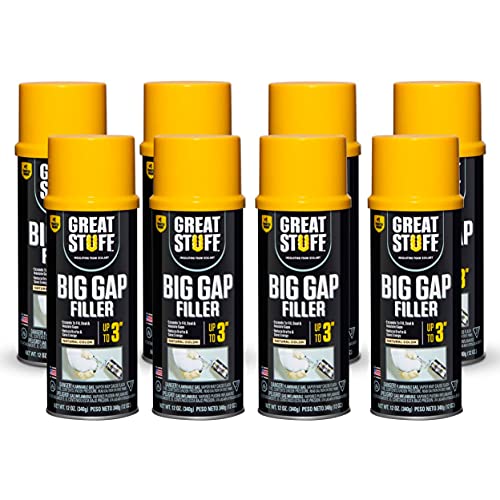
The Big Gap Filler variant from Great Stuff is formulated for gaps up to three inches, making it the straw-applied champion for large cracks around rim joists, HVAC penetrations, and plumbing chases. The foam cures tack-free in 20 minutes and is rigid enough to trim in one hour, which keeps your project moving. The eight-pack gives you enough volume to seal an entire basement perimeter or a garage floor’s expansion joints.
Users love the value per can and the fact that the foam expands more aggressively than the standard Gaps & Cracks formula. However, the aggressive expansion is a double-edged sword—if the gap is less than half an inch, the foam can bulge significantly and require heavy trimming. The straw system means you cannot save a partially used can, so plan your application sequence carefully to avoid waste.
The cured foam is rigid and paintable, but it lacks the UV stability of Loctite’s Tite Foam, so keep it out of direct sunlight or paint it promptly. A few users reported that some cans in the case didn’t empty completely, which is a common frustration with straw-applied foam. Gloves and eye protection are non-negotiable; the foam is tenaciously sticky before curing.
Why it’s great
- Specifically formulated for gaps up to 3 in.
- Fast 20-minute tack-free cure keeps workflow moving
- Excellent value per can in the 8-pack configuration
Good to know
- Not UV-stable, requires paint or covering for exterior use
- Over-expansion in small gaps creates waste
- Some cans may not empty completely
7. Magic Chems Spray Foam Insulation 1-Pack + Gun Kit
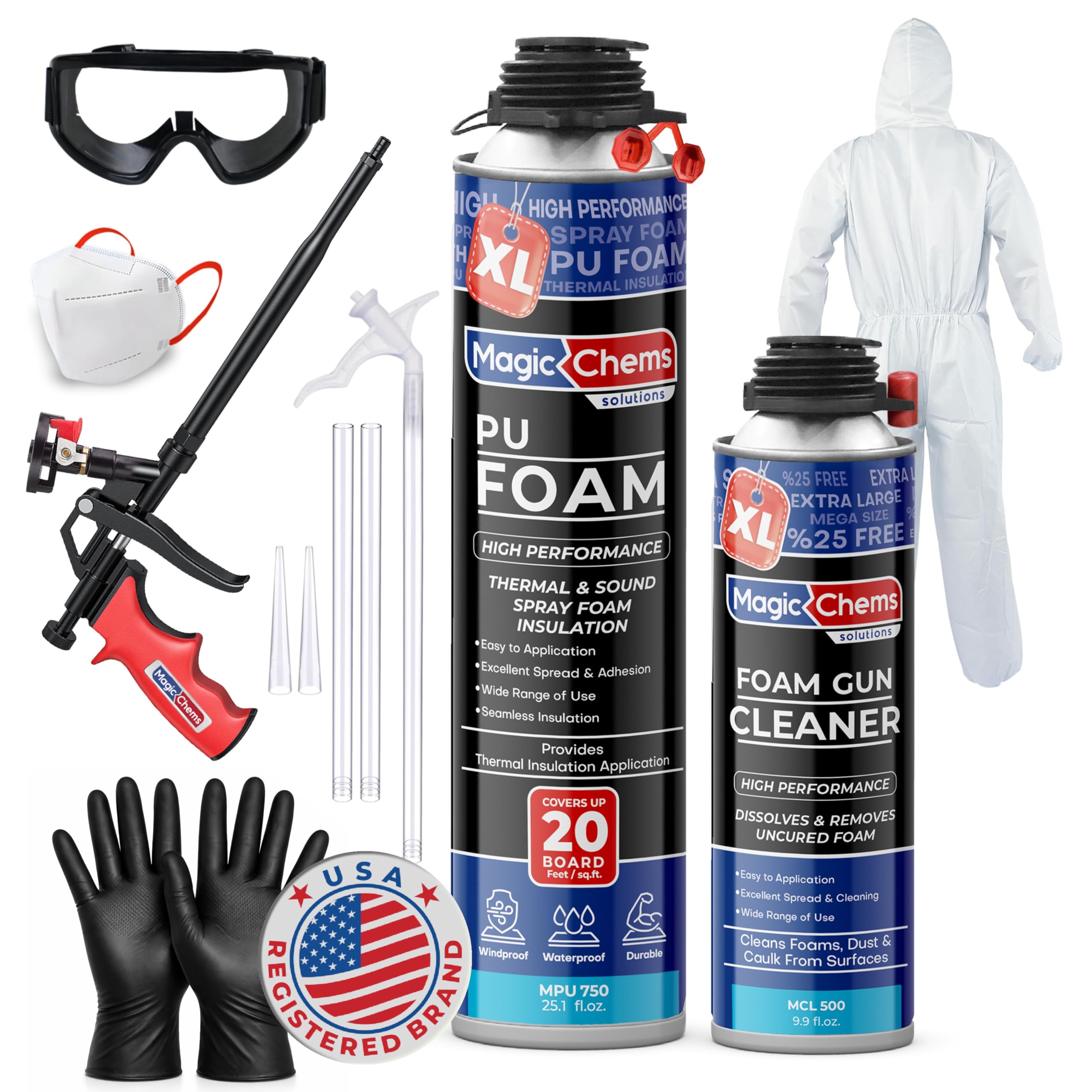
This Magic Chems kit is the most complete entry point for first-time spray foam users, bundling a 25.4-ounce can of closed-cell foam with a Teflon-coated spray gun, a bottle of gun cleaner, multiple nozzle tips, and full PPE including a coverall suit, goggles, gloves, and a mask. For someone who doesn’t already own a foam gun or PPE, this kit removes the guesswork of gathering compatible equipment.
The foam covers 20 board feet at one-inch thickness, which is on par with other single-can kits, and the gun provides much better control than a straw. Users praise the included suit as thicker than standard Tyvek, and the cleaner effectively flushes the gun for reuse. The kit is ideal for a single focused project like sealing a shed, an RV roof vent, or the rim joists in a small crawl space.
The downsides are the same as the Magic Chems 6-pack: the can must be held upside down during use, making overhead spraying awkward, and the foam can be inconsistent if the temperature dips below 70°F. Some users found the gun’s red nozzle tips prone to clogging if not cleaned immediately after each can. The 24-hour full cure time is standard, but the kit’s single-can size means you’ll need to buy more for anything larger than a small room.
Why it’s great
- Complete kit with gun, cleaner, and PPE included
- Gun system offers far better control than straw cans
- Good entry-level coverage for small projects
Good to know
- Upside-down can orientation complicates overhead work
- Cool temperatures significantly reduce foam expansion
- Nozzle tips require immediate cleaning to prevent clogging
FAQ
Can I use closed-cell spray foam in a can around electrical wiring?
How long does a can last once I start spraying?
Does closed-cell spray foam in a can need a vapor barrier over it?
Final Thoughts: The Verdict
For most users, the best closed cell spray foam in a can winner is the BEEST FullStop 12-Pack because it combines the highest R-value per inch in this test with a Class A fire rating and 240 board feet of coverage. If you want UV stability and flexible outdoor sealing, grab the Loctite Tite Foam 3-Pack. And for a complete starter gun kit that includes every piece of PPE you need, nothing beats the Magic Chems 1-Pack + Gun Kit.

Mo Maruf
I created WellFizz to bridge the gap between vague wellness advice and actionable solutions. My mission is simple: to decode the research and give you practical tools you can actually use.
Beyond the data, I am a passionate traveler. I believe that stepping away from the screen to explore new environments is essential for mental clarity and physical vitality.