Our readers keep the lights on and my smoothie glass nicely filled. As an Amazon Associate, I earn from qualifying purchases.
Specs are compiled from manufacturer listings and verified buyer reviews and can change over time — please confirm the key details on the product page before buying.
Tired of watching cuttings wilt in a cup of water? A cloning machine solves that by pumping oxygen and moisture straight to the stem, so roots appear in days instead of weeks, without you having to guess when to water.
I’m Mohammad Maruf — the founder and writer behind WellFizz. This guide is built by comparing the manufacturers’ published specifications and the patterns across verified customer reviews, so you get each pick’s real strengths and trade-offs instead of marketing spin.
The goal is simple: help you find the best cloning machine for your space and budget, whether you are a home hobbyist rooting a few cuttings or a serious grower running multiple cycles every season.
Quick Picks
- EZ Clone 16 Cutting Cloning System — Best Overall
- Aeroponic Cloner Machine, Cloning Machine 35 Site — High Volume
- 25 Site Aeroponic Cloning Machine — Consistent Workhorse
- DWC Cloner Rooting Recirculating System 24 Site — 2-in-1 System
- Psycloner Clone Machine, Hydroponics System, 24 Site — Budget Entry
How To Choose The Best Cloning Machine
Picking the right cloning machine depends on matching the system type to your setup and the number of cuttings you plan to root. Here are the key factors that separate a solid investment from a frustrating waste of space.
Aeroponic vs. Deep Water Culture
Aeroponic machines spray a fine mist directly on the cuttings’ stems, providing constant oxygen and moisture. This method tends to produce roots faster — often in 4-10 days. Deep Water Culture (DWC) units submerge the roots in oxygen-rich water using an air pump and air stones. DWC is simpler and uses fewer moving parts, but root growth may take a bit longer. Both work well if you keep conditions stable.
Site Count and Reservoir Size
The number of “sites” tells you how many cuttings the machine can hold at once. A 16-site machine fits easily on a tabletop and suits a hobby grower. A 35-site unit covers a serious propagation run but takes up more floor space. Reservoir size matters too — a 2-gallon tank requires more frequent top-offs than a larger system. Match the site count to your typical batch size so you are not running a half-empty machine.
Pump Reliability and Spray Coverage
The water pump is the heart of any aeroponic cloner. A weak pump or one that clogs leads to dry stems and failed clones. Look for a submersible pump with a pre-filter housing to keep debris out of the spray heads. The number of spray heads and their coverage pattern determines whether every cutting gets even misting. More heads generally mean more consistent moisture for all sites.
Quick Comparison
| Model | Best For | Sites | Type | Weight | Amazon |
|---|---|---|---|---|---|
| EZ Clone 16 Cutting Cloning System | Premium reliability | 16 | Aeroponic | 8 lbs | Amazon |
| Aeroponic Cloner 35 Site | High-volume rooting | 35 | Aeroponic | — | Amazon |
| 25 Site Aeroponic Cloning Machine | Mid-range simplicity | 25 | Aeroponic | 5 lbs | Amazon |
| DWC Cloner 24 Site | 2-in-1 cloning & seeding | 24 | DWC | 2.09 kg | Amazon |
| Psycloner Clone Machine 24 Site | Budget entry-point | 24 | DWC | — | Amazon |
In‑Depth Reviews
1. EZ Clone 16 Cutting Cloning System

This 8-pound aeroponic cloner roots notoriously tough fig cuttings with a reported 95%+ success rate.
If you are after a machine that feels built to last and delivers on its promises, the EZ Clone 16 is exactly what serious growers reach for. It holds 16 cuttings in a 14.3 x 14.7 x 12.3-inch frame and uses a submersible pump to spray the stems. Buyers report a 95%+ success rate rooting stubborn fig cuttings, a tough test that most machines fail. They also note the new design is leak-proof with thick, sturdy plastic, which directly fixes complaints about earlier models.
This unit is noticeably heavier than the 25-site aeroponic machine below — 8 pounds vs 5 pounds — and that heft comes from denser materials that stay put on a shelf. Reviewers mention roots exploding by day 7 when the water is kept clean and a decent light is used. The trade-off is the 16-site capacity and the lack of an included humidity dome, which one buyer found necessary for improving success rates on certain cuttings. Still, the build quality and 100% rooting track record make it a long-term buy for anyone who clones frequently.
The reservoir holds a few gallons, and the pump runs quietly, so you can keep it in a living space without noise complaints. It is made in the United States by Hawthorne Hydroponics, which adds confidence for replacement parts.
What It Does Best
- 95%+ success on difficult cuttings like fig
- Leak-proof design with thick, durable plastic
- Quiet pump operation
- Made in the USA
One Thing to Know
- No humidity dome included
Stick with it if: you need a rugged, no-compromise machine that handles tough cuttings and lasts many cycles.
Think twice if: you absolutely need a humidity dome right in the box.
2. Aeroponic Cloner Machine, Cloning Machine 35 Site
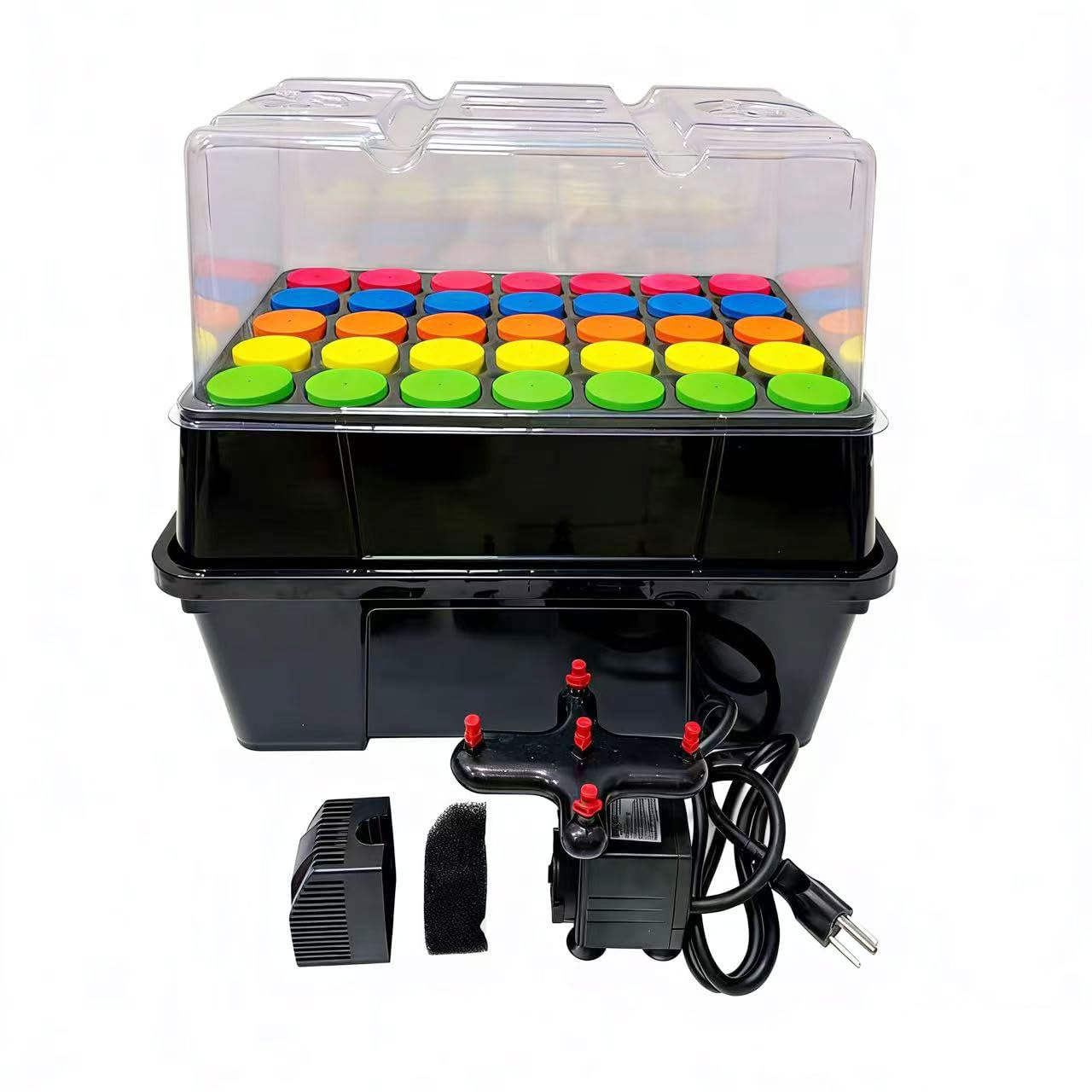
A 35-site powerhouse for growers who need to root a full tray of cuttings every cycle — more than double the capacity of the EZ Clone 16.
This aeroponic propagator steps up the site count to 35, making it the largest capacity unit in this lineup. It uses 1.625-inch neoprene clone inserts to hold cuttings and a patent-pending spray manifold that needs no air pump — the lid itself has venting and circulation features to keep oxygen flowing. The included foldable humidity dome helps prevent leaf transpiration (water loss from leaves), which is a common cause of wilting in dry rooms.
One experienced buyer reports pairing it with a timer set to 15-20 minute cycles to reduce heat from the pump, and still saw root buds in 72 hours and full roots after 7 days. Another reviewer who used it with fungicide, Protekt, and Cal-Mag (a calcium and magnesium supplement) called it the best time they have ever had rooting cuttings, noting no dome was needed with water kept at 70-80°F. However, not every experience is smooth — some owners mention the neoprene pads are too small for medium stems, causing plants to fall over, and one unit leaked badly. The pump has a pre-filter housing to stop clogging, but two reviewers experienced early pump failures that ruined expensive clones.
The 35-site capacity is tough to top for the price, but the mixed pump reliability means you may want to run it with a cycle timer and keep an eye on water levels. It is made from durable ABS and PP materials.
Gets the job done when: you need 35 sites and you are willing to add a cycle timer to protect the pump.
Heads up: pump reliability is inconsistent; a few buyers reported failures within days.
3. 25 Site Aeroponic Cloning Machine

This 25-site aeroponic cloner packs 9 more sites than the EZ Clone 16 in nearly the same footprint, with one buyer reporting a 100% success rate since 2023.
This unit from Harrigan’s Hydroponics hits a balance between capacity and simplicity. It comes with a complete 25-site system — reservoir, lid, spray manifold with 13 spray heads, a 317 GPH (gallons per hour) submersible pump, and inserts. The 13.75 x 13.75 x 12.5-inch footprint is nearly the same width as the EZ Clone 16 but packs 25 sites, making it a space-efficient option. The pump in the 25-site unit pushes more water than many similar-sized machines, giving even coverage across all sites.
Customers note root bumps in 7-10 days with an 80-90% success rate, and one long-term user since 2023 says every cutting survives. The unit is totally organic, meaning no hormones or chemicals are required, and it includes extra neoprene cookies and net pots. The pump can fail after a few weeks — one reviewer noted this — but the seller sent a replacement immediately. The 25-site capacity is a big step up from the 16-site EZ Clone without taking up much more shelf space.
At 5 pounds, it is lighter than the 8-pound EZ Clone, which makes it easier to move around. The 13 spray heads provide solid coverage for the 25 sites, and the included instructions make setup possible in about 5 minutes.
Solid Points
- 100% success rate reported by long-term users
- 13 spray heads for even coverage
- Easy 5-minute setup
- Includes spare parts
Watch For
- Pump reliability varies; consider a spare
Best for: anyone who wants a mid-size aeroponic system with a proven track record and easy setup.
Not for: buyers who want the absolute thickest plastic — this is a lighter build than the EZ Clone.
4. DWC Cloner Rooting Recirculating System 24 Site

A Deep Water Culture (DWC) cloner that doubles as a seed starter with a clear humidity dome — no spray heads to clog.
This system from HORTIPOTS uses Deep Water Culture rather than aeroponic misting. Instead of spray heads, it uses a unique oxygen bubble tubing kit that generates millions of air bubbles every minute to deliver oxygen directly to the root zone. The claim is that this method avoids the clogging and heating issues that can plague aeroponic pumps. It comes with a clear humidity dome to prevent leaf transpiration, which is especially useful during the first hours after taking cuttings.
Reviewers point out roots on clones in about 10 days, describing them as strong and healthy. One reviewer who bought the unit in 2022 came back for a second one because the first worked so well for vegetable growing. The system can also be used as a seed starter germination kit with U.S. standard 2-inch net pots and neoprene inserts. The unit is heavier than it looks at 2.09 kg, and the instructions recommend keeping water temperature between 65-75°F and pH between 5.5-6.5 for best results.
The trade-off is that DWC tends to produce roots slightly slower than aeroponics. One buyer mentioned cold weather slowed growth and suggested raising the temperature during the lights-off period. The 24-site capacity is ample for home growers, and the built-in bubble system means no spray heads to clog or replace.
Reach for it if: you prefer the simplicity of DWC and want a single unit that handles both cloning and seed starting.
Keep in mind: root growth may be a few days slower than top-tier aeroponic machines like the EZ Clone 16.
5. Psycloner Clone Machine, Hydroponics System, 24 Site

A low-cost 24-site DWC cloner — the cheapest way into this list — but you might need to swap the stock air pump for something more reliable.
The Psycloner is the most affordable entry point in this roundup, offering 24 sites and a 2-gallon reservoir for Deep Water Culture. It features an aerating air pump that pulls oxygen from outside the reservoir and delivers it into the water. The neoprene inserts hold cuttings firmly, and the compact 16 x 12 x 6-inch dimensions let it fit on a small shelf or countertop.
Shoppers say that sprouts appeared in about a week, and one reviewer with cannabis clones saw roots in 7 days. The unit avoids soil to hydro transition issues, which is a common headache. However, the included air pump has weak suction cup feet that let it float around, and the impeller (the spinning part inside the pump) lacks a centering mechanism, causing some pumps to wear out quickly and make noise. One reviewer swapped the pump for air stones entirely. Another buyer called it “absolute garbage,” claiming it leaks and does not work as a clone machine. The user manual recommends changing water every 10-14 days and checking pH daily.
At this price point, the Psycloner works for new growers who want to test DWC cloning without a big investment. The 24-site capacity ties the HortiPots unit above (both have 24 sites), but the Psycloner is a simpler build and lighter on features. Plan on upgrading the pump or running air stones for a more reliable experience.
What Works
- Lowest price for a 24-site DWC system
- Compact footprint
- Neoprene inserts hold cuttings well
What Needs Work
- Stock air pump is unreliable; suction cups fail
- Some units leak
Good for: beginners on a tight budget who are comfortable upgrading the pump or switching to air stones.
Step away if: you want a turnkey system with consistent quality from the start.
Understanding the Specs
Site Count
The number of cuttings a machine can hold at once. A 16-site unit is enough for most home growers, while 24 to 35 sites suit serious propagation runs. More sites mean a larger reservoir and more pump power to keep every stem evenly moist. Match the site count to your typical batch — running a 35-site machine with only 6 cuttings wastes water and electricity.
Aeroponic vs. DWC
Aeroponic machines spray a fine mist directly on the cuttings, providing constant air and moisture and usually producing roots in 4-10 days. Deep Water Culture (DWC) machines submerge the stems in oxygenated water via an air pump and air stones. DWC is simpler and has fewer parts that can clog, but root growth may take a few days longer. Both methods work; your choice depends on whether you prioritize speed or simplicity.
Pump Quality
In aeroponic machines, the submersible pump is the most critical component. A weak pump or one without a pre-filter will struggle to push water through all spray heads evenly. Look for a pump that uses a UL-listed motor and has a pre-filter housing to keep debris out. In DWC machines, the air pump matters — a cheap air pump may fail within weeks. Several reviewers recommend buying a backup pump regardless of the brand.
Spray Heads
The number and positioning of spray heads determine whether every cutting gets consistent misting. More heads spread across the reservoir make it less likely that outer sites dry out. Some machines use a manifold design where heads can be added or removed. If the spray coverage is uneven, you will notice slower rooting on the edges first.
FAQ
How long does it take for a cloning machine to root cuttings?
Is aeroponic better than DWC for propagating cuttings?
Can I use a cloning machine for seeds too?
What water temperature is best for a cloning machine?
Do I need rooting hormone for a cloning machine to work?
How often do I need to change the water in a cloning machine?
Can I leave clones in the machine after they root?
Will a cloning machine work for woody plants like roses or figs?
How do I clean my cloning machine between batches?
Why are my cuttings wilting in the cloning machine?
Final Thoughts: The Verdict
For most people, the cloning machine winner is the EZ Clone 16 because it combines proven 95%+ success on difficult cuttings with a leak-proof build that lasts. If you want the highest capacity — 35 sites — grab the Aeroponic Cloner Machine 35 Site. And for a reliable mid-size aeroponic system that just works, the standout is the 25 Site Aeroponic Cloning Machine.
How We Picked
We do not accept paid placement. Every pick is matched to a real buyer and a real use-case; we do not hands-on test units.
Sources & Methodology
Specifications: manufacturer listings and product documentation. Review insights: verified customer reviews, as of July 2026. Pricing: not shown on this page (it changes often); check the current price via the retailer link.
As an Amazon Associate, WellFizz earns from qualifying purchases. This does not affect which products we feature.

Mo Maruf
I created WellFizz to bridge the gap between vague wellness advice and actionable solutions. My mission is simple: to decode the research and give you practical tools you can actually use.
Beyond the data, I am a passionate traveler. I believe that stepping away from the screen to explore new environments is essential for mental clarity and physical vitality.