Our readers keep the lights on and my smoothie glass nicely filled. As an Amazon Associate, I earn from qualifying purchases.
Specs are compiled from manufacturer listings and verified buyer reviews and can change over time — please confirm the key details on the product page before buying.
The first time you strap into clipless pedals, your brain screams that you are about to fall over — and you probably will. That moment of panic is the single biggest hurdle for anyone making the switch from flat pedals, and the right beginner set makes that learning curve far less embarrassing. This guide cuts through the jargon to show you exactly which pedals get you clipped in confidently while staying affordable or your collarbone.
I’m Mohammad Maruf — the founder and writer behind WellFizz. This guide is built by comparing the manufacturers’ published specifications and the patterns across verified customer reviews, so you get each pick’s real strengths and trade-offs instead of marketing spin.
Whether you ride a road bike, mountain bike, or commuter, the choice depends on how the pedal handles your first few shaky rides — which is why we focused on tension adjustment range, platform support, and real beginner feedback to find the best clipless pedals for beginners.
Quick Picks
- Shimano PD-ES600 SPD Pedal — Best Overall
- Funn Mamba MTB Clipless Pedals — Trail Boss
- ROCKBROS MTB Dual Function Pedals — Best Value
- Pinsync Road Bike Pedals — Road Ready
- Venzo Dual Function Platform Pedals — Commuter Choice
How To Choose The Best Clipless Pedals For Beginners
The leap from flat pedals to clipless is mostly a mental game — your feet are mechanically locked to the bike, which feels unnatural until muscle memory kicks in. The three things that make or break that transition are tension range, platform stability, and whether you can still ride in everyday shoes.
Tension Adjustment Range
You want a pedal that lets you set the release tension very loose for your first few rides, then tighten it as you gain confidence. Without adjustable tension, you are stuck with whatever spring force the factory chose — which is often too stiff for a panicked emergency unclip. Every pedal on this list offers some form of tension screw, but the range varies.
Dual vs Single Sided Entry
Double-sided pedals (SPD on both faces) are far easier to click into because you do not need to flip the pedal to the correct side. Single-sided pedals save a little weight but force you to find the clip-in face with your foot while rolling — a coordination test beginners do not need.
Cleat Compatibility and Shoe Fit
The two major standards are the 2-bolt SPD system (recessed cleat, walkable, used on MTB and commuter shoes) and the 3-bolt SPD-SL system (larger cleat, better power transfer, harder to walk in). For a beginner who wants to ride to the cafe without clacking like tap shoes, a 2-bolt SPD pedal is almost always the smarter starting point.
Quick Comparison
| Model | Best For | Weight (pair) | Cleat System | Entry Type | Amazon |
|---|---|---|---|---|---|
| Shimano PD-ES600 | Premium road/touring | 279 g | 2-bolt SPD | Single-sided | Amazon |
| Funn Mamba | Aggressive trail & gravel | 455 g | 2-bolt SPD | Single-sided | Amazon |
| ROCKBROS MTB Dual | Budget all-around dual | 15.52 oz | 2-bolt SPD | Double-sided (SPD+flat) | Amazon |
| Pinsync Road | Entry-level road bike | 0.6 lbs | 3-bolt SPD-SL | Single-sided | Amazon |
| Venzo Dual Platform | Commute & casual mix | 580 g | 2-bolt SPD | Double-sided (SPD+flat) | Amazon |
In‑Depth Reviews
1. Shimano PD-ES600 SPD Pedal

The pedigree that makes first-timers feel like they already know what they are doing.
This single-sided SPD pedal gives you the stability of a three-bolt road pedal with the walking convenience of a recessed two-bolt cleat — meaning you can clip into a stiff platform for power on the pavement, then walk into a store without the penguin-waddle and click-clack of an SPD-SL cleat. At just 279 g per pair, it is lighter than every other pedal on this list, which matters if you ever try to accelerate away from a stoplight on a steep hill.
Buyers report the sealed cartridge axle bearings spin so smoothly that one rider said they “wouldn’t return to lower-cost models” after trying these. The single-sided design does require a small extra focus to flip the pedal to the right face before clipping in — something you will adapt to in about three rides. Reviewer feedback also notes the finish scratches easily, so if cosmetic perfection matters to you, expect a few scuffs after normal use. The included SM-SH51 cleats and 1.0 mm cleat spacers get you rolling from the start with no extra purchases.
Refined simplicity: The PD-ES600 is the benchmark for a reason — the release mechanism is predictable, the platform width stabilizes your foot better than many cheaper SPD pedals, and the 2-bolt cleat compatibility means one pair of shoes works on your road bike, mountain bike, and spin bike.
One honest trade-off: You pay a premium over dual-function pedals, and you lose the ability to ride in regular sneakers since there is no flat side — this is a pedal for committed clipless riders, not casual-yard-lappers.
Reach for this if: you want the most refined, lightweight SPD pedal available and are ready to go all-in on clipless riding without compromises.
Look elsewhere if: you need a flat side for quick trips in sneakers or are shopping on a strict budget under the price of most dual-platform alternatives.
2. Funn Mamba MTB Clipless Pedals

The oversized platform that catches your foot before you psyche yourself out.
Most clipless pedals present a tiny target for your cleat to find, which is the core stress for beginners — but the Mamba buckles that trend with a 3.94″ x 3.98″ platform nearly as large as a flat pedal. That extra real estate makes clip-in unusually forgiving: you can land your foot slightly off-center and still engage. The single-sided SPD mechanism is crisp and predictable, and reviewers consistently call the engagement “outstanding” and “on par with genuine Shimano.”
Unlike the slimmer profile of the Shimano PD-ES600, the Mamba is built for aggressive terrain with a CNC-machined 6061 alloy body and a 9/16-inch CrMo axle with sealed cartridge bearings and a DU bushing. One bikepacker reported the pedal “performed great” on the Great Divide Mountain Bike Route, noting the open frame design sheds mud and dirt effectively. A unique advantage is the patented Grease Renew System (GRS) that lets you service the bearings in about 60 seconds without disassembling anything — a feature no other pedal on this list offers.
What makes it beginner-friendly
- Huge platform eliminates the “missing the clip” frustration that kills confidence.
- SPD side is easy to clip in and out of, with adjustable tension that goes from very light to firm.
- Flat side with studs works well for regular shoes, giving you a dual-use option similar to the Venzo but with far better build quality.
The catch for casual riders
- At 455 g per pair, it is noticeably heavier than the Shimano at 279 g per pair, which matters on long paved climbs.
- The premium price reflects mountain-bike-specific durability you may not need if you stick to paved paths.
Grab these for rough stuff: if you ride trail, gravel, or bikepack and want a pedal that doubles as a stable platform when unclipped on technical sections.
Pass if: your riding is entirely pavement and you value low weight over bombproof construction — the Shimano PD-ES600 serves your needs at a similar or lower investment.
3. ROCKBROS MTB Dual Function Pedals
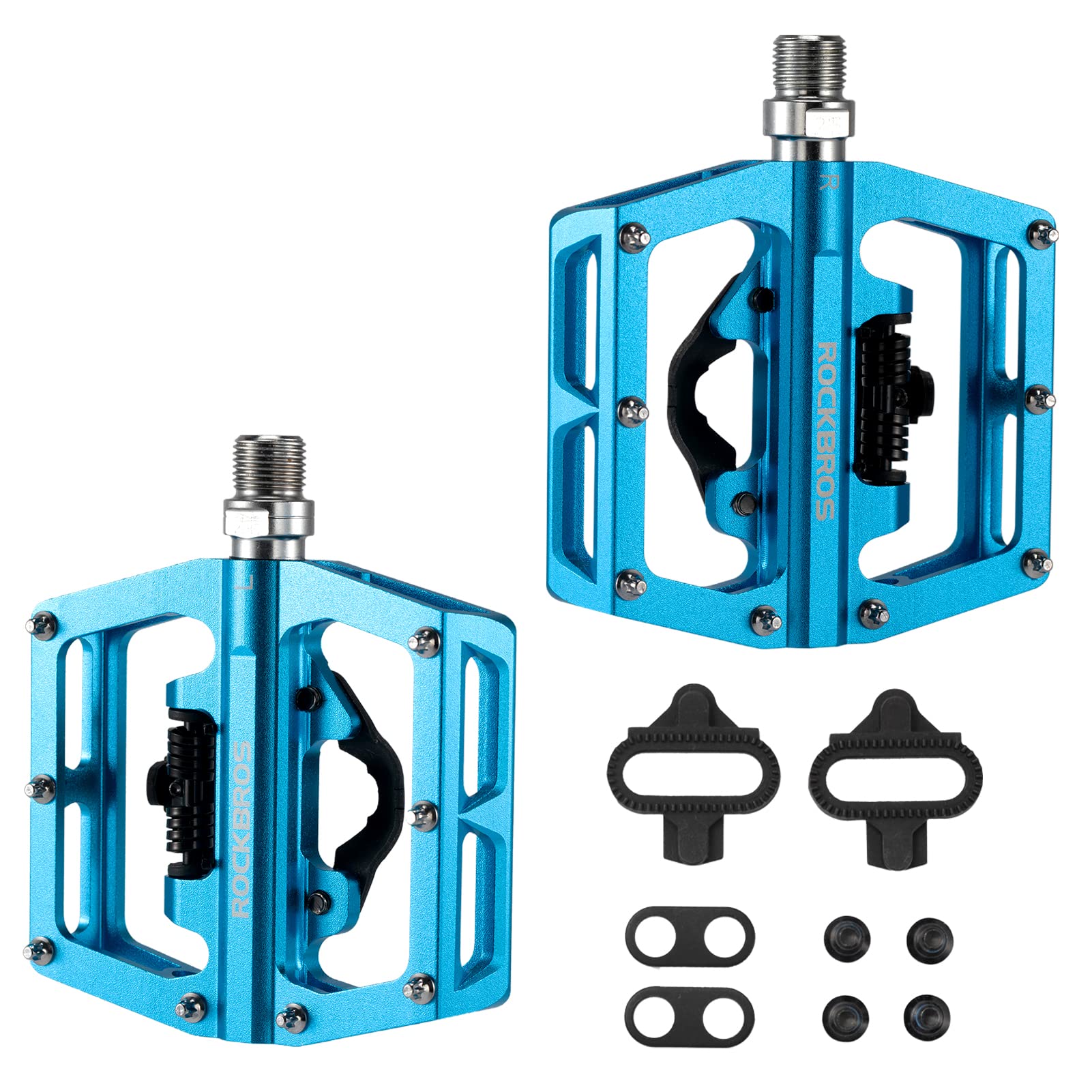
The dual-sided workhorse that survives your learning mistakes and foul weather.
With an SPD side on one face and a flat platform with stainless steel anti-skid spikes on the other, these pedals let you ride clipped in on your weekend group ride and switch to sneakers for a quick trip to the store without wrenching anything. The aluminum body measures 3.98″ x 3.62″ — a 4% larger footprint than the Pinsync road pedal’s 3.84″ x 3.5″ — giving you a stable base whether you are clipped in or riding flat.
The tension adjustment is a standout for new riders: one reviewer noted the SPD side has “lots of float” and the tension can be set “very loose for quick disengagement,” exactly what you need when your brain freezes mid-unclip. Owners mention the pedals survived five years of foul weather with sand kept out of the sealed bearings, though one long-term user noted water intrusion eventually rusted a bearing because the inner gasket is thin at 3 mm. The flat side grips tenaciously thanks to the metal studs, but reviewers warn that hard-soled SPD shoes slip on that side — so keep a pair of soft-soled sneakers handy if you plan to ride unclipped regularly.
Unbeatable for the price: You get a CNC-machined alloy body, sealed bearings, adjustable tension, and included cleats. The dual function removes the “I need to commit to clipless entirely” pressure that stops many beginners from trying.
The durability asterisk: The low gasket quality means this pedal is best treated as a 2-3 year item for wet-weather riders, not a decade-long investment like the Shimano.
Start here confidently: if you want a low-risk, low-cost first clipless pedal that lets you ride clipped in or in sneakers and won’t hurt your wallet if you decide clipless is not for you.
Upgrade if: you ride in heavy rain weekly or want the lighter weight and better bearing seal of a premium pedal — the Shimano PD-ES600 will outlast this pedal in all-weather commuting.
4. Pinsync Road Bike Pedals
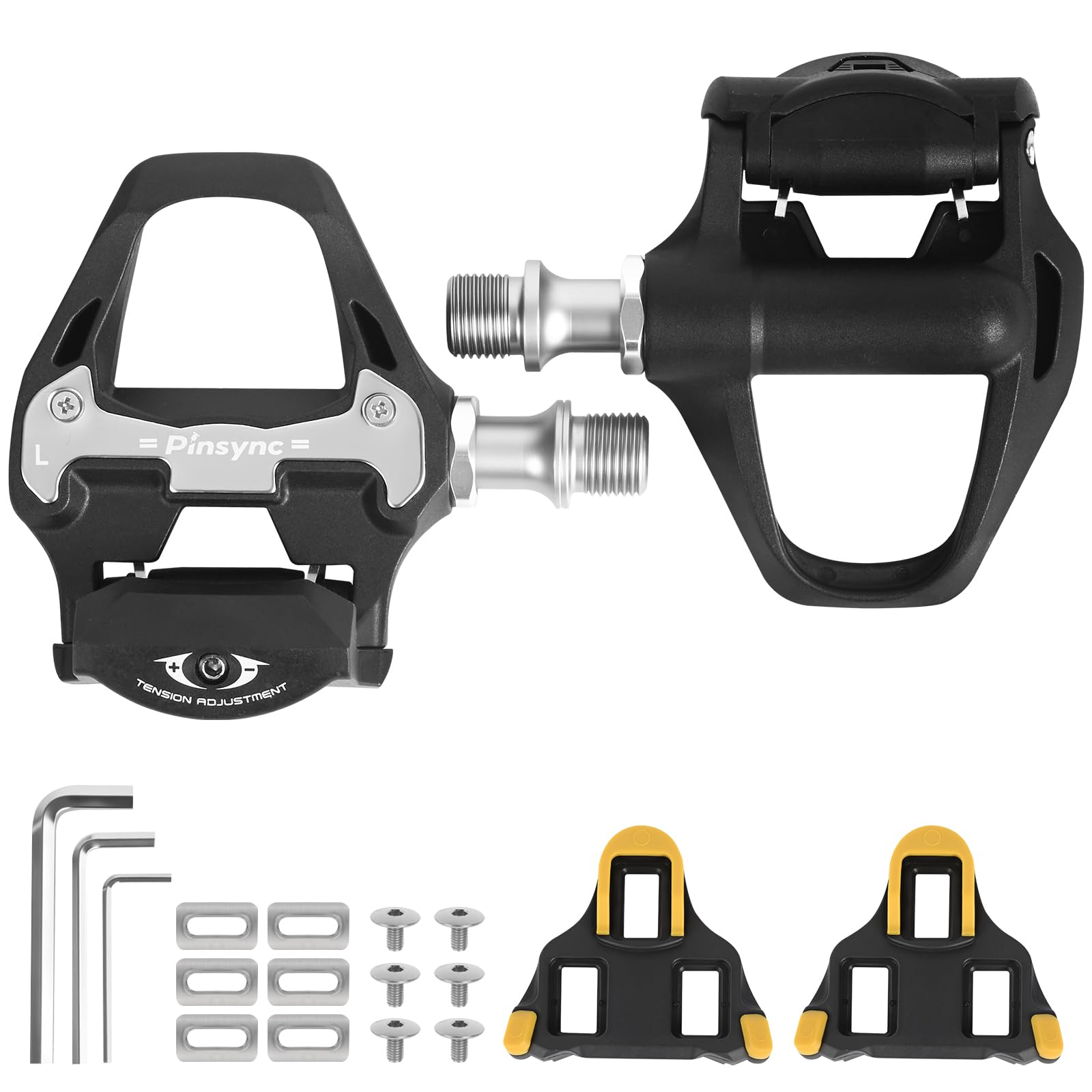
The SPD-SL beginner pedal that practically clicks itself into your foot.
This is the only pedal on the list built for the 3-bolt SPD-SL cleat system, which road cyclists prefer for the larger platform and stiffer power transfer. The killer feature for beginners is the auto vertical drop — the pedal naturally falls to the correct orientation after installation, so you are not fumbling to flip it while rolling. The stepless tension adjustment goes from a very loose “-” setting (intended to prevent newbie accidental falls) to a tight “+” for experienced riders, giving you a wide safety margin as you learn.
The nylon body keeps weight low at 0.6 lbs per pair, and the chromoly steel axle with sealed waterproof bearings handles all-weather use with little maintenance. One reviewer completed a 50-mile ride on their first outing and reported the pedals felt “perfect,” questioning why anyone would pay more for Ultegra-level hardware. That said, this pedal is SPD-SL only — it is not compatible with 2-bolt SPD shoes, so you must own or buy 3-bolt road-specific shoes. The 6-degree float in the cleats helps ease knee strain, which is a thoughtful touch for longer training sessions.
Beginner-friendly road features
- Auto drop means the pedal is always facing up, ready to clip into — no awkward foot-flipping.
- Very wide platform delivers max power transfer, making each pedal stroke feel efficient even at low cadence.
- Comes with cleats, mounting hardware, and three Allen wrenches — truly ready-to-ride from the start.
What limits its appeal
- 3-bolt cleats protrude from the shoe sole, making walking feel like you are wearing slippery wooden blocks — not ideal for commuters who stop at shops.
- Nylon body feels less premium than the aluminum ROCKBROS or the full-metal Shimano, and long-term durability at the clip-in mechanism is unproven compared to established brands.
Perfect for pure road beginners: if you already own 3-bolt road shoes or are buying your first pair and want the most beginner-friendly SPD-SL pedal available, this is your pick.
skip it if: you want walkability, dual-function use, or plan to ride a mountain bike or gravel bike — the 2-bolt SPD pedals on this list (ROCKBROS, Venzo, Shimano) are better fits.
5. Venzo Dual Function Platform Pedals
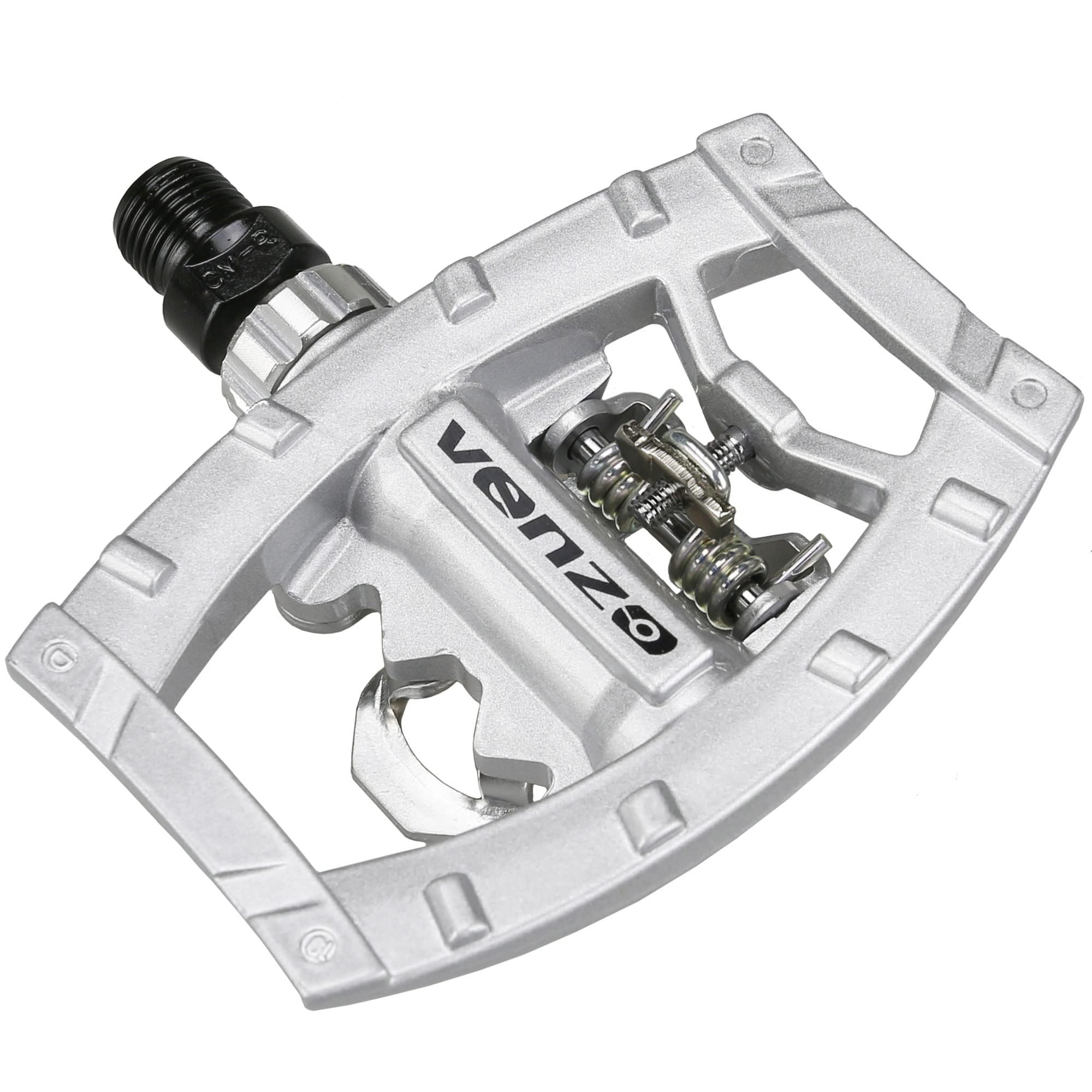
The affordable hybrid that saves you from choosing between clipless and casual.
Like the ROCKBROS, the Venzo puts SPD on one side and a flat platform on the other, but it uses a die-cast aluminum body with a CNC Cr-Mo 9/16-inch axle — a step up in spindle strength. The platform is 3.94″ x 3.54″, slightly narrower than the ROCKBROS but still large enough to feel stable under a sneaker. One commuter reported switching from platform touring pedals after 700 miles because their feet “would sometimes drop too close to the ground” — the SPD side solved that by locking the foot in a consistent position.
The sealed bearings feel smooth from the start, and customers note the tension adjustment is easy to dial in for a clean release. That extra heft matters if you are accelerating from stops on a long commute, but for the rider who values versatility over grams, the trade-off is worth it. Several reviewers noted the pedals are a “bit narrow for multi-mile rides,” so if you have large feet, the larger platform of the Funn Mamba may serve you better.
Solid entry-level dual: The Venzo gives you the same SPD-plus-flat flexibility as the ROCKBROS at a similar price point but with a stronger Cr-Mo axle and slightly wider platform. It is a dependable “try before you commit” pedal that includes cleats.
Where it falls short: Weight is the biggest compromise, and the platform width may feel cramped for riders with US size 12+ feet or those accustomed to large flat pedals.
Best for short-haul riders: if your daily ride is under 10 miles and you regularly switch between clipless shoes and sneakers (commuting, errands, casual spins), this pedal is a cost-effective solution.
Consider a different option if: you ride longer distances, prioritize low weight, or want a wider platform — the Funn Mamba or Shimano PD-ES600 serve those needs better despite the higher cost.
Understanding the Specs
2-Bolt SPD vs 3-Bolt SPD-SL Cleats
The 2-bolt system uses a small cleat that recesses into the sole of mountain bike or commuter shoes, so you can walk normally without sounding like a tap dancer on tile floors. The 3-bolt SPD-SL system uses a larger triangular cleat that protrudes from the sole for better power transfer but makes walking slippery and awkward. For a beginner who wants to ride to a coffee shop or into a store, the 2-bolt system is almost always the wiser choice — it offers 80% of the pedaling efficiency with 100% of the walkability.
Tension Adjustment and Float
Tension adjustment changes how much force is needed to twist your foot out of the pedal. A very loose setting (marked “-” on most pedals) lets you exit with a gentle heel-twist, which is a lifesaver when you panic during your first stop. Float is the side-to-side rotational play your cleat has while clipped in — typically 4 to 6 degrees — and it reduces knee strain by letting your foot find its natural alignment. Beginners should start at minimum tension and maximum float, then tighten as muscle memory develops.
FAQ
Will clipless pedals work with my existing bike shoes?
How do I set the tension on my first clipless ride?
Can I use Shimano cleats on Venzo or ROCKBROS pedals?
What does 9/16 inch thread size mean for my bike?
How long do sealed bearings last in clipless pedals?
Is single-sided or double-sided clipless better for a beginner?
Do I need special shoes for clipless pedals?
What should I do if I keep falling over while clipped in?
How do I know which pedal size fits my crank arm?
Are dual-function pedals heavier than pure clipless pedals?
Final Thoughts: The Verdict
Across the board, the best clipless pedals for beginners winner is the Shimano PD-ES600 because it combines the walkability of a recessed 2-bolt cleat with a refined, lightweight platform that gives new riders confidence without unnecessary bulk. If you want an oversized platform that is uncannily easy to click into on rough terrain, grab the Funn Mamba. And if you want dual-function flexibility at a budget-friendly entry point, the standout is the ROCKBROS MTB Dual Function for letting you test the clipless water without committing to one riding style.
How We Picked
We do not accept paid placement. Every pick is matched to a real buyer and a real use-case; we do not hands-on test units.
Sources & Methodology
Specifications: manufacturer listings and product documentation. Review insights: verified customer reviews, as of July 2026. Pricing: not shown on this page (it changes often); check the current price via the retailer link.
As an Amazon Associate, WellFizz earns from qualifying purchases. This does not affect which products we feature.
Related Guides

Mo Maruf
I created WellFizz to bridge the gap between vague wellness advice and actionable solutions. My mission is simple: to decode the research and give you practical tools you can actually use.
Beyond the data, I am a passionate traveler. I believe that stepping away from the screen to explore new environments is essential for mental clarity and physical vitality.