Our readers keep the lights on and my smoothie glass nicely filled. As an Amazon Associate, I earn from qualifying purchases.
Specs are compiled from manufacturer listings and verified buyer reviews and can change over time — please confirm the key details on the product page before buying.
Getting into climbing is thrilling until you lace up shoes that hurt wrong or slip off tiny edges. the balance is not the priciest pair — it is the one that matches your foot shape and the style of climbing you actually do, whether that is bouldering (short, powerful routes near the ground), sport lead (climbing with a rope up pre-placed bolts), or relaxed gym sessions. This guide cuts through the confusion by matching seven real options to specific needs, so you know exactly which pair earns a spot in your gear bag.
I’m Mohammad Maruf — the founder and writer behind WellFizz. This guide is built by comparing the manufacturers’ published specifications and the patterns across verified customer reviews, so you get each pick’s real strengths and trade-offs instead of marketing spin.
These are the details that matter most when you shop for climbing shoes.
Our Picks at a Glance


How To Choose The Best Climbing Shoes
Climbing shoes are your single most important tool on the wall. A shoe that matches your foot shape and intended use will feel like an extension of your body. A mismatch will kill your confidence on even easy routes.
Match the Shoe to Your Climbing Style
Bouldering and sport climbing reward precision and power — look for a moderate-to-aggressive downturn (toe curve) and a soft, sensitive sole so you feel every edge. All-day trad climbing (placing gear as you go up) and gym sessions favor a flatter profile with a thicker, more durable outsole so your feet stay comfortable for hours.
Fit and Rubber Are What Count
A shoe that is too loose wastes energy on footholds. A shoe that is too painful will end your session early. The rubber compound (the material on the bottom) determines grip versus durability: softer compounds like Vibram XS Grip 2 feel sticky on smears (smooth, angled holds) but wear faster. Harder compounds like Vibram XS Edge last longer and edge (stand on small holds) better at the cost of some sensitivity.
Quick Comparison
| Model | Best For | Outsole | Weight | Profile | Amazon |
|---|---|---|---|---|---|
| SCARPA Instinct VS★ Best Overall | Sport & Bouldering | Vibram XS Edge (4mm) | 7.8 oz (1/2 pair size 40) | Moderately Downturned | Amazon |
| BLACK DIAMOND Momentum StrapBest Starter | Beginners & Gym | 4.3mm Rubber | — | Flat | Amazon |
| SCARPA Helix Lace | Trad & All-Day Gym | Vibram XS Edge (3.5mm) | 7.6 oz (1/2 pair size 40) | Flat | Amazon |
| La Sportiva Tarantulace | Introductory Climbing | 5mm FriXion RS | — | Flat, Low Asymmetry | Amazon |
| La Sportiva Tarantula (Women’s) | Beginners & Gym | 5mm FriXion RS | — | Flat, Low Asymmetry | Amazon |
| Ocun Striker QC | Bouldering & Gym | CAT rubber 1.1, 4mm | 418 g | Moderately Downturned | Amazon |
| EVOLV Defy | Entry-Level & Bouldering | — | — | Downturned Toe | Amazon |
In‑Depth Reviews
1. SCARPA Instinct VS
Our pick — 4.5★ from 250+ verified ratings; the strongest balance of quality and price.
This aggressive bouldering shoe dominates edges better than the flat-profile Helix Lace, yet still fits a wide forefoot without punishing your foot all session.
The Instinct VS uses a 4mm Vibram XS Edge outsole (a hard, durable rubber designed for standing on small holds) — the same rubber SCARPA puts on its Helix Lace (3.5mm) — giving you a solid platform for standing on razor-thin edges without the rubber folding. At 7.8 oz per half-pair (size 40), it is practically the same weight as the Helix Lace at 7.6 oz, so you get serious power without lugging around a heavy boot.
What wins people over is that this shoe fits wide forefeet and Morton’s toe (a longer second toe) surprisingly well for a moderately downturned last (the mold shape of the shoe). There is minimal dead space in the heel and the Bi-Tension rand (the rubber part wrapping the heel) lets you loosen the laces for longer sessions between burns. The trade-off is the break-in: the leather and Microsuede (a synthetic suede) upper takes real effort, with some owners reporting a painful period where they wear socks inside the shoe to get through it. The XS Edge rubber, while excellent for edging, is less sticky on smears (smooth angled holds) than the softer XS Grip 2 compound.
The fit is polarizing — it works wonders for wide feet but buyers report that sizing is an absolute minefield. Most owners recommend going at least one full size larger than your street shoe. The old-wisdom of ordering 0.5 to 1 size smaller than previous Instinct VS generations only adds confusion. If you nail the size, you get a powerful, precise, durable shoe that lasts two years of three-times-a-week climbing, according to owners.
Why it dominates
- 4mm Vibram XS Edge rubber bites micro-edges with authority, so you stick on small footholds
- Heel hooking is secure with zero slipping, ideal for hanging your heel on a hold
- Wide forefoot and Morton’s toe (longer second toe) fit without pressure points
The headache
- Break-in is painful — expect to wear socks during the first sessions
- Smearing on polished volumes (smooth, slippery gym holds) feels precarious vs. stickier rubbers
- Sizing is inconsistent between generations; read recent reviews carefully
Snatch these if: you boulder or sport climb hard, need an edging monster, and have a wider forefoot or Morton’s toe (longer second toe).
Think twice if: you want an instant-get-on shoe with no break-in, or you climb mostly on slick indoor volumes where smearing (standing on angled holds) matters.
2. BLACK DIAMOND Women’s Momentum Strap
This is the first climbing shoe you will not hate wearing for a full gym session, unlike the more aggressive Tarantulace which needs aggressive sizing.
The Momentum Strap is built around an engineered knit upper (a breathable fabric base) and a 4.3mm rubber outsole (the bottom material) — a bit thicker than average, which helps beginners who tend to drag their toes. The knit breathes far better than the leather and synthetic hybrids found on more aggressive shoes. The strap closure means you can yank the shoe on and off between climbs without fumbling with laces.
It runs small. Most owners mention that street-shoe sizing gives a “teensy bit smaller” fit, which is exactly what you want since the shoe loosens as it breaks in. A few buyers who ordered true to size found the shoe too painful to wear — the material is firm and some described it as “hard, hurting my feet while climbing.” The fix is simple: go half a size up from your street shoe for a snug-but-comfortable fit. If you stick with your normal size, expect a tight break-in that will eventually give.
Where this shoe shines is as a direct upgrade from rental shoes. Owners consistently report an immediate jump in balance, grip, and the ability to climb one grade higher on their first outing. It is not designed for tiny overhanging pockets or aggressive heel hooks — the flat profile and forgiving rubber are for vertical and slab (less than vertical) terrain, exactly where new climbers spend most of their time.
Why it fits
- Engineered knit upper (breathable fabric) breathes better than leather shoes
- Strap closure makes on/off easy between climbs
- 4.3mm rubber is forgiving against toe drag, so you do not wear through it quickly as a beginner
The fit factor
- Material is stiff — some find it painful if not sized up a half size
- Not suitable for steep overhang or tiny edges, which need a more aggressive shoe
- Women’s sizing only; larger-foot climbers should check size run (men’s equivalent is not available)
Great for: new climbers, casual gym-goers, and anyone upgrading from rentals who wants all-day comfort.
Not for: advanced boulderers or climbers who need a precise, downturned (curved) shoe for steep terrain.
3. SCARPA Men’s Helix Lace

The flat-last (non-curved mold) all-day shoe you barely notice on your feet after five hours, but its 3.5mm rubber is too thin for the aggressive edging you get from the 4mm Instinct VS.
The Helix Lace runs a flat profile with a 3.5mm Vibram XS Edge outsole (a hard, durable rubber for standing on small holds), making it a direct competitor to the La Sportiva Tarantulace. At 7.6 oz per half-pair (size 40), it is the lightest shoe in this lineup — just barely lighter than the Instinct VS’s 7.8 oz — and you feel that weight savings on long multi-pitch (multiple rope-length) days. The lace system lets you micro-adjust tightness across the entire foot rather than relying on a single velcro strap.
The standing caveat (warning) with the Helix Lace is durability. A regular owner who climbs two to four times a week reported the sole “wore out in less than 3 months” during ARC training (Aerobic Restoration and Capillarity, a low-intensity climbing method). That aligns with other reports: the 3.5mm XS Edge rubber is quite thin and the suede upper is soft, so this is not a shoe for frequent outdoor climbers who drag toes. What it does well is deliver a comfortable, non-painful experience that owners describe as “the most comfortable shoe for long sessions” — the fabric heel lining and flat last mean you can walk between routes without that desperate urge to rip them off.
Most buyers recommend going half a size up from your street shoe, especially if you have a wider foot. The shoe is slightly smaller than same-size SCARPA velcro models, and the blue suede is known to stain feet for the first few wears — an odd quirk but harmless.
Your lazy-day pick: the Helix Lace excels for gym sessions, trad climbing (placing gear as you go up), and any day where comfort matters more than power. Its 3.5mm rubber is thin for aggressive edging but fine for moderate angles. The flat profile and lace adjustment make it a great second-pair shoe for long approaches or easy multipitch routes.
Where it stops: if you climb hard (5.12+ on the climbing rating scale) or boulder aggressively, you will burn through the thin rubber quickly and miss the downturn for overhangs.
4. La Sportiva Mens Tarantulace

A lace-up that refuses to slip loose and keeps your foot planted all day, with rubber at 5mm compared to the SCARPA Helix Lace's 3.5mm for better beginner durability.
The Tarantulace uses a 5mm FriXion RS outsole (a hard, beginner-friendly rubber compound) and a rounded, flat profile with no downturn (toe curve). The rubber is noticeably thick at 5mm — that is 25% thicker than the Helix Lace’s 3.5mm Vibram XS Edge — and it gives new climbers the confidence to stand on holds without the sole folding. The shoe is built around an unlined leather upper, so it stretches more than synthetic models, which owners use to their advantage by starting very tight.
The thing everyone raves about is the fit and comfort. With 49 mentions, fit is the top-discussed aspect, and customers note that sizing down 1.5 to 2 full sizes from your street shoe gives a snug performance fit. Some wearers found that a half-size down from street shoe was enough, but the consensus for that precise, toe-scrunched feel is to go smaller than you think. The lace system stays tied and does not slip, which is rare for budget-friendly climbing shoes.
Durability is the recurring mixed note. A few reviewers point out material splitting along the seam at the front toe area after only a couple of months, used exclusively on padded gym mats. This is not a universal problem — many others climb for years in the same pair — but it means the leather upper can be vulnerable to wear if you are hard on your toes. The traction also gets divided reactions: it is grippy enough for gym walls but does not have the sticky, smear-happy feel of softer rubber compounds.
Strengths
- 5mm FriXion RS rubber stands up to beginner’s toe drag, so you do not wear through it quickly
- Unlined leather stretches to your foot over time, allowing an initial tight fit
- Laces hold tight and never untie during a climb
Watch for
- Some units develop seam splits at the toe after limited use, per a few owner reports
- FriXion RS is less sticky than Vibram XS Grip 2 on smooth holds
- Not ideal for steep bouldering due to flat profile (no downturn for hooking)
Best for: new climbers and intermediates who want a lace-up for all-day gym or outdoor use, willing to size down aggressively.
Look elsewhere if: you need a downturned shoe for overhangs, or you want immediately sticky rubber for smears.
5. La Sportiva Womens Tarantula
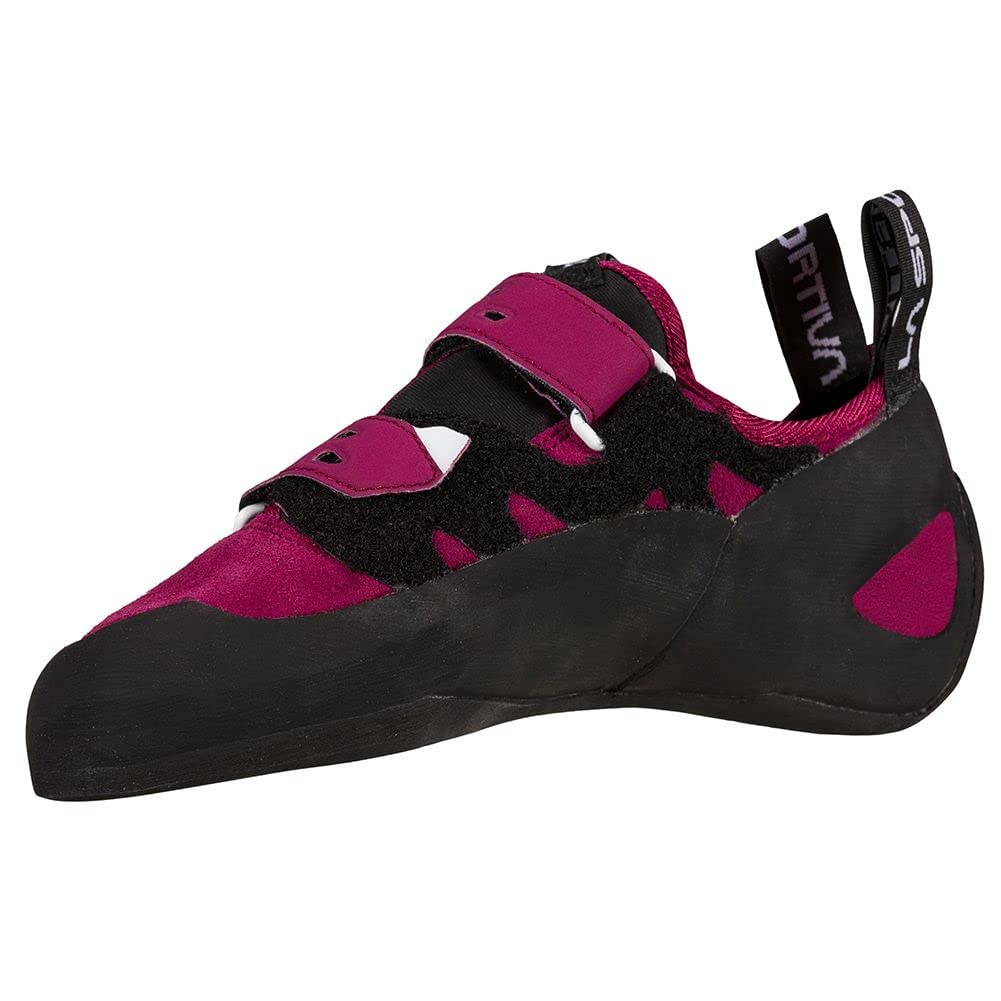
A velcro-equipped beginner shoe that goes on fast and stays comfortable for hours, but it can cause heel blisters if the high back does not match your foot shape.
The women’s Tarantula shares the same 5mm FriXion RS outsole (hard beginner rubber) and rounded, flat last as the men’s Tarantulace but swaps laces for a two-strap velcro closure. That makes it dramatically easier to take on and off between burns (climbing attempts) — a real benefit for gym climbers who rest and rerack repeatedly. The shoe is designed for narrow feet with long toes, and most owners confirm sizing down a full size from street shoe gives that snug-but-not-crushing fit.
The build quality earns high marks — with 18 mentions, quality is the most praised aspect of this shoe. Shoppers say the shoe is durable after three months of regular use and handles 5.9 to 5.10 sport routes (moderate difficulty grades) with ease. The interior lining, however, has a known quirk: after 30-plus wears, the fabric can peel off and leave an orange residue on your feet. It does not affect performance, and many owners say they would repurchase regardless, but it is worth knowing before you commit.
Some find the shoe perfect from the start, while others report the toe box is too large or the high back causes heel blisters. If you have a wider foot or a heel that slips in other brands, this shoe may not lock you in the way you want. The flat, low-asymmetry (minimally curved) profile is excellent for slab and vertical climbing but not for steep overhangs.
Why it stands out
- Velcro makes it the easiest shoe here to put on and take off
- Quality build lasts through months of regular climbing, per owner reports
- 5mm FriXion RS rubber feels tough and supportive for beginners, so you can stand on holds without the sole folding
Know before you buy
- Interior lining can peel and leave orange residue on feet after 30+ wears
- Heel blisters possible if the high back (the shoe’s heel cup) does not match your foot shape
- Not designed for bouldering or aggressive overhangs due to flat profile
Perfect for: women new to climbing who want a velcro convenience shoe for gym sessions and easy outdoor routes.
Skip if: you have a wide heel that slips easily, or you need a downturned shoe for overhanging terrain.
6. Ocun Striker QC

A comfortable non-aggressive shoe that a seven-year climber calls the most comfortable he has worn, ideal if you want a mild downturn without a painful break-in like the Instinct VS requires.
The Striker QC uses a 4mm CAT rubber 1.1 outsole (a sticky but less durable compound) and a moderately downturned profile, designed for bouldering and gym climbing. The Striker QC weighs 418 grams; the SCARPA Instinct VS weighs about 221 grams per half-pair (size 40) or roughly 442 grams for a full pair but still feels nimble on the wall. The microfiber upper is vegan-friendly and soft from day one, with almost no break-in needed. Owners with a wide forefoot and narrow heel find the last (shoe mold) matches them perfectly — the velcro strap secures the heel with zero pressure points.
Seven-year climbers report these as the most comfortable climbing shoes they have ever worn, praising the grippy rubber and good durability even after three months of hard use. The shoe is not aggressive, which means it trades raw overhanging power for all-day versatility on gym walls and moderate outdoor boulders. The trade-off is that the CAT rubber, while sticky, is not as durable as a harder compound like Vibram XS Edge — one owner reported the shoes began pulling apart after less than two months.
Sizing is the biggest hurdle. The shoe runs extremely small. A women’s size 5.5-6 had to order a 7 wide just to fit. Those with US street shoe size 9.5 found that ordering a 9 to 10 gave a snug-but-comfortable fit. The safest rule is to go at least a half size up from your street shoe; for a performance fit, stay near street shoe size but expect a very tight break-in.
The comfort champion: if you prioritize a no-pain, all-session shoe that still has a mild downturn for moderate overhangs, the Striker QC delivers. It works for bouldering and gym climbing, suits wide forefeet, and requires almost no break-in after you nail the sizing.
The catch: the CAT rubber sole is less resistant to wear than harder rubbers, and the sizing inconsistency means you may need to order twice to get it right.
7. EVOLV Defy
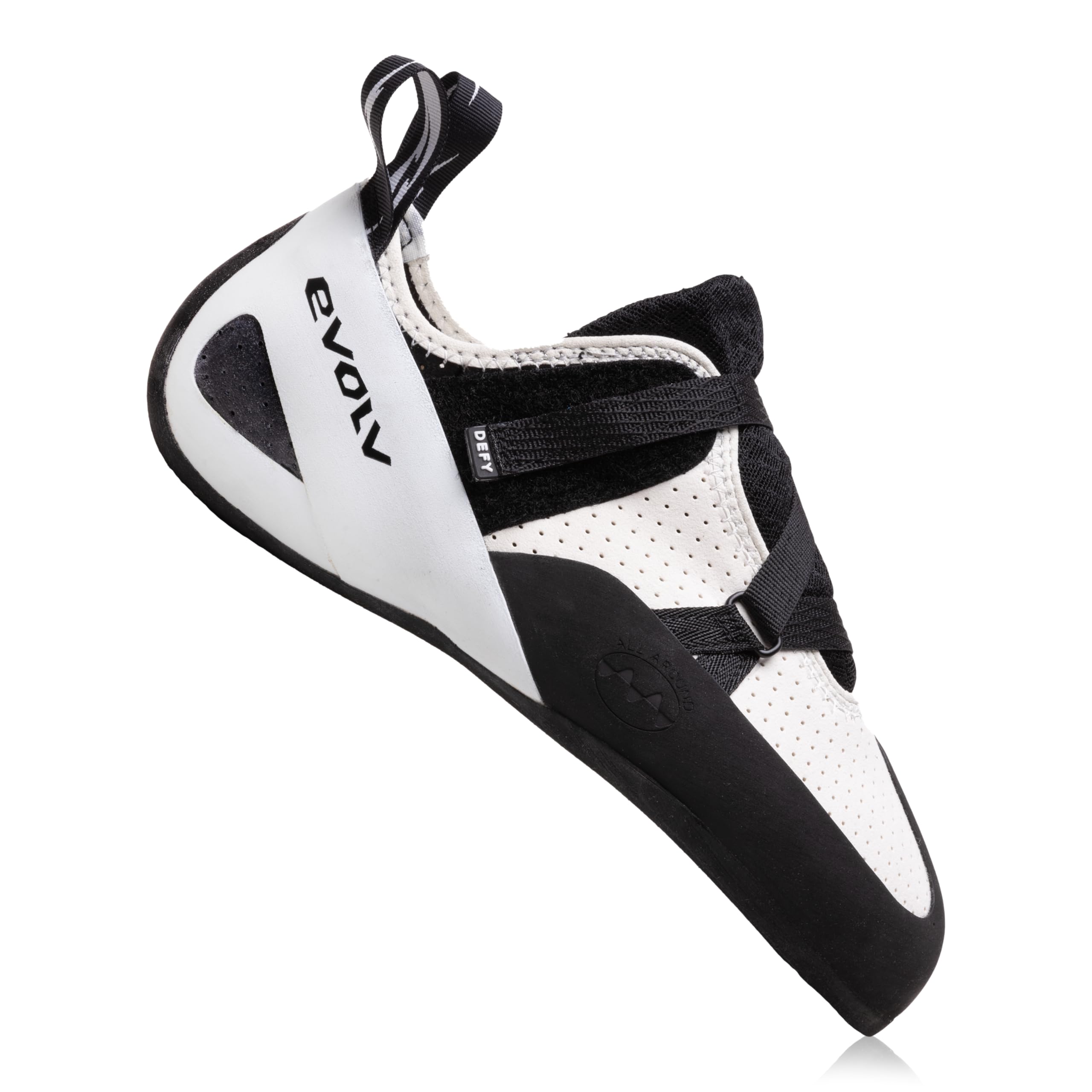
A downturned toe on a budget shoe that fits wide feet better than most, but its sizing is the trickiest guess of any pick here — you may need to go up 1.5 to 2 sizes.
The EVOLV Defy brings a downturned toe (curved downward) for hooking and power transfer, which is unusual at this price point. It is designed for entry-level bouldering and indoor climbing, giving new climbers a taste of an aggressive profile without the expensive price tag. The shoe is noticeably wider in the forefoot than other entry-level models, which is a rare advantage for climbers with wide or 4E-width (extra-wide) feet who usually struggle to find anything comfortable.
Comfort is the most praised aspect, with 7 mentions from buyers. Owners describe the shoe as great for all-day wear, working well both indoors and outdoors for months at a time. The soft, non-aggressive sole makes smearing (standing on smooth holds) easier for beginners, though it is not precise enough for tiny holds. The major recurring theme across reviews is sizing: the EVOLV Defy runs incredibly small. At least half a dozen owners confirm you need to go up 1.5 to 2 sizes from your street shoe just to get a snug fit. A street shoe size 9.5 needed a size 12. Several buyers tried going up 1.5 sizes and still found the toe box too cramped. The shoe does not stretch like leather models because of its synthetic upper, so you cannot count on break-in to fix a too-small fit.
The return policy from this seller adds friction — one owner noted a return fee, which is frustrating when sizing is this unpredictable. If you get the size right, the Defy is a comfortable, wide-friendly, budget option with a rare downturned toe. If you get it wrong, it is a costly guess.
Standout traits
- Downturned toe (curved downward) at an entry-level price point, unusual for this budget bracket
- Wide forefoot fits 4E (extra-wide) feet better than most climbing shoes
- Comfortable for all-day wear and indoor bouldering, per owner reports
Frustrations
- Runs very small — size up 1.5 to 2 sizes from street shoe, multiple owners confirm
- Synthetic upper does not stretch to accommodate sizing mistakes
- Toe precision is not great for tiny hooks or edges, so avoid if you need micro-edging power
Best for: new boulderers with wide feet who want an aggressive toe shape at a budget price.
Skip if: you have normal or narrow feet, or you hate playing the sizing guessing game — the inconsistent fit and return fee make this a gamble.
Understanding the Specs
Downturn and Asymmetry
A shoe’s downturn (how much the toe curves downward) and asymmetry (how much the shoe curves into a banana shape) determine how aggressive the shoe is on steep terrain. A flat, symmetrical shoe like the La Sportiva Tarantulace is comfortable for vertical walls and long days. A moderately downturned shoe like the SCARPA Instinct VS transfers power to your big toe for standing on small edges and hooking overhangs. More aggression usually means less all-day comfort.
Rubber Compound and Thickness
The rubber on the bottom determines grip and durability. Softer compounds like Vibram XS Grip 2 feel sticky on smooth holds but wear through faster. Harder compounds like Vibram XS Edge or FriXion RS last longer and edge better (stand on small holds) but feel less sensitive on smears (smooth holds). Thicker rubber (4mm to 5mm) is more durable and forgiving for beginners. Thinner rubber (3.5mm or less) gives better sensitivity but wears out sooner, especially for climbers who drag their toes.
Closure System
Lace-up shoes like the SCARPA Helix Lace and La Sportiva Tarantulace allow micro-adjustments across the entire foot, giving a precise fit but taking longer to put on and take off. Velcro (strap) shoes like the BLACK DIAMOND Momentum Strap and La Sportiva Tarantula are easier to rip on and off between climbs but offer less fine-tuning. Slip-last shoes with a single pull-string are rare at this price range but offer the fastest entry.
Weight
Lighter shoes (around 7.6 to 8.1 oz per half-pair) feel less fatiguing on steep terrain and long routes. Heavier shoes (up to 418 g or more) feel more substantial but can tire you out on overhangs. A difference of half an ounce is barely noticeable on flat ground, but on a roof or a twelve-pitch route, that weight savings adds up.
FAQ
How tight should climbing shoes feel?
Do I need aggressive shoes as a beginner?
What is the difference between Vibram XS Edge and Vibram XS Grip 2?
Should I buy lace-up or velcro climbing shoes?
How long should a pair of climbing shoes last?
Can I resole climbing shoes?
Do climbing shoes stretch as much as people say?
What is the difference between a men’s and women’s climbing shoe?
Final Thoughts: The Verdict
For the majority of shoppers, the climbing shoes winner is the SCARPA Instinct VS because it combines aggressive edging power from its 4mm Vibram XS Edge outsole with a surprisingly comfortable fit for wide feet and Morton’s toe (longer second toe). If you want a forgiving beginner shoe you can wear all day without pain, grab the BLACK DIAMOND Momentum Strap. And for budget-conscious boulderers with wide feet who want a downturned toe, the EVOLV Defy is the one to reach for — just order two sizes up to avoid the sizing headache.
How We Picked
We do not accept paid placement. Every pick is matched to a real buyer and a real use-case; we do not hands-on test units.
Sources & Methodology
Specifications: manufacturer listings and product documentation. Review insights: verified customer reviews, as of July 2026. Pricing: not shown on this page (it changes often); check the current price via the retailer link.
As an Amazon Associate, WellFizz earns from qualifying purchases. This does not affect which products we feature.
Related Guides

Mo Maruf
I created WellFizz to bridge the gap between vague wellness advice and actionable solutions. My mission is simple: to decode the research and give you practical tools you can actually use.
Beyond the data, I am a passionate traveler. I believe that stepping away from the screen to explore new environments is essential for mental clarity and physical vitality.