Our readers keep the lights on and my smoothie glass nicely filled. As an Amazon Associate, I earn from qualifying purchases.
Specs are compiled from manufacturer listings and verified buyer reviews and can change over time — please confirm the key details on the product page before buying.
Bouldering throws short, explosive problems at you that test strength, technique, and the shoe on your foot. When you curl your toes over a tiny chip or slap for a sloper, a sloppy shoe means a failed send. The right pair wraps your foot into a precise, sensitive tool that turns small edges into footholds and lets you hook, smear, and heel-hook up the wall. The wrong one slips, hurts, and holds you back from that project you have been working on for weeks.
I’m Mohammad Maruf — the founder and writer behind WellFizz. This guide is built by comparing the manufacturers’ published specifications and the patterns across verified customer reviews, so you get each pick’s real strengths and trade-offs instead of marketing spin.
What follows is a focused look at the top candidates for the climbing shoes for bouldering, ranked by their actual build, the rubber they use, and what hundreds of fellow climbers have found on the wall.
Our Picks at a Glance


How To Choose The Best Climbing Shoes For Bouldering
Finding the right shoe for bouldering depends on a few key decisions that are different from general sport climbing. Bouldering problems are steep and powerful, so your shoe needs to prioritize precision and grip over long-distance comfort. Here are the three specs that matter most.
The Last: Aggressive Downturn and Asymmetry
A bouldering shoe has a pronounced downturned shape — it curves like a claw, not a flat slipper. This “aggressive last” (the internal shape of the shoe) puts your toes into a powerful, curled position that lets you stand on tiny footholds and hook onto edges. The more aggressive the downturn, the better the shoe performs on steep, overhanging problems. Neutral shoes are for slabs or all-day multi-pitch, not bouldering.
Rubber Compound and Thickness
The rubber on the bottom of the shoe determines how well you stick to the rock or plastic. Softer rubbers like Vibram XS Grip2 (a sticky compound that provides high friction) provide incredible friction for smearing and toe-hooking, but they wear down faster. Thicker soles (3.5mm–4mm) last longer but reduce sensitivity for feeling the holds. A bouldering specialist will usually sacrifice a bit of longevity for that extra stickiness.
Fit and Sizing
Bouldering shoes are worn extremely tight — often one to two full sizes smaller than your street shoe. This prevents your foot from rolling inside the shoe when you stand on a small edge. A painful break-in period is normal for the most aggressive models, but a shoe that cuts into your bone or causes hotspots is a bad fit. Look for a snug heel cup and a toe box that matches your foot’s width.
Quick Comparison
| Model | Best For | Last | Sole Rubber (Thickness) | Closure | Amazon |
|---|---|---|---|---|---|
| La Sportiva Skwama★ Best Overall | Best Overall | Pointed, Large Downturn, High Asymmetry (PD75) | Vibram XS Grip2 (4mm) | Hook and Loop | Amazon |
| Ocun Advancer QCValue Performance | Value Performance | Advantic All-round | CAT rubber 1.5, 4mm | Hook and Loop | Amazon |
| Mad Rock Drone HV 2.0 | High-Volume Feet | Significant Downturn, Aggressive Asymmetry | Science Friction 3.0 | Hook-and-Loop | Amazon |
| La Sportiva Solution (Mens) | High-Level Steep Climbing | Pointed, Large Downturn, Higher Asymmetry (PD75) | Vibram XS Grip2 (3.5mm) | Slipper/Lock Harness System | Amazon |
| La Sportiva Solution (Womens) | Narrow-Foot Bouldering | Pointed, Large Downturn, High Asymmetry (PD 75) | Vibram XS Grip2 (3.5mm) | Hook and Loop | Amazon |
| EVOLV Phantom | Max Power with Sensitivity | Aggressively Cambered, Downturned Toe | TRAX SAS | 6-Point Single-Pull Closure | Amazon |
| SCARPA Drago XT | Ultimate Sensitivity | Highly Downturned, Highly Asymmetric | Vibram XS Grip2 (3.5 mm) | Hook and Loop | Amazon |
In‑Depth Reviews
1. La Sportiva Mens Skwama Performance Rock Climbing Shoes
Our pick — 4.5★ from 250+ verified ratings; the strongest balance of quality and price.
An aggressive, versatile weapon that tunes your foot into a precise tool for steep problems.
You get reliable grip on small footholds and damp surfaces because the Skwama uses a PD75 last — that means a pointed, aggressively downturned shape with high asymmetry (the shoe angles toward your big toe) — to let you stand on razor-edge footholds and also smear on slopey volumes. The 4mm Vibram XS Grip2 rubber (a soft, sticky compound) provides high friction on both plastic and rock. Buyers confirm it delivers: the most-discussed quality is the construction, with “quality” earning the top count from owners. Grip and functionality follow close behind.
The catch is the break-in, which nearly every owner mentions. One honest review sums it up: “it took me 4-5 sessions to break them in. It was digging into my skin hard around the ankle.” That is the price of a performance fit. The S-heel and rubber patch around the toe make heel and toe hooks feel easy, but the comfort is a mixed bag — some find the heel cup too shallow, others say the elastic stretches after use. The Skwama beats the La Sportiva Solution on versatility because it smears better while still edging like a competition shoe.
What wins over owners
- Exceptional grip on small footholds and damp surfaces
- Aggressive design works for overhangs, edging, and toe/heel hooking
- Versatile enough for both bouldering and technical sport climbs
The honest trade-offs
- Break-in is genuinely painful, often requiring 4-5 sessions
- Rubber wears quickly around the toe area
- Heel cup can feel too big for narrow heels, slipping on hooks
For the dedicated boulderer: If you are projecting V5+ and want one shoe that does everything — steep, vertical, and technical — without switching pairs, the Skwama is the top contender.
Not for beginners: The pain and specific fit mean this shoe is wasted on a first-time climber who is not ready for the discomfort.
2. Ocun Advancer QC and Advancer LU Bouldering Shoe
A budget-friendly bouldering shoe that does not cut corners on comfort or climbability.
For the climber hitting the gym several times a week but not yet at the elite level, the Advancer QC delivers more than its price suggests. It uses a 4mm CAT rubber 1.5 sole — a sticky compound that provides good friction for indoor plastic and outdoor sandstone. The Advantic all-round last (the shoe’s shape) is less severely downturned than the Skwama’s PD75, making it a friendlier choice for the V4-V6 crowd who still want performance without a brutal break-in. One buyer who had only been climbing for a month put it simply: “these shoes have the fit, comfort and quality I love.” The microfiber upper keeps weight down at 438g per pair.
The trade-off appears at higher grades. A few owners note that the grip on pinches and overhangs at the 5.12 level is not as secure as pricier La Sportiva models, and the heel lacks cushioning for aggressive hooking. For the intermediate climber working up to harder projects, though, the value is clear. delivers 90% of the feel for the first year of climbing.
Best for mid-grade climbers: If you are sending up to V5 and want a comfortable, ready-to-wear shoe that does not need weeks of torture to break in, this is your best value.
Skip for wide feet: The fit runs narrow, and several owners with wider feet had to return them.
3. Mad Rock Drone HV 2.0 Climbing Shoe

A premium bouldering shoe that finally gives high-volume feet a performance fit.
If you find that aggressive shoes squeeze your toes into a painful vice, the Drone HV 2.0 is built specifically for you. “HV” stands for high volume — it has a wider toe box, a bigger heel cup, and a boxier profile than the standard Drone. The shoe retains a significant downturn and aggressive asymmetrical curvature, so it still delivers the power transfer you need for steep problems. The patented Science Friction 3.0 rubber compound is designed for higher friction and improved durability over previous Mad Rock formulas. One five-star review calls it “a cheat code for toe/heel hooks.”
The break-in is not easy. The shoe is very stiff initially, with a weird toe space that takes one to two sessions to settle. Sizing is tricky: the general rule is to buy your street shoe size or go half a size down for a tight fit. It is heavier than the Skwama at roughly the same price tier, and the fit remains a mixed bag for some — a few owners found it slightly larger than the 1.0 version. But for a climber with wide feet who has been squeezing into narrow European shoes, the Drone HV 2.0 is a revelation.
What stands out
- Patented Concave Sole and 3D Molded Heel Cup for superior hooking
- Science Friction 3.0 rubber offers a strong balance of durability and grip
- Arch Flex support system reduces pain while maintaining a snug fit
What to watch for
- Stiff and difficult to break in; needs several sessions to feel broken-in
- Sizing guidance is inconsistent across reviews
- Some owners found it slightly larger than the Drone 1.0
High-volume boulderers: This is your pick if you are a heavier climber (over 170lb) with wide feet who wants the power of a Skwama but cannot find one that fits.
Think twice if: You prefer a lighter, slipper-style shoe or have narrow, low-volume feet.
4. La Sportiva Mens Solution Rock Climbing Shoe
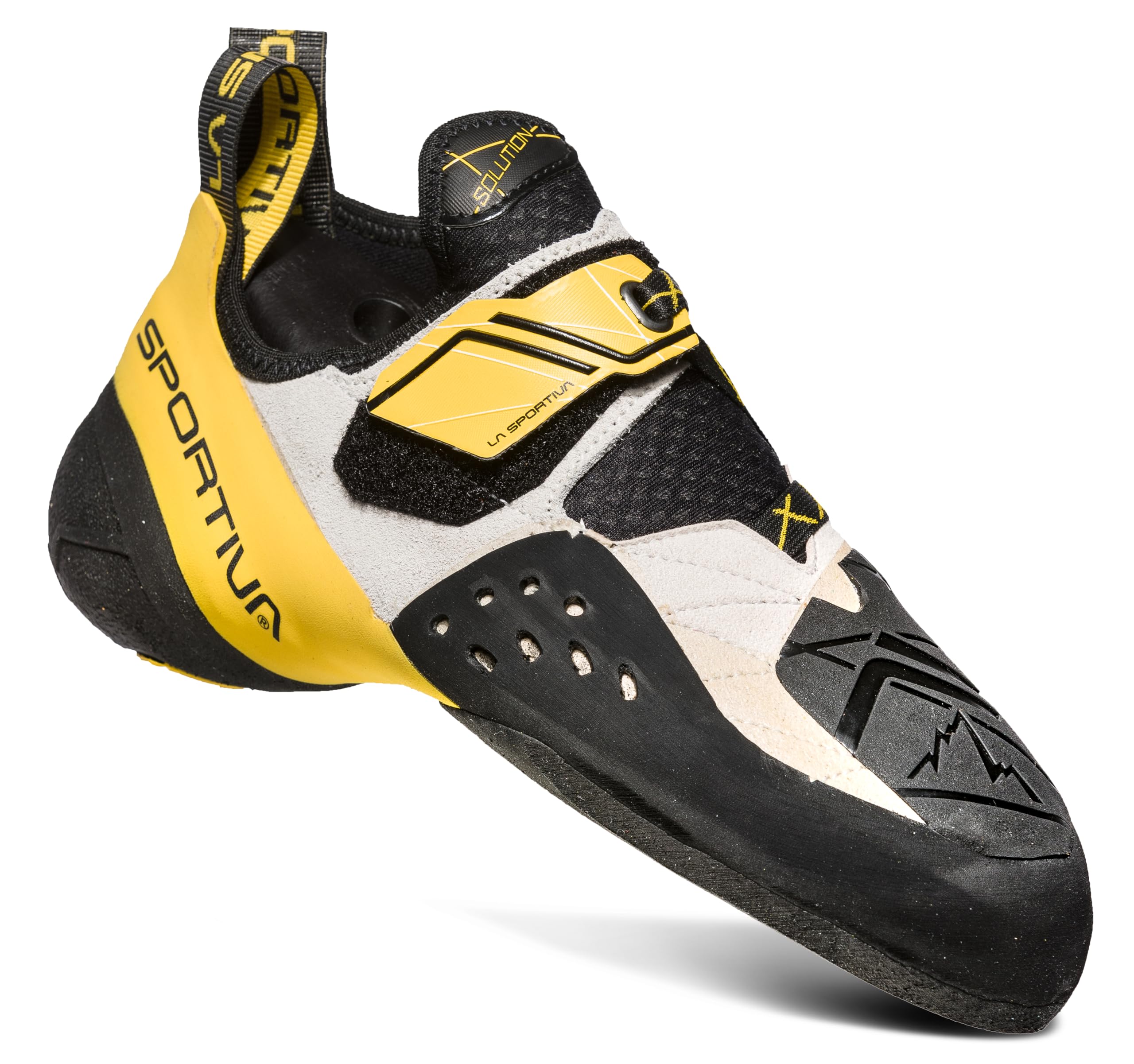
A legendary steep-climbing shoe that set the standard for edging and heel hooks.
The Solution is among the most recognized names in bouldering, and for good reason. Its PD75 last gives it a large downturn and high asymmetry, putting the foot into a powerful, arched position. The 3.5mm Vibram XS Grip2 sole (versus the Skwama’s 4mm) trades a bit of durability for increased sensitivity on tiny holds so you can feel the rock better on small edges. The slipper/lock harness closure wraps the heel securely, and the no-lining construction lets the shoe mold to your foot over time. Owners consistently praise its precision on small footholds and its ability to hold on damp surfaces.
The dealbreaker for many is sizing: the newer version runs significantly smaller than the old Solutions. One verified owner warns that you need to size up at least half a size compared to the older model, even after breaking them in. The sides cut into ankle bones for some users, and there is a rare but serious complaint about the shoe delaminating after just two and a half weeks of indoor use. Still, for a climber used to aggressive shoes who knows their La Sportiva size, the Solution remains a benchmark for steep, powerful climbing.
For the dedicated project climber: If you spend your sessions on steep overhangs and need a shoe that transfers every ounce of power to a razor edge, the Solution is time-tested and proven.
Be careful with sizing: The new model runs small; you need to size up 0.5 from your old Solutions or risk a painful, unusable fit.
5. La Sportiva Womens Solution Rock Climbing Shoe
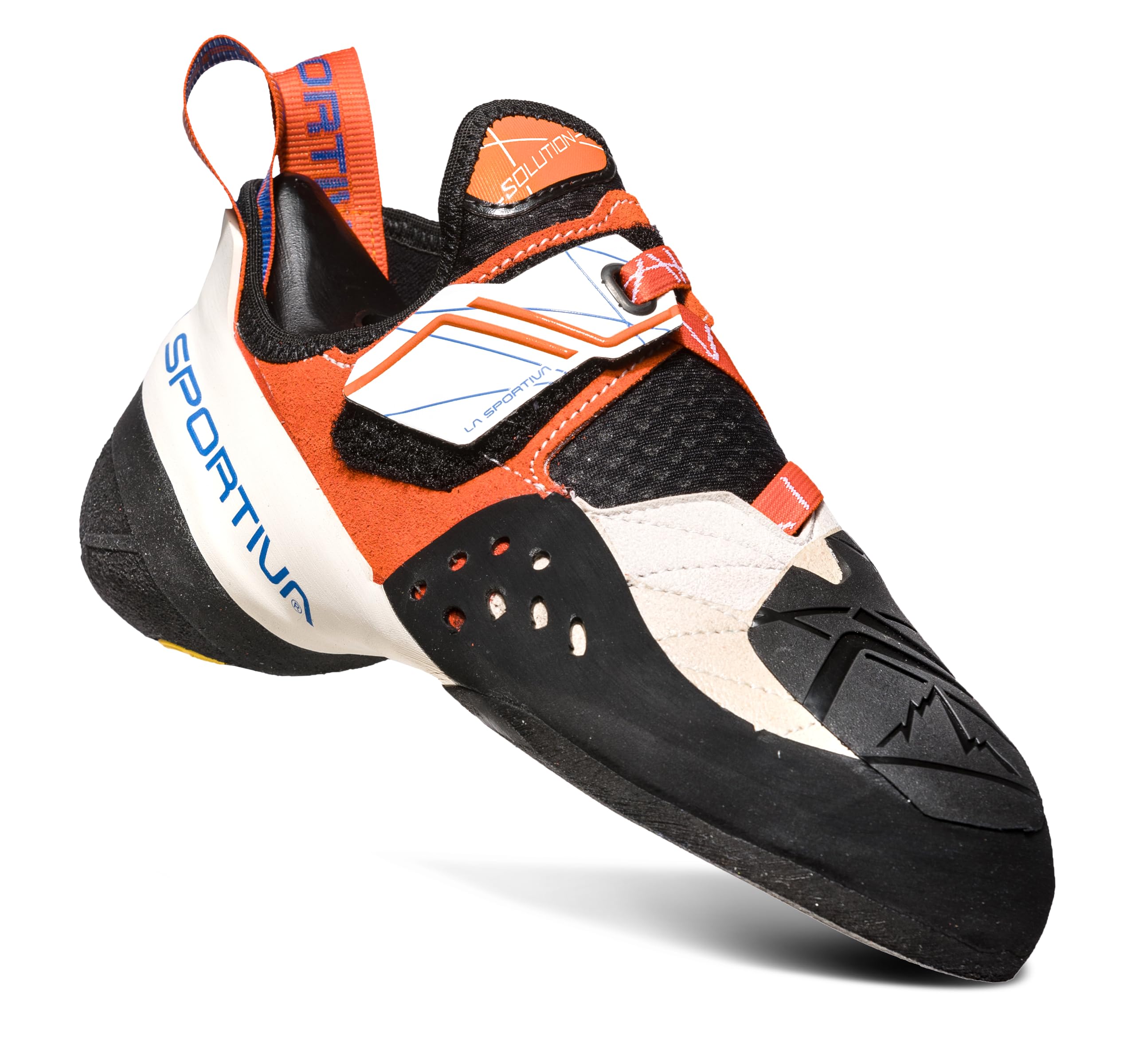
A women’s-specific powerhouse that gives narrow feet the same aggressive edge as the men’s classic.
The women’s Solution is not just a scaled-down men’s shoe. It uses the same PD75 last (the internal shape) and 3.5mm Vibram XS Grip2 rubber, but the heel, foot, and toe box are narrower and lower-volume — ideal for feet that tend to slip out of unisex models. A buyer who switched from the men’s version found the women’s fit “superior” for narrow feet. The aggressive downturn provides precise edging under half an inch, and the rubber that wraps around the toe aids in toe-hooking. One owner who uses it for bouldering says “the heel cup is fantastic” and it is her go-to for hard problems.
The downsides mirror the men’s version: the shoe runs small compared to other La Sportiva models, making sizing a guessing game. The aggressive arch makes it painful to walk in, so you will want to take it off between attempts. A few buyers report that the shoe laces and back straps can rip if you tie them very tightly, which is worth monitoring on a premium shoe. For the narrow-footed boulderer who has been struggling with gaping heels, this is the dedicated solution.
Perfect for narrow feet: If the men’s or unisex versions leave your heel slipping and your toes swimming, the women’s Solution locks you in.
Not for beginners: This is a performance shoe for intermediate to advanced climbers ready for a painful, performance fit.
6. EVOLV Phantom Rock Climbing Shoe for Bouldering & Sport Climbing

A high-performance boulderer’s shoe that trades ultimate sensitivity for raw power and durability.
The Phantom is built for climbers who want to boost power transfer to small edges. Its aggressively cambered, downturned toe box and thicker plastic midsole (reinforced at the forefoot) create a stiff platform — stiffer than the La Sportiva Solution but more comfortable than the 5.10 Dragon, according to one owner with over 120 climbing days. The TRAX SAS rubber compound is Evolv’s stickiest, according to the brand, providing grip on plastic and rock. The 6-point single-pull closure system lets you dial in the fit precisely, and the Dark Spine S heel midsole pushes more power through your foot to the toe box, a design elite athletes like Daniel Woods are said to rely on.
The trade-off is a thicker sole that reduces sensitivity for smearing. You feel the holds less than you would in a thinner-soled shoe like the SCARPA Drago XT. The heel straps can feel weak, and one owner reported a buckle breaking after three months (resolved through warranty). Sizing is also tricky: most buyers recommend going one full size up from your street size, and the shoe is very tight initially before stretching significantly over time. For the boulderer who wants a shoe that lasts through hundreds of sessions without needing a resole, the Phantom is a long-term investment.
Strengths
- Excellent power transfer for small edges and overhangs
- TRAX SAS rubber is sticky and durable; one owner reports it lasting over 120 climbing days
- Heel and toe hooks feel secure and precise
Limitations
- Thick sole reduces sensitivity; not ideal for smearing
- Heel strap and buckle quality has been questioned
- Break-in is long and sizing guidance is inconsistent
For the power boulderer: If you project V7+ and need a shoe that keeps its edge for years, the Phantom offers proven durability that rivals the La Sportiva Solution.
Not for the smeary: If your style relies on feeling volumes and slopers through the sole, the Phantom’s stiffness works against you.
7. SCARPA Drago XT Rock Climbing & Bouldering Shoes

The featherweight specialist built for climbers who want to feel every grain of the hold.
The Drago XT is the lightest shoe in this lineup at just 7.1 oz per half pair (size 41), and it is engineered for maximum sensitivity. Its highly downturned, highly asymmetric last wraps the foot into a powerful claw, while the 3.5mm Vibram XS Grip2 sole is paired with a Flexan 1.0 midsole that provides just enough support without killing the ground feel. This is the shoe you put on when you need to stand on tiny divots and trust that your foot will feel exactly where the edge is. The upper combines microsuede and leather for a soft, molding fit, and the Alcantara toe pocket adds comfort for toe hooks.
The main challenge is sizing, which is notoriously tricky across SCARPA’s Drago line. One verified owner notes that “it is very hard finding what your size is, but the quality of it was great.” You will likely need to try them on in person or use an online size converter with care. The shoe also has limited padding, so if you have bony feet or a low pain tolerance, the break-in could be uncomfortable. For the elite boulderer who prioritizes sensitivity above all else, the Drago XT is the lightest, most connected option on this list.
For the feel-dependent climber: If you want the most feedback from the rock and are willing to trade durability for weight, the Drago XT is your tool.
Watch the sizing: Unpredictable fit makes this a risky blind buy; size carefully or try first.
Understanding the Specs
Last and Downturn
The “last” is the shape of the shoe — it determines how your foot sits inside. A bouldering shoe has a significant downturn, meaning the shoe curves downward like a claw. This puts your toes into a powerful, curled position for standing on tiny edges. The asymmetry (how much the shoe is angled toward the big toe) works with the downturn to focus power onto a single point. A PD75 or PD85 last, common in the picks above, means a very aggressive last that is ideal for steep, overhanging problems but painful to walk in.
Rubber Compound
The rubber on the sole is what actually sticks to the wall. Vibram XS Grip2 is the most common high-performance rubber here — it is a soft, sticky compound that provides maximum friction on both plastic and rock. The thickness (measured in millimeters) directly trades off between durability and sensitivity: a 4mm sole lasts longer but you feel the holds less, while a 3.5mm sole gives you more feel but wears faster. Science Friction 3.0 and TRAX SAS are proprietary blends from Mad Rock and EVOLV, respectively, designed to offer a similar balance of stickiness and durability.
FAQ
What is the difference between bouldering shoes and general rock climbing shoes?
Should I size down my climbing shoes for bouldering?
How long does it take to break in aggressive bouldering shoes?
Which rubber compound is best for bouldering?
Can I wear bouldering shoes for sport or trad climbing?
What is a “slipper” closure and how does it differ from hook-and-loop?
Why do some climbing shoes have no lining?
What is the difference between the La Sportiva Solution (Mens) and the Solution (Womens)?
How do I know if a shoe fits my heel?
Final Thoughts: The Verdict
For most climbers looking for the best climbing shoes for bouldering, the La Sportiva Skwama is the most versatile and rounded choice — it edges like a demon, hooks well, and smears confidently. If you have high-volume or wide feet, the Mad Rock Drone HV 2.0 delivers the same aggressive performance without the squeeze. And if you are on a budget but still want proper performance, the Ocun Advancer QC delivers strong value for intermediate climbers. Each shoe here earns its place for the right foot shape and climbing style — Match the last to your needs and you’ll be sending harder in no time.
How We Picked
We do not accept paid placement. Every pick is matched to a real buyer and a real use-case; we do not hands-on test units.
Sources & Methodology
Specifications: manufacturer listings and product documentation. Review insights: verified customer reviews, as of July 2026. Pricing: not shown on this page (it changes often); check the current price via the retailer link.
As an Amazon Associate, WellFizz earns from qualifying purchases. This does not affect which products we feature.
Related Guides

Mo Maruf
I created WellFizz to bridge the gap between vague wellness advice and actionable solutions. My mission is simple: to decode the research and give you practical tools you can actually use.
Beyond the data, I am a passionate traveler. I believe that stepping away from the screen to explore new environments is essential for mental clarity and physical vitality.