Our readers keep the lights on and my smoothie glass nicely filled. As an Amazon Associate, I earn from qualifying purchases.
Specs are compiled from manufacturer listings and verified buyer reviews and can change over time — please confirm the key details on the product page before buying.
You want a pack that disappears on your back when you need to move and holds exactly what you need—rope, rack, shoes, water—without flapping or bulging where it should not. A bag that slides sideways in a chimney, snags on overhangs, or forces you to unpack everything just to grab a snack will ruin a great day on the wall. This guide compares three packs built for that job, from a fast-and-light single-pitch pocket to a full alpine hauler, so you pick the one that matches your day out.
I’m Mohammad Maruf — the founder and writer behind WellFizz. This guide is built by comparing the manufacturers’ published specifications and the patterns across verified customer reviews, so you get each pick’s real strengths and trade-offs instead of marketing spin.
Every pack here is designed specifically for climbing—with ice-axe loops, rope carry options, or gear loops—so you are not guessing whether a general hiking bag will hold your rack on a multi-pitch route. These are the options that define today’s market for best climbing packs.
Quick Picks
- Osprey Mutant 38L Climbing — Best Overall
- Deuter Guide 30L Backpack — Versatile Midweight
- PETZL BUG Backpack (18L) — Fast & Minimal
How To Choose The Best Climbing Packs
Picking a climbing pack is different from choosing a daypack for hiking. You care less about hip-belt padding and more about how the bag sits when you lean back on a wall, whether it slides sideways in an off-width crack, and if you can grab your rope without taking the whole pack off.
Volume: Day on the wall or overnight mission
For a single day of multi-pitch climbing where you carry a rack, rope, shoes, water, and a layer, an 18L to 30L pack is the balance. Jump to 38L or more if you need a down jacket, extra food, a headlamp, and overnight gear for alpine routes. Overstuff a small pack and you lose mobility; underfill a big one and it flops around on your back.
Weight and profile
Every ounce you add to the pack is an ounce you lift on every move. A lightweight pack under 1.5 pounds disappears when you are on the rock. But lighter often means fewer features—fewer gear loops, no removable lid, a simpler frame. Weigh the trade-off between carrying comfort on the approach versus agility on the climb.
Climbing-specific attachments
Look for ice-axe loops, a rope carry strap or bungee, gear loops on the hipbelt, and a helmet holder. These features turn a generic backpack into a tool you can use without stretching or fumbling. A pack without them means you will spend your belay time rigging your rope to compression straps that were never designed for it.
Quick Comparison
In‑Depth Reviews
1. Osprey Mutant 38L Climbing and Mountaineering Backpack
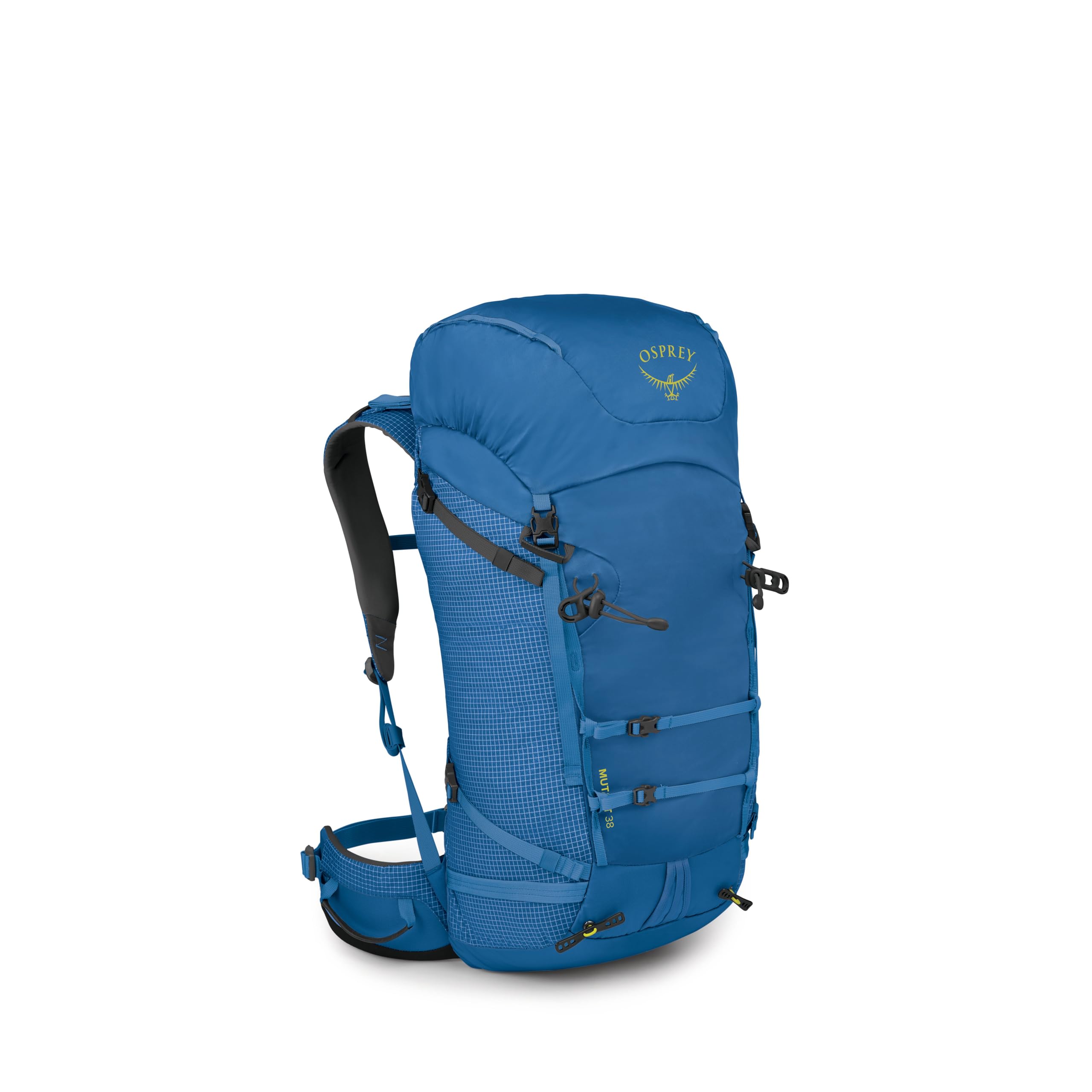
The big-pack alpine hauler that strips down for a day on the wall.
The Osprey Mutant 38L is the one you grab for long alpine routes where you need a down jacket, extra water, and a headlamp plus the usual rack and rope. It holds 38L compared to the Petzl BUG’s 18L, so you can stretch a day-and-a-half mission without running out of room. According to buyers, the reverse-wrap hipbelt keeps the load snug against your hips during steep approaches and the glove-friendly buckles are a real help when your fingers are cold.
The pack includes Dual ToolLocks (a bungee and cam-lock setup that holds your ice-axe head securely so it does not flop around) with bungee tie-offs, a snowshed backpanel that stops snow from building up between your back and the pack, and a reinforced A-frame ski carry if you are mixing climbing with a ski approach. It also has a removable top lid with a zip pocket and a FlapJacket that covers the opening when you take the lid off to save weight. At 2.69 pounds, though, it is the heaviest of the three packs here (the Petzl BUG is 1.2 pounds and the Deuter Guide is 1.9 pounds), so if every ounce matters on a hanging belay, the Mutant makes you carry that weight. It also lacks a dedicated ice-axe loop like the Deuter Guide has; the ToolLock system does the same job but adds a bit of bulk.
Alpine Armory
- Dual ToolLocks with bungee tie-offs keep axes secure without flopping
- Removable top lid with FlapJacket lets you shed weight for shorter climbs
- Reinforced A-frame ski carry adds winter versatility
- Snowshed backpanel stops snow buildup on your back
Weight Trade-Off
- At 2.69 lb it is significantly heavier than the Petzl BUG (1.2 lb) and Deuter Guide (1.9 lb)
- You pay a premium for all the features
Who needs this: The climber doing long alpine routes, ski mountaineering, or multi-day wall missions where volume and tool-carrying hardware matter more than pack weight.
The catch: If you only ever do single-pitch sport climbing, the Mutant is overkill—you will haul a heavy, feature-rich pack for gear that fits in an 18L bag.
2. Deuter Guide 30L Backpack
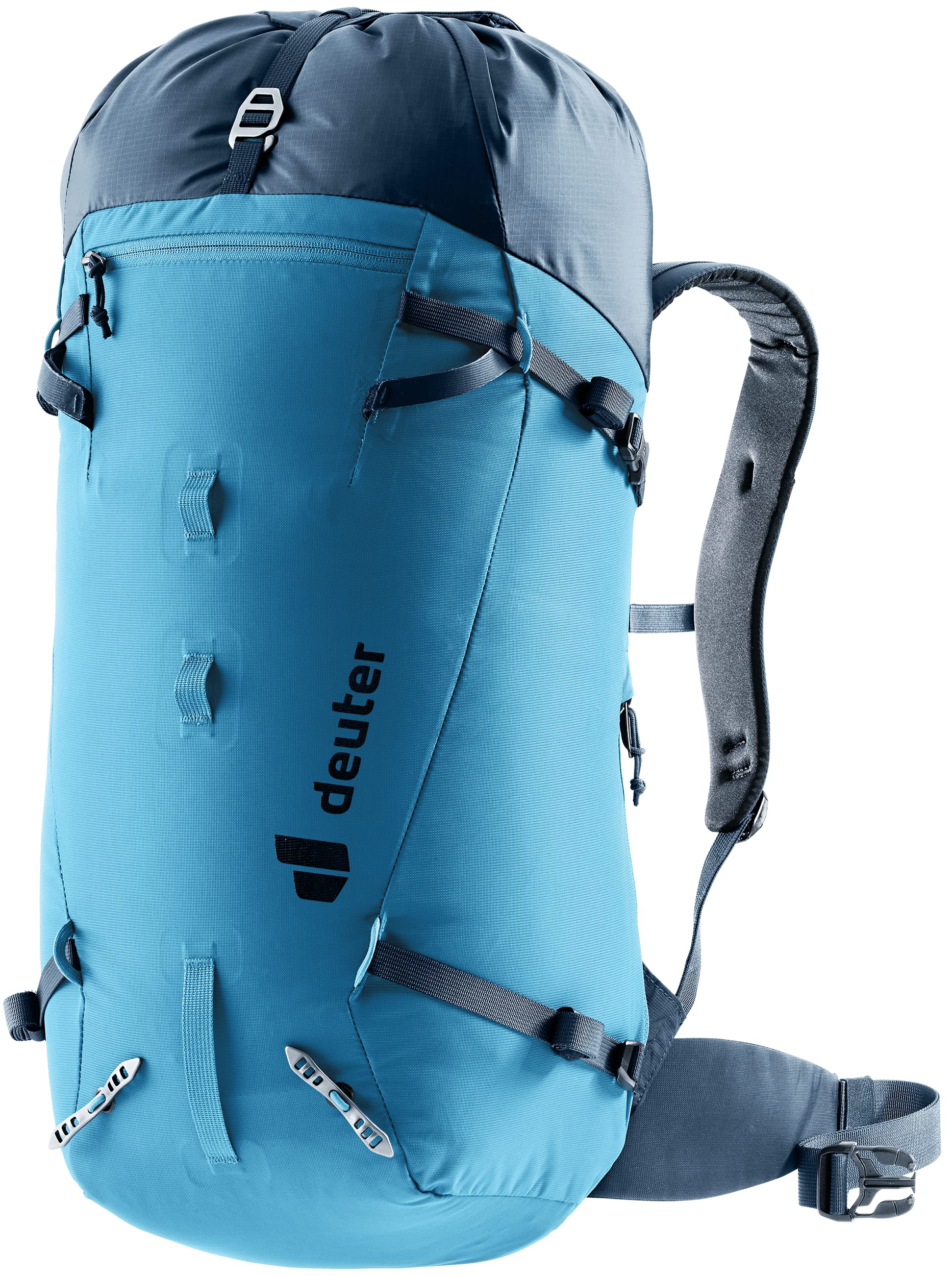
The alpine pack that balances carrying comfort with a slim, controlled profile.
Deuter built the Guide 30L for mountaineers who want lightweight gear but do not want to give up stability when the load gets heavier. A Delrin U-shaped frame (a rigid plastic frame that keeps the pack’s shape) distributes weight evenly so you can carry a bigger rack and more food without the bag sagging or shifting when you are scrambling up fourth-class terrain. At 1.9 pounds it sits right between the Petzl BUG (1.2 lb) and the Osprey Mutant (2.69 lb) in weight.
The pack comes with features that make alpine life easier: an integrated helmet holder in the lid, a glasses stow system so you do not scratch your sunglasses, a front pocket with a key clip, and a zippered cell phone pocket. It also has an ice axe attachment, a detachable rope strap, trekking pole attachment, and gear loops. The stowable hip fins and precision-adjustable sternum straps give you that secure fit without the bulk of a full hipbelt. According to buyers, the pack climbs well in tight spaces because it sits close to the body—its dimensions are 9.5 inches deep, narrower than the Petzl BUG which is 13 inches deep, so it squeezes through chimneys more easily. That slim depth is a real advantage over the Mutant’s 10.2-inch depth too.
Smart Alpine Design
- Delrin U-shaped frame distributes weight evenly for a stable carry on approach
- Integrated helmet holder and glasses stow system reduce fumbling at the base
- Stowable hip fins and adjustable sternum straps dial in a secure, close-to-body fit
- Narrow depth (9.5 in) helps the pack slide through tight rock
Not the Lightest
- At 1.9 lb it is heavier than the PETZL BUG (1.2 lb), which matters on long hanging belays
- Drawstring closure can be less convenient than a zipper for quick access
The right pick for: The climber who does everything from single-pitch trad to short alpine routes and wants a versatile pack that carries well without being heavy or bulky.
Look elsewhere if: You need to pack for an overnight alpine bivy—30L will be tight with a sleeping bag and bivy sack on top of your rack.
3. PETZL BUG Backpack (18L)

The feather-light pocket that disappears in off-widths and chimneys.
Weighing just 1.2 pounds, the Petzl BUG is the lightest pack here (the Deuter Guide is 1.9 pounds and the Osprey Mutant is 2.69 pounds). When you are hanging on a multi-pitch route, every ounce you carry on your back pulls on your shoulders. The BUG’s low-profile design keeps the pack close to your body. At 13 inches deep it is the widest of the three, but that width is mostly in the top section where a rope sits. The bag is only 3 inches thick at the bottom, so when you are wedged in a chimney there is less bulk fighting the rock.
The 18-liter volume is enough for shoes, a light rack, a single rope, water, and a thin layer—exactly what you need for a single day of multi-pitch climbing. It has an adjustable rope strap on top, a wide exterior pocket, an interior compartment for a hydration system or a thin laptop, and a wallet pocket. The waistbelt folds away when you do not need it, and the adjustable sternum strap helps lock the pack in place during overhangs. Buyers comment that the BUG feels like it is not there during the climb. The trade-off is that at 18L it holds 18L compared to the 38L of the Mutant, so if your day includes a cold belay in the shade where you need a puffy jacket, you will be strapping it to the outside. Back at the car, budget-oriented climbers appreciate that this simple design costs less than the feature-packed Mutant or Guide.
Disappears on Your Back
- At just 1.2 lb it is the lightest pack in the comparison, ideal for hanging belays
- Low-profile shape and 3-inch depth help in tight chimney and off-width squeezes
- Adjustable rope strap and fold-away waistbelt keep the pack tidy on the wall
- 18L is just right for a full day single-pitch or quick multi-pitch
Limited Capacity
- 18L is cramped for colder days or longer alpine routes where you need extra insulation
- No ice-axe loop or ToolLock system—you need to use the rope strap for your axe
Best for: The sport or trad climber who wants a pack that is barely noticeable on the wall and only carries the absolute essentials for a day of climbing.
Not ideal for: Anyone who needs to bring extra layers, overnight gear, or a double rack over 18L—you will run out of room fast.
Understanding the Specs
Volume (Liters)
Volume measures how much gear the pack can hold, in liters. An 18L pack fits a rope, rack, shoes, water, and a thin jacket—perfect for a day of single-pitch or short multi-pitch climbing. A 30L pack adds room for a bigger rack, more layers, and extra food, which works for longer alpine routes. A 38L pack handles all of that plus a down jacket, bivy gear, and overnight essentials so you are not strapping gear to the outside. Pick the volume that matches your typical mission length and how much insulation your climate demands.
Weight (Pounds)
Every pound you add to the pack is weight you lift with every move on the wall. A 1.2-pound pack like the Petzl BUG is barely noticeable on hanging belays and in steep chimneys. A 1.9-pound pack like the Deuter Guide gives you more carrying comfort and frame stability for heavier loads. A 2.69-pound pack like the Osprey Mutant carries the most gear and has the most features, but you feel that extra weight on every pitch. Heavier packs usually mean more frame structure and more attachments—the trade-off is carrying performance versus agility on the climb.
FAQ
Can I use a regular hiking backpack for climbing?
What is the best pack size for a single day of multi-pitch climbing?
What is the difference between ice-axe loops and a ToolLock system?
How do I carry a rope on a climbing pack?
Does the Petzl BUG have ice-axe loops?
Which pack is best for chimneys and off-width climbing?
What features should I look for if I climb in cold weather?
How much weight do climbing packs add to my carry on a multi-pitch route?
Final Thoughts: The Verdict
For most buyers, the best climbing packs winner is the Osprey Mutant 38L because it packs the most alpine-specific features (Dual ToolLocks, rope carry, snowshed backpanel) into a 38-liter volume that handles everything from a full day to a light overnight mission. If you want a lighter carrying experience for single-day alpine climbs, grab the Deuter Guide 30L. And for fast, minimal single-pitch days where every ounce counts, the Petzl BUG 18L is the one to beat for weight and simplicity.
How We Picked
We do not accept paid placement. Every pick is matched to a real buyer and a real use-case; we do not hands-on test units.
Sources & Methodology
Specifications: manufacturer listings and product documentation. Review insights: verified customer reviews, as of July 2026. Pricing: not shown on this page (it changes often); check the current price via the retailer link.
As an Amazon Associate, WellFizz earns from qualifying purchases. This does not affect which products we feature.
Related Guides

Mo Maruf
I created WellFizz to bridge the gap between vague wellness advice and actionable solutions. My mission is simple: to decode the research and give you practical tools you can actually use.
Beyond the data, I am a passionate traveler. I believe that stepping away from the screen to explore new environments is essential for mental clarity and physical vitality.