Active Daily Care Eat Smart Health Hacks Recommended
About Contact The Library

7 Best Climbing Harness For Men | Weightless on the Wall

Our readers keep the lights on and my smoothie glass nicely filled. As an Amazon Associate, I earn from qualifying purchases.

Specs are compiled from manufacturer listings and verified buyer reviews and can change over time — please confirm the key details on the product page before buying.

A quick note on sizes: not every pick below is the exact size or number you searched — where the exact one is scarce, the nearest same-type option that serves the same purpose is included so you get real, in-stock choices. Each pick’s actual specs are listed.

You want a climbing harness that stays comfortable, holds your gear, and does not dig into your hips when you hang. This guide compares actual weight, gear-loop count, adjustability, and real buyer feedback so you pick the harness that disappears on your waist.

I’m Mohammad Maruf — the founder and writer behind WellFizz. This guide is built by comparing the manufacturers’ published specifications and the patterns across verified customer reviews, so you get each pick’s real strengths and trade-offs instead of marketing spin.

Whether you climb at the gym on weekends or hit multi-pitch routes, the right climbing harness for men depends on its weight, adjustability, gear capacity, and how it feels when you hang in it for more than a minute.

Our Picks at a Glance

PETZL Adjama Men's Climbing Harness
Best OverallPETZL Adjama Men’s Climbing Harness4.7★290 ratingsThe PETZL Adjama earns its top spot because it solves two big problems: pressure points after you hang for a while, and running out of room for gear.Check Price on Amazon
KAILAS B3 Rock Climbing Harness
Heavy-Duty PickKAILAS B3 Rock Climbing Harness4.4★96 ratingsThe KAILAS B3 is built with a quick buckle design (a buckle that adjusts fast by sliding the webbing) that lets you adjust both the waistbelt and leg loops quickly.Check Price on Amazon

How To Choose The Best Climbing Harness For Men

A climbing harness is your last line of defense against the ground, so fit and features matter more than brand hype. First, nail the waistbelt fit. A harness that is too loose can slip over your hips in a fall; one that is too tight punishes you on every hang. Most men find their size by measuring their waist at the iliac crest (the bony top of your hips) and matching it against the manufacturer’s size chart — not just picking Small, Medium, or Large by guess.

Fixed vs. Adjustable Leg Loops

Adjustable leg loops let you fine-tune each leg and make it easy to share a harness between partners or seasons (with thicker pants in cold weather). Fixed leg loops (non-adjustable) save a little weight and look cleaner, but they only fit one specific leg size. If you have muscular thighs or plan to climb in varying layers, adjustable loops give you room to breathe.

Gear Loop Design and Count

Sport climbers on single-pitch routes can get by with two front gear loops (small plastic or fabric loops on the waistbelt for clipping carabiners). But anyone setting up for a trad or multi-pitch climb wants at least four rigid loops so carabiners and quickdraws stay open and easy to grab. The harnesses on this list carry between two and four fixed loops plus sometimes an extra rear loop for a chalk bag or a belay device. Stiff loops hold their shape and let you clip with one hand — a detail that matters when you are hanging on with the other.

Weight and Padding

A lightweight harness around 380 grams feels invisible on the wall but may have thinner padding that gets uncomfortable during a long hang or a big fall. Heavier harnesses with more foam distribute pressure across your hips and thighs better for all-day projects. The trade-off is real: less than a pound of extra weight on your waist becomes tiring over a 10-pitch day, so match cushioning to your longest hangs.

Quick Comparison

Model Best For Weight Leg Loops Gear Loops Amazon
PETZL Adjama Men’s★ Best Overall Best Overall / Multi-Pitch 1.1 Pounds (approx) Adjustable (DOUBLEBACK) 4 + 1 rear loop Amazon
KAILAS B3Heavy-Duty Pick Durable / Heavy Duty 405 Grams Adjustable (Quick Buckle) 2 outward + rear + side points Amazon
EDELRID Jay Men’s Versatile / All-Around 0.4 Kilograms Adjustable (Slide Block) 4 fixed Amazon
Mammut Ophir 3 Slide Lightweight / Budget-Minded 380 Grams Adjustable (Slide Bloc) 2 fixed front Amazon
KAILAS Airo Ultra-Light / Gym Ultra-Lightweight Dual Adjustable 2 front + rear Amazon
PETZL CORAX LT Entry-Level / Starter 13 x 6 x 5 in (pkg) Adjustable 2 front Amazon

In‑Depth Reviews

★ Best Overall

1. PETZL Adjama Men’s Climbing Harness

Our pick — over 4.5★ from 250+ verified ratings; the strongest balance of quality and price.

Adjustable Leg Loops1.1 Pounds

The PETZL Adjama earns its top spot because it solves two big problems: pressure points after you hang for a while, and running out of room for gear.

It gives you five places to rack carabiners, quickdraws, and a belay device (a device that controls the rope during belaying) — that is more than any other harness on this list. Specifically, it has two very large rigid gear loops in front and two flexible angled loops at the rear, plus one large center rear loop. The waistbelt and leg loops are tapered and have smooth-seamed edges so nothing digs into your skin. The interior fabric is breathable and moisture-wicking, and the exterior is 100% recycled polyester. Buyers report that after six months of climbing both indoors and outside, the harness still “looks and feels like new.”

The leg loops use DOUBLEBACK buckles (traditional friction-style buckles where you thread the webbing through and cinch it tight) that adjust easily for different body types and seasonal clothing. Unlike the Mammut Ophir 3 Slide that hits 380 grams and is built for speed and lightness, the Adjama at 1.1 pounds (about 500 grams) is heavier — but that extra weight comes from more padded support and extra gear loops, making it a better pick for multi-pitch or trad days where you hang longer and carry more. Sizing runs a bit small, so check the chart carefully (one buyer needed an XL when a Large barely fit).

All-day comfort, serious gear capacity: If you are projecting multi-pitch routes or trad climbing, the Adjama delivers — the tapered padding and breathable recycled fabric make long hangs far less miserable, and the five gear loops keep everything organized.

Sizing can be tricky: One verified buyer found the Medium barely fit and had to step up to an XL for a comfortable fit, so measure your waist exactly at the iliac crest (the top of your hip bones) and go a size larger if you are between sizes.

Multi-pitch climber: Pick this if your average climb involves a rack of quickdraws, a belay device, and a few slings — the gear loops alone make it worth it, and the tapered foam keeps you comfortable through multiple pitches.

Speed climber: skip it if you prioritize a featherweight feel for alpine missions or gym-only days, where the 380-gram Mammut Ophir 3 will serve you better.

Heavy-Duty Pick

2. KAILAS B3 Rock Climbing Harness

405 GramsAdjustable Legs (Quick Buckle)

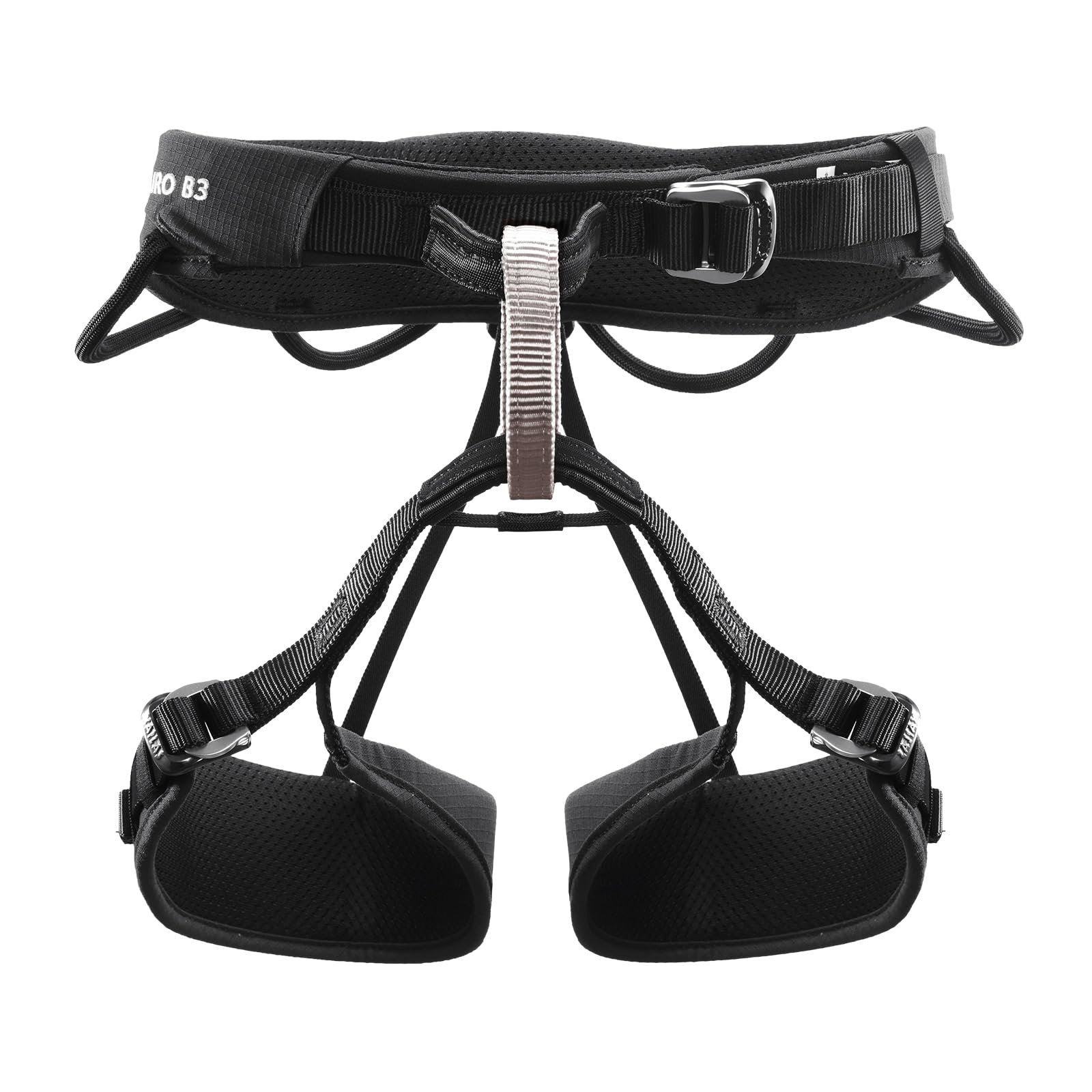
The KAILAS B3 is built with a quick buckle design (a buckle that adjusts fast by sliding the webbing) that lets you adjust both the waistbelt and leg loops quickly.

It uses high-strength polyester with CE0082 EN12277 UIAA Type C certification (a safety standard that tests for higher static loads and abrasion resistance than a standard climbing harness), so it is approved for both climbing and rescue work — the manufacturer states the load-bearing webbing is “sewn very strong.” The weight is 405 grams, which is slightly heavier than the 380-gram Mammut Ophir 3 but still light enough for a full day. The front two outward curved tool rings (rigid loops that hold carabiners open) are easy to clip into, and the rear tool ring sits flat against the backpack, which is a smart touch for alpine or tree climbing where backpacks are common.

Owners mention the harness fits large users well: one verified reviewer (6’1″, 240 pounds) says it works for his size, while another mentions it feels safe but the adjustment buckles can be “difficult to adjust on-body.” The side rope points make it easier to get the leg loops over a larger rear end. Compared to the Adjama’s five gear loops, the B3 offers two front outward loops plus rear and side hanging points, which gives you plenty of attachment points for ice screws or tool holders. One 20-year climber calls it a solid buy for sport climbing.

Quick-adjust and heavy-duty: The quick buckle system makes on-body adjustment faster than any other harness here, and the UIAA Type C certification means it is built for rescue and roof work in addition to climbing.

Buckles can be stiff: Some customers note the adjustment buckles are sturdy but not easy to adjust while wearing the harness, so take a minute to set them before you start climbing.

Big climbers and roof workers: At 405 grams with quick-adjust legs and side rope points, this harness is a strong pick for larger body types (up to 240 pounds) and anyone who needs a harness for both climbing and work-at-height tasks.

Minimalist gym-only climbers: Look elsewhere if you want a stripped-down, ultra-light gym harness — the KAILAS Airo or Mammut Ophir 3 are lighter and less bulky for gym sessions.

Versatile All-Rounder

3. EDELRID Jay Climbing Harness – Men’s

Adjustable Leg Loops4 Fixed Gear Loops

The EDELRID Jay features moveable foam waist padding, which allows the tie-in point and the four fixed gear loops to be centered regardless of your exact waist position.

That small engineering detail makes a real difference when you rack heavy gear and want it evenly balanced. The leg loops are adjustable with Slide Block buckles (spring-loaded sliding buckles that let you lengthen or shorten the webbing quickly) for a secure fit. The harness weighs 0.4 kilograms (about 400 grams), putting it in the same lightweight class as the Mammut Ophir 3’s 380 grams. It includes two attachment options for ice screw clips and a chalk bag loop, so it is ready for trad, sport, and winter climbing right from the start. The harness is made from bluesign-certified materials (certified for environmentally responsible manufacturing), so if sustainability matters to you, this one checks that box.

Reviewers point out the sizing runs large — one reviewer with a 31-32 inch waist nearly maxed out the Medium — so size down if you are between sizes. Another reviewer notes the stiff front gear loops are good for holding carabiners open, but prefers a fifth loop over the small accessory loop. Compared to the Adjama’s five loops, the Jay’s four fixed loops are still ample for most sport and trad routes, and the moveable waist padding is a feature none of the other harnesses here offer. One buyer describes it as “good all round harness for indoor/trad/winter” and comfortable for short hangs.

Smart design, solid build

  • Moveable foam padding centers the tie-in point and gear loops
  • Four stiff gear loops hold carabiners open for one-hand clipping
  • Bluesign-certified materials for sustainable manufacturing

Size down and small features

  • Sizing runs large — a Medium fits a 31-32 inch waist near max
  • Small accessory loop instead of a fifth full gear loop

Climbers who value a balanced rack: If the centering of your gear loops and a floating waistbelt matter for your trad or multi-pitch setup, the Jay’s moveable padding is a standout detail at this weight — and the four stiff loops deliver good one-hand clipping.

Between sizes: Order a size down from your usual, and if you need five full gear loops, the Adjama is a better fit for heavy rack days.

Lightweight Versatile

4. Mammut Ophir 3 Slide Climbing Harness for Men

380 GramsSlide Bloc Buckles

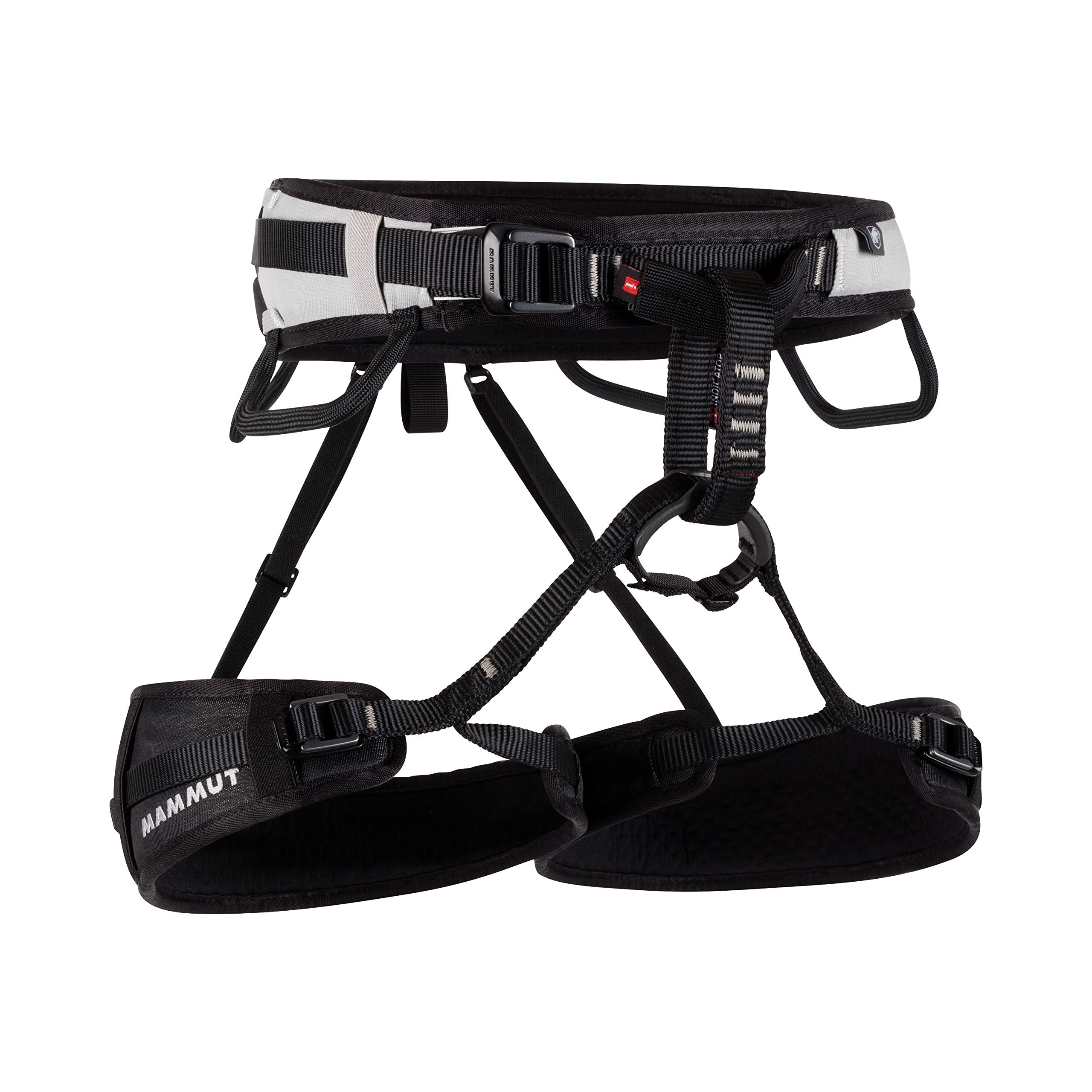
The Mammut Ophir 3 Slide is built for the climber who values weight savings above all else — at 380 grams, it is the lightest harness on this list by a noticeable margin.

That is lighter than the 405-gram KAILAS B3 and much lighter than the roughly 500-gram Petzl Adjama. The weight comes from a minimalist two-part webbing construction with abrasion protection where it counts, and Slide Bloc buckles (spring-loaded buckles that let you snap on and off quickly) that let you adjust fast without fuss. It is designed for rock, ice, sport, and gym climbing, and it carries the bluesign and Fair Wear certifications for responsible manufacturing (certifications for environmental and labor standards), so you are getting an eco-friendly build without skimping on safety.

Shoppers say it is extremely comfortable: one reviewer uses it with “all the ascending and abseiling equipment” and says “it doesn’t rub wrong or pressure awkwardly.” Another mentions it is “lightweight, quick on/off with slide-lock buckles” and holds up well after frequent use. The trade-off versus the Adjama is gear loop count — the Ophir 3 has two fixed front loops, while the Adjama carries five loops in total. If you are a sport climber carrying a few quickdraws, two loops are fine, but a trad rack will feel cramped. One reviewer adds that adjusting anything on it can be a “pain” compared to a Petzl, so it may not be the most user-friendly for on-body tweaks.

Featherweight with top certifications: At 380 grams with bluesign and Fair Wear certification, this is the lightest and most ethically produced harness in the roundup — ideal for alpine approaches and gym sessions where every gram counts.

Less gear real estate: Two front gear loops mean you are limited to a few quickdraws and a belay device; for trad or multi-pitch, step up to the Adjama or EDELRID Jay for more racking space.

Speed climbers and alpine missions: If you are moving fast over long approaches or hitting the gym multiple times a week, the 380-gram Ophir 3 is the most weight-conscious pick here, and the Slide Bloc buckles make transitions quick.

Heavy trad rack days: it’s not for you if you carry a full set of cams and nuts — the two gear loops will frustrate you on every pitch, making the Adjama or Jay a smarter choice.

Ultra-Light Gym/Trad

5. KAILAS Airo Rock Climbing Harness

Breathable 3D MeshCE & UIAA Certified

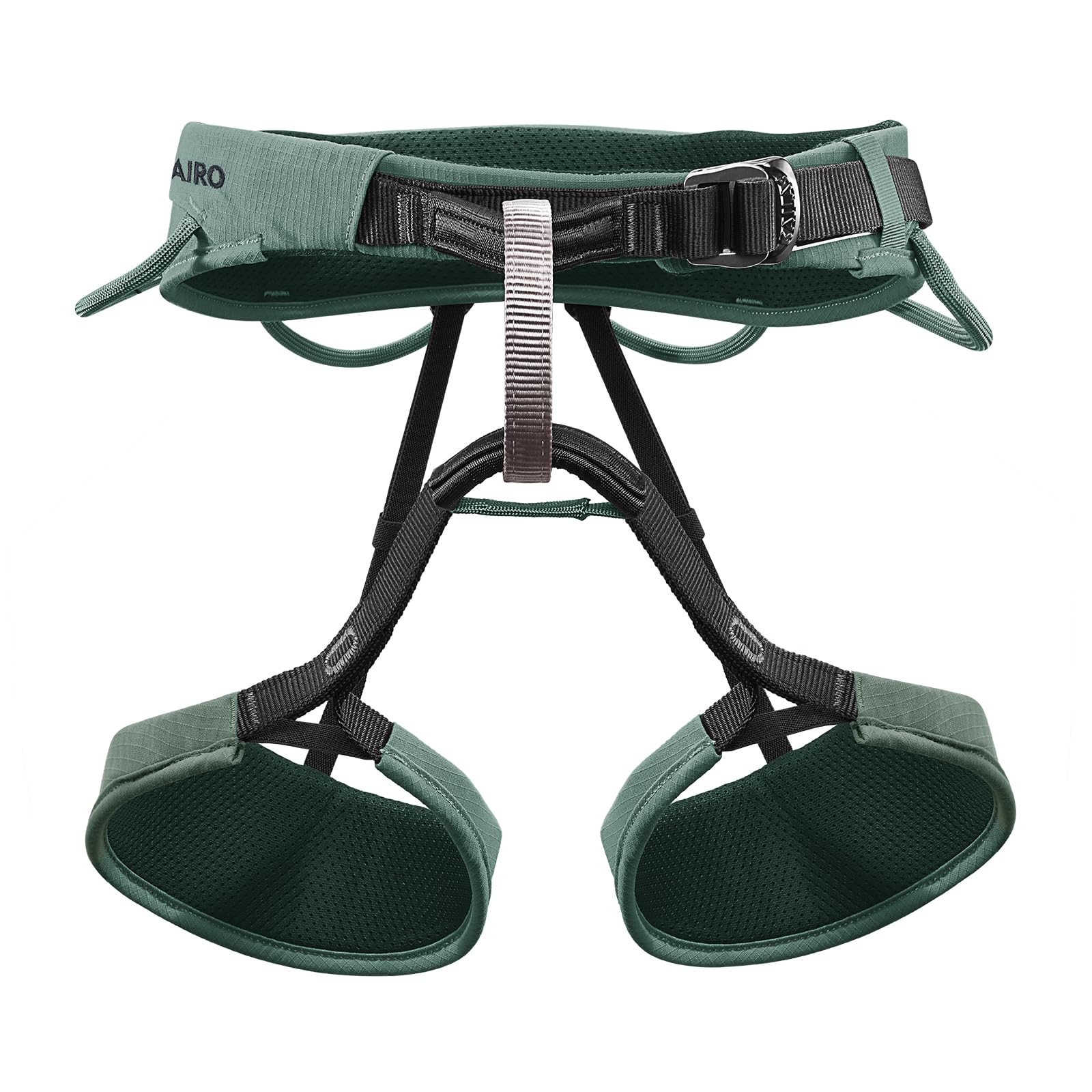
The KAILAS Airo is built around two standout specs: an ultra-lightweight design using abrasion-resistant nylon that the maker says is “5x stronger than standard harnesses,” and breathable 3D mesh padding that reduces thigh pressure during long climbs.

It is CE and UIAA certified, so safety standards are solid. The dual adjustable leg loops and waistbelt are designed to fit both men and women (size XS-XL) without hip slippage, which gives it more universal appeal than the men’s-specific Petzl Sama. With moisture-wicking fabric and an emphasis on reducing fatigue for multi-pitch climbs or gym training, it is a strong value at a mid-range price point.

Buyers report it feels “safe” after three weeks of use, though one reviewer notes the leg loops are non-adjustable and “too large despite being mid-size chart” while the waist fits tight — a sizing inconsistency worth noting. Compared to the Ophir 3 at 380 grams, the Airo is also lightweight but adds 3D mesh for breathability that the Mammut lacks. Another buyer calls it “very comfortable durable material.” The harness includes a carry bag, which is a convenience the other harnesses in this price tier do not always offer.

Light and airy build

  • Breathable 3D mesh padding reduces sweat and thigh pressure
  • CE & UIAA certified for safety assurance
  • Includes a carry bag for transport

Sizing is inconsistent

  • Leg loops may be too large even when matching size chart
  • Non-adjustable leg loops on some sizes (dual adjustable on others)

Hot-weather climbers and gym rats: Pick the Airo if you sweat heavily or climb in warm conditions — the 3D mesh padding breathes far better than the solid foam on the Adjama or Sama, and the ultra-lightweight build reduces fatigue on volume days.

Precise-sizing seekers: look elsewhere if you need exact leg-loop sizing — the non-adjustable loops on some versions make it a gamble, so the Ophir 3 or Adjama are safer bets for a customizable fit.

Budget Starter

6. PETZL CORAX LT Unisex Harness

Unisex AdultAdjustable

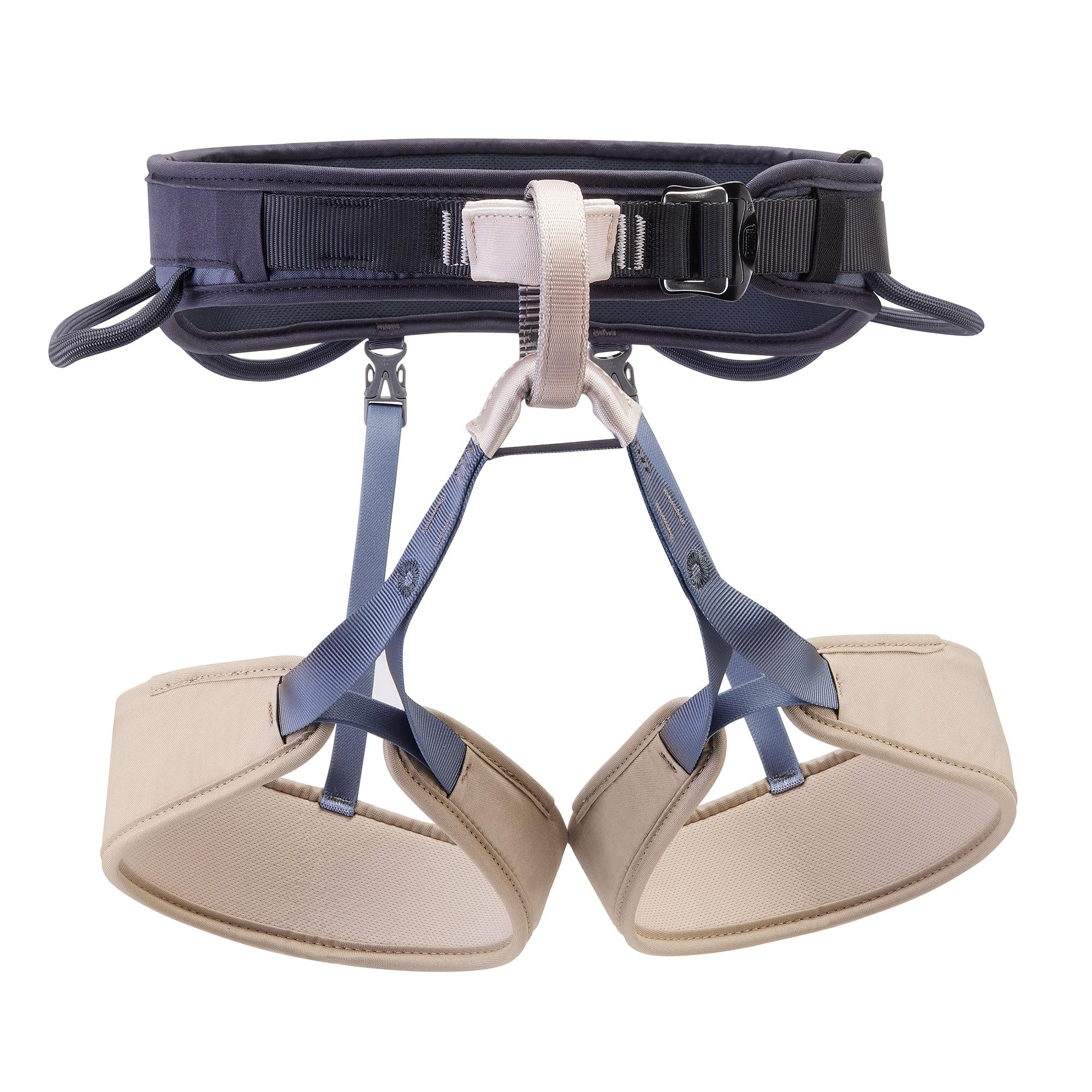
The CORAX LT is Petzl’s budget-friendly unisex option, designed for the new climber who wants a reliable, comfortable harness without spending Adjama money.

It features adjustable leg loops and a straightforward design with two front gear loops that hold the basics: a couple of quickdraws and a belay device. The package dimensions are 13 x 6 x 5 inches, and the harness runs true to size according to buyers. One verified reviewer calls it a “great starter harness” that is “well made,” while another says it “fits everything I need on the gear loops” and is “affordable.” It is simple, no-frills, and gets the job done for gym and occasional outdoor sport climbing.

There is a clear catch: the manufacturer’s tag actually labels this a women’s harness, not a men’s model — a verified buyer explicitly notes “it very clearly states on the tag that this is a WOMANS harness.” If you need a men’s-specific fit with a wide waistbelt and longer torso proportions, the Sama or Adjama will fit better. The CORAX LT also lacks the extra gear loops and thick padding of the Adjama, so multi-pitch days with a full rack would be cramped. But for the new climber on a tight budget who just wants a safe, comfortable harness for the gym, this is the cheapest entry point from a trusted brand with a 4.5-star average from 203 ratings.

Safe entry-level harness, no risk: At this price point, you get Petzl build quality and a 4.5-star average rating — it is the cheapest way to get a trusted harness for the gym, as long as the unisex (and potentially women’s) fit works for your body.

Not a men’s-specific fit: If you need the longer rise and wider waistbelt of a true men’s harness, skip this and go for the Adjama or Sama — the CORAX LT is unisex and reported as women’s on the tag.

First-time gym climber on a budget: The CORAX LT gives you Petzl reliability at the lowest cost in this roundup, and adjustable leg loops mean you can dial the fit in without spending Adjama money — a safe starter pick.

Anyone seeking a men’s-specific harness: steer clear if you need a dedicated men’s fit with a wider waistbelt; the Adjama, Sama, or EDELRID Jay are worth the extra spend for a proper men’s anatomical shape.

Understanding the Specs

Harness Weight and Why It Matters

Harness weight is measured in grams or pounds and directly affects how tired you feel at the end of the day, especially on multi-pitch climbs where every extra gram on your waist adds up over ten or twelve pitches. A harness around 380 grams (like the Mammut Ophir 3 Slide) feels barely there and is ideal for fast ascents, alpine missions, and gym training. A harness around 500 grams or 1.1 pounds (like the PETZL Adjama) brings more padding and gear loops, trading a bit of weight for extra all-day comfort when you are hanging or carrying a full trad rack (a set of cams, nuts, and slings).

Gear Loop Count and Stiffness

A gear loop is a rigid or flexible plastic or fabric loop sewn onto the waistbelt where you clip carabiners, quickdraws (a short sling with two carabiners used for sport climbing), slings, and your belay device. Rigid (stiff) loops stay open so you can clip them one-handed while holding the wall — that is a real advantage when you are pumped at the end of a pitch. The number of loops matters: two front loops (common on gym and lightweight harnesses like the Ophir 3) are enough for a few quickdraws, while four fixed loops plus a rear loop (like on the Adjama or EDELRID Jay) let you organize a full trad rack without things tangling.

UIAA and CE Certification

UIAA Type C certification (written as “CE0082 EN12277” on harnesses like the KAILAS B3) means the harness has passed European Union safety standards for body-weight support, dynamic loading (forces during a fall), and buckle strength. CE marking alone is standard across all climbing gear sold in Europe and recognized globally. A UIAA-certified harness has undergone extra drop-testing beyond basic CE requirements. If you are buying from an unknown brand, this certification is your minimum bar — all harnesses in this list carry at least CE marking, and some (like the KAILAS Airo and B3) carry UIAA certification explicitly.

FAQ

How do I measure my waist for a climbing harness?
Measure around your iliac crest (the top of your hip bones) with a flexible tape measure, not at your pant waistline. Most manufacturers, including PETZL and Mammut, provide size charts based on this measurement — for example, a Medium may fit a 76-86 cm (30-34 inch) waist. If you are between sizes, the safe rule is to go up one size because a tight waist belt can cause discomfort and may slip in a fall.
Is a harness with fixed leg loops okay for a beginner?
Yes, fixed leg loops are fine for beginners who do not plan to share the harness or climb in varying layers. They save a bit of weight and cost less. But if you have thick thighs or expect to climb in both shorts and insulated pants, adjustable leg loops (found on the PETZL Adjama, EDELRID Jay, and Mammut Ophir 3) let you fine-tune each leg for a snug fit without pinching.
What does UIAA certification mean for a climbing harness?
UIAA certification means the harness has passed dynamic drop tests from the International Climbing and Mountaineering Federation, which goes beyond the general CE (European safety) standard. It tests buckle strength, webbing abrasion resistance, and the harness’s ability to absorb a fall. Harnesses like the KAILAS Airo and B3 carry explicit UIAA certification, giving you an extra layer of safety assurance.
Can I use a climbing harness for tree work or rescue operations?
Only if the harness is specifically rated for work-at-height use with a UIAA Type C certification (like the KAILAS B3), which tests for higher static loads and abrasion resistance than standard climbing harnesses. A typical sport climbing harness is designed for dynamic falls, not prolonged hanging under a static load, and should not be used for work or rescue without checking the manufacturer’s approval.
How many gear loops do I need for sport climbing?
For a typical sport climb of 20-25 quickdraws plus a belay device, two rigid front gear loops are enough — a harness like the Mammut Ophir 3 or PETZL CORAX LT handles this fine. For trad climbing where you carry nuts, cams, slings, and alpine draws, four stiff gear loops (like on the Adjama or EDELRID Jay) give you better organization and prevent swings clattering together on your waist.
How do I clean and store my harness to last?
Hand-wash your harness with mild soap in water no hotter than 30°C (86°F), then air-dry it away from direct heat and UV rays. Avoid bleach, solvents, or machine washing. PETZL specifies a shelf life of 10 years from the date of manufacture for their harnesses — but you should retire a harness immediately after a hard fall, if you see frayed webbing, broken stitching, or deformed buckle teeth.
Are men’s and women’s climbing harnesses different?
Yes, the main differences are waistbelt rise (distance from hip to tie-in point) and waist-to-leg-loop proportion. Men’s harnesses (like the PETZL Sama and Adjama Men’s) typically have a longer front rise and a wider waistbelt, while women’s harnesses have a shorter rise and a wider hip shape. A unisex model like the PETZL CORAX LT uses an intermediate cut that fits most body types but may not be ideal for a very long or very short torso.
How tight should the leg loops be?
You should be able to slide a flat hand under the leg loop webbing — not tightly gripping your thigh, but not loose enough that they slide down your leg when you hang. Adjustable leg loops let you dial this tension per leg, while fixed loops require you to match the size exactly. Leg loops that are too tight compress your femoral artery (a major blood vessel in the thigh) and cause numbness; too loose and they slip over your thighs in an inverted fall.
What is the difference between Slide Bloc and DOUBLEBACK buckles?
Slide Bloc buckles (found on the Mammut Ophir 3 and EDELRID Jay) use a spring-loaded sliding mechanism that lets you quickly lengthen or shorten the webbing with one hand — great for fast adjustments on the wall. DOUBLEBACK buckles (PETZL Adjama) are the traditional friction-style buckles where you thread the webbing through and cinch it tight. DOUBLEBACK buckles are slightly slower to adjust but hold settings more securely over time, while Slide Blocs are faster but require occasional re-tightening.
Can I use a gym-only harness for outdoor climbing?
Yes, as long as the harness is UIAA or CE certified and fits properly, it is safe for outdoor sport climbing. However, gym harnesses often have fewer gear loops and lighter padding, so they may feel uncomfortable during longer hangs at the crag (a climbing area) and lack capacity for a full set of quickdraws. If you climb outside, a harness like the PETZL Adjama or EDELRID Jay with more gear loops and thicker padding will serve you better than a minimalist gym model.

Final Thoughts: The Verdict

Across the board, the climbing harness for men winner is the PETZL Adjama Men’s because it combines adjustable leg loops, five gear loops, and smooth-seamed tapered padding that stays comfortable for multi-pitch days, and real buyers confirm it holds up well after half a year of use. If you prioritize featherweight speed and eco-friendly certification for alpine missions, grab the Mammut Ophir 3 Slide at 380 grams. And for a heavy-duty harness with quick-buckle adjustability and UIAA Type C certification that fits bigger body types up to 240 pounds, the KAILAS B3 is the one to choose.

How We Picked

We do not accept paid placement. Every pick is matched to a real buyer and a real use-case; we do not hands-on test units.

Sources & Methodology

Specifications: manufacturer listings and product documentation. Review insights: verified customer reviews, as of July 2026. Pricing: not shown on this page (it changes often); check the current price via the retailer link.

As an Amazon Associate, WellFizz earns from qualifying purchases. This does not affect which products we feature.

Related Guides

Mo Maruf
Founder & Lead Editor

Mo Maruf

I created WellFizz to bridge the gap between vague wellness advice and actionable solutions. My mission is simple: to decode the research and give you practical tools you can actually use.

Beyond the data, I am a passionate traveler. I believe that stepping away from the screen to explore new environments is essential for mental clarity and physical vitality.

Please use a real email you check. If it's fake or mistyped, your message won't reach us and we can't reply — wrong addresses are rejected automatically.