Our readers keep the lights on and my smoothie glass nicely filled. As an Amazon Associate, I earn from qualifying purchases.
Specs are compiled from manufacturer listings and verified buyer reviews and can change over time — please confirm the key details on the product page before buying.
Getting a belay device right means the difference between a confident lead and a sketchy day at the crag. The right pick handles your rope without fighting you, catches a fall cleanly, and doesn’t add weight you will curse on the approach. This guide breaks down six of the most respected options so you know exactly which one fits your climbing style — whether you are a gym rat, a trad climber, or someone building a first rack on a budget.
I’m Mohammad Maruf — the founder and writer behind WellFizz. This guide is built by comparing the manufacturers’ published specifications and the patterns across verified customer reviews, so you get each pick’s real strengths and trade-offs instead of marketing spin.
The best way to find your match is to understand the main trade-off: do you want an old-school tube device that is simple and lightweight, or a cam-assisted model that catches falls automatically? The rest is about weight, rope range, and whether it handles a two-rope rappel. Here is everything you need to pick the right climbing belay device for your next outing.
Quick Picks
- PETZL NEOX Belay Device with cam-Assisted — Best Overall
- EDELRID GigaJul Belay Device – Slate — Versatile Pick
- BLACK DIAMOND ATC Belay Rappel Device — Value Combo
- PETZL REVERSO Multi-Purpose Belay/Rappel Device — Ultralight Specialist
- Mammut Smart 2.0 Belay Device — Top Rope King
- Mad Rock Safeguard Belay Device — SRT Specialist
How To Choose The Best Climbing Belay Device
Belay devices look simple, but the type you choose changes how you climb, how you manage rope, and how much margin you have when catching a fall. The main fork is between tube-style devices (classic ATCs and their variations) and cam-assisted devices (like a Grigri or a Neox). Here is what to look at first.
Tube vs. Assisted Braking
A tube device has no moving parts — you control the friction entirely with your brake hand. It is lightweight, simple, and works with almost any rope diameter, including half and twin ropes. An assisted-braking device adds a cam or a brake insert that helps lock the rope during a fall, giving the belayer extra margin. Assisted devices are heavier and pricier, but they reduce hand fatigue significantly on long days or with heavier climbers.
Rope Diameter Compatibility
Every device has a specific rope range printed on it. A wide range (like 8.5 to 10.5 mm) means you can swap between a skinny half rope and a fat gym rope without switching devices. If you climb mostly indoors on thick 10.2 mm ropes, any device will work, but if you use skinny 8.9 mm ropes for multi-pitch trad, you need a device rated to grip that small diameter reliably.
Weight
Every gram counts when you are carrying gear up a multi-pitch route. A lightweight tube device weighing around 57 to 80 grams is barely noticeable on your harness. A full-featured assisted device like the Petzl Neox weighs about 286 grams (10.08 ounces) — that is roughly the weight of an energy bar. For gym climbing or single-pitch sport, weight matters far less than ease of use and safety features.
Guide Mode vs. Non-Guide Mode
If you climb multi-pitch routes, you need a device that can belay a second climber from the anchor without a separate setup. Guide mode (sometimes called Reverso mode) lets the device lock automatically when weighted from below, so you can manage two followers independently. Tube devices with guide mode are usually a bit heavier and more expensive than basic tubes that lack this feature.
Quick Comparison
| Model | Best For | Weight | Rope Diameter | Assisted Braking | Amazon |
|---|---|---|---|---|---|
| PETZL NEOX | Smooth lead belaying & reduced fatigue | 10.08 oz (286 g) | 9.1 – 10.5 mm | Cam-assisted | Amazon |
| EDELRID GigaJul | Versatile gym-to-crag with guide mode | 121 g | Single & half ropes | Assisted braking guide mode | Amazon |
| BLACK DIAMOND ATC-XP | Reliable all-around tube + carabiner | — | Wide range | No (high-friction mode) | Amazon |
| PETZL REVERSO | Ultralight multi-pitch & mountaineering | 57 g | 8.5 – 10.5 mm | No (guide mode) | Amazon |
| Mammut Smart 2.0 | Top-rope gym sessions | 80 g | 8.7 – 10.5 mm | Brake insert | Amazon |
| Mad Rock Safeguard | SRT saddle hunting & rappelling | 5 oz (142 g) | 8.1 – 11 mm (rescue/rigging) | Assisted brake | Amazon |
In‑Depth Reviews
1. PETZL NEOX Belay Device with cam-Assisted Blocking
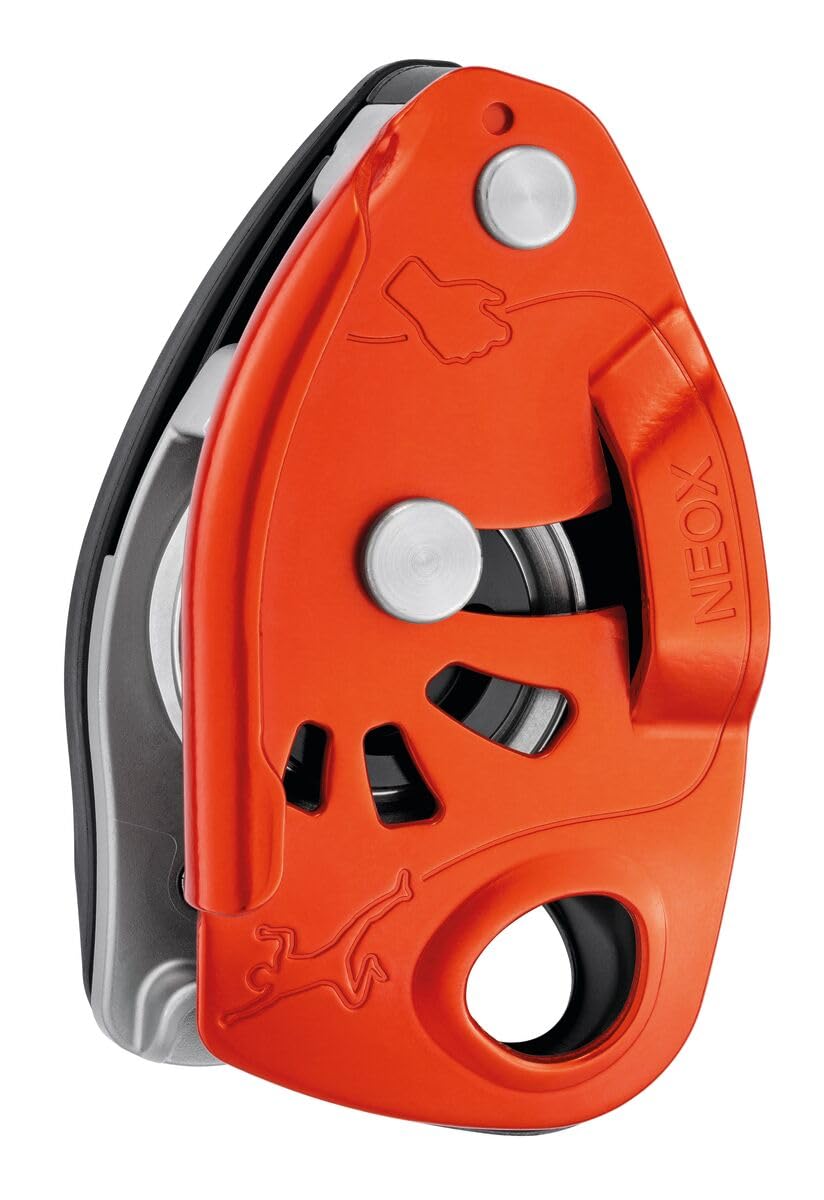
The cam-assisted device that feeds slack like a tube and locks like a vice.
If you have ever fought a stiff Grigri to pay out slack on a wandering lead, you will appreciate what the Neox does differently. It has a stainless steel wheel that rotates freely when you give or take rope — so you are not fighting the device every time the climber pulls a foot of slack to clip. When the rope is weighted from a fall, the wheel stops and an internal cam pivots to clamp down and block the rope. The result is a smooth, relaxed belay that feels less like wrestling gear and more like second nature. Buyers report that the clicking sound it makes when locking is reassuring, and one buyer — a beginner learning to rappel — mentioned it locks up smooth and releases easily with the right amount of friction on the break hand.
You also get a 3:1 mechanical advantage for lowering, which means the ergonomic handle lets you lower a climber in a smooth and progressive descent without cranking hard. The Neox works with ropes from 9.1 to 10.5 mm, but a few reviewers found that with thicker ropes (above 10.2 mm) it can block a little easily — the Grigri’s finger position handles those diameters more gracefully. At 10.08 ounces (286 grams), it is the heaviest device here, but the cam-assisted block and smooth rope feed make it the most refined all-around choice for lead climbers who value a relaxed belay over minimal weight.
Why It Stands Out
- Free-spinning wheel makes slack payout vastly easier than older assisted devices — less “hand magic” needed.
- 3:1 mechanical advantage handle gives you a smooth, controlled lower without fighting the rope.
- Spring-loaded cam clamps regardless of brake-strand angle, adding safety margin in awkward positions.
The Trade-Offs
- Thicker ropes (9.8 mm and above) can cause the cam to block a bit early — Grigri is easier for those.
- At 10.08 oz it is noticeably heavier than a simple tube device, so less ideal for an alpine rack.
- The premium price reflects the cam mechanism; you can get a solid tube device for half the cost.
Reach for it if: lead climbing is your main game and you want a device that reduces brake-hand fatigue while feeding slack as easily as a tube.
Think again if: you are on a tight budget or need a featherweight for a multi-pitch alpine rack where every gram counts.
2. EDELRID GigaJul Belay Device – Slate
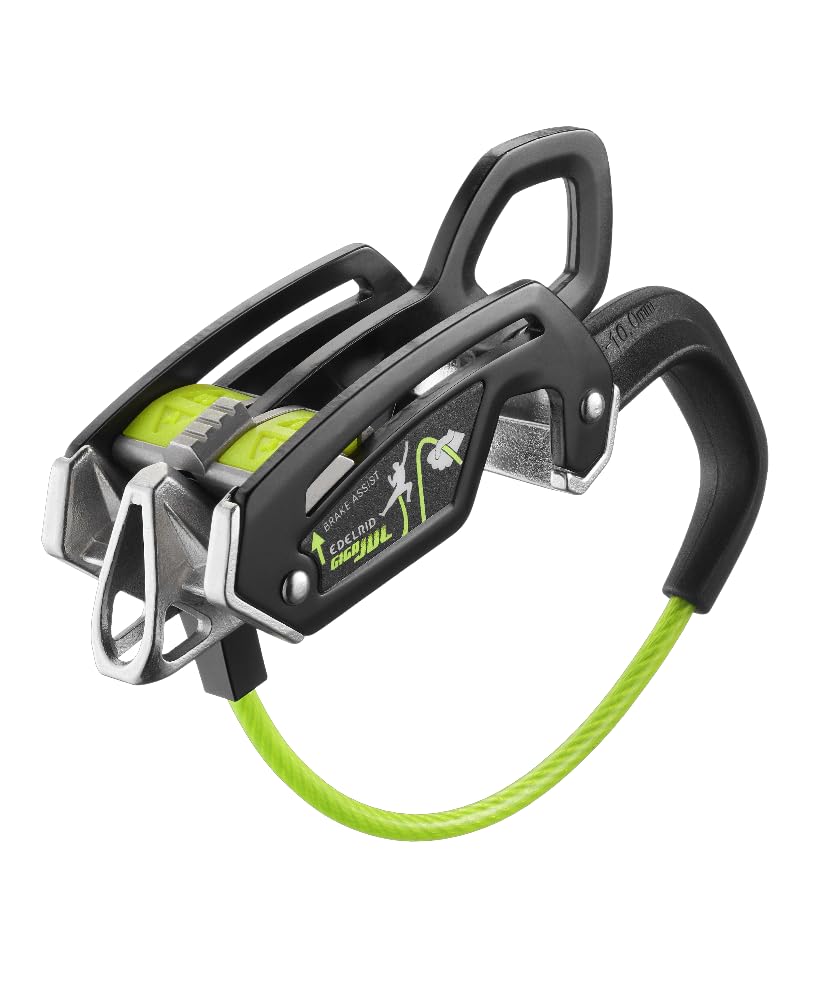
The hybrid tube that behaves like an ATC and locks like an assisted device.
One major complaint about cam-assisted devices is that you cannot use them for a traditional two-rope rappel — you either need a separate tube or you carry an extra backup. The GigaJul sidesteps that entirely because it pairs a lightweight aluminum body with stainless steel inserts where the wear points are, and it offers assisted braking in guide mode. That means you get a brake boost when catching a lead fall, but you can still rappel on a doubled rope without any fuss. Owners mention that it has become their go-to belay device because it locks solid on falls while paying out and taking in slack feels exactly like a standard ATC — the thumb hook gives you easy control over descent rate.
It handles single and half ropes, and the guide mode lets you bring up seconds from the anchor with the device locked in place. One reviewer called it a “jack of all trades, master of none” — meaning it does everything reasonably well but nothing perfectly — but also noted that the assisted braking works well on lead and that rappelling in auto-locking mode on the belay loop is excellent, no prusik needed. The learning curve is slight; once you get the thumb-hook feel down, it becomes a natural extension of your hand.
What Makes It Special
- Hybrid build with stainless steel wear zones means it lasts longer than a pure aluminum device.
- Assisted braking in guide mode gives you the security of a cam without losing two-rope rappel ability.
- Thumb hook lets you control descent speed with one finger — a small detail that makes big day-to-day difference.
Where It Compromises
- Top-rope belay has more friction than a dedicated tube, which can get tiring during long gym sessions.
- At 121 grams it is heavier than the Petzl Reverso (57 g) or the Mammut Smart 2.0 (80 g).
- The assisted braking slips a little more than the older Megajuul, per one reviewer’s observation.
Grab it if: you climb a mix of sport, trad, and multi-pitch and want one device that covers lead belay, top rope, and two-rope rappels without carrying a second tube.
skip it if: you are strictly a gym top-roping climber — a simpler tube or a dedicated assisted device will be less tiring.
3. BLACK DIAMOND ATC Belay Rappel Device – Big Air XP Package

The classic tube that gives you three times the holding force when you need it.
If you are new to climbing or just want a simple, no-moving-parts device that you can trust for a decade, the ATC-XP is the standard. This package comes with a RockLock locking carabiner already paired, so you are ready to belay from the start. The ATC-XP has two friction modes — the standard mode for normal belaying, and a high-friction mode. That extra friction reduces hand fatigue when belaying a heavier climber or on steep overhanging routes. Customers note that the blue ATC-XP combo with high friction provides a secure belay and reduces hand fatigue, and one reviewer called it dependable and pretty, praising the carabiner’s quality.
The RockLock carabiner that comes in this package is a large HMS-style locking carabiner with a screw-lock closure and a keylock nose that snags less on bolt hangers. However, at least one reviewer found the carabiner that shipped had a nose defect — Black Diamond quickly replaced it with a RockLock Screwgate that requires three turns to lock rather than the typical 1.5 turns. That reviewer recommended buying the ATC-XP and RockLock separately to ensure the better 3-turn lock. For the price of this package, you get a reliable tube device and a solid carabiner that would cost nearly as much on its own, making this a strong value proposition for anyone building a starter rack.
Why It Works
- High-friction mode increases holding force — great for heavier climbers or long lowers.
- Comes with a RockLock screw-gate carabiner, so you have a complete belay setup in one box.
- Hot-forged aluminum construction holds up to repeated use at the gym and crag.
Watch Out For
- Some packages ship the 1.5-turn RockLock instead of the more secure 3-turn version — check yours.
- No assisted braking; you need proper brake-hand technique at all times.
- Heavier than a bare tube because of the included carabiner, but you are getting a combo anyway.
Best for: new climbers building their first kit who want a dependable, simple tube at a great price — the carabiner included saves you a separate purchase.
Not for: lead climbers who prefer the safety net of an assisted-braking device; the ATC-XP requires constant attention.
4. PETZL REVERSO Multi-Purpose Belay/Rappel Device

The featherweight tube that handles single, half, and twin ropes without blinking.
At just 57 grams, the Reverso is one of the lightest belay devices on the market — you honestly forget it is on your harness until you need it. It is designed for cragging, multi-pitch, and mountaineering, and it handles single ropes (8.5 to 10.5 mm), half ropes (7.1 to 9.2 mm), and twin ropes (6.9 to 9.2 mm). That range covers virtually every rope you will touch. The Reverso mode (also called guide mode) lets you belay one or two seconding climbers from the anchor with assisted braking, so you can manage two followers independently and simultaneously. One reviewer summed it up as a smooth ATC belay device for two-rope climbing, multi-pitch, and backup — extremely lightweight, strong, with no moving parts.
The V-shaped friction grooves with asymmetrical lateral channels adapt friction to the rope type, which gives you more control during lowering or rappelling than a basic tube. But there is a trade-off: the Reverso has no cam or brake insert. You need proper belay technique at all times, and one reviewer noted it is less forgiving than semi-automatic devices. If you are a new climber who has not developed muscle memory for a tube, it is worth pairing this with a class or a more experienced partner for your first few sessions. For experienced climbers who want a lightweight, cheap backup for the alpine, reviewers point out it is a solid piece of gear that works well with sub-9.5 mm ropes.
The Lightweight Advantage
- 57 grams is the lightest device here — perfect for long alpine approaches where every ounce matters.
- Works with single, half, and twin ropes across a wide diameter range (7.1 to 10.5 mm).
- Guide mode lets you belay two seconds independently from the anchor — essential for multi-pitch.
The Catch
- No assisted braking; you must hold the dead-end rope at all times — one slip and the fall runs.
- Indoor gyms often favor Grigris for safety compliance, so this is better as an outdoor or backup device.
- The lower friction with sub-9.5 mm ropes demands attention; one reviewer called it “less forgiving.”
Reach for this if: you are an experienced climber who wants a featherweight, multi-rope device for alpine and multi-pitch routes — the guide mode is a real plus.
Look elsewhere if: you are a new climber or you prefer the safety margin of an assisted-braking device for lead climbing.
5. Mammut Smart 2.0 Belay Device
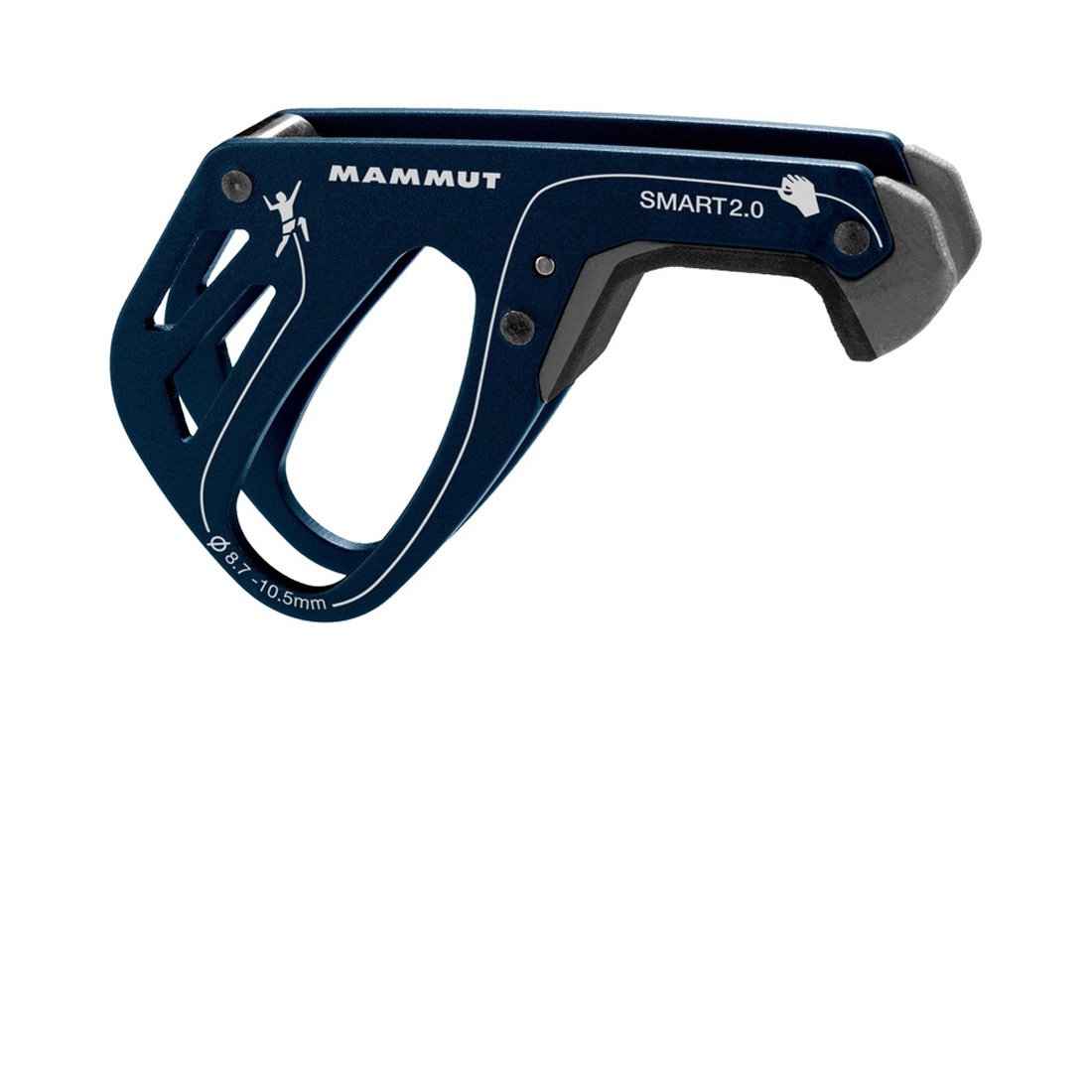
The ultralight brake-insert device that shines on top rope but struggles on lead.
At 80 grams, the Smart 2.0 is only 23 grams heavier than the featherweight Reverso, but it adds a brake insert that assists in catching a fall. The device operates on the tube principle — no moving parts or levers — but the high-performance brake insert interacts with the belay carabiner to block the rope during a fall, offering the belayer optimal support and significantly improved safety. On top rope, buyers absolutely love it: one reviewer called it the “top rope king for gyms,” saying it is probably their favorite for top rope, even over a Petzl Neox.
But the Smart 2.0 has a well-known limitation: it is not good for lead climbing. Reviewers report that it gets stuck when giving slack, no matter what technique they try. The same buyer who praised it for top rope said it is “not good for lead, because it gets stuck when giving slack no matter what it seems.” Another reviewer described it as safe with a learning curve, noting that giving slack is difficult. If you mainly climb top rope — which is the case for many gym climbers — the Smart 2.0 is a fantastic, lightweight, safe choice at a reasonable price. Just keep a separate device for lead days. Mammut recommends using the Smart HMS carabiner with this device for proper operation, and it works with rope diameters from 8.7 to 10.5 mm.
What Shines
- At 80 grams it is lighter than most assisted devices and still adds brake-insert safety for top rope.
- No moving parts or levers — simple and reliable, just a tube with a friction insert.
- Reviewers consistently praise it as a fantastic, safe device for indoor top rope climbing.
The Known Issue
- Lead climbing is frustrating — the device grips the rope when you try to pay out slack, making clipping a chore.
- Descending a climber requires a different technique than a standard tube; some practice needed.
- Not suitable for half or twin ropes; recommended for single ropes only.
Ideal for: gym climbers who primarily top rope and want a lightweight, safe device that catches falls automatically — this is the best budget-friendly option for that use case.
Skip for: anyone who leads climbs regularly. You will be fighting the device all day.
6. Mad Rock Safeguard Belay Device

The assisted-brake device that saddle hunters rely on for SRT ascents.
You might notice a different tone in the reviews for the Safeguard compared to the other devices here — almost every buyer is a saddle hunter, not a rock climber. The device works as an assisted-braking ascender and descender for single-rope technique (SRT), which is exactly what hunters use to climb up to their tree stands. One buyer stated bluntly: “This is the 1st assender/repel device I have ever used,” and after an initial rough attempt, they found it much smoother and now use it to SRT up to their saddle platform and repel after the hunt. Another reviewer called it a “one-stick must have” for saddle hunting and praised it for working flawlessly.
The construction is aircraft-grade aluminum with stainless steel parts, and it weighs 5 ounces (about 142 grams). The recommended rope diameter for climbing is 8.9 to 11 mm, but for rescue and rigging it opens up to 8.1 to 11 mm. That wide range makes it useful for arborists and rope-access workers too. If you are a traditional rock climber, this device is overkill — you can get a lighter, cheaper tube device for belaying. But if you are a saddle hunter, a rope-access technician, or anyone who needs a single device for SRT ascent and assisted-brake descent, the Safeguard is purpose-built for that niche, and finding one in stock can be harder than you think. Several reviewers mentioned paying a premium because Amazon was the only store with inventory.
Why It Is Unique
- Assisted braking works in both ascent and descent modes — rare for a device this compact.
- Aircraft-grade aluminum and stainless steel handle the wear of repeated SRT use.
- Wide rope range (8.1–11 mm) makes it useful for rescue, rigging, and arborist work too.
The Limitations
- Not designed for conventional rock climbing belays (lead or top-rope) — stick to dedicated climbing devices.
- Heavier and pricier than a simple tube device; not a good value for pure climbers.
- Stock is inconsistent; you may pay a premium just to get one in hand.
Build for: saddle hunters, arborists, and rope-access workers who need a single device to ascend and descend on SRT safely.
Steer clear if: you are a standard rock climber. The Safeguard is overbuilt and overpriced for gym or crag belaying compared to the other options here.
Understanding the Specs
Assisted Braking
Assisted braking means the device helps lock the rope automatically during a fall, reducing the force you need to hold with your brake hand. Some devices use a spring-loaded cam (like the Petzl Neox), some use a brake insert that interacts with the carabiner (like the Mammut Smart 2.0). The trade-off is that assisted devices are heavier and more expensive, and some of them (like the Smart 2.0) can be frustrating when paying out slack for lead climbing. If you climb mainly top rope or want extra safety margin on lead, an assisted device is worth the extra money. If you are experienced and want simplicity, a tube device like the ATC-XP or the Petzl Reverso gives you full control without any mechanisms.
Rope Diameter Range
Every belay device lists a minimum and maximum rope diameter it can handle safely. A wide range — say 8.5 to 10.5 mm — means you can swap between a skinny half rope for alpine climbing and a thick gym rope without switching devices. If you use a device outside its rated range, the rope may slip through (too thin) or jam (too thick). For climbers who stick to one rope type, any device that covers that diameter works fine. For multi-pitch or trad climbers who switch between single and half ropes, look for a device like the Petzl Reverso or the EDELRID GigaJul that explicitly lists compatibility with both.
FAQ
What is the difference between a tube belay device and a cam-assisted belay device?
Can I use a half-rope set with any belay device?
How does guide mode work for multi-pitch climbing?
Is the Mammut Smart 2.0 good for lead climbing?
What rope diameter should I use with the Petzl Neox?
Can I use the Mad Rock Safeguard for rock climbing belays?
How much does the Petzl Reverso weigh and why does it matter?
Does the Black Diamond ATC-XP package include a carabiner?
What is the difference between the EDELRID GigaJul and a standard ATC?
Can I use these devices for rappelling?
Final Thoughts: The Verdict
For most people, the best climbing belay device overall is the Petzl Neox because it combines a smooth, low-effort slack payout with reliable cam-assisted blocking and a 3:1 mechanical advantage for lowering, making lead climbing feel easy. If you want a versatile hybrid that handles guide mode and two-rope rappels without carrying a second device, grab the EDELRID GigaJul. And for the budget-conscious climber who wants a dependable tube setup with a carabiner included, the Black Diamond ATC-XP package delivers proven performance at a fair price.
How We Picked
We do not accept paid placement. Every pick is matched to a real buyer and a real use-case; we do not hands-on test units.
Sources & Methodology
Specifications: manufacturer listings and product documentation. Review insights: verified customer reviews, as of July 2026. Pricing: not shown on this page (it changes often); check the current price via the retailer link.
As an Amazon Associate, WellFizz earns from qualifying purchases. This does not affect which products we feature.
Related Guides

Mo Maruf
I created WellFizz to bridge the gap between vague wellness advice and actionable solutions. My mission is simple: to decode the research and give you practical tools you can actually use.
Beyond the data, I am a passionate traveler. I believe that stepping away from the screen to explore new environments is essential for mental clarity and physical vitality.