Our readers keep the lights on and my smoothie glass nicely filled. As an Amazon Associate, I earn from qualifying purchases.
Ever tried to split a butternut squash with a flimsy chef’s knife? Or spent ten minutes hacking through a chicken joint? A cleaver is the heavy blade that turns those frustrating chores into one clean, confident chop. This guide covers five cleavers, from a budget-friendly workhorse to a premium German-forged heavyweight.
I’m Mohammad Maruf — the co-founder and writer behind WellFizz. This guide is built by comparing the manufacturers’ published specifications and the patterns across verified customer reviews, so you get each pick’s real strengths and trade-offs instead of marketing spin.
Whether you need to break down a whole chicken or just want a more comfortable way to dice a mountain of onions, the right cleaver knife makes all the difference. Here are five distinct options for every cooking style and budget.
How To Choose The Best Cleaver Knife
A cleaver is a simple tool, but a few specs separate a joy to use from a daily frustration. Here are the three things to look at first before you buy.
Blade Material and Hardness
The steel determines how long the edge stays sharp and how easy it is to re-sharpen. High-carbon stainless steel is the sweet spot — it resists rust while holding a sharp edge for a long time. Look for a Rockwell hardness (a standard scale that measures how hard the steel is) of 56 or higher: harder steel stays sharper longer but is more brittle, while softer steel (below 56) is tougher but dulls faster.
Weight and Balance
A cleaver’s weight is what gives it power. A heavier blade (around 10 to 14 ounces) lets gravity do the work when chopping through cartilage or hard squash. But if the handle is heavier than the blade, the knife will feel awkward and tire your wrist. The best balance is when the cleaver feels “head-heavy” — the blade is slightly heavier than the handle, so the knife falls forward into the cut naturally.
Handle Grip and Comfort
You want a handle that stays secure even when your hands are slick with oil or water. Wood handles (like Pakkawood) look beautiful and feel warm but need hand-washing and occasional oiling. Synthetic handles like Fibrox (a textured thermoplastic rubber) are dishwasher-safe and provide a steady grip. Stainless steel handles are sleek and durable but can be slippery unless they have an ergonomic shape or cutout.
Quick Comparison
On smaller screens, swipe sideways to see the full table.
| Model | Category | Best For | Key Spec | Amazon |
|---|---|---|---|---|
| PAUDIN Cleaver Knife | Mid-Range | Daily veggie & meat prep | 7-inch blade, 56+ HRC hardness | Amazon |
| ROCOCO Meat Cleaver (Bronze) | Mid-Range | Labor-saving, no-bone slicing | 8.66-inch blade, 60 HRC forged | Amazon |
| ROCOCO Easy Handle (Red) | Mid-Range | Comfort grip, same-day chef use | 8.66-inch blade, 60 HRC forged | Amazon |
| Victorinox Fibrox Cleaver | Premium | Dishwasher-safe workhorse | 7.1-inch blade, Fibrox non-slip handle | Amazon |
| ZWILLING HENCKELS Cleaver | Premium | Breaking down bones & ribs | 6-inch forged blade, 0.9 lbs | Amazon |
In‑Depth Reviews
1. PAUDIN Cleaver Knife

The PAUDIN earns the top spot because its 7-inch high-carbon stainless steel blade hits a Rockwell hardness of 56+ (a solid, durable balance of sharpness and toughness) so it resists rust and holds an edge through heavy daily use. You get one cleaver that handles everything from dicing onions to disjointing a chicken while staying affordable.
Buyers report using it daily for 6 months, noting it is excellent for chopping onions and peppers and actually feels safer than a standard chef’s knife — the wide blade acts as a shield for your knuckles. The luxury Pakkawood handle (a layered, compressed wood that resists moisture) gives you a comfortable, non-slip grip even after chopping for 30 minutes.
The one honest trade-off is the balance: some owners mention the handle is noticeably heavier than the blade, which makes the cleaver feel a bit handle-heavy during extended prep sessions. But for the price and versatility, this is the most well-rounded cleaver for the average home cook. A confident all-arounder.
Why it’s great
- High-carbon stainless steel resists rust for years
- Comfortable Pakkawood handle stays secure
- Versatile 7-inch blade handles meat and vegetables
Good to know
- Handle is heavier than the blade, affecting balance
- Hand wash only; not dishwasher safe
2. ROCOCO Meat Cleaver (Bronze)
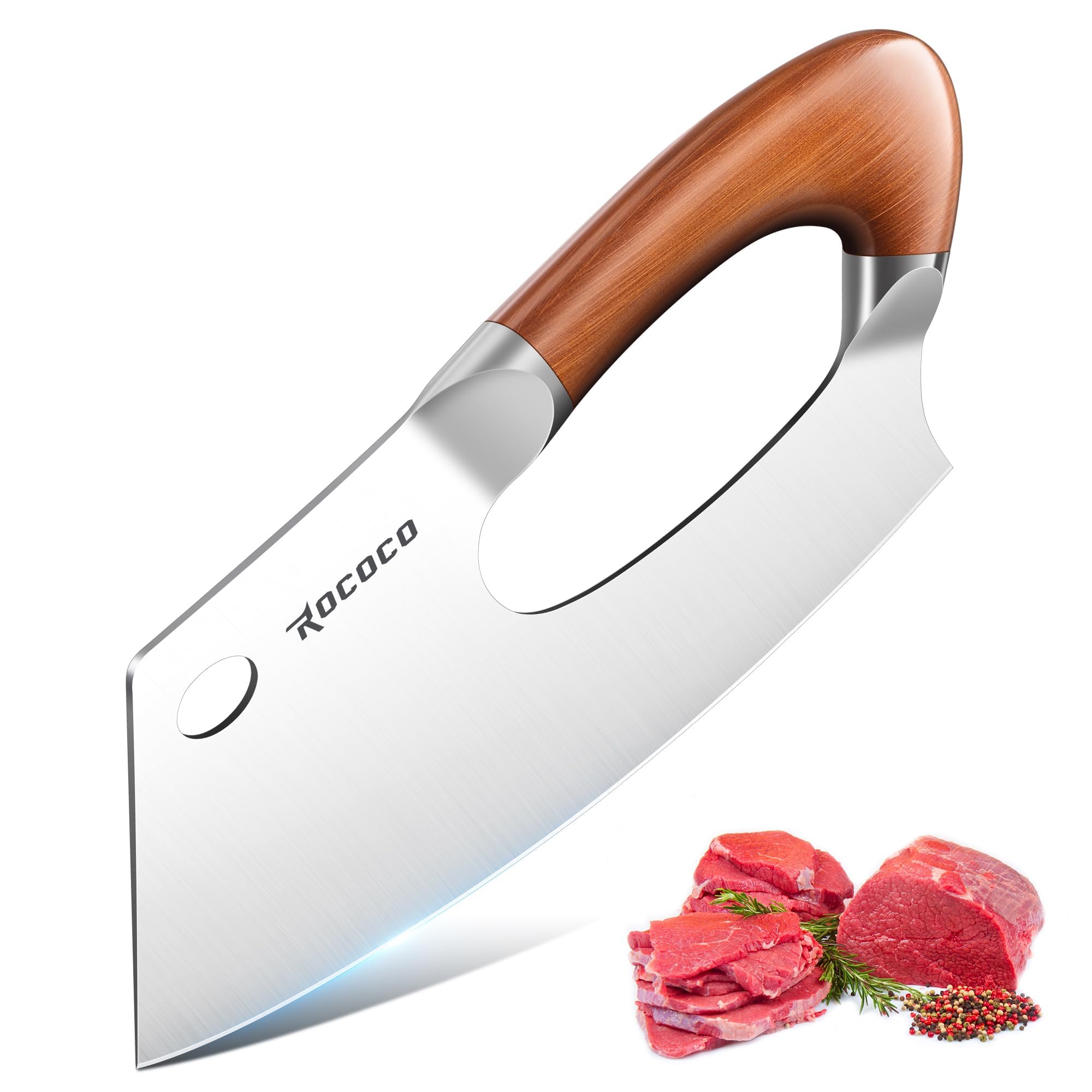
The ROCOCO bronze cleaver beats the PAUDIN on blade length (8.66 inches vs 7 inches, a 24% larger cutting surface) and hardness (60 HRC vs 56+) — giving you a longer, sharper edge that stays sharper for longer. That extra length is noticeable when you are slicing through a whole cabbage or a flank steak in one smooth motion.
Its fully forged construction (where the blade is shaped from a single piece of heated steel, rather than stamped from a sheet) makes it tougher and more wear-resistant. Buyers rave that it glides through steak and vegetables, and one reviewer called it “unbeatable” and “like magic” for how easily it cuts. The upcurved bronze handle is designed to shorten the force distance, which means less wrist fatigue during long prep sessions.
The catch: the handle’s unique cutout shape has a sharp edge that some reviewers found abrasive on their fingers. And like many cleavers in this range, it does not come with a sheath, so you will need to store it carefully. Choose this over the PAUDIN if you do more slicing than chopping and want a longer, harder blade.
Where it shines
- Longer 8.66-inch forged blade for bigger cuts
- High 60 HRC hardness holds sharp edge longer
- Upcurved handle reduces wrist fatigue
Worth noting
- Handle cutout can be abrasive on fingers
- No included sheath; store with care
3. ROCOCO Easy Handle (Red Stainless Steel)
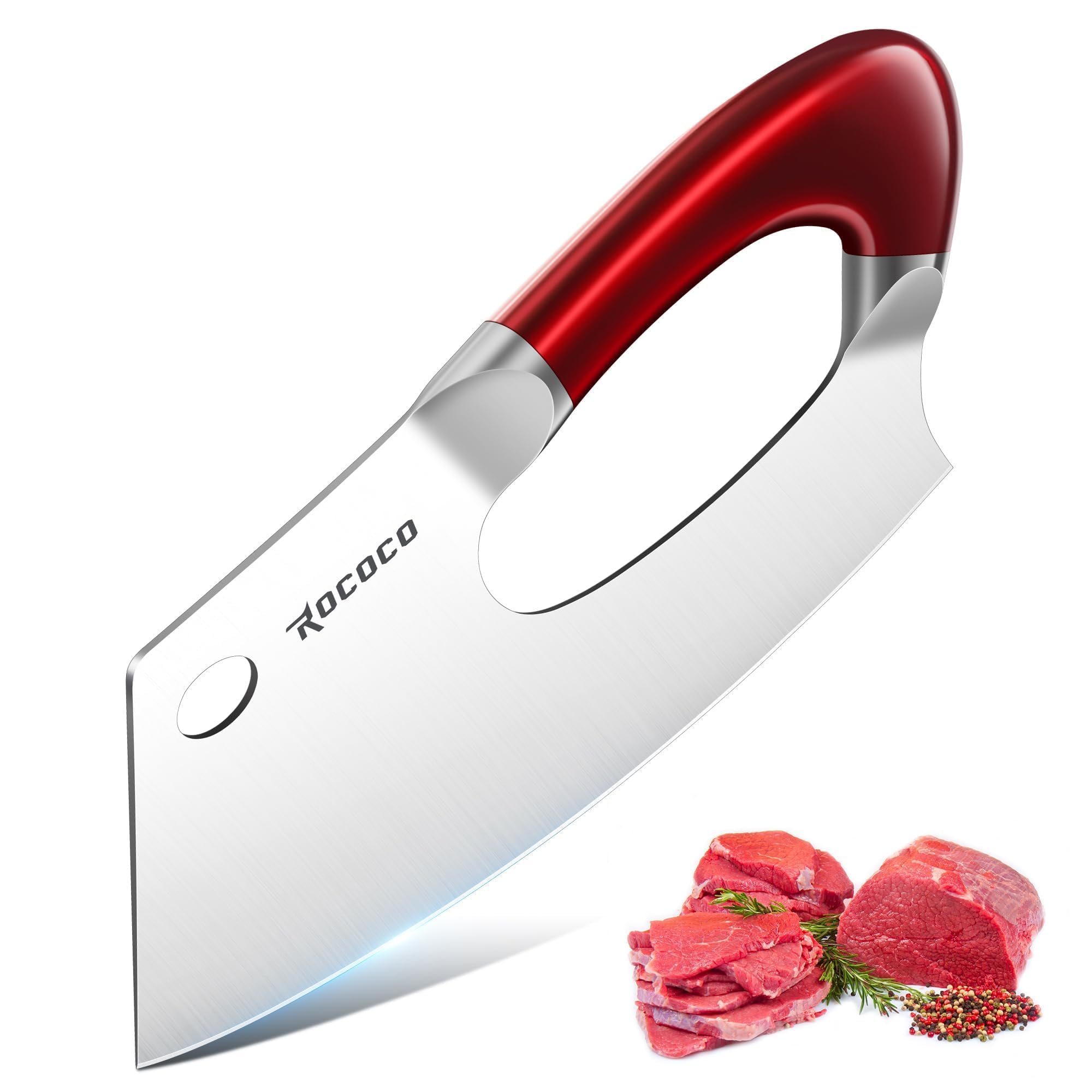
If you have arthritis, carpal tunnel, or just hate when your hand cramps up after dicing five cloves of garlic, the ROCOCO Easy Handle in red is built specifically for you. Its upcurved, forward-positioned handle (the “easy handle” design) shortens the distance between your hand and the blade, letting you cut with less wrist angle and less strain.
Like its bronze sibling, this cleaver sports an 8.66-inch blade forged from high-carbon stainless steel at 60 HRC (the same top-tier hardness that keeps it razor-sharp for a long time). Buyers love how “magically easy” it feels — one reviewer noted the heavy blade does the work for you, so you do not have to push. It is also magnetic, meaning it sticks to a magnetic knife strip for easy storage.
The standout spec here is the seamless stainless steel handle that integrates directly into the blade, giving you a solid, one-piece feel with no weak joints. Just be aware that, like the bronze version, it lacks a sheath and the handle cutout can feel sharp. A mic-drop for comfort-minded cooks.
What stands out
- Upcurved handle reduces wrist and palm fatigue
- One-piece forged construction with no weak joints
- Magnetic for convenient board or strip storage
The trade-offs
- Handle cutout can feel sharp after extended use
- No sheath included for safe storage
4. Victorinox Fibrox 7 Inch Cleaver

The single number that matters most in this category is dishwasher safety, and the Victorinox Fibrox scores a perfect yes—it is the only cleaver on this list that is dishwasher-safe without worry. Its 7.1-inch blade is made from Swiss stainless steel — a stamped blade (cut from a sheet of steel instead of forged) but razor-sharp out of the box and known for long edge retention.
The downside you accept here is that this is a vegetable cleaver, not a bone-cracker. Customers note the edge can roll if you try to chop through chicken thigh bones or duck leg bones. However, for vegetables, fruit, and boneless meat, it is a joy — one buyer mentioned the flat blade doubles as a bench scraper for scooping chopped ingredients into a pan. The Fibrox handle (a textured thermoplastic rubber) provides a confident grip even when wet.
At this price point, you are paying for a trusted brand and a handle that many chefs swear by for ergonomics. It is a price-to-performance play: you lose a little in construction (stamped vs forged) but gain real convenience with dishwasher cleaning and a comfortable, slip-resistant grip. Best for the cook who values easy cleanup over maximum toughness.
The upsides
- Dishwasher-safe for effortless cleaning
- Non-slip Fibrox handle works well when wet
- Flat blade doubles as a bench scraper
Keep in mind
- Not for cutting through bones; edge can roll
- Stamped construction, not forged
5. ZWILLING HENCKELS Classic 6-inch Cleaver

At this lower price, you get a fully forged 6-inch cleaver that weighs 0.9 lbs (about 14.4 ounces) — noticeably heavier than the other cleavers on this list, giving you real momentum with each swing. The ZWILLING HENCKELS Classic is the heavy hitter you reach for when splitting a rack of ribs, chopping through a turkey joint, or breaking down a chicken with authority.
Reviewers point out it cuts cleanly through pork ribs, cabbage, fish, and even frozen foods with a firm hit, holding its edge much longer than cheaper knives. The stainless steel handle integrates seamlessly into the blade, so there is no gap for food to get trapped. One owner reported it is super sharp and “stays sharp longer, even with minimal care.”
What you give up for that power is a slightly shorter blade (6 inches vs the ROCOCO’s 8.66 inches), so you have less slicing surface for large vegetables. And a few buyers mention the tang has a sharp square edge that can feel uncomfortable in some grips. This is the field-vs-this value pick for durability — perfect for the budget buyer who regularly breaks down meat with bones.
Why we’d pick it
- Heavy 0.9 lb forged blade powers through bones
- German engineering holds edge for a long time
- One-piece forged handle, no food traps
A few caveats
- Shorter 6-inch blade limits slicing on large veggies
- Handle tang can feel sharp in some grips
Understanding the Specs
Blade Length
Measured in inches from the handle to the tip. A longer blade (like the ROCOCO’s 8.66 inches) gives you more slicing surface for big vegetables and wide cuts of meat. A shorter blade (like the 6-inch ZWILLING) feels more maneuverable and is better for breaking down bones where precision matters over reach. For most home cooks, a 7-inch blade is the Goldilocks zone — enough surface for veggies, compact enough for chicken joints.
Rockwell Hardness (HRC)
This is a standard scale that measures how hard the steel is. A higher number means a harder blade that stays sharp longer but is more brittle. For cleavers, the sweet spot is 56 to 60 HRC. At 56 (like the PAUDIN), the blade is tough and easy to re-sharpen. At 60 (like both ROCOCO models), the blade holds its edge much longer but is slightly more prone to chipping if you abuse it on bones. Most kitchen tasks do not need above 60 HRC.
FAQ
Can I use a cleaver to chop through bones?
How do I clean and store a cleaver to keep it sharp?
What is the difference between a Chinese cleaver and a Western cleaver?
Final Thoughts: The Verdict
When it comes down to it, the cleaver knife winner is the PAUDIN Cleaver Knife because it delivers a sharp, durable 7-inch blade with a comfortable handle at a price that does not hurt — perfect for everyday slicing, dicing, and light meat prep. If you want a longer, harder blade that feels like magic on vegetables, grab the ROCOCO Meat Cleaver (Bronze). And for breaking down bones and ribs with brute force, the standout is the ZWILLING HENCKELS Classic Cleaver.

Mo Maruf
I created WellFizz to bridge the gap between vague wellness advice and actionable solutions. My mission is simple: to decode the research and give you practical tools you can actually use.
Beyond the data, I am a passionate traveler. I believe that stepping away from the screen to explore new environments is essential for mental clarity and physical vitality.