Our readers keep the lights on and my smoothie glass nicely filled. As an Amazon Associate, I earn from qualifying purchases.
Specs are compiled from manufacturer listings and verified buyer reviews and can change over time — please confirm the key details on the product page before buying.
A transparent print that stays transparent — that is the whole point of buying clear resin. But many bottles that start glass-like turn yellow within weeks, and a layer of fog kills the internal detail you actually printed. This guide cuts through the claims to find the resins that deliver true clarity, resist that amber shift, and cure into parts you would actually display under a light.
I’m Mohammad Maruf — the founder and writer behind WellFizz. This guide is built by comparing the manufacturers’ published specifications and the patterns across verified customer reviews, so you get each pick’s real strengths and trade-offs instead of marketing spin.
Whether you are printing a microscopic dental model, a prop lens, or a decorative miniature, finding the best clear resin for 3d printing means picking a formula that balances yellowing resistance, toughness, and easy post-processing without needing a chemistry degree to figure out.
Our Picks at a Glance


How To Choose The Best Clear Resin For 3D Printing
Clear resin is different from every other photopolymer. You are not just looking for layer adhesion and low shrinkage — you need optical clarity that survives post-curing and long-term display. Here are the three factors that separate a usable clear resin from a frustrating one.
Yellowing Resistance is non-negotiable
Standard resins turn amber or yellow under UV light over time. A resin labelled as non-yellowing uses stabilizers that slow this shift dramatically. If you want a part that stays water-clear months after printing, this is the single spec that matters most — skip it and your beautiful model will look like old varnish within weeks.
Post-processing defines the final clarity
No clear resin comes out of the wash and cure looking like glass. Every clear formula requires extra steps: a clear gloss coat, wet sanding, or a thin dip in the same resin before a final cure. The data lines make this obvious — resins that state their post-processing steps clearly are the ones that actually deliver transparency. A bottle that promises “high clarity” without telling you how to achieve it is usually hiding a cloudy finish.
Water washable versus alcohol wash
Water-washable resins eliminate the need for isopropyl alcohol, which keeps fumes down and cleanup simpler. The trade-off is that water-washed clear parts can retain an oily residue or arrive slightly less crisp than alcohol-washed parts. If your workspace is indoors or you are sensitive to alcohol fumes, a water-washable clear resin is worth the extra calibration time. If you want the absolute clearest surface, alcohol washing still wins.
Quick Comparison
| Model | Best For | Yellowing Resistance | Print Speed | Wash Method | Amazon |
|---|---|---|---|---|---|
| ANYCUBIC High Clear★ Best Overall | Everyday clear prints with proven consistency | Excellent | Standard | Alcohol | Amazon |
| SuperFast 8K Water WashableSpeed Champion | Speedy production with water cleanup | Good (yellowish hue noted) | Fast (0.5s at 50um) | Water | Amazon |
| Siraya Tech Craft Ultra-ClearCraft Pick | Craft projects needing glossy finish | Excellent | Fast (Monochrome LCD tune) | Alcohol | Amazon |
| SUNLU High Clear | Budget-friendly bulk clear printing | Excellent | Standard | Alcohol | Amazon |
| Phrozen Aqua Clear Plus | Strong miniatures with low shrinkage | Good | Fast | Alcohol | Amazon |
| Inslogic High Clear | Large prints with blue-tint resistance | Blue Tint & Yellowing Resistant | Standard | Alcohol | Amazon |
| NOVA3D Ultra Clear | Low-odor water washable clarity | Excellent | Fast | Water | Amazon |
| RESIONE G217 Clear Tough | Functional clear parts with ABS-like strength | Non-yellowing (slight blue tint) | Standard (thick viscosity needs rest time) | Alcohol | Amazon |
| UniFormation T01 Transparent | Optical parts with ultra-high transparency | Excellent | Standard (needs calibration) | Alcohol | Amazon |
In‑Depth Reviews
1. ANYCUBIC High Clear 3D Printer Resin
Our pick — over 4.5★ from 10,000+ verified ratings; the strongest balance of quality and price.
The clear resin that tens of thousands of owners keep coming back to for good reason.
This is the bottle that stays anti-amber better than most formulas at this level. The maker states it offers excellent resist yellowing, meaning your prints hold their crisp look in an interior environment for a long time without taking on that warm, aged hue. To make that happen, you do need to reset the light exposure time per the recommended parameters printed on the bottle — the data confirms that, and owners who ignore that step lose clarity fast.
The toughness here is a real upgrade: ANYCUBIC claims a 100% rise in resilience compared to standard resin, so thin parts like dental retainers or miniature wings do not snap the moment you look at them. The bottle is compact at 2.33 x 2.33 x 5.44 inches and weighs 2.61 pounds, which is actually a little heavier than the SuperFast resin below (2.61 pounds vs. 2.2 pounds) — so you feel you are getting dense material. Owners across many reviews point out that it prints well straight out of the bottle on both consumer LCD machines and professional dental printers like the SprintRay Pro 2, where it is called “accurate enough for basic dental models.” The common thread in hundreds of reviews is print quality, with reliability and value for money also scoring high.
The catch is exposure. As buyers report, “High Clear resin needs higher exposure than other AnyCubic resins; low exposure causes adhesion failure and warping.” That means you can not copy settings from a grey or black resin and expect success. Give it the extra exposure it asks for, and it rewards you with a strong, clear print that will not yellow.
What owners love
- Exceptional yellowing resistance keeps prints clear long-term
- Noticeably tougher than standard resin — less likely to break on drop
- Low odor and mild irritation during printing
- Wide compatibility with 365-405nm band printers
What to watch
- Requires higher exposure time than other AnyCubic resins — get that dialed
- Printing is slower due to the longer exposure needed
Your best bet if: you want a proven, crowd-tested clear resin that resists yellowing and offers real toughness without a premium tier price.
Think twice if: you are looking for the absolute fastest print speeds — the extra exposure time here is deliberate, not a flaw.
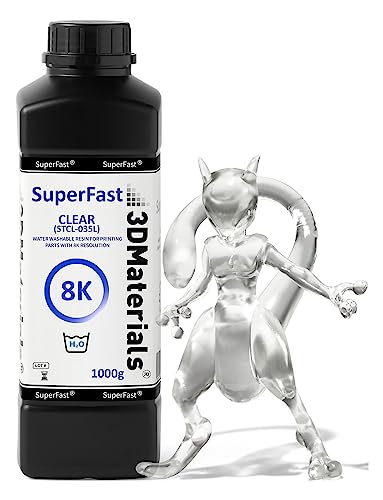
2. SuperFast 8K 3D Printer Resin Water Washable
The clear resin that prints a 50-micron layer in half a second — no IPA needed.
This resin from 3DMaterials is built for speed above everything else. The spec is striking: you can print a 50um layer in 0.5 seconds on a monochrome LCD printer, which the maker claims enhances productivity by at least 40%. That is a serious advantage if you run a print farm or batch-produce clear parts. The 8K precision claim comes from an extremely low viscosity that allows 22um resolution — fine enough for tiny N-scale railroad parts, as one owner confirmed on Anycubic machines.
The water washable aspect is the second biggest draw. You clean the platform, the tank, and the printed parts themselves with warm tap water and soap. That eliminates the IPA supply chain entirely, which owners who work in small spaces or with sensitive noses genuinely appreciate. The bottle shape is noticeably different too — at 3.35 x 10.63 x 3.35 inches, it is tall and narrow compared to the ANYCUBIC above, a 44% size gap in product dimensions — but it weighs less at 2.2 pounds. Buyers running a Saturn 2 8K report that “prints 0.2mm smallest opening” is achievable, and the resulting print has a slightly yellowish hue that is flexible like hard rubber.
The honest trade-off is that yellowish tint. This is not the clearest resin on the list — owners describe the cured parts as having a yellow cast straight out of the bottle. It also has a stronger odor than some alternatives, though it is still within the normal range for a photopolymer. If you need truly water-clear transparency for display pieces, this is not the one. But for fast, durable, water-washable production parts where a barely-warm tint does not matter, it is tough to top.
Speed bargain: water washability eliminates the IPA step and cuts cleaning time dramatically. The yellow cast is the price you pay for that speed — accept it as a feature of a fast production resin, not a defect of a display resin.
Reach for this if: you need fast turnaround on clear, durable parts and want to skip alcohol cleaning entirely.
Look elsewhere if: water-clear optical transparency is your priority — the yellow tint here is noticeable versus other picks.
3. Siraya Tech Craft Ultra-Clear 3D Printer Resin
The clear resin tune for craft projects demanding a glossy, high-clarity surface.
Siraya Tech specifically calls out that this resin is designed for craft projects, and the data backs that up. The formulation reduces volume shrinkage during photocuring and is tune for Monochrome LCD printers and 8K capable machines. The maker states the pigment particles settle slower than other resins, which means you get fewer layer-line artifacts and a smoother surface straight off the print bed. That matters when you are printing a decorative miniature or a jewelry piece where every surface finish detail is visible.
Clarity is strong but comes with a clear instruction: you must apply a clear coating after curing to restore the true transparency. The maker is upfront about this — “just as it is with any clear resin,” they note. Owners confirm that if you clean with clean alcohol, apply a clear gloss coat, then polish, the result is genuinely glass-like and resists yellowing over time. As owners mention, “prints well at normal exposure (4.5s on Halot One),” which is a relief if you are tired of endlessly dialing in exposure settings for every clear resin batch. At 1 kilogram per bottle, the item weight is standard, and the material is polyurethane-based, which gives it a distinct feel versus standard acrylic resins.
The recurring note across reviews is that the clarity exceeds many other clear resins, but it is still not crystal without the coating step. That is not a flaw — it is how all clear photopolymers work. The price is on the higher side of the mid-range, and the bottle is a single 35.27 ounce unit. If you want a resin that goes through post-processing reliably and yields a glossy finish every time, this is a strong candidate.
Gloss-first design: the settled-pigment formula reduces artifacts and yields a smooth surface. The coating step is mandatory — skip it and you lose the very clarity you are paying for.
Best for: crafters and detail-oriented makers who value a glossy, smooth surface and are willing to do the three-step post-processing (clean, coat, polish) to get it.
Not for: anyone looking for a simple print-and-display clear resin — this one demands the coating step for full transparency.
4. SUNLU High Clear 3D Printer Resin
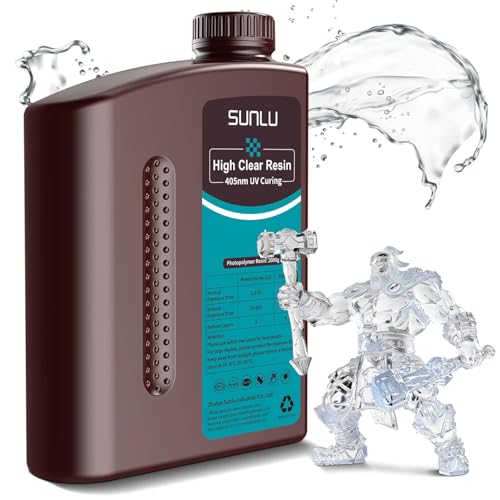
The bulk clear resin that delivers glass-like finish at a budget-friendly price.
SUNLU brings a 2000-gram package to the table — double the size of the standard 1kg bottle — at a price that undercuts many premium brands. The maker states the prints achieve a glass-like finish with excellent clarity and superior yellowing resistance, meaning your models stay transparent for a long time without the amber shift. The formula also delivers ultra-low volume shrinkage, which is critical when printing precision prototypes or miniatures where dimensional accuracy matters. You wash the surface with detergent or alcohol, apply a gloss oil, cure it for 2 minutes, and the finish becomes noticeably glossier and clearer.
Owners consistently highlight quality and value for money as the top two aspects, with over a dozen reviewers calling out each. The resin is described as high quality, low odor, and offering good flexibility before curing while being sturdy after final cure. It is compatible with most 4K and 8K LCD, DLP, and SLA printers within the 405nm wavelength range, and the leak-proof bottle packaging reduces the risk of a resin spill during shipping — a practical concern when ordering any photopolymer online.
The odor is listed as MIXED in the customer data — some find it low, others disagree. Durability also gets mixed reviews, with some owners reporting excellent impact resistance and others finding the cured parts brittle. For a value-tier resin, that split is typical: you are paying less than premium formulas, and the trade-off is that batch consistency can vary. If you need a large quantity of clear resin for prototyping or batch runs at a lower cost per gram, this is the volume play.
Volume value: the 2000-gram package is a clear money-saver on a per-gram basis. Durability and odor are the variables you accept at this tier.
Reach for this if: you go through clear resin fast and want the best cost-per-gram ratio without sacrificing yellowing resistance.
Think twice if: you need guaranteed batch consistency for critical functional parts — the mixed durability reports make larger investments a slight gamble.
5. Phrozen Aqua Clear Plus 3D Printer Resin
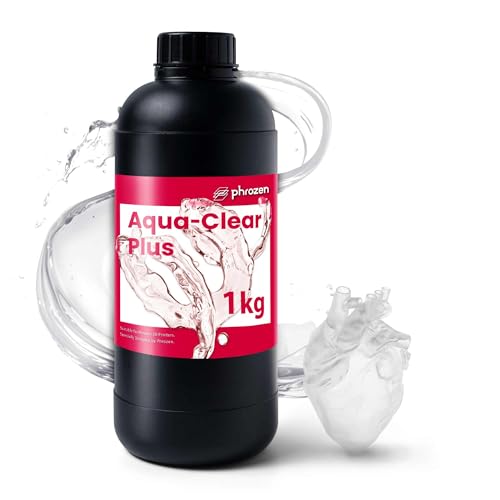
The low-viscosity clear resin that prints miniatures fast without sacrificing strength.
Phrozen engineered this Aqua series specifically for 405nm LCD printers, and the low viscosity is the headline feature. Lower viscosity means the resin flows quickly across the build plate between layers, which reduces print failures from suction and allows faster printing times without quality loss. The maker states it offers remarkable high precision with minimal shrinkage and low warpage, making it ideal for head sculptures, action figure miniatures, and detailed prototypes. At 2.61 pounds and 3.54 x 3.54 x 8.86 inches, the bottle is a compact cube that stacks easily on a shelf.
What sets this apart from other clear resins is the 21% elongation — a measure of flexibility before breaking. Owners specifically note that the Aqua Clear Plus is more flexible than the standard Aqua Gray 4K (which has 7% elongation), so thin parts like antennae, spears, and delicate details survive support removal and accidental drops much better. A dental technician confirmed it prints quickly, cleans up easily due to the low viscosity, and is reasonably priced for the performance. The Phrozen Sonic Mini 8k and Mighty 8k are both cited as compatible printers.
The durability feedback is MIXED across reviews — some find it tough, others note it can be brittle in certain orientations. Odor is also divided, with owners finding it either incredibly low or strong depending on their sensitivity. The price sits in the mid-range tier, slightly above the economy options, but the print quality is consistently praised as high.
Why it stands out
- Low viscosity enables fast printing and easy cleanup with IPA
- 21% elongation is significantly more flexible than standard clear resins
- Minimal shrinkage and low warpage for precise miniatures
- Compatible with both 4K and 8K LCD printers
Consider this
- Durability feedback is mixed — test your specific print orientation
- Odor levels vary between users; works best in ventilated spaces
Best for: miniature makers who need fast prints with high detail and appreciate the flexibility that protects thin features from snapping.
Skip if: you are highly sensitive to resin odor or need consistent durability across every print orientation.
6. Inslogic High Clear 3D Printer Resin
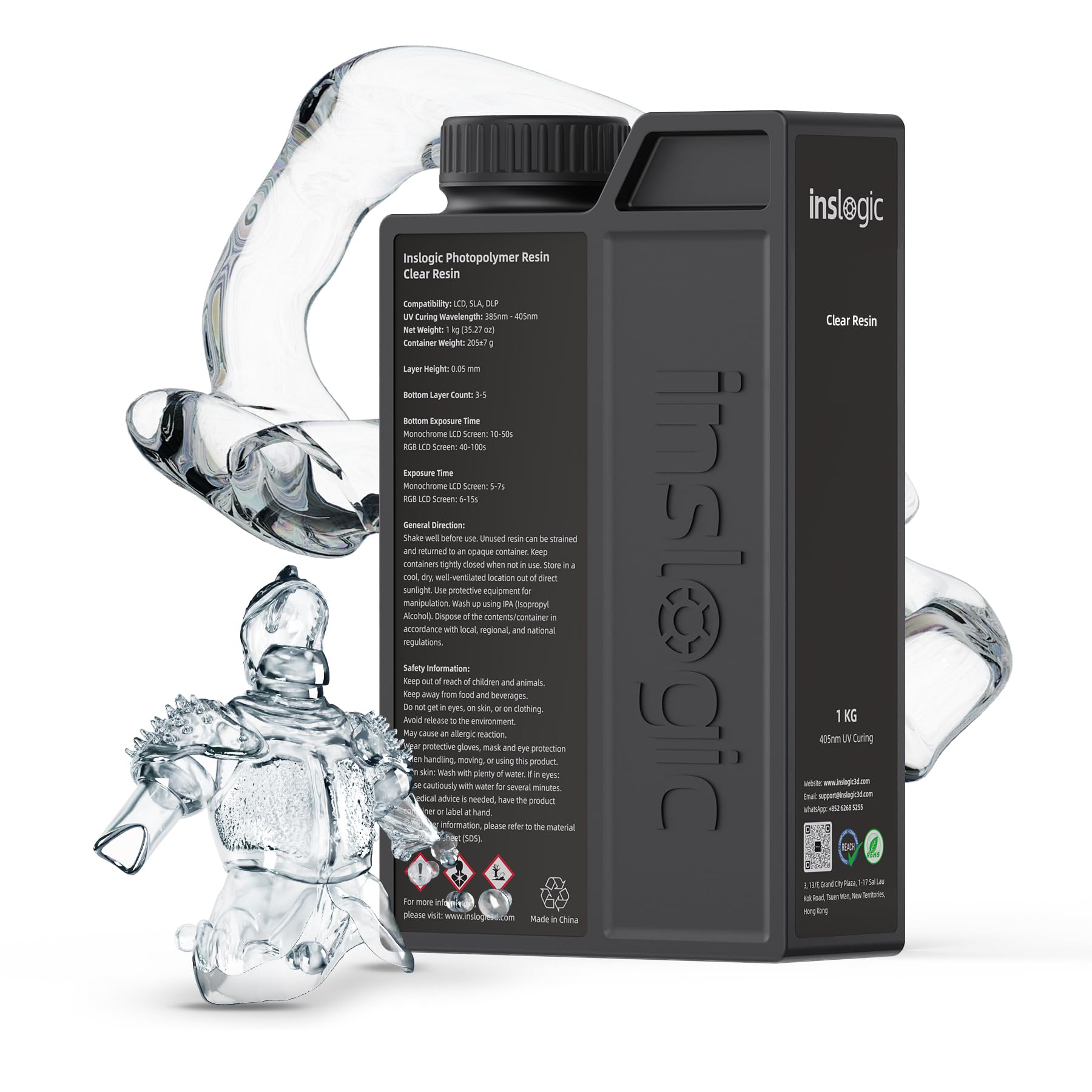
The clear resin that fights both yellowing and the annoying blue cast many clear resins develop.
Most clear resins only advertise non-yellowing — Inslogic goes one step further by specifically resisting blue tint as well. That blue shift is a subtle haze that makes transparent parts look like frosted glass rather than water-clear. The maker states the formula is resistant to both yellowing and cracking over time, maintaining long-lasting clarity, stability, and HD transparent details. The resin is tune for 385-405nm printers, so it covers the full wavelength range of most LCD, DLP, and SLA machines on the market.
At 2.2 pounds, the bottle is light, and the packaging includes a tight-fitting air bag around the bottle specifically to prevent leakage during transport. Customers note impressive print quality, with one calling it a “great resin option at low price point” and another buying 10 bottles after being satisfied with large prints and miniatures. The print quality aspect is the most mentioned positive, with 8 mentions in the data. The resin also promises low shrinkage and warping, which is important for maintaining dimensional precision on complex geometries.
The honest catch is that the customer base is still small — 97 ratings at the time of this data — so long-term yellowing resistance across multiple batches is less proven than established brands with thousands of reviews. Owners note that a “used” bottle arrived empty in one case (Amazon honored the return), so buying new rather than warehouse deals is wise. If you want a fresh formula that specifically addresses the blue tint issue that many clear resins ignore, this is an interesting pick.
Dual resistance: targets both yellowing and blue tint — a rare combo in the sub-98 review tier. Small review pool means batch consistency is less proven than mass-market names.
Best for: users frustrated by the blue haze on other clear resins and willing to try a newer formula with strong initial positive feedback.
Think twice if: you want a resin with a proven multi-batch track record — the review count is still low at this writing.
7. NOVA3D Ultra Clear Resin

The water-washable clear resin with nearly zero odor that paradoxically offers fast cure times.
NOVA3D calls this a “Revolutionary Ultra-Clear water washable” formula, and the spec sheets back the claim: print efficiency is up to 30% higher than traditional highly transparent resins. That means shorter exposure times and faster overall print jobs. The water washable aspect is the big draw — you clean everything with tap water, avoiding the fume and cost overhead of isopropyl alcohol. The maker specifically notes the combination of imported raw materials and a unique composition results in almost no odor during printing. That is a rare claim among clear resins, which typically have at least some photopolymer smell.
Owners confirm the water cleanup is a legitimate time-saver, though they note the parts can feel oily after washing. A workaround the community has discovered is to cure the prints in water, which produces a crisp finish without the brittle edge that IPA washing sometimes causes. The prints are described as “fairly clear” out of the wash, and a clear coat is still recommended to achieve the shiniest transparency. The bottle holds 1kg at 2.51 pounds and is 3.94 x 3.94 x 9.06 inches, a taller bottle shape. The resin is compatible with the Anycubic Photon M5s, among other printers.
The main trade-off is cost — this is a premium-tier resin priced for those who value odor-free and water-washable convenience over per-bottle economy. The review count is still modest, so long-term yellowing resistance is not as documented as more established lines. Some reviewers point out warping after curing, though this is common across many clear resins and often linked to over-curing rather than the material itself.
Odor-free clarity: the near-zero smell and water cleanup make this ideal for indoor printing without venting. Pay the premium for convenience, not for the lowest cost.
Reach for this if: you print in a living space, dislike IPA fumes, and want a water-washable clear resin that also prints fast.
Look elsewhere if: you need a cheap bulk resin — this premium bottle is priced for the convenience, not the volume.
8. RESIONE G217 Clear Tough 3D Printer Resin
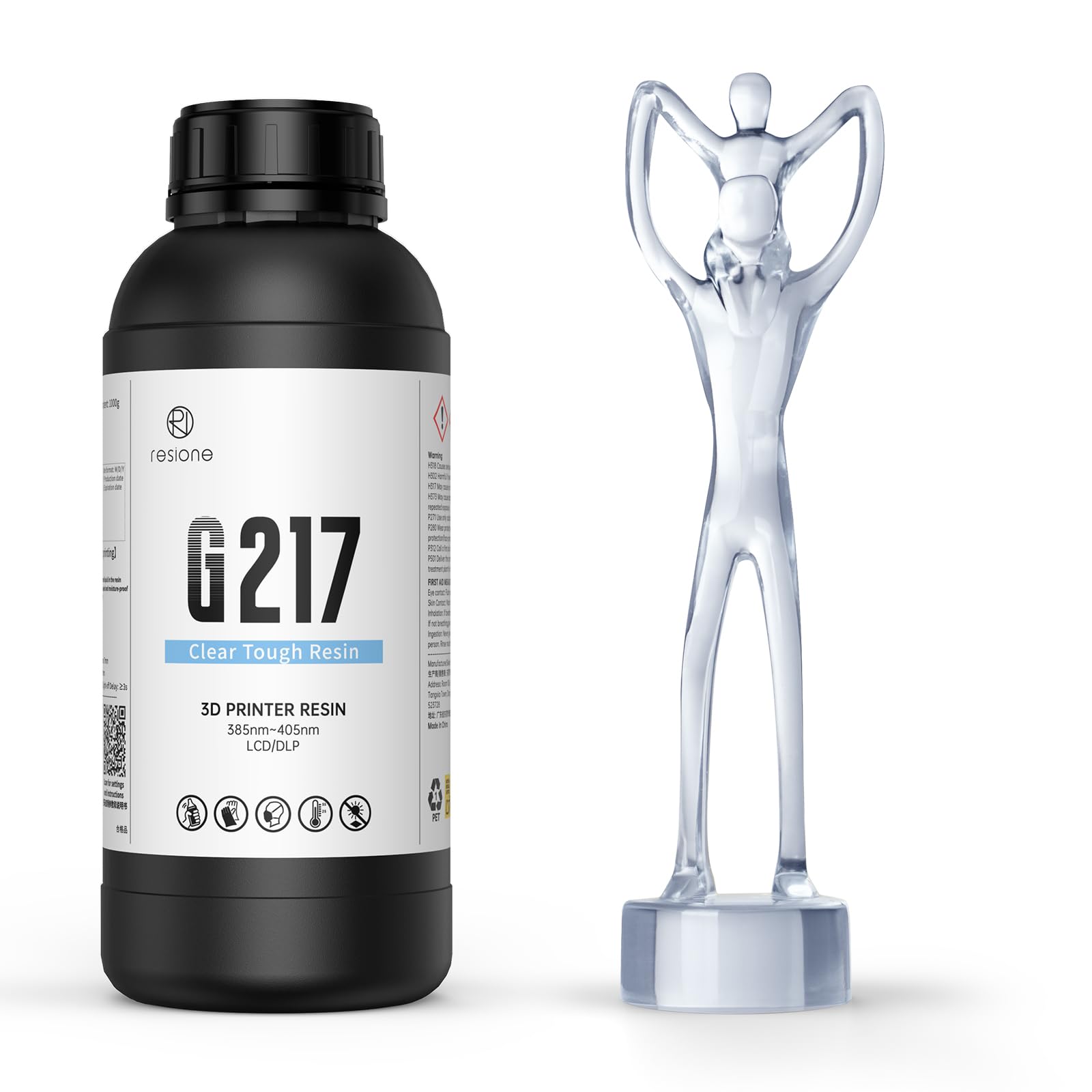
The clear resin that pursues ABS-like toughness without compromising on transparency.
This is a fundamentally different clear resin because it targets mechanical properties as the primary goal. RESIONE states the G217 formula delivers mechanical properties similar to tough thermoplastic materials (ABS), with high tensile strength and excellent impact strength. The resin is so strong that the maker says prints can be machined repeatedly. For functional clear parts like enclosures, housing, or impact-resistant components that need to be transparent, this is the one to consider. The raw materials are all clear and transparent with no impurities, and the maker specifically controls the production process to maintain that purity.
The clarity is top-tier when properly post-processed. Owners who sand, spray clear varnish or dip in G217 resin itself achieve a completely transparent finish with only a slight bluish tint. Two owners on different Elegoo printers called it the “best clear resin” they have found, noting that a boiling water post-cure makes it very clear. The non-yellowing claim is specific: prints may yellow slightly after post-curing but will fade back to transparent within a few days. That self-healing yellowing property is unusual and suggests a chemical rebalancing over time rather than permanent damage.
The practical downside is viscosity. The resin is noticeably thicker than alternatives like the Siraya Craft, so you must increase your rest time settings significantly. One owner mentioned running rest times at 5 seconds, and possibly needing higher. That slows down the print process. The resin is also expensive relative to mid-range options, and one owner reported cloudiness and a brown layer after sun exposure. If you need a clear part that must withstand mechanical stress, the G217 is a solid choice.
Strengths
- ABS-like toughness with high tensile and impact strength
- Non-yellowing — even if it yellows after curing, it fades back to clear in days
- Considered the clearest resin by some owners after proper sanding and coating
- Can be machined post-cure for exact fits
Weaknesses
- Thick viscosity requires longer rest times — slows print speed
- Premium pricing — among the most expensive bottles on this list
- Some shoppers say cloudiness and slight blue tint
Best for: functional clear parts that must withstand impact, wear, or machining — the ABS-like toughness is real.
Not for: high-volume printing or users who want a low-viscosity resin that prints fast with standard rest times.
9. UniFormation T01 Boxed Transparent 3D Printer Resin
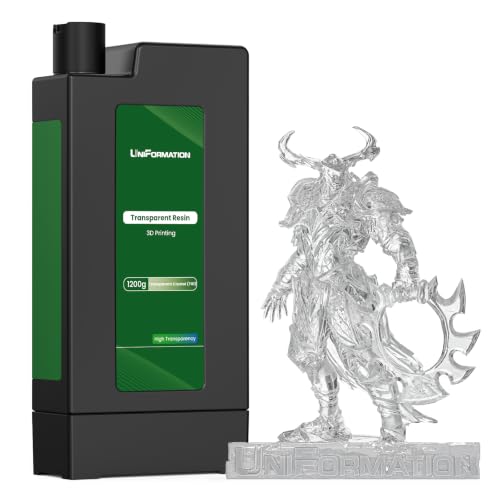
The boxed clear resin that pairs with automatic feeding systems for high-end optical parts.
UniFormation designed the T01 with a specific target: ultra-high transparency and crisp results for optical applications. The maker states it delivers outstanding optical clarity with a glass-like appearance after proper post-processing, making it ideal for transparent display models, lenses, light-guiding parts, and architectural models. The 1.2 kilogram bottle is slightly larger than the standard 1kg bottles, and the spill-resistant design is fully compatible with UniFormation GK3 series automatic resin feeding systems — a unique feature if you have that printer ecosystem. The low-odor composition makes long printing sessions more comfortable.
The resin combines high resolution with low volume shrinkage to reproduce intricate textures and crisp edges. Buyers report excellent print resolution with fine details on an Elegoo Mars 2 Pro, and one buyer who upgraded from Anycubic resin called the detail level “superior.” The material is described as “not brittle at all after final cure,” which is an advantage over many clear formulas that become glass-like and fragile. The low viscosity is noted as helpful for detail but also makes calibration tricky — one owner reported wasting a third of the bottle finding the right settings (final success at 4-second exposure and 100-second base exposure).
The honest catch is the calibration curve. Multiple owners mention that there are no recommended settings provided in the box, and the pre-benchmarked slicer profiles are only for GKone printers. If you use a different printer, you will be dialing in exposure times manually, and the first third of the bottle may be calibration waste. That is a real cost for a premium-priced resin. If you own a UniFormation printer and use the auto-feeding system, this is a smooth match. If you are on a standard Elegoo or Anycubic machine, expect a calibration tax upfront.
Ecosystem match: tune for UniFormation printers with auto-feed compatibility, the T01 delivers premium optical clarity but demands calibration patience on non-UniFormation machines.
Best for: optical-grade parts like lenses and light guides where absolute clarity is the goal, especially if you own a UniFormation printer.
Think twice if: you are unwilling to spend the first third of a bottle dialing in exposure — the calibration process is real and material-intensive.
Understanding the Specs
Yellowing Resistance
This is the single biggest pain point for clear resin buyers. Without it, a transparent print turns amber or yellow under UV light from sunlight or even indoor LEDs over weeks or months. Resins with “excellent resist yellowing” use UV stabilizers that dramatically slow this reaction. Look for phrases in the description that mention “non-yellowing” or “yellowing resistance” specifically — if the bottle does not say it, assume it will yellow. Remember that some resins may yellow immediately after post-curing but fade back to clear within a few days (like RESIONE G217), which is a different mechanism from permanent yellowing.
Water Washable vs Alcohol Wash
Standard clear resin requires isopropyl alcohol (IPA) for cleaning uncured resin off prints. That adds cost, smell, and a flammable liquid to your workspace. Water-washable clear resin eliminates the IPA step — you use warm tap water and soap. The trade-off is that water-washed parts can feel oily and may not be as immediately clear as IPA-washed parts. Some users find water-washing produces less brittle prints. If you print in a small room or near living spaces, water-washable is the safer, simpler choice. If absolute clarity is the only goal, alcohol washing still yields a slightly better surface.
FAQ
Why does my clear resin print look cloudy or milky?
Can I print clear resin on any 3D printer?
How long does clear resin stay clear before yellowing?
Do I need to sand and coat clear resin prints?
Is water-washable clear resin as clear as alcohol-wash resin?
Why does my clear resin print crack or snap easily?
Can I mix clear resin with colored resin to make tinted transparent parts?
What exposure time should I start with for clear resin?
How do I store leftover clear resin?
Is clear resin more expensive than standard opaque resin?
Final Thoughts: The Verdict
For most buyers, the best clear resin for 3d printing winner is the ANYCUBIC High Clear because it delivers proven yellowing resistance, real toughness (100% rise in resilience), and the largest review consensus of any clear resin on the market — a safe, reliable choice for both beginners and professionals. If you want the fastest print speeds with water-washable convenience, grab the SuperFast 8K. And for functional clear parts that need ABS-like strength without sacrificing transparency, the RESIONE G217 is the one to reach for.
How We Picked
We do not accept paid placement. Every pick is matched to a real buyer and a real use-case; we do not hands-on test units.
Sources & Methodology
Specifications: manufacturer listings and product documentation. Review insights: verified customer reviews, as of July 2026. Pricing: not shown on this page (it changes often); check the current price via the retailer link.
As an Amazon Associate, WellFizz earns from qualifying purchases. This does not affect which products we feature.
Related Guides

Mo Maruf
I created WellFizz to bridge the gap between vague wellness advice and actionable solutions. My mission is simple: to decode the research and give you practical tools you can actually use.
Beyond the data, I am a passionate traveler. I believe that stepping away from the screen to explore new environments is essential for mental clarity and physical vitality.