Our readers keep the lights on and my smoothie glass nicely filled. As an Amazon Associate, I earn from qualifying purchases.
Wood cabinets silently absorb grease, steam, and every splash from meal prep, yet using the wrong spray can strip the finish faster than a decade of cooking. The line between restoring the wood’s natural grain and dulling the protective seal depends entirely on the formula you choose. Many household all-purpose sprays contain harsh degreasers or waxes that build a sticky film, attracting more dust and turning cabinets into a high-maintenance chore.
I’m Mohammad Maruf — the founder and writer behind WellFizz. My research focuses on matching household cleaning formulations to specific finish types and everyday use scenarios, analyzing hundreds of verified consumer reports and chemical specifications to identify which products actually deliver on their promise without damaging cabinet surfaces.
This guide breaks down five distinct formulas—from natural enzyme-based sprays to wax-infused polishes and pure conditioning oils—so you can confidently select the best cleaner for wood kitchen cabinets that fits your kitchen’s specific needs, finish type, and maintenance preferences.
How To Choose The Best Cleaner For Wood Kitchen Cabinets
Kitchen cabinet cleaners sit at the intersection of floor care and furniture polish, but they face a much harsher environment: airborne cooking grease, steam from boiling pots, sticky fingerprints near handles, and the occasional splash of acidic ingredients. A cleaner that works beautifully on a dining table may leave a cloudy film on cabinet doors that never truly dries. Understanding three specific factors will prevent you from making that mistake.
Residue Profile: Wax vs. No-Wax vs. Oil-Based
Wax-based formulas like Jubilee Kitchen Wax leave a protective hard shine that repels future stains, but they require thorough buffing and can create a sticky film when applied too thickly or in humid kitchens. No-wax formulas such as Aunt Fannie’s Wood Spray Cleaner clean without leaving any layer behind, making them ideal for frequent use on cabinets that already have a factory finish. Oil-based polishes like Howard Lemon Oil soak into the wood to restore moisture and enhance grain depth, but they can attract dust if over-applied and should not be used on silicone-sealed or plastic-laminate surfaces.
Finish Compatibility: Factory Seal vs. Antique Raw Wood
Modern kitchen cabinets typically have a polyurethane, lacquer, or conversion varnish finish that is durable but sensitive to alcohol, ammonia, and silicone. Aggressive formulas can cloud or soften these factory seals over time. If your cabinets are raw, unfinished, or antique wood, conditioning oils like Touch Of Oranges are preferable because they replace lost moisture rather than depositing a protective layer on top. For sealed cabinets, a spray that evaporates nearly fully—like the natural plant-based enzyme cleaner from Aunt Fannie’s—minimizes chemical exposure to the finish.
Ingredient Safety in Food-Prep Adjacent Spaces
Because cabinets surround your food storage and preparation zones, volatile organic compounds and strong synthetic fragrances from conventional aerosol polishes can settle on countertops and mix with raw ingredients. Look for EWG A-rated cleaners, Leaping Bunny certified cruelty-free products, or formulas explicitly tested for use around kids and pets. Aunt Fannie’s and Touch Of Oranges both emphasize plant-derived or food-grade ingredients, whereas wax-based products like Goddard’s and Jubilee rely on mineral spirits and synthetic polymers that require good ventilation during and after application.
Quick Comparison
On smaller screens, swipe sideways to see the full table.
| Model | Category | Best For | Key Spec | Amazon |
|---|---|---|---|---|
| Touch Of Oranges | Oil Conditioner | Restoring moisture to dry wood | No-wax, no-silicone formula, 32 oz | Amazon |
| Howard Lemon Oil | Conditioning Polish | Enhancing grain on finished wood | 16 oz, silicone-free liquid | Amazon |
| Goddard’s Cabinet Wax | Wax Spray | Protecting vintage wooden cabinets | Beeswax + lemon oil, 23 oz | Amazon |
| Jubilee Kitchen Wax | Wax Polish | Streak-free shine on laminate | 2-pack, 1.98 lbs total | Amazon |
| Aunt Fannie’s | No-Wax Spray | Daily residue-free cleaning | 16.9 oz, EWG A-rated | Amazon |
In‑Depth Reviews
1. Touch Of Oranges Wood Cleaner & Polish Spray

Touch Of Oranges uses real orange oil as its active degreasing and conditioning agent rather than synthetic petrolatum or mineral oil. This gives it a dual ability: it cuts through years of baked-on kitchen grease near stove tops while simultaneously moisturizing dried-out cabinet wood from the inside. The absence of wax and silicone means that repeated applications never build a tacky layer that attracts kitchen dust, a common complaint with traditional furniture polishes used weekly in high-traffic kitchens.
Users consistently report that the orange fragrance remains pleasant rather than cloying, and a single 32-ounce bottle covers entire kitchen cabinet sets plus hardwood floors when used sparingly. The formulation is gentle enough for use around children and pets, which matters in kitchen environments where countertops and food storage areas are within inches of cleaning residue. Cleanup requires no buffing stage—spray, wipe along the grain, and the oil does the conditioning work.
Owners of older, drying wood cabinets find that after two or three applications the grain becomes noticeably richer and the wood feels more supple rather than brittle. The tip to spray lightly onto a cloth rather than directly onto vertical cabinet faces prevents run-off that could stain adjacent wall paint. For a deep restorative treatment that also cleans heavy grime, this is the most versatile single-bottle solution available in the category.
Why it’s great
- Real orange oil dissolves grease without ammonia or bleach
- Conditions wood while cleaning, reducing future cracking risk
- No wax buildup even after repeated use on sealed surfaces
Good to know
- Higher upfront cost than standard cleaners
- Not recommended for unsealed raw wood floors without finish
2. Howard Products Lemon Oil Furniture Polish

Howard’s Lemon Oil occupies a middle space between a simple dusting spray and a deep conditioning oil. The silicone-free formula is designed specifically to avoid the slippery buildup that makes silicone-based polishes dangerous on kitchen cabinet handles and drawer pulls. Many users apply it as a weekly cabinet maintenance product, finding that it removes fingerprint smudges and light cooking residue immediately while imparting a bright citrus scent that contrasts with the heavy floral notes of many commercial polishes.
The 16-ounce trigger bottle gives precise control over spray direction, though several owners caution against spraying directly onto cabinet doors. The mechanism produces a mist that can travel if the nozzle is aimed too aggressively, potentially leaving oil stains on nearby wall paint. The better method is to spray a small amount onto a microfiber cloth and then wipe the cabinet surface. When used correctly, the polish leaves a warm, organic luster rather than a synthetic plastic-like shine.
As a restorative for older finished wood, Howard’s is effective but not transformative. It maintains existing moisture levels rather than deeply replenishing parched grain, making it better suited for routine care than for reviving a neglected cabinet set. Users with stainless steel sinks also discovered that the same formula buffs water spots and fingerprints off their sink surface effectively, expanding its utility beyond cabinet care.
Why it’s great
- Silicone-free so it won’t make cabinet handles slippery
- Bright lemon scent freshens kitchen without chemical odor
- Affordable enough for weekly use on large cabinet sets
Good to know
- Spray nozzle can overspray and stain walls if used carelessly
- Shine fades faster than wax-based or oil-blend competitors
3. Goddard’s Cabinet & Wood Wax Spray

Goddard’s differentiates itself by using a beeswax and lemon oil emulsion that deposits a thin protective wax layer as you wipe. This is distinctly different from oil-only products because the wax creates a physical barrier against moisture and sun damage—particularly useful for cabinets located near windows that receive direct afternoon light. After the spray dries, dust and kitchen grease collect on the wax surface rather than embedding into the wood pores, making the next cleaning cycle significantly easier.
The 23-ounce container provides good value per square foot of cabinet coverage. Owners report excellent results on vintage oak cabinets that had faded patchy after years of neglect. The wax restores a uniform sheen across worn areas without altering the underlying stain color. A thin haze may appear if too much product is applied, but a second dry-buff pass resolves this entirely. The protective effect also causes subsequent dust accumulation to be much less stubborn, reducing the frequency of deep cleanings.
One limitation is that cabinets must be pre-degreased before applying this wax. If you spray Goddard’s directly onto cabinets with heavy grease buildup near the stove, the wax will seal the grease into the finish rather than removing it. A preliminary wipe with a degreasing agent is recommended for high-grease zones. Users who followed this two-step process described dramatic transformations of cabinets that otherwise looked permanently stained.
Why it’s great
- Beeswax forms a durable moisture barrier for high-humidity kitchens
- Restores uniform sheen to faded vintage cabinet doors
- DIY application with no buffing required for most surfaces
Good to know
- Must degrease cabinets first to avoid sealing in grime
- Sprayer can be inconsistent, sometimes sputtering rather than misting
4. Jubilee Kitchen Wax (2-Pack)

Jubilee Kitchen Wax is a decades-old formulation that works as a combined cleaner and protective polish. Unlike spray-on-then-wipe products, Jubilee requires deliberate application: spread the paste evenly, let it dry to a haze, and then buff vigorously to a hard shine. The dual-package format provides backup supply for large kitchens or for covering both cabinets and laminate countertops with a single product. The resulting finish is a streak-resistant, hard gloss that many users describe as the original “like new” look their cabinets had decades ago.
Because Jubilee builds a protective layer rather than absorbing into the wood, it works exceptionally well on sealed laminate cabinets and on Corian countertops where oil-based products would create slippery patches. The scent is a classic, nostalgic lemony wax aroma that is less aggressive than modern synthetic polishes. Users who grew up using this product report it triggers positive sensory memories while delivering consistent cleaning results. The stain-resistant barrier it forms makes subsequent spills easier to wipe away without scrubbing.
The buffing requirement is real. Multiple buyers warn that skipping the full drying time or rushing the buffing stage leaves visible streaks on high-gloss surfaces. On flat cabinet faces that lack a strong grain pattern, the streaks are especially noticeable. A second pass with a clean dry cloth resolves the issue, but this doubles the time investment per cleaning session compared to a simple spray-and-wipe product. For busy families, the extra elbow grease may push it down the priority list.
Why it’s great
- Hard-wearing shine that protects cabinets from daily kitchen grime
- Works on laminate, Corian, chrome, ceramic tile, and more
- Classic scent and trusted vintage formula
Good to know
- Requires thorough buffing to avoid streaky film
- Not recommended for stainless steel or granite surfaces
5. Aunt Fannie’s All Purpose Wood Spray Cleaner
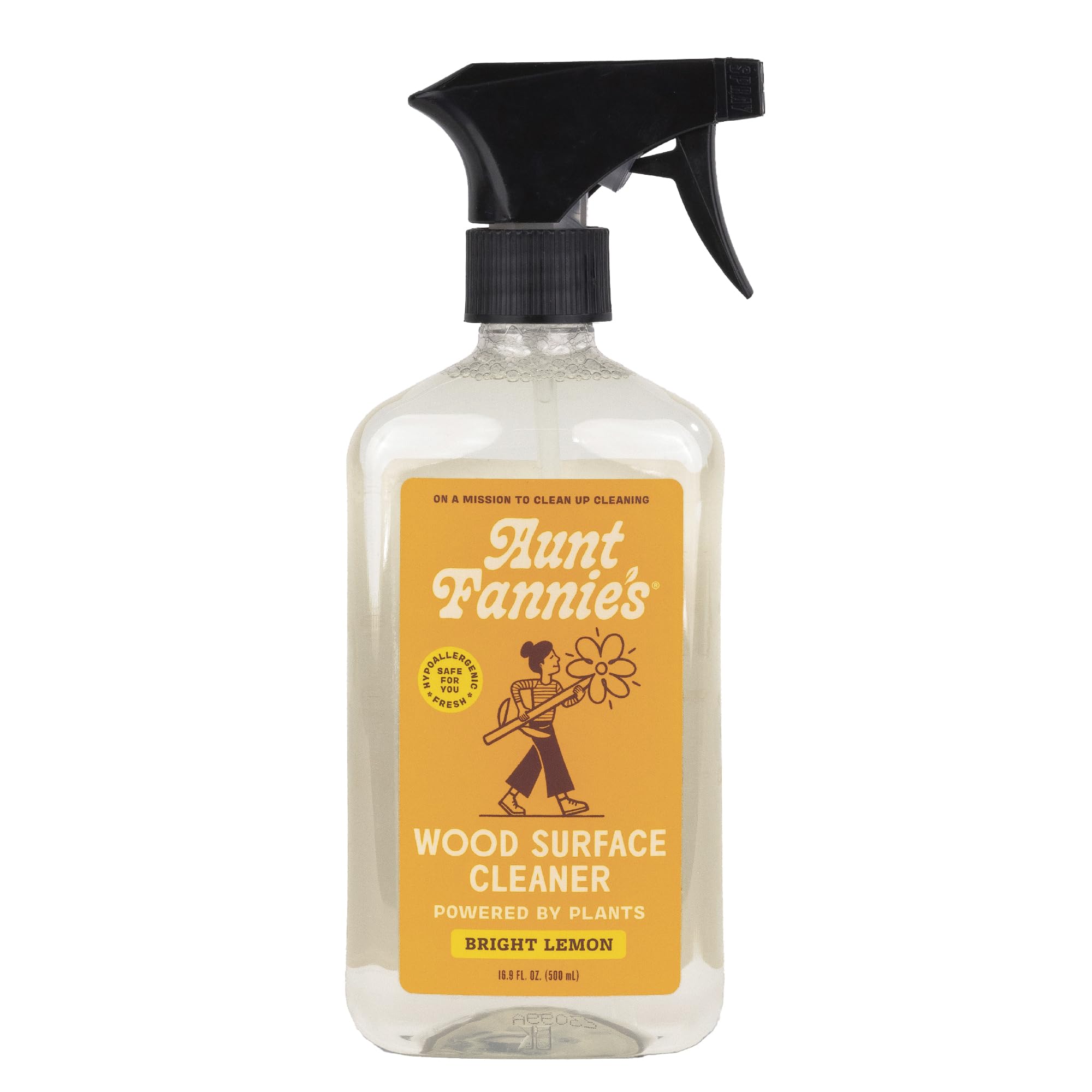
Aunt Fannie’s takes a chemistry-minimalist approach: it uses plant-derived enzymes to break down food soils, grease, and general kitchen grime without synthetic surfactants. The no-wax formulation means there is absolutely no layer left behind—the cleaner lifts debris into the cloth and leaves only a very faint lemon scent. This makes it the safest daily-use product for cabinets that are already sealed and do not require additional conditioning or wax protection. It is particularly valuable in households with asthma or scent sensitivities, where chemical-based polishes can trigger respiratory discomfort.
Users frequently mention that this product works well on textured cabinet surfaces where dirt gets trapped in the grain. The liquid is thin enough to seep into carved details and crevices without pooling, and a single pass with a microfiber cloth lifts the embedded grime. The EWG A-rating confirms that none of the listed ingredients carry known health hazards, which is rare in the cabinet cleaning category where many competitors contain glycol ethers or phthalates. The Leaping Bunny and vegan certifications expand its appeal to conscientious buyers.
The trade-off is that Aunt Fannie’s provides no conditioning or protective properties. It cleans and nothing more. If your cabinets feel dry or look faded, this spray will not restore the wood’s color or moisture. It is best used as a maintenance cleaner between deeper treatments with an oil or wax product. Given its moderate price point, it functions as a high-volume, residue-free option that can be used on walls, shelves, and trim without worrying about waxy buildup over time.
Why it’s great
- Safe for respiratory-sensitive households, no harsh chemical fumes
- Leaves zero residue, perfect for polished factory-finished cabinets
- Works into textured grain and crevices for thorough cleaning
Good to know
- Does not condition or protect the wood
- Smaller 16.9-oz bottle may require frequent repurchasing
FAQ
Can I use the same cleaner on both painted and stained cabinets?
How often should I clean my wood kitchen cabinets with a dedicated cleaner?
Does a wax-based cabinet cleaner protect against future damage?
Final Thoughts: The Verdict
For most users, the cleaner for wood kitchen cabinets winner is the Touch Of Oranges Wood Cleaner & Polish Spray because it combines real orange oil degreasing power with deep wood conditioning in a single, no-wax, no-silicone formula that suits heavily used kitchens and restorative applications alike. If you want a quick daily maintenance spray that leaves zero residue and is safe for scent-sensitive households, grab the Aunt Fannie’s All Purpose Wood Spray Cleaner. And for protecting vintage cabinets or creating a durable moisture barrier near steam-rich dishwashers, nothing beats the Goddard’s Cabinet & Wood Wax Spray with its beeswax-based layer that simplifies future cleanings.

Mo Maruf
I created WellFizz to bridge the gap between vague wellness advice and actionable solutions. My mission is simple: to decode the research and give you practical tools you can actually use.
Beyond the data, I am a passionate traveler. I believe that stepping away from the screen to explore new environments is essential for mental clarity and physical vitality.