Our readers keep the lights on and my smoothie glass nicely filled. As an Amazon Associate, I earn from qualifying purchases.
Brake dust doesn’t just make your wheels look neglected—it bonds to the finish and, over time, can etch into clear coats and alloy surfaces. A dedicated cleaner for wheels must tackle that metallic grime without stripping protective layers or requiring a chemistry degree to use correctly.
I’m Mohammad Maruf — the founder and writer behind WellFizz. I’ve spent hundreds of hours analyzing chemical formulations, pH balances, and customer use patterns across dozens of wheel cleaning products to understand what actually lifts iron particles versus what just foams up and smells strong.
The goal was simple: find the formula that balances cleaning aggression with finish safety. After digging into the specs and real-world feedback, I’ve narrowed it down to a tight list that represents the best cleaner for wheels available right now for different budgets and use cases.
How To Choose The Best Cleaner For Wheels
Wheel cleaners are not all cut from the same chemistry. Choose wrong and you either waste time scrubbing or risk damaging the finish. Focus on three things: the chemical aggressiveness relative to your wheel type, the physical format of the product, and whether you need a contact or a non-contact clean.
Acid vs. Non-Acid vs. pH-Neutral Formulations
Acid-based cleaners cut through brake dust fast but can etch uncoated or anodized wheels over repeated use. Non-acid formulas rely on alkaline surfactants to lift grime without the corrosion risk, making them safer for painted and powder-coated finishes. pH-neutral cleaners sit at the gentlest end of the spectrum—ideal for ceramic-coated or regularly maintained wheels but weaker on heavy buildup. Match the formulation to your wheel surface, not just to the grime level.
Ready-to-Use vs. Concentrate
A ready-to-use spray bottle gives convenience—spray, dwell, rinse. You pay a premium per ounce for that convenience. Concentrates, typically diluted at ratios from 1:1 up to 4:1, deliver far more cleaning capacity per dollar. If you detail multiple vehicles or clean wheels every week, a gallon concentrate is the smarter investment. If you want a single bottle for occasional washes, a ready-to-use formula simplifies the process.
Color-Changing Technology and Dwell Time
Color-changing wheel cleaners turn purple or red when they react with iron particles. That visual cue tells you the chemical is still actively working. The key is to let it dwell until the color stops changing—rinsing too early wastes cleaning power, leaving it on too long after the reaction finishes can let the formula dry, causing residue. For heavy contamination, a second application beats scrubbing harder with a brush.
Quick Comparison
On smaller screens, swipe sideways to see the full table.
| Model | Category | Best For | Key Spec | Amazon |
|---|---|---|---|---|
| SONAX Beast | Premium | Heavy brake dust removal | Color-changing pH-balanced formula, 33.8 oz | Amazon |
| Nanoskin Non Acid | Premium | Professional detailing, high volume | Concentrated 4:1 ratio, gallon bottle | Amazon |
| Griot’s Garage All Finishes | Mid-Range | Safe weekly maintenance | pH-balanced, 35 oz spray | Amazon |
| ExoForma 2-in-1 | Mid-Range | Tire browning and wheel grime | Dilutable 1:1 concentrate, 16 oz | Amazon |
| 303 Products Wheel & Tire | Mid-Range | Removing tire browning | Foaming spray, 16 oz | Amazon |
In‑Depth Reviews
1. SONAX Beast Wheel Cleaner

The SONAX Beast uses a color-changing chemistry that sprays on clear and turns deep purple on contact with iron particles. That visual feedback eliminates guesswork—you can see exactly where the brake dust still sits. The formula is acid-free and pH-balanced, so it won’t etch clear coats or corrode alloy surfaces even on sensitive anodized finishes, though SONAX recommends a spot test before full use.
Users consistently report that it cuts scrubbing time dramatically. One reviewer noted that after a harsh winter with heavy buildup, the Beast melted the dirt and grime off with far less effort than a standard cleaner. Another described it as the best wheel cleaner they’d ever owned, though they acknowledged the cost per use is higher than average, particularly for frequent washes.
At 33.8 fluid ounces, the bottle size is generous but the product is a ready-to-use spray, not a concentrate. Users advise wearing gloves because the formula is strong enough to irritate skin on contact. For heavily caked-on dust, a second application or light brush agitation delivers the best results without harming the wheel finish.
Why it’s great
- Color-changing technology shows exactly where iron contamination remains
- Acid-free pH-balanced formula protects clear coats and alloys
- Dramatically reduces scrubbing effort on heavy brake dust
Good to know
- Higher cost per ounce compared to concentrated alternatives
- Requires gloves during use to avoid skin irritation
- Not a concentrate—no dilution flexibility
2. Nanoskin Non Acid Professional Wheel & Tire Cleaner

Nanoskin delivers a concentrated non-acid formula designed for high-volume use. The recommended dilution ratio is 4:1, meaning a single gallon produces five gallons of ready-to-use cleaner—ideal for mobile detailers or owners of multiple vehicles. The advanced alkaline chemistry uses Xtreme Cling technology to produce thick foam that stays on vertical wheel surfaces, increasing dwell time and lifting brake dust without aggressive scrubbing.
Professional users report that this product outperforms many brand-name alternatives while costing significantly less per use. One detailing business owner switched to Nanoskin after testing it daily and found it consistently broke down the nastiest wheels without needing additional chemicals. Several customers noted that with no dilution at all, the cleaner can work as a no-contact spray—apply, let it dwell for a minute, and rinse off without ever touching the wheel.
The 9-pound gallon jug is heavy but efficient. Users do mention a strong chemical odor during application, though it dissipates quickly after rinsing. The non-acid formulation makes it safe for clear-coated, powder-coated, chrome, and factory-painted wheels, though it is not pH-neutral—alkaline-based, so it’s stronger than gentle maintenance sprays but still safer than acid-based competitors.
Why it’s great
- Outstanding value at 4:1 dilution—five gallons from one gallon
- Thick foaming cling technology for vertical wheel surfaces
- Can be used as a no-contact cleaner at full strength
Good to know
- Strong chemical odor during application
- Heavy gallon jug, not a small spray bottle
- Alkaline formula is stronger than pH-neutral options
3. Griot’s Garage Wheel Cleaner for All Finishes
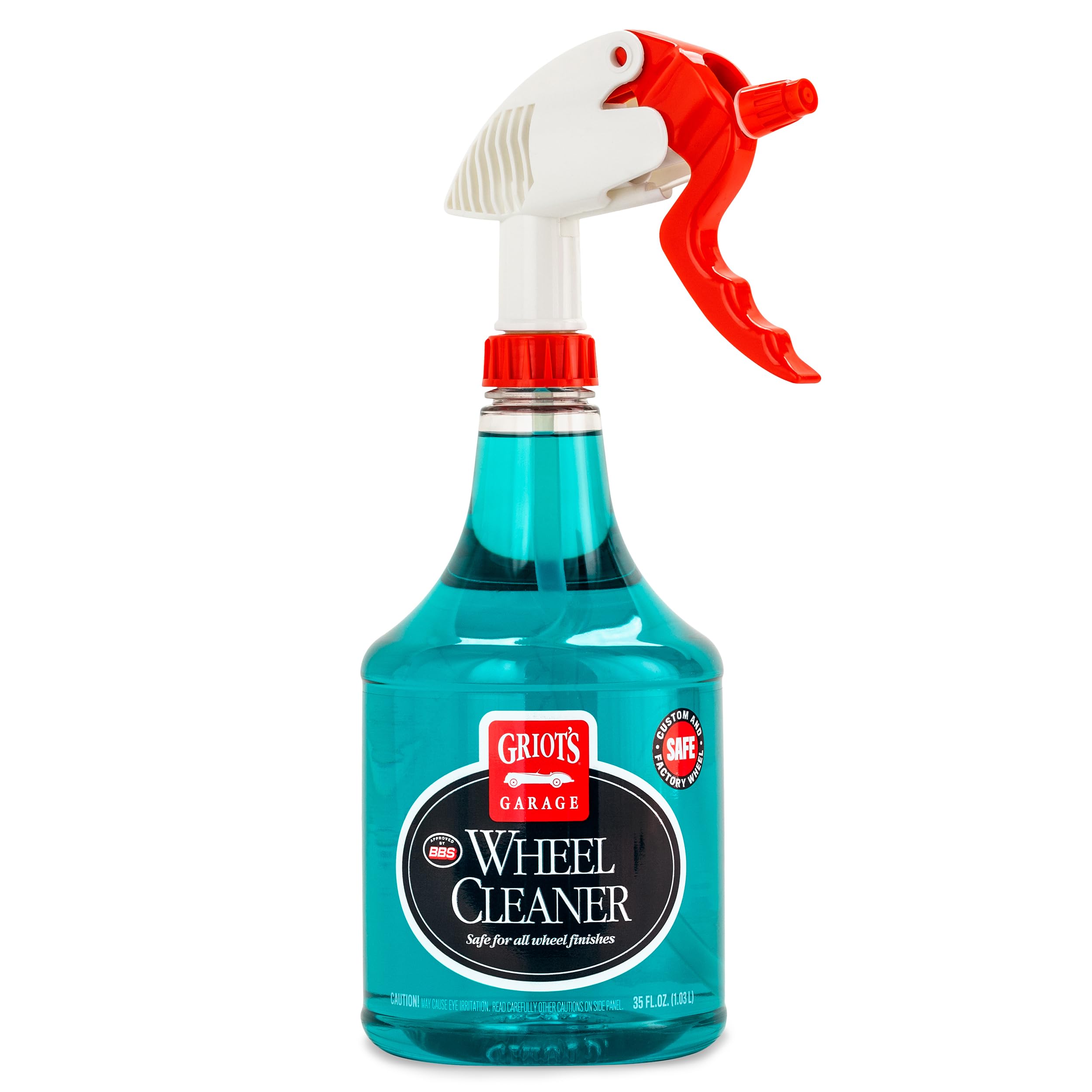
Griot’s Garage positions this wheel cleaner as a pH-balanced solution safe for all wheel finishes—chrome, polished, powder-coated, aluminum, and steel. It tackles brake dust, tar, and road grime without containing iron removers, making it a gentler weekly maintenance product rather than a heavy-duty stripper. The formula sprays onto a cool, damp wheel and requires a dwell time of at least 30 seconds before agitation.
Feedback from owners of higher-end vehicles, including an Aston Martin, confirms that the product removes brake dust effectively without pitting or damaging the wheel surface. One reviewer noted that the cleaner works well with a sponge but is not a true spray-and-rinse product—you need to physically wipe or brush to lift the grime. Another experienced user pointed out that because it lacks iron-removing agents, it’s weaker on heavily baked-on contamination than color-changing alternatives, which is exactly why it’s safe for ceramic-coated wheels.
At 35 fluid ounces, the bottle is larger than most mid-range competitors, offering good coverage per application. The lack of iron removers means it won’t strip ceramic coatings, making this the right pick if you maintain a protected wheel finish and want a cleaner that won’t undo that protection. The trade-off is that you’ll need to scrub more on neglected wheels.
Why it’s great
- Safe for all wheel finishes including ceramic-coated surfaces
- Large 35-ounce bottle provides ample coverage
- No iron removers means no risk of stripping protective layers
Good to know
- Requires physical agitation—not a no-contact cleaner
- Weaker on heavy, baked-on brake dust compared to color-changing formulas
- Not a concentrate, so cost per wash is higher
4. ExoForma Wheel & Tire Cleaner

ExoForma takes a 2-in-1 approach, formulated to clean both the wheel face and the tire sidewall in a single application. The specific claim is that it removes brownish oxidation gunk from tires—a type of staining that standard wheel cleaners often miss. As a dilutable concentrate with a 1:1 ratio, it offers flexibility: use it full strength for heavy contamination or stretch it for routine maintenance washes.
Users with older pitted chrome rims reported that the ExoForma formula cleaned both tires and old chrome with one application per wheel, outperforming major brands like Meguiar’s, Turtle Wax, and Armor All in direct comparison. The bottle covered three trucks with some left over for a motorcycle, giving good coverage despite its modest 16-ounce size. Backyard detailers found it essential for preparing tires for dressings, as it removes silicone residues and old polymers that prevent new dressings from bonding.
The product includes a QR code for a refill discount, a nice touch for repeat buyers. It’s not the strongest iron remover on the market—it relies more on surfactant action than chemical reaction—so heavily embedded brake dust on neglected wheels will still need some brush work. But for regular maintenance and tire browning, it punches above its price tier.
Why it’s great
- 2-in-1 formula cleans wheels and tires in one pass
- Effectively removes brown tire oxidation that other cleaners miss
- Dilutable 1:1 concentrate extends value per bottle
Good to know
- Not as strong on heavy iron particle buildup as dedicated iron removers
- 16-ounce size is smaller than most competitors
- Requires agitation for stubborn deposits
5. 303 Products Wheel and Tire Cleaner

303’s foaming formula targets both wheels and tires, with a particular strength in removing tire browning—the ugly brown stain that develops on sidewalls over time. The foam clings to vertical surfaces and works best when applied with a tire brush in circular motions. Users recommend a dwell time of no more than 30 seconds, drying with a microfiber towel afterward to prevent white residue from forming.
Multiple customers reported that the product was effective at cleaning one-year-old Michelin tires with minimal effort, lifting browning that soap-and-water alone couldn’t touch. The 303 brand carries strong loyalty among users who trust its full ecosystem of products, with one reviewer stating that 303 products excel across the board. However, significant shipping issues surfaced repeatedly—bottles arrived leaking in the box due to inadequate packaging, and Amazon fulfillment problems led to multiple refund requests.
The 16-ounce bottle is on the smaller side, but the foaming action helps it spread farther than a liquid of the same volume. It pairs naturally with 303’s tire dressing, which leaves a satin black finish without petroleum or silicone. If you buy from a physical store, you avoid the leak risk entirely, making this an excellent option for in-person purchase.
Why it’s great
- Excellent at removing brown tire sidewall staining
- Foaming formula clings well to vertical tire and rim surfaces
- Pairs seamlessly with 303 tire dressing for a complete system
Good to know
- Frequent reports of bottles leaking during shipping
- White residue if not dried immediately with a towel
- Cannot leave on for more than 30 seconds to avoid streaking
FAQ
Can I use wheel cleaner on ceramic-coated wheels?
How long should I let wheel cleaner sit before rinsing?
What is the difference between wheel cleaner and tire cleaner?
Final Thoughts: The Verdict
For most users, the best cleaner for wheels winner is the SONAX Beast because its color-changing technology eliminates guesswork and cuts scrubbing time dramatically while remaining safe on clear-coated and alloy wheels. If you want the best value per wash and detail multiple vehicles, grab the Nanoskin Non Acid gallon. And for a gentle, pH-balanced weekly cleaner that protects ceramic coatings, nothing beats the Griot’s Garage All Finishes.

Mo Maruf
I created WellFizz to bridge the gap between vague wellness advice and actionable solutions. My mission is simple: to decode the research and give you practical tools you can actually use.
Beyond the data, I am a passionate traveler. I believe that stepping away from the screen to explore new environments is essential for mental clarity and physical vitality.