Our readers keep the lights on and my smoothie glass nicely filled. As an Amazon Associate, I earn from qualifying purchases.
Specs are compiled from manufacturer listings and verified buyer reviews and can change over time — please confirm the key details on the product page before buying.
Hardie board siding looks sharp for years — until algae, mildew, and grime turn that crisp curb appeal into a dull, streaky mess. The risk with fiber-cement siding is that aggressive pressure washing or harsh chemicals can damage the surface or leave a chalky residue. The right cleaner gets the filth off without harming the material, saving you elbow grease and protecting your home.
I’m Mohammad Maruf — the founder and writer behind WellFizz. This guide is built by comparing the manufacturers’ published specifications and the patterns across verified customer reviews, so you get each pick’s real strengths and trade-offs instead of marketing spin.
We have matched each formula to the unique demands of fiber cement, from concentrate coverage to surface safety. After combing through the owner experiences and raw specs, these are the three standout contenders for best cleaner for hardie board siding.
Our Picks at a Glance

How To Choose The Best Cleaner For Hardie Board Siding
Hardie board is a cement-and-fiber composite that is tougher than wood but more porous than vinyl. The wrong cleaner — especially one with harsh acids or high-pressure blasting — can etch the surface or force moisture behind the boards. You want a formula that dissolves organic growth (mold, mildew, algae) and rinses away without leaving a sticky residue.
Concentrate vs. Ready-to-Use
Concentrates cost less per square foot of coverage and let you dial in the strength for heavy grime. A ready-to-use spray is convenient for quick touch-ups but runs out fast on a full house. Most owners mixing their own find a 1:1 or 4:1 water-to-chemical ratio works for routine cleaning, while tougher stains might call for a stronger mix.
Surface Compatibility
Look for a formula that explicitly lists cement, stucco, brick, or fiber cement on the label. Cleaners designed only for wood or vinyl may contain bleach concentrations that discolor Hardie board or leave a chalky film. The best picks are pH-balanced or biodegradable options that break down in the soil after rinsing.
Application Method
Some formulas work with a garden sprayer and a soft brush, others are designed to be run through a pressure washer. If you want to avoid high-pressure risks, a hose-end sprayer or pump sprayer is the safer route. Check whether the product says “no pressure washing needed” — that is a strong signal of gentle cleaning.
Quick Comparison
In‑Depth Reviews
1. Zep House and Siding Pressure Wash Cleaner Concentrate – 1 Gallon (Case of 2)
Our pick — over 4★ from 550+ verified ratings; the strongest balance of quality and price.
The high-yield concentrate that turns one gallon into twenty, covering an entire home.
This Zep formula is the crowd favorite for good reason: it is explicitly safe for cement and Hardie Plank siding, and a single case of two gallons makes up to 20 gallons of ready spray — enough to cover 5,000 square feet. That kind of coverage means you can wash the whole house, the fence, and the driveway without running back to the store. The concentrate dilutes in a pressure washer or a garden sprayer, so you choose the method that fits your comfort level.
Owners who tackled heavy buildup mixed it full-strength, sprayed it on, brushed the worst spots, and rinsed with a hose. The feedback is consistent: mold, algae, and dirt come off completely, and the savings versus hiring a pressure-washing crew are significant. The thing everyone raves about is the cleaning performance — it beats out every other aspect by a wide margin. The only recurring note is that some stubborn stains need a second pass and a bit of scrubbing, but that is true of most non-acidic cleaners.
The 8-pound weight of the case is manageable, and the product leaves no visible residue when you rinse from top to bottom. If you own a pressure washer and want a construction-grade cleaner that handles cement-based siding as well as vinyl and wood, this is the one that earns its spot at the top of the list. Anyone who prefers a completely no-pressure application might find the Zep works better with a machine than a spray bottle.
Pro-grade cleaning reach: The 5,000 sq. ft. coverage from a single case outperforms smaller concentrates on price-per-square-foot, and the streak-free formula means no chalky residue on your Hardie boards.
One honest trade-off: If you are not using a pressure washer, this cleaner still works with a garden sprayer, but heavier stains will need manual scrubbing — it is not a spray-and-walk-away formula for deep-set grime.
Reach for this if: you have a pressure washer, want industrial-grade results, and need maximum coverage from a single purchase.
Look elsewhere if: you are dead-set on a no-tools, hose-only approach and want zero scrubbing — the 30 Seconds line is easier for that.
2. 30 Seconds Outdoor Cleaner Concentrate, 1.3 Gallon
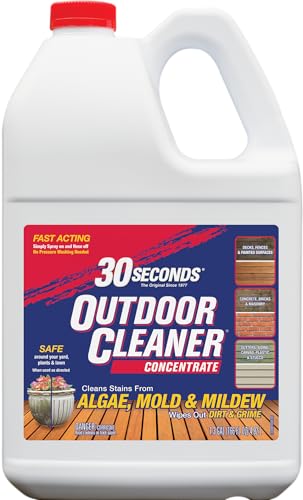
The spray-and-hose-off formula that cleans a fence in 45 minutes — no pressure washer required.
This 1.3-gallon concentrate is the pick for anyone who wants to avoid high-pressure equipment entirely. The official coverage is 1,800 square feet, and the mixing instructions call for a simple 1:1 ratio with water. The brand’s reputation for “spray on, wait, hose off” cleaning is real: one owner reports scrubbing a white vinyl fence in 45 minutes versus more than two hours with a pressure washer. For Hardie board siding, this means you can tackle the whole house with a hose-end sprayer and a soft brush for the stubborn spots.
The formula works on a wide range of outdoor surfaces — decks, concrete, brick, stucco, and painted surfaces — and it is safe around plants and lawns when used as directed. The buyers’ consensus lands on effectiveness and ease of use as the strongest points. A handful of owners note that deep streaks on heavy growth may need a second application, which tracks with any mild cleaner that avoids harsh bleach. One buyer mentions the formula can create white spots on dark clothing, so cover your gear.
At 166.4 fluid ounces per jug, it is a solid mid-range volume. Compared to the Zep, the 30 Seconds is the gentler, more forgiving option that works beautifully when you just want to spray and rinse without breaking out the heavy machinery.
What wins owners over
- No pressure washer needed — a garden hose and sprayer do the job
- Safe around landscaping and lawns when used as directed
- Cleans white vinyl fence walls in about 45 minutes vs. 2+ hours with a power washer
The honest caveats
- Heavy mold or deep-set stains may require a second application or light brushing
- Can bleach or spot dark fabrics — wear clothes you do not care about
This one fits if: you want low-effort cleaning, own a garden sprayer, and value plant-safe chemistry over brute-force scrubbing.
Think twice if: your Hardie board has thick, years-old grime and you want a one-pass killer — the Zep with a pressure washer is stronger for that.
3. 30 Seconds Outdoor Cleaner 1000 Sq. Ft. Concentrate 5 Gal

Five gallons of biodegradable concentrate built to blast through a whole property without reloading.
This is the bulk-format version of the same 30 Seconds formula, scaled up for large homes, rental properties, or anyone who refuses to buy cleaning chemicals twice in one season. The 5-gallon pail weighs 86 pounds when full, so it is a heavy delivery — but the payoff is having multiple seasons worth of siding cleaner in one container. The formula is marked as biodegradable, which matters for runoff into flower beds and lawn areas.
Owner experiences mirror the smaller jug: spray it on straight or diluted, wait a few minutes, and rinse. One buyer on a camping trip used it on a camper and reported the rig “looks new again” after a single application. For Hardie board, this is the same plant-safe, pressure-washer-free chemistry as the 1.3-gallon version, just at a fraction of the per-ounce cost. The heavier stains on siding may still need a brush or a second coat, as one owner noted for “light grime and mildew” versus heavier buildup.
If you are cleaning a large two-story house or multiple buildings, the 5-gallon size saves you repeat trips to the hardware store. Just make sure you have a sturdy dolly or a helper — 86 pounds is not something you want to carry up a ladder.
Season-long supply: At 640 fluid ounces, this jug holds nearly five times the 1.3-gallon size, and the biodegradable formulation means you can rinse freely without worrying about harming your yard.
The honest physical cost: The 86-pound weight of the full pail is a genuine handling challenge — you will want to decant it into smaller spray bottles rather than carry the whole thing around the house.
Grab this if: you have a large home, a landlord portfolio, or simply want the lowest per-gallon price and the convenience of a single purchase that lasts.
skip it if: you only need to wash a small bungalow or a single wall — the 1.3-gallon jug is easier to handle and will not leave you with five gallons of open concentrate to store.
Understanding the Specs
Coverage (Square Feet)
This tells you how much cleanable surface area one container covers once diluted. A product like the Zep that covers 5,000 square feet per case can handle a typical 2,000-square-foot house plus the garage. If the label does not list coverage for your specific siding type, aim for a conservative estimate — fiber cement often absorbs more solution than vinyl, so you may use slightly more per pass.
Concentrate Ratio
Most outdoor cleaners need mixing with water before use. A 1:1 ratio (equal parts cleaner and water) is typical for heavy mildew; a 4:1 or 5:1 ratio is for lighter maintenance. The advantage of concentrate is that you control the strength. Ready-to-use formulas cost more per square foot and limit your options on tough stains. Always read the mixing guide for your specific surface — Hardie board does well with a moderate mix that does not oversaturate the pores.
FAQ
Can I use a regular house wash on Hardie board siding?
Do I need a pressure washer for these cleaners?
How often should I clean Hardie board siding?
Will these cleaners damage my plants or lawn?
How long do I need to leave the cleaner on the siding?
What is the difference between the 1.3-gallon and 5-gallon 30 Seconds pails?
Can I mix these cleaners with bleach for stronger cleaning?
Will these cleaners remove chalky white residue from old Hardie board?
Final Thoughts: The Verdict
For most people, the best cleaner for hardie board siding winner is the Zep House and Siding Pressure Wash Cleaner because its 5,000 sq. ft. coverage and construction-grade formula give you the most cleaning power for the widest range of siding types. If you want a hose-only, no-pressure-washer solution, grab the 30 Seconds Outdoor Cleaner 1.3 Gal. And for whole-house bulk that lasts multiple seasons, the 30 Seconds 5 Gal pail is the one to reach for.
How We Picked
We do not accept paid placement. Every pick is matched to a real buyer and a real use-case; we do not hands-on test units.
Sources & Methodology
Specifications: manufacturer listings and product documentation. Review insights: verified customer reviews, as of July 2026. Pricing: not shown on this page (it changes often); check the current price via the retailer link.
As an Amazon Associate, WellFizz earns from qualifying purchases. This does not affect which products we feature.
Related Guides

Mo Maruf
I created WellFizz to bridge the gap between vague wellness advice and actionable solutions. My mission is simple: to decode the research and give you practical tools you can actually use.
Beyond the data, I am a passionate traveler. I believe that stepping away from the screen to explore new environments is essential for mental clarity and physical vitality.