Our readers keep the lights on and my smoothie glass nicely filled. As an Amazon Associate, I earn from qualifying purchases.
A diesel particulate filter clogged with soot forces your truck into limp mode or an endless regeneration cycle that wastes fuel and time. The chemistry that breaks down that accumulated carbon inside the DPF channels is what separates a real solution from a simple fuel conditioner. A treatment that lowers the combustion temperature of trapped soot lets the filter burn itself clean without a trip to the shop.
I’m Mohammad Maruf — the founder and writer behind WellFizz. I’ve spent hundreds of hours analyzing independent lab data, customer regen-interval logs, and injector-cleanup results to identify which DPF-focused chemistries actually deliver measurable regeneration improvements.
If your service interval is shrinking and you’re staring down a forced regen at the dealership, the right chemistry can buy you thousands of miles of trouble-free operation. This guide breaks down seven contenders to help you find the best cleaner for dpf based on real-world performance data rather than marketing claims.
How To Choose The Best Cleaner For DPF
Choosing a DPF cleaner starts with understanding whether you need a fuel-system flush that tackles injector deposits first, or a direct soot-burning regenerator that targets the filter itself. Many products do one or the other, and using the wrong type wastes money and leaves your DPF still partially blocked.
Regeneration Chemistry vs. Deposit Removal
The two core mechanisms are soot-combustion catalysis and injector-deposit dissolution. Products that lower the temperature at which soot ignites — often using cerium or iron-based compounds — allow passive regeneration to happen during normal driving rather than only during high-load highway runs. Injector cleaners focus on restoring spray patterns so unburned fuel never reaches the DPF in the first place. The best approach often combines both functions.
Concentration and Treatment Volume
A 500-milliliter bottle treats roughly 20 to 26 gallons of diesel, while a full 64-ounce container handles larger fuel tanks or multiple treatments. Check your tank size and the recommended dose ratio — over-diluting reduces effectiveness, while under-diluting can foul sensors. Some products allow continuous use at lower concentrations for ongoing maintenance.
Quick Comparison
On smaller screens, swipe sideways to see the full table.
| Model | Category | Best For | Key Spec | Amazon |
|---|---|---|---|---|
| Lucas Oil 10873 Diesel Deep Clean | DPF Focused | Clogged DPF recovery | 32% particulate reduction | Amazon |
| Power Service Diesel Injector & DPF Flush | Dual Action | Injector + DPF flush | REGENEXTEND reduces regen 50% | Amazon |
| BG 245 Premium Diesel Fuel System Cleaner | Pro Grade | Stubborn injector deposits | High-pressure common rail focus | Amazon |
| Stanadyne Performance Formula | Maintenance | Continuous protection | 4% average MPG improvement | Amazon |
| Wynn’s DPF Regenerator | Temperature Catalyst | Lowering soot burn temperature | 500ml treats 26 gallons | Amazon |
| Liqui-Moly Diesel Purge | Direct Purge | Direct injector cleaning | 16.9 oz applied to fuel filter | Amazon |
| Hot Shot’s Secret Fuel Duo | Dual Bottle | Cetane boost + lubrication | Lowers regen cycles 50% | Amazon |
In‑Depth Reviews
1. Lucas Oil 10873 Diesel Deep Clean

The Lucas Diesel Deep Clean targets the DPF directly by chemically reducing particulate matter by up to 32 percent — a measurable spec that few competitors publish. One full 64-ounce bottle poured into a nearly empty tank followed by a forced or highway-driven regen has resolved DPF-full warnings on Ram 6.7 Cummins, Nissan XD 5.0, and Duramax platforms according to verified user reports. The cleaner dissolves exhaust deposits that bridge the filter channels without requiring filter removal.
Real-world regen interval improvements are substantial — one driver saw their DPF gauge drop from full to zero after a 30-mile drive following treatment, saving a replacement. The formula also cleans injectors as a secondary mechanism, which reduces the fresh soot load entering the filter. Users report smoother idle and restored fuel economy, with MPG climbing from 17.8 back to 20.2 on one documented test. The 64-ounce volume covers large tanks or multiple treatments on smaller systems.
The product works best when used in a full-tank shock treatment, though some owners add 16 ounces every fourth fill-up for ongoing maintenance. That continuous-use approach keeps the DPF from accumulating heavy deposits between full treatments. The only downside is the bottle size — it takes up storage space, and the initial price is higher than smaller single-use bottles.
Why it’s great
- Verified DPF unclogging in under 30 minutes of driving
- Published 32% particulate reduction backed by user data
- Works as both shock treatment and continuous maintenance
Good to know
- Large bottle may be excessive for small diesel cars
- Best results require a forced regen or sustained highway run
2. Power Service Diesel Injector & DPF Flush

Power Service’s newest formulation uses REGENEXTEND technology to slash regen frequency and duration by up to half while also removing internal diesel injector deposits in a single tank. The 64-ounce bottle treats the entire fuel system — injectors, DPF, turbo, EGR, and MAF sensor — making it one of the most comprehensive single-dose treatments available. The chemistry specifically targets nozzle coking and IDIDs that degrade spray patterns and push unburned fuel into the DPF.
A 2006 Duramax LBZ with 240,000 miles showed dramatically reduced smoke, quieter idle, and restored power after one treatment. A 2017 6.7 Powerstroke owner using it preventatively noted minor tailpipe smoke for about a minute during the cleaning cycle, which the manufacturer confirms is normal as deposits burn off. The product also reduces NOx and black smoke by up to 50 percent according to the spec sheet, making it a strong choice for emissions-conscious operators.
The single-tank treatment model means you don’t have to track multiple doses or remember additive schedules — pour the full bottle in before filling up and drive normally. That simplicity comes at a premium price point, but it replaces the need for separate injector cleaner and DPF regenerator products. Some users report no noticeable change after a single treatment, suggesting heavily clogged systems may require a second application.
Why it’s great
- REGENEXTEND cuts regen frequency by up to 50%
- One bottle cleans injectors, DPF, EGR, and turbo
- Single-tank treatment eliminates guesswork
Good to know
- Higher initial cost per treatment compared to smaller bottles
- Heavily clogged filters may need repeated applications
3. BG 245 Premium Diesel Fuel System Cleaner

BG 245 is a professional-grade cleaner designed specifically for high-pressure common rail injection systems, which are notoriously sensitive to deposit buildup. Unlike pour-in-tank additives that work across the whole fuel volume, BG 245 is often applied directly by dealerships and independent shops. The concentrated formula targets hard carbon deposits inside injector tips that cause rough idle, poor cold starts, and increased soot load on the DPF.
A Case 580C backhoe with a rough idle issue saw the problem resolved after running half a bottle at fast idle for 15 minutes — the deposits broke loose without pulling injectors. Duramax 3.0L owners report using it at 95,000 miles as part of routine maintenance to keep the common rail system clean. The downside is that the bottle lacks clear mixing instructions, so users need to research the correct ratio for their specific engine or rely on a service center for application.
This product works best as a periodic deep clean rather than a continuous additive, and it excels at preventing the injector degradation that causes DPF overloading in the first place. It is not designed to directly lower soot combustion temperature like a dedicated regenerator, but by restoring clean injector spray patterns it reduces the soot entering the filter. The premium price per ounce reflects the professional-grade chemistry.
Why it’s great
- Professional-grade formula targets common rail injector deposits
- Resolved rough idle on high-hour equipment quickly
- Prevents soot overloading by restoring spray patterns
Good to know
- Bottle lacks usage directions — requires research or pro application
- Not formulated to lower DPF soot combustion temperature
4. Stanadyne Performance Formula Diesel Fuel Additive

Stanadyne Performance Formula is a fuel additive first and a DPF cleaner second, but its impact on filter health is significant because it attacks soot at the combustion stage. Laboratory tests show an average 4 percent MPG improvement with gains up to 9.6 percent, and reduced smoke and particulate emissions. The cetane improver refines the burn quality so fewer unburned carbon particles enter the exhaust stream in the first place.
Six-point-seven Powerstroke owners specifically choose this formula for CP4 pump protection, since the lubricity improvers restore lubrication to ultra-low-sulfur diesel, reducing internal wear that can lead to injector failure and DPF contamination. Two half-gallon jugs provide enough volume for multiple fill-ups, making this a cost-effective maintenance solution for high-mileage drivers. Users on 10-year continuous use report no fuel-related issues and consistent regen intervals.
The formula does not directly lower soot combustion temperature in the filter, so it is not a rescue product for an already-clogged DPF. It works best as a preventive measure that reduces how often you need aggressive regeneration cycles. The 2-pack format requires upfront investment but lowers the per-treatment cost for users who commit to adding it at every fill-up.
Why it’s great
- Proven CP4 pump protection via lubricity additives
- Reduces particulate emissions at the combustion stage
- Bulk 2-pack brings per-treatment cost down
Good to know
- Does not actively clean an already clogged DPF
- Best suited for maintenance rather than rescue operations
5. Wynn’s Diesel Particulate Filter Regenerator
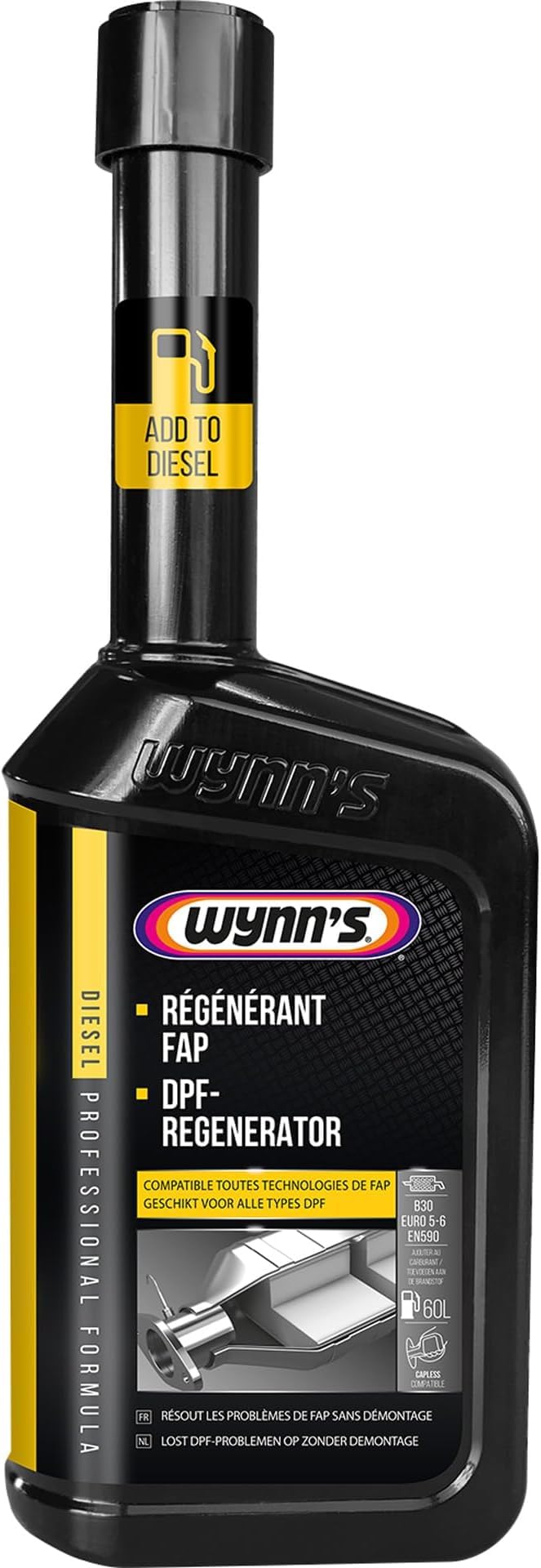
Wynn’s DPF Regenerator uses a catalytic approach — it lowers the combustion temperature of trapped soot so the particles burn off faster during passive regeneration without dismantling the filter. The 500-milliliter bottle treats approximately 26 gallons of diesel fuel, and the chemistry is designed specifically for blocked diesel soot filters rather than general fuel system cleaning. The label notes it is for professional use, though DIY owners have used it successfully.
One documented test showed the regen interval increased from 384 miles to 462 miles after a 1,000-milliliter treatment in 26 gallons, representing a 78-mile gain over baseline. Injector balance numbers improved, idle fuel consumption dropped, and regen soot levels fell to 2 grams. Another owner reported that the van ran like it had a new motor the morning after treatment, with effects lasting through most of the fuel tank. The product takes time to show full results — it is not an instant fix.
The value proposition is strong for users who want a dedicated soot-burn catalyst at a low entry price. However, the bottle size is small, and heavily clogged filters may require multiple applications. The professional designation also means some users report confusion about the proper dilution ratio for their specific vehicle.
Why it’s great
- Catalyzes soot combustion at lower temperatures
- Proven regen interval extension in real-world testing
- Low initial cost for entry-level DPF maintenance
Good to know
- Small bottle may require multiple treatments for severe clogs
- Professional formula lacks consumer-friendly dosing guides
6. Liqui-Moly Diesel Purge Injection Cleaner

Liqui-Moly Diesel Purge is a direct injection cleaner, not a pour-in-tank additive — you introduce it directly into the fuel filter or a bypass line so that 100 percent of the cleaning agent passes through the injectors undiluted. This method concentrates the solvent power on the injector tips where deposit buildup alters spray patterns and causes the rough idle and smoke that often precede DPF issues. The 2-pack gives you two treatments, one for immediate cleaning and a second for follow-up maintenance.
Users report dramatic results in minutes. A 2003 VW TDI that ran rough with smoking startup ran perfectly smooth and smoke-free after one treatment. A Toyota diesel with persistent stumbling and bucking that fuel filter changes had not fixed saw a 50 percent power increase within five minutes. The product also quieted engine noise immediately. For preventive maintenance, one 2005 VW Jetta TDI owner uses a can during each fuel filter change and reports faster acceleration with no startup smoke at 207,000 miles.
The limitation is that Diesel Purge does not directly treat the DPF — it cleans the injectors so that the engine stops producing the excess soot that clogs the filter. If your DPF is already blocked, this product alone will not clear it. It works best as a complementary tool used alongside a dedicated DPF regenerator. The direct-injection method also requires some mechanical comfort with fuel system access.
Why it’s great
- 100% undiluted cleaning agent reaches injectors directly
- Resolved rough idle and smoke in under 5 minutes
- Excellent preventive maintenance at fuel filter changes
Good to know
- Does not directly clean an already clogged DPF
- Requires fuel filter access for direct application
7. Hot Shot’s Secret Fuel Duo – Diesel Extreme & EDT

Hot Shot’s Secret Fuel Duo bundles two products — Diesel Extreme for deep system cleaning and Everyday Diesel Treatment for ongoing lubrication and moisture control. Diesel Extreme raises cetane by up to seven points and claims to cut DPF regeneration cycles by as much as 50 percent, which puts it in direct competition with the dedicated DPF-focused formulas. The EDT bottle uses LX4 Lubricity Extreme to minimize friction and protect the CP4-style high-pressure fuel pumps common in modern diesels.
A GMC 2500HD Duramax 6.6L owner reported that a ticking engine noise stopped after four weeks of regular use, along with improved turbo response and throttle feel. Ecodiesel owners specifically note that the combo protects against fuel pump failures, a known vulnerability in Euro-style common rail systems. The recommended dosage is one quart of Diesel Extreme per 80 gallons roughly every 6,000 miles, with EDT added at 1-2 ounces per 25 gallons at each fill-up. That dual regimen keeps both the injectors and the fuel system lubricated year-round.
The DPF cycle reduction claim is significant, but it depends on the engine starting from a relatively healthy baseline — severely clogged filters may need a more aggressive dedicated product first. The 2-bottle system also requires a two-step approach that some users find more complicated than a single-bottle treatment. Once you establish the routine, however, the per-mile cost becomes very competitive.
Why it’s great
- Cetane boost up to 7 points improves combustion quality
- Claims 50% reduction in DPF regen cycles
- LX4 lubricity additive protects CP4 pumps
Good to know
- Two-step regimen requires tracking separate doses
- Less effective on already-clogged DPFs without pretreatment
FAQ
Can a DPF cleaner fix a fully clogged filter or do I still need a forced regen?
Should I use a DPF regenerator or an injector cleaner for soot problems?
How often should I treat my diesel with a DPF cleaner for maintenance?
Final Thoughts: The Verdict
For most users, the best cleaner for dpf winner is the Lucas Oil 10873 Diesel Deep Clean because its 32-percent particulate reduction spec is backed by real-world DPF unclogging reports across multiple platforms and it works as both a rescue treatment and ongoing maintenance. If you want a comprehensive injector-plus-DPF flush, grab the Power Service Diesel Injector & DPF Flush. And for preventive, continuous protection, nothing beats the Stanadyne Performance Formula.

Mo Maruf
I created WellFizz to bridge the gap between vague wellness advice and actionable solutions. My mission is simple: to decode the research and give you practical tools you can actually use.
Beyond the data, I am a passionate traveler. I believe that stepping away from the screen to explore new environments is essential for mental clarity and physical vitality.