Our readers keep the lights on and my smoothie glass nicely filled. As an Amazon Associate, I earn from qualifying purchases.
Specs are compiled from manufacturer listings and verified buyer reviews and can change over time — please confirm the key details on the product page before buying.
Choosing the wrong clamp meter for electricians means chasing ghost voltages or fumbling with tight wires you can’t reach. The real difference isn’t brand hype—it’s whether the meter handles your specific daily jobs without adding friction. This guide shows you the models that earned their spot through accuracy, safety ratings, and real-world ease of use.
I’m Mohammad Maruf — the founder and writer behind WellFizz. This guide is built by comparing the manufacturers’ published specifications and the patterns across verified customer reviews, so you get each pick’s real strengths and trade-offs instead of marketing spin.
You will find the best clamp meter for electricians broken down by who each model actually suits, from commercial workhorses to budget-friendly entry points that still deliver true RMS and proper CAT safety ratings.
Our Picks at a Glance


How To Choose The Best Clamp Meter For Electricians
An electrician’s clamp meter lives in your hand every day, so picking the wrong one adds frustration — missed readings, risky exposure, or a battery drain at the wrong moment. Focus on these four factors instead of flashy feature lists.
Safety rating: CAT III vs. CAT IV
The safety category tells you how much transient energy (sudden power surges or arc flash) the meter can survive without failing. CAT III 600V or 1000V covers most panel work in residential and commercial buildings. CAT IV 600V handles service-entrance work and outdoor utility connections. A meter without a clearly stated CAT rating is not suitable for live electrical work.
True RMS vs. average-sensing
True RMS (Root Mean Square) calculates the heating value of an AC waveform accurately even when the waveform is distorted by motors, VFDs, or LED drivers. An average-sensing meter only gives a correct number on a clean sine wave, which you rarely see in modern buildings. If your job touches any electronic load, you need True RMS.
Jaw size and iFlex probes
The jaw opening determines which wires fit. A 1.2-inch jaw handles most 4/0 cables, but you need an iFlex Rogowski coil to wrap around bundled or oversized conductors. The Fluke 376 FC and 381 use iFlex to reach 2500A AC in spaces a hard jaw cannot enter.
Inrush current capture
Starting current of a motor or compressor can be 5-10x the running current. A meter with an inrush mode captures that brief surge so you can diagnose startup failures. Without it, the meter just shows zero or the running current.
Quick Comparison
| Model | Best For | Max AC Current | Safety Rating | iFlex / Wireless | Amazon |
|---|---|---|---|---|---|
| Fluke 376 FC★ Best Overall | Commercial troubleshooting with logging | 1000A (jaw), 2500A (iFlex) | CAT III 1000V / CAT IV 600V | iFlex + Bluetooth Connect | Amazon |
| AstroAI CM6K0RBudget Champion | Budget-friendly entry | 1000A AC/DC | CAT III 1000V / CAT IV 600V | No | Amazon |
| IDEAL 61-747 | DC clamp measurement on solar systems | 400A AC/DC | CAT III 600V / CAT IV 1000V | No | Amazon |
| UEi DL389B | HVAC and refrigeration service | 400A AC | CAT III 600V | No | Amazon |
| Klein CL900 | Versatile field work with inrush | 2000A AC | CAT III 1000V / CAT IV 600V | No | Amazon |
| Fluke 381 | High-amp service and remote monitoring | 999.9A (jaw), 2500A (iFlex) | CAT III 1000V / CAT IV 600V | iFlex + detachable remote display | Amazon |
In‑Depth Reviews
1. Fluke – FLUKE-376 FC 376 FC 1000A Ac/Dc TRMS Wireless Clamp W/Iflex
Our pick — over 4.5★ from 850+ verified ratings; the strongest balance of quality and price.
Data-logging workhorse built for punishing commercial environments.
The Fluke 376 FC is the meter you reach for when a panel is live and you need a reading from a safe distance. It measures AC/DC current up to 1000A through the jaw and up to 2500A AC through the iFlex flexible probe — that wraps around oversized cables or bundles you could never fit inside a fixed jaw.
Buyers report “the I-flex rogowski current probes are awesome for working with anything in tight spaces.” The Bluetooth wireless connection sends readings to your phone via the Fluke Connect app, so you can log and trend measurements over time and pinpoint intermittent faults without hovering over the panel. At 13 x 3.74 inches, the package is the largest among the picks here, but the trade-off is a first-line safety distance from arc flash zones.
One reviewer switched from a Klein CL800 (which he paid for) and said the accuracy gap was enough to justify the jump. The 376 FC integrates with Fluke’s full test-tool ecosystem, so if you already own a 117 or 28II, the voltage readings stay consistent across meters.
Why it leads the list
- iFlex probe reaches 2500A AC in spaces a rigid jaw cannot enter
- Wireless data logging via Fluke Connect captures trends over time
- CAT III 1000V / CAT IV 600V safety covers commercial panels
What to know before buying
- No built-in non-contact voltage detector — you need a separate Fluke NCV tool
- Dimensions are 10.63 x 13 x 3.74 inches, which is bigger than most
Reach for it when: you troubleshoot commercial or industrial panels daily and want trend data from a safe distance.
Look elsewhere if: you just need a one-time residential reading — the cost and size are overkill for light use.
2. AstroAI Inrush Digital Clamp Meter Multimeter 1000A TRMS 6000 Counts
Entry-level true RMS that punches above its price on accuracy.
The AstroAI CM6K0R is the meter that proves you do not need a three-figure budget to get a reliable True RMS reading. It measures up to 1000A AC/DC, 1000V DC / 750V AC, plus capacitance, frequency, duty cycle, resistance, diode check, continuity, and temperature via the included K-type thermocouple.
Owners mention one did “a Design of Experiments comparing it with a Fluke and found identical performance.” That kind of real-world cross-check is rare for a meter at this level. The inrush mode captures the startup surge of motors — about 100ms of measurement time — and the LoZ (low-impedance) mode kills ghost voltages that lead to false readings on long runs.
The backlight LCD and a built-in flashlight make it easy to read in a dark panel, and the safety rating of CAT IV 600V / CAT III 1000V matches meters costing five times as much. One trade-off is that the temperature display shows both Celsius and Fahrenheit simultaneously, without a US-specific firmware option to switch to Fahrenheit-only.
What stands out
- LoZ mode eliminates ghost voltages on long cable runs
- Inrush current capture helps diagnose motor startup failures
- CAT IV 600V safety at a fraction of premium-meter cost
The limitation
- Temperature readout only shows both °C and °F — no Fahrenheit-only option
- Thermocouple stabilization is slow initially
Best suited for: a home workshop or apprentice budget — the feature set covers more ground than its price suggests.
skip it if: you need a detachable remote display or iFlex capability for confined conduit spaces.
3. IDEAL Electrical 61-747 TightSight 400 Amp 600-Volt Digital Truerms AC/DC Clamp Meter
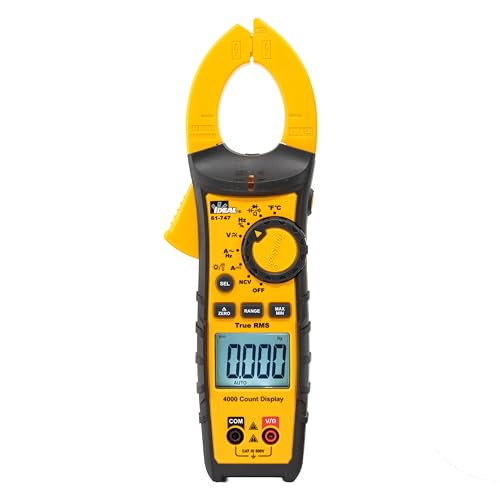
The go-to when you need DC current through the clamp, not the leads.
The IDEAL 61-747 stands out because it measures DC current directly through the clamp — something its sibling, the 61-737, cannot do. This matters a lot if you work with solar panels, LiFePO4 batteries, or any non-grid charging system where DC current is the main variable.
A buyer noted “Model 61-747: solid build, measures DC current via clamp (unlike 61-737). Essential for non-grid solar charging station, LiFePO4 batteries, and inverters.” The dual backlit display shows readings from two measurement points at once, and the secondary display near the jaw lets you see the number without twisting your wrist. At 10 x 6 x 2 inches and rated CAT III 600V / CAT IV 1000V, it is rugged enough for jobsite conditions.
Compared to the Fluke 376 FC above, the IDEAL is lighter on advanced features — no iFlex, no Bluetooth logging — but it keeps a simpler workflow for daily breaker tracing and continuity checks. The continuity alarm is loud enough to hear in a noisy panel room, which buyers specifically mention as a plus.
The edge it holds
- Clamp measures DC current directly — handy for solar and battery work
- Dual backlit displays let you see readings at different angles
- Loud continuity alarm audible in noisy environments
Where it comes up short
- Max 400A AC — not enough for large commercial service entrance work
- No iFlex or wireless remote display
Own it if: you regularly measure DC amperage on inverters, solar arrays, or battery banks without breaking the circuit.
Pass on it if: your primary work is 600A+ commercial panels where you need flexible probes.
4. UEi Test Instruments DL389B True RMS Dual Display Clamp Meter

A large-jawed workhorse built for refrigeration and HVAC service.
The UEi DL389B is the meter you grab when you need a clamp that opens wide enough to fit over 3/0 or larger conductors in a crowded compressor cabinet. At 1.5 x 3.23 x 8.7 inches, it is the most compact body in this list, but the jaw opening is generous enough to reach around wires that would jam a smaller clamp.
Customers note one “electrician/refrigeration tech used for 6 units,” confirming its place in daily HVAC service. It measures True RMS AC current up to 400A, AC/DC volts, AC/DC microamps for flame-sensor testing, temperature in °F or °C, frequency, resistance, capacitance, and duty cycle. The dual display shows two values at once — useful when you are live-tracking a capacitor’s microfarad reading while monitoring voltage.
The DL389B comes with a 3-year limited warranty, and the auto-power-off feature saves batteries when you forget to shut it down at the end of a long day. It lacks an inrush capture mode and does not measure DC current through the clamp, so it is less versatile than the IDEAL 61-747 for solar work. But for refrigeration techs who need a reliable, compact meter with a big jaw, it fits the slot.
What makes it useful
- Large jaw fits 3/0+ wires in tight spaces around compressors
- 3-year limited warranty covers professional use
- Dual display shows two measurement values at the same time
What it misses
- No DC current clamp measurement — for AC circuits only
- No inrush capture mode for diagnosing startup surges
Right for: a refrigeration or HVAC tech who needs a compact, reliable meter with a wide jaw for large cables.
Not for: anyone who needs DC clamp readings or 1000A+ AC range for heavy commercial work.
5. Klein Tools CL900 Digital Clamp Meter, Auto Ranging TRMS, AC/DC Voltage/Current, 2000A
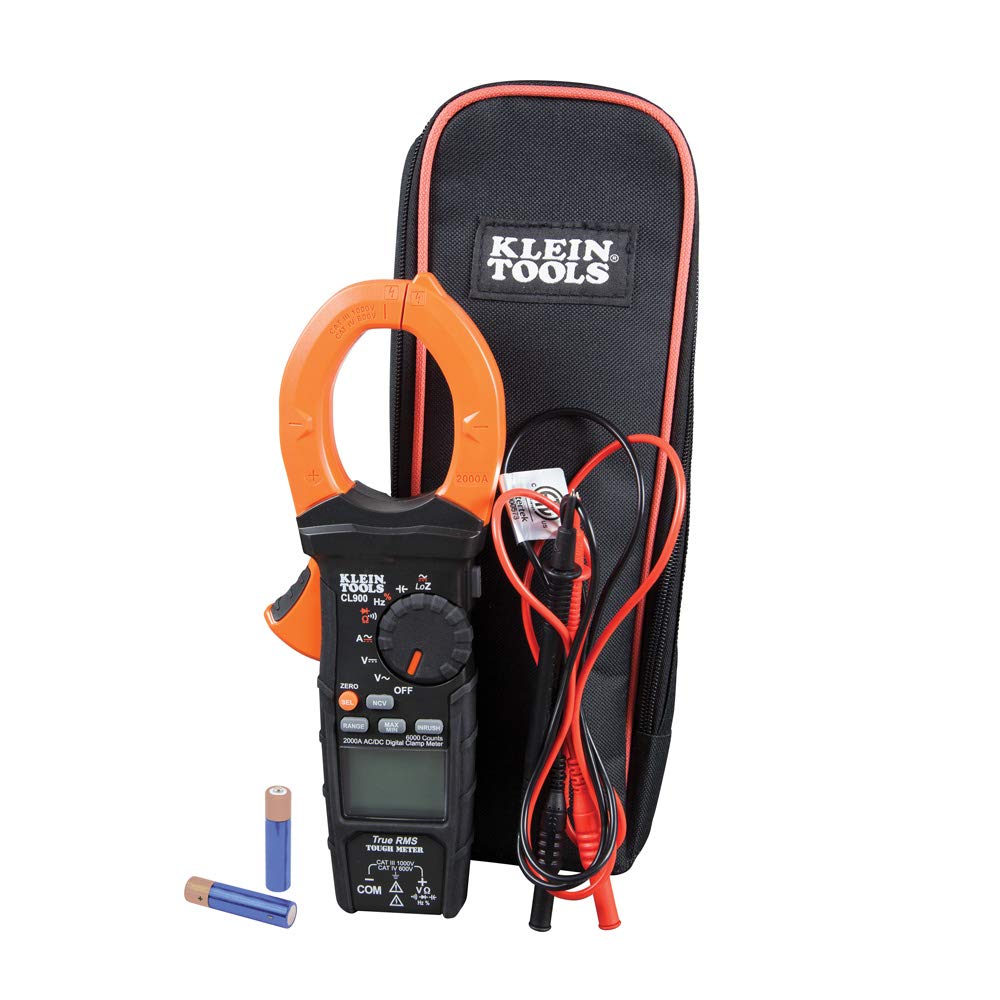
2000A AC range with drop protection built for demanding jobsites.
The Klein CL900 brings the highest AC current capacity of the standard-jaw meters here — 2000A AC through the clamp — plus inrush capture, LoZ mode for ghost-voltage elimination, and non-contact voltage detection (NCVT) through the clamp itself. If you work with large service entrances or heavy motor circuits, that extra headroom avoids the annoyance of over-ranging.
It is rated IP40 for ingress protection (resists tools larger than 1mm, like a wire, from entering) and survives a 6.6-foot (2-meter) drop, which one reviewer described as “insanely good” and found reasons to use it every day. The CL900 measures DC current via the leads (not through the clamp), so it is less direct than the IDEAL 61-747 for solar battery monitoring, but it compensates with a test-lead holder on the side and an optional magnetic hanger for hands-free operation.
A reviewer cross-checked the CL900 against a Fluke 179 and a BK Precision 880 LCR and found it held its own on resistor and capacitor readings, even outperforming the Fluke on nanofarad capacitors. Klein backs it with UL, CE, and ETL listings, rated CAT III 1000V / CAT IV 600V.
The strengths
- 2000A AC clamp range handles large service entrance wires
- 6.6-foot drop protection and IP40 rating survive jobsite abuse
- Test-lead holder and optional magnetic hanger for hands-free work
Trade-offs
- No iFlex or remote display — you hold the meter to the wire
- DC current is via leads only, not through the clamp
Best for: an electrician who works on high-amp panels and needs a drop-proof meter that fits a standard tool bag.
Skip if: you need iFlex flexibility or detachable display for tight busway measurements.
6. Fluke 381 Remote Display True-RMS AC/DC Clamp Meter with iFlex

Remote display that takes you out of the arc flash zone.
The Fluke 381 is the meter for the electrician who wants to read current draw without contorting into a panel. The display detaches and works wirelessly up to 30 feet away from the clamp body, so you can clip the iFlex around a bus bar and then walk to the other end of the room to see the reading — no Bluetooth phone pairing required.
It measures AC/DC current up to 999.9A through the jaw and up to 2500A AC through the iFlex coil. Buyers love the remote display for troubleshooting: “I like the detachable piece so I don’t have to hold it at a weird angle trying to read my current draw when the wires are tight together.” The meter includes a low-pass filter for noisy environments and inrush measurement to capture startup surges.
One reviewer called it “the apex predator of clamp meters” and noted the iFlex accuracy is class-leading for reading bundled 500 or 750 MCM wires. It comes with TL175 silicone test leads and a soft carrying case, but no rubber boot — so if you drop it on concrete regularly, you should buy the separate boot. It also lacks a Low-Z voltage mode (a low-impedance setting that drains ghost voltage from floating wires), unlike the AstroAI CM6K0R or Klein CL900.
Why it stands apart
- Detachable remote display works up to 30 ft away from the clamp
- iFlex coil handles up to 2500A AC in tight busway spaces
- Low-pass filter stabilizes readings in electrically noisy environments
Consider before buying
- No rubber boot included — separate purchase needed for drop protection
- No Low-Z voltage measurement for ghost-voltage elimination
Ideal for: an electrician who reads current in live panels and wants to keep the display at eye level, away from the arc flash zone.
Probably too much if: you never work around live bus bars or you prefer an all-in-one body without a separate display piece.
Understanding the Specs
True RMS (True Root Mean Square)
This term describes how the meter calculates an AC waveform. A simple meter assumes the wave is a perfect sine shape, which gives an incorrect reading on the distorted waveforms produced by VFDs, LED drivers, ballasts, and motor starters. True RMS measures the actual heating value of the waveform — so when you read 120V on a VFD output, that number is real. Every meter on this list is True RMS, which is the baseline for any professional electrician.
iFlex / Rogowski Coil
An iFlex is a flexible, rope-like current sensor that wraps around a conductor instead of needing a rigid jaw opening. It is useful when wires are bundled, run through tight conduit, or covered by a panel cover. The Fluke 376 FC and 381 both include iFlex, which extends their AC current range to 2500A without needing a bigger jaw. The trade-off is that iFlex only measures AC current — for DC current you still need the metal jaw.
CAT III / CAT IV Safety Rating
These ratings tell you the maximum transient voltage (a sudden power surge from a lightning strike or utility switching) the meter can withstand without arcing to the user. CAT III 600V is safe for most inside-the-building panel work. CAT III 1000V adds margin for larger commercial panels. CAT IV 600V is needed for service-entrance connections and outdoor utility meters. If a meter does not state its CAT rating, do not use it on live circuits.
Inrush Current
Motors, compressors, and transformers draw a much higher current for the first few milliseconds when they start — sometimes 5 to 10 times the running current. A meter with an inrush mode captures that brief surge so you can identify a locked rotor or a failing starting capacitor. Meters without it just show zero or the steady-state current. The AstroAI and Klein models on this list include inrush capture.
FAQ
Can I use a clamp meter to measure DC current?
What does the CAT III 600V rating mean in plain language?
Do I really need True RMS or can I save money with a cheaper meter?
What is the difference between iFlex and a standard clamp jaw?
How does the remote display on the Fluke 381 work?
What is ghost voltage and how does LoZ eliminate it?
Which meter is best for solar panel installation?
Can I leave the clamp meter in my tool bag every day?
How does inrush current capture help with motor troubleshooting?
Final Thoughts: The Verdict
For the majority of shoppers, the clamp meter for electricians winner is the Fluke 376 FC because it combines iFlex flexibility, Bluetooth data logging, and CAT III/IV safety in a single rugged package. If you want the highest AC current capacity with drop protection, grab the Klein CL900. And for budget-conscious buyers who still demand True RMS and inrush capture, the AstroAI CM6K0R is the hands-down value pick.
How We Picked
We do not accept paid placement. Every pick is matched to a real buyer and a real use-case; we do not hands-on test units.
Sources & Methodology
Specifications: manufacturer listings and product documentation. Review insights: verified customer reviews, as of July 2026. Pricing: not shown on this page (it changes often); check the current price via the retailer link.
As an Amazon Associate, WellFizz earns from qualifying purchases. This does not affect which products we feature.
Related Guides

Mo Maruf
I created WellFizz to bridge the gap between vague wellness advice and actionable solutions. My mission is simple: to decode the research and give you practical tools you can actually use.
Beyond the data, I am a passionate traveler. I believe that stepping away from the screen to explore new environments is essential for mental clarity and physical vitality.