Our readers keep the lights on and my smoothie glass nicely filled. As an Amazon Associate, I earn from qualifying purchases.
Dropped cell service, dense tree cover, and the roar of a side-by-side engine all have one thing in common—they kill standard consumer radios fast. A civilian tactical radio is the difference between a coordinated group movement and a frustrating game of hide-and-seek across the trail or jobsite.
I’m Mohammad Maruf — the founder and writer behind WellFizz. I’ve spent hundreds of hours analyzing the hardware specs, durability certifications, and real-world performance data of two-way radios to separate genuine field-ready gear from overhyped consumer gadgets.
The best method to find a truly capable unit is to focus on transmission power, ruggedness ratings, and battery architecture rather than marketing range claims. This guide breaks down the top contenders for the best civilian tactical radio based on those critical metrics.
How To Choose The Best Civilian Tactical Radio
Selecting a tactical radio requires looking past the flashy packaging and zeroing in on the specifications that determine whether a unit survives a drop down a rocky ledge or fades to static in a valley. Four core criteria define the field performance.
Transmission Power and Frequency Band
Power is measured in watts, and more watts mean stronger signal penetration through trees, buildings, and terrain. FRS radios are limited to 2 watts and require no license. GMRS radios can output up to 5 watts but require a simple FCC license covering your whole family. For serious off-road or backcountry use, the extra 3 watts of a GMRS unit provide a tangible advantage in maintaining a clear channel over distance.
Durability and Environmental Sealing
An IP67 rating means the radio is fully dust-tight and can survive submersion in three feet of water for 30 minutes. MIL-STD-810H certification indicates the unit passed 19 separate tests for shock, vibration, temperature shock, humidity, and salt fog. A radio that lacks these certifications will likely fail at the worst possible moment.
Battery Life Under Load
Battery capacity is often quoted in mAh, but real-world runtime depends on transmission duty cycle and temperature. Lithium-ion cells perform better in cold than older NiMH packs. A radio that claims 20 hours of battery life on paper might only deliver 8 hours of heavy transmit use in freezing conditions. Look for units with replaceable batteries or USB-C charging for extended trips.
Accessory Ecosystem and Ease of Use
A tactical radio is only useful if you can operate it while wearing gloves or in heavy rain. Oversized PTT buttons, large front knobs, and shatterproof screens matter. The ability to connect to external microphones, speaker mics, or earpieces also separates a true tactical tool from a toy. A radio locked to its own proprietary accessories limits its utility in group scenarios where team members use different brands.
Quick Comparison
On smaller screens, swipe sideways to see the full table.
| Model | Category | Best For | Key Spec | Amazon |
|---|---|---|---|---|
| Midland GXT67 | GMRS | Overlanding & Off-Road | 5W power, IP67, Repeater capable | Amazon |
| Rocky Talkie Mountain Radio | FRS | Backcountry & Climbing | 4-day battery, climbing carabiner | Amazon |
| Retevis RB48 | FRS | Jobsites & Heavy Duty | MIL-STD-810H, IP67, floats | Amazon |
| Motorola T475 | FRS | Family & Casual Trail | 22 channels, NOAA alerts, VibraCall | Amazon |
| Rugged Radios GMR2 Plus | GMRS | Off-Road & Farming | Safety orange, weather channels | Amazon |
| SAMCOM FPCN30A | UHF | Professional Jobsite | 5W power, Group Call, PC programmable | Amazon |
| Retevis RT68 | FRS | Business & Light Industrial | 10-pack, VOX, 500mW speaker | Amazon |
In‑Depth Reviews
1. Midland GXT67 Pro

The Midland GXT67 Pro stands at the top of the class for good reason. It pushes the legal GMRS limit of 5 watts, giving it real penetration through dense brush and canyon walls where lower-powered FRS units fall silent. The fully sealed IP67 chassis means you can submerge it without worrying about a leaky battery door—a common failure point on cheaper radios.
Repeater capability extends the range by dozens of miles when you’re near a GMRS repeater tower, making this a true expedition-grade tool. The backlit display and oversized buttons operate cleanly with gloves on, and the included hard case and desktop charger make it ready for vehicle storage. Users consistently report clear audio even with engine and wind noise.
Battery life lands around 16 hours of continuous use under standard conditions, and the Li-Ion pack recharges via the included AC/DC adapters including a car charger. The fixed antenna is the only minor limitation, but stock performance satisfies most off-road scenarios without modification.
Why it’s great
- Full 5W GMRS output with repeater support
- IP67 sealed chassis prevents water and dust ingress
- Hard case and desktop charger included in the kit
Good to know
- Fixed antenna limits aftermarket upgrade options
- Requires GMRS license for legal operation
2. Rocky Talkie Mountain Radio
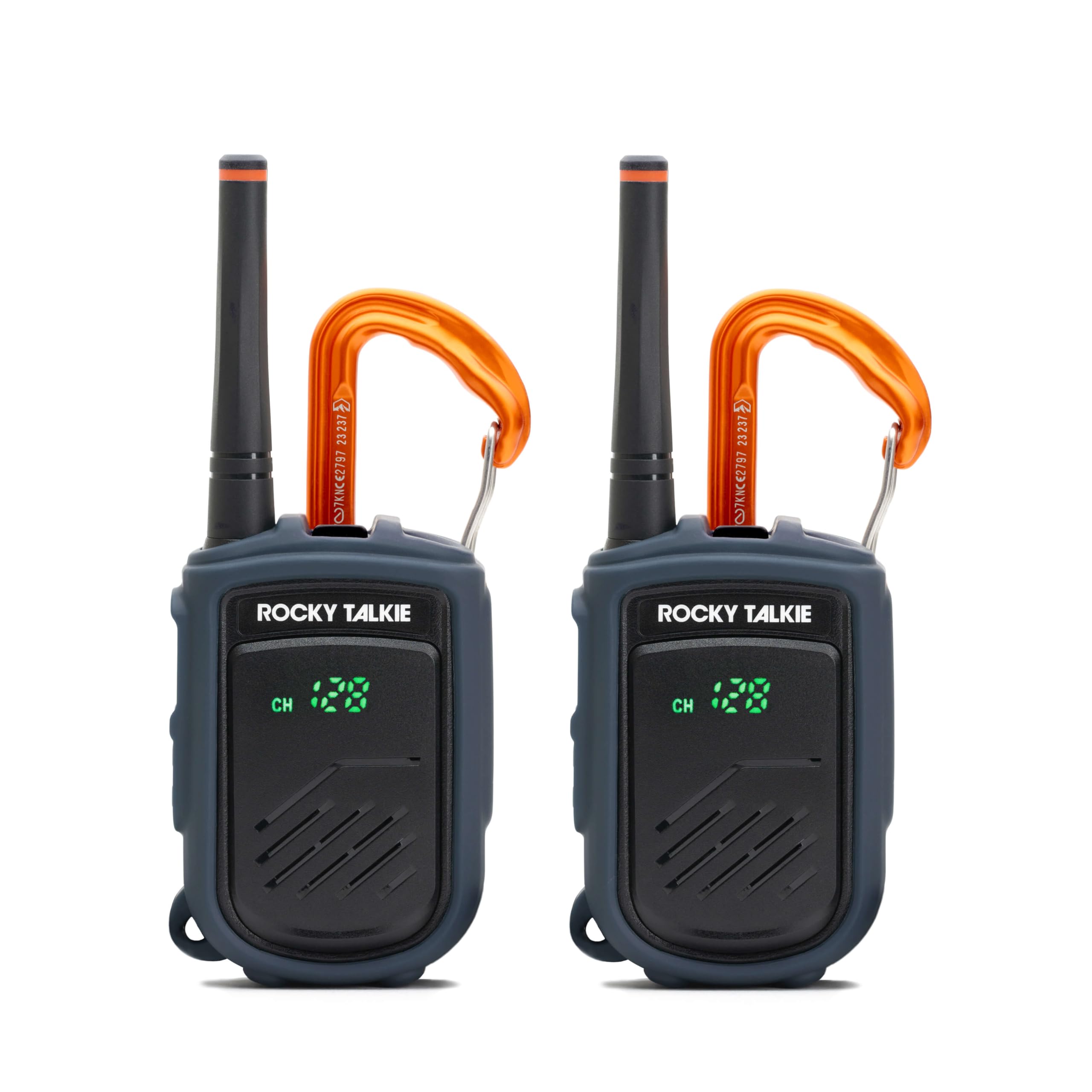
The Rocky Talkie Mountain Radio is engineered specifically for the climbing and backpacking crowd where every ounce matters and battery charging opportunities are nonexistent. Its specialized lithium-ion battery delivers over four days of runtime even in freezing conditions—a significant advantage over radios that quote battery life in hours rather than days.
The build quality is exceptional. A shatterproof LCD screen sits behind a rubberized thermoplastic armor, and the unit attaches to a pack using a climbing-rated Trango Quantum carabiner plus a metal-reinforced backup leash. This dual-tether system prevents loss on a steep scramble. The IP56 rating handles splashes and snow, though it stops short of full submersion like the IP67-rated rivals.
With 2 watts of maximum FRS power, you are limited to license-free operation, but users report 25-plus miles of line-of-sight range over water and reliable communication across a mile of dense backcountry. The five-button interface requires zero configuration out of the box—ideal for groups that do not want to fiddle with menus.
Why it’s great
- Four-day battery life in cold weather
- Carabiner and backup leash prevent drops
- Shatterproof screen and rubberized armor
Good to know
- Limited to FRS 2W maximum power
- Lower IP56 rating not fully submersible
3. Retevis RB48

The Retevis RB48 is built to meet MIL-STD-810H, passing 19 separate tests including temperature shock, rain, salt fog, humidity, sand and dust, vibration, and shock. That is the kind of certification you trust when the radio gets dropped off a forklift or buried in mud on a construction site. The IP67 rating means it is also fully dust-tight and submersible.
A truly unique feature is that the RB48 floats. If you drop it into a river or a flooded trench, it sits on the surface instead of sinking to the bottom. The large front PTT button is easy to mash with work gloves, and the vibration alert ensures you never miss a call in a noisy environment. The 2000mAh battery delivers up to 20 hours of use on a single charge.
The 4-pack configuration is well suited for crew coordination across a 300,000-square-foot jobsite or up to 25 floors. Real-world range in a city is about half a mile to a mile, but on open farmland users report clear communication across 40 to 60 acres with tree cover. The audio is loud and clear, and the sturdy antenna design resists breakage better than many competitors.
Why it’s great
- MIL-STD-810H certification for extreme conditions
- Floats in water, preventing loss
- Large PTT button works with gloves
Good to know
- Limited to FRS license-free power limits
- Replacement batteries are proprietary
4. Motorola Solutions T475 Extreme
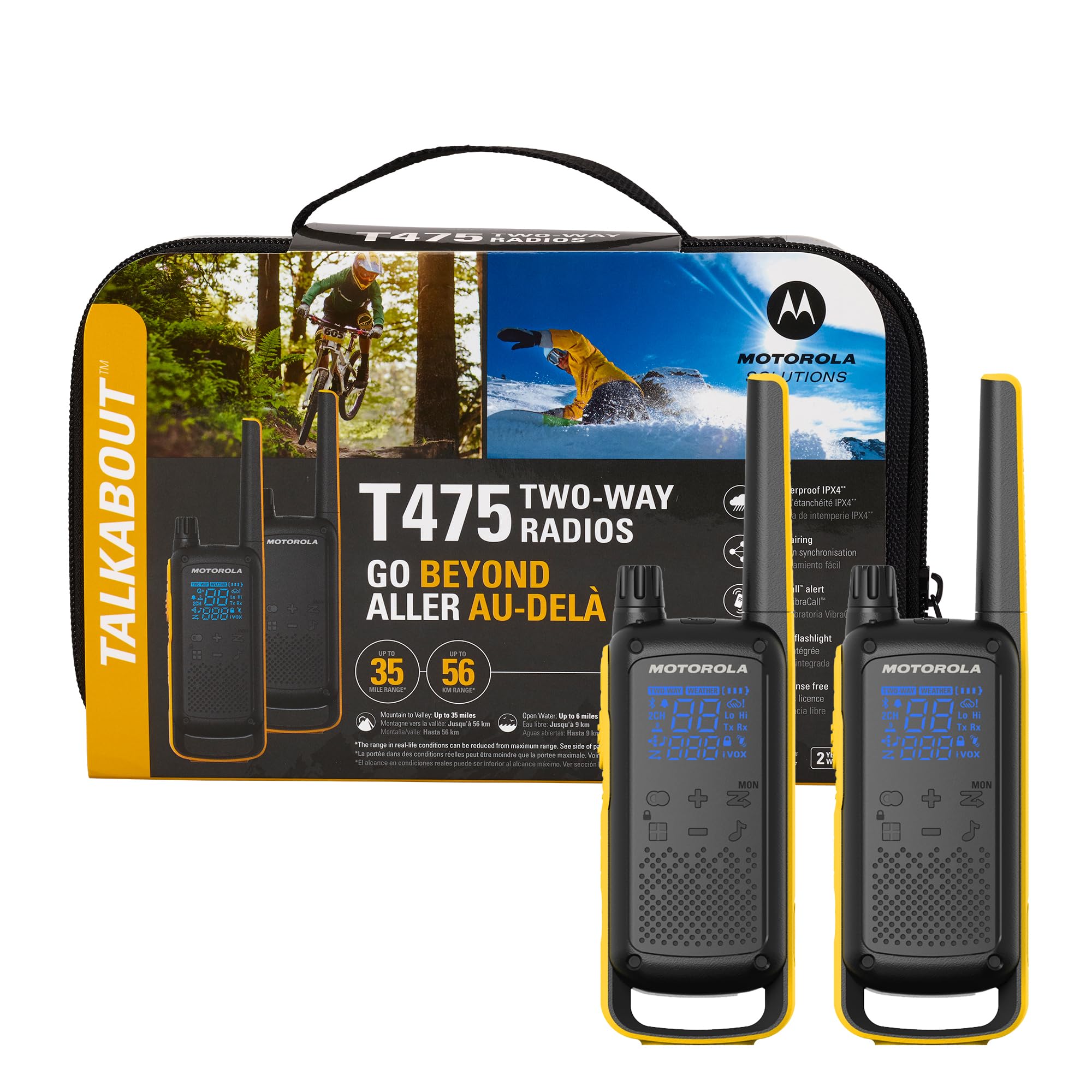
The Motorola T475 is a solid entry point for families or casual trail users who want reliable FRS communication without the complexity of GMRS licensing. With 22 channels and 121 privacy codes giving 2,662 channel combinations, finding an open frequency is rarely an issue. The IPX4 weatherproof rating handles rain but stops short of full submersion.
The built-in flashlight is a practical bonus for camp setup or emergency signaling, and the NOAA weather radio and alert function automatically broadcasts severe weather warnings—a feature that matters more than most people realize in backcountry scenarios. Users report real-world range of 3 to 5 miles in open terrain and consistent performance across hilly Kentucky and Maui forest roads.
Battery life with the included 800 mAh NiMH pack runs around 8 to 12 hours depending on transmit frequency. A common complaint is that the battery drains faster than expected under heavy use, and some users noted the pack degraded within a year. The VibraCall alert helps you catch incoming transmissions in noisy environments, and the wind cancellation feature keeps audio clear in breezy conditions.
Why it’s great
- NOAA weather alerts keep you informed
- VibraCall alerts you silently in loud areas
- Excellent range for an FRS radio
Good to know
- Battery life runs short with heavy transmit
- NiMH pack degrades faster than Li-Ion
5. Rugged Radios GMR2 Plus
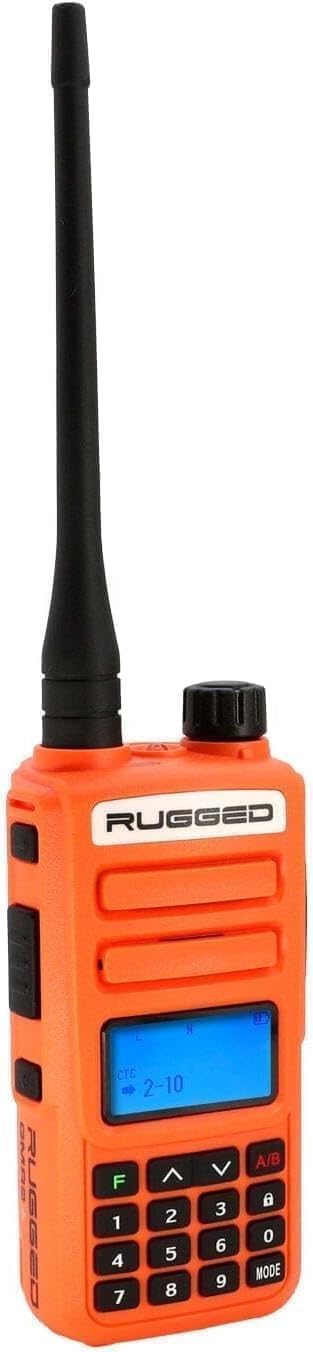
The Rugged Radios GMR2 Plus is purpose-built for the off-road community, particularly Jeep and overlanding enthusiasts who need reliable group communication on the trail. The safety orange color is highly visible if you set the radio down on a rocky trail, and the GMRS frequencies let you connect with other GMRS users in your convoy. The FCC requires a GMRS license, but the process is simple and covers your entire household.
The optimized transmitter and tuned antenna provide solid range performance in harsh conditions, though users note that the advertised 3-mile range is a realistic maximum in hilly terrain. The inclusion of NOAA weather channels adds an extra layer of safety for unplanned storms. The intuitive button layout and easy-to-read LCD screen make it simple to adjust settings while driving.
Battery life is the weak point here—users consistently report that the included battery does not last a full day of heavy use. However, Rugged Radios offers a wide ecosystem of accessories including speaker mics, headsets, and replacement battery packs, which makes the GMR2 Plus easy to customize for specific needs like trail spotting or farming.
Why it’s great
- Bright safety orange color prevents loss
- NOAA weather channels for emergency alerts
- Compatible with Rugged Radios accessory ecosystem
Good to know
- Battery life is short under heavy transmit
- Requires GMRS license for legal operation
6. SAMCOM FPCN30A

The SAMCOM FPCN30A is a high-power UHF radio designed for professional commercial use on construction sites, warehouses, and stadium events. The 5-watt output gives it serious penetrating power through concrete walls and steel beams, and the Group Call function lets you broadcast a message to all teams even when they are on different channels—critical for safety alerts or site-wide announcements.
A standout feature is the programmable capability via PC software, allowing site supervisors to lock specific channels, set transmit power levels, and customize squelch settings. The scrambler function provides basic voice privacy, which is rare in this price tier. The 1500mAh battery delivers 8-plus hours of continuous use and 21 hours of standby, comfortably handling a full shift.
Users consistently praise the build quality and sturdiness, with reports of flawless performance at large stadium events and across sprawling industrial facilities. However, the radio ships without standard channel frequencies pre-programmed, which means you need the separate USB programming cable to get it operational out of the box. That extra step can be a barrier for less technical users.
Why it’s great
- 5W UHF power cuts through concrete and steel
- Group Call function reaches all teams on any channel
- Scrambler provides basic voice privacy
Good to know
- Requires PC and USB cable for initial programming
- No pre-loaded standard channel frequencies
7. Retevis RT68 10-Pack
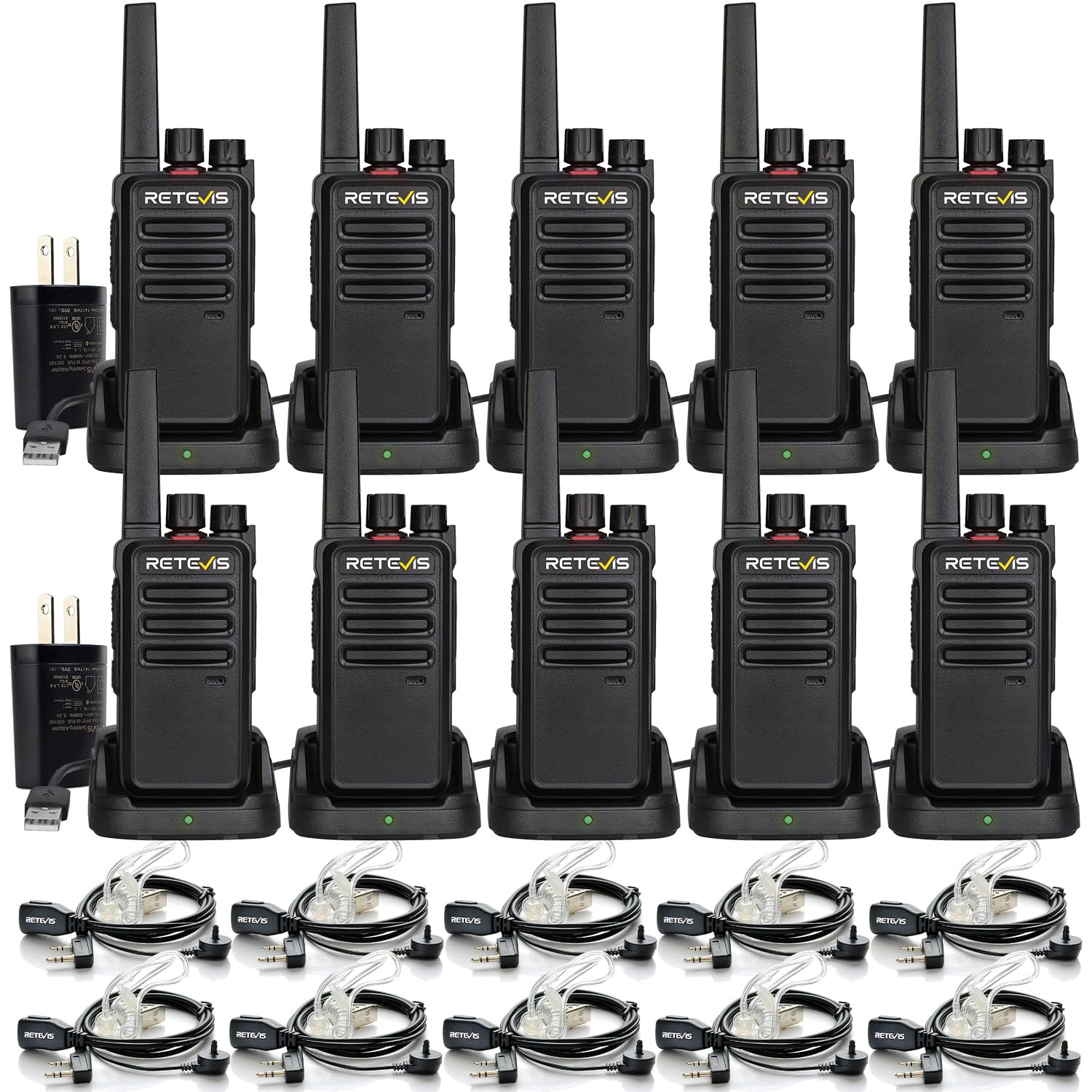
The Retevis RT68 is optimized for team-scale deployments in manufacturing, retail, hospitality, and school environments where you need to equip a whole department with reliable communication. The 10-pack configuration provides consistent coverage across a large building, and the VOX hands-free function lets workers talk without pressing the PTT button—ideal for tasks requiring both hands.
The palm-sized body is compact enough to clip on an apron or belt without feeling bulky, and the hardened durable shell handles normal drops without issue. The 500 mW speaker delivers clear and loud audio even in noisy environments, and the 0-9 level squelch adjustment helps cut down background chatter on crowded channels. Battery life is around 14 hours from the included Li-Ion pack, which covers a full work day.
Users appreciate the straightforward operation with a simple knob for volume and channel selection. The included earpiece and belt clip add value for hospitality and security teams. However, the audio through the earpiece is noticeably quieter than through the built-in speaker, and some users with hearing difficulties found it insufficient. For group communication in a controlled indoor setting, the RT68 delivers dependable performance at a competitive per-unit cost.
Why it’s great
- 10-pack provides complete team coverage
- VOX function enables true hands-free operation
- Compact size and durable shell handle daily use
Good to know
- Earpiece audio is quieter than built-in speaker
- Limited to FRS power and range
FAQ
Do I need a license to use a GMRS tactical radio?
What is the real-world range I can expect from a 5-watt radio?
Can a civilian tactical radio connect to amateur ham radio repeaters?
Final Thoughts: The Verdict
For most users, the best civilian tactical radio winner is the Midland GXT67 Pro because it combines full 5-watt GMRS power, IP67 waterproofing, and repeater capability in a package that is ready for off-road, farming, or emergency use right out of the box. If you want a dedicated backcountry companion with multi-day battery life, grab the Rocky Talkie Mountain Radio. And for the toughest jobsite conditions where drops and submersion are daily risks, nothing beats the Retevis RB48 with its MIL-STD-810H certification and floating design.

Mo Maruf
I created WellFizz to bridge the gap between vague wellness advice and actionable solutions. My mission is simple: to decode the research and give you practical tools you can actually use.
Beyond the data, I am a passionate traveler. I believe that stepping away from the screen to explore new environments is essential for mental clarity and physical vitality.