Our readers keep the lights on and my smoothie glass nicely filled. As an Amazon Associate, I earn from qualifying purchases.
Specs are compiled from manufacturer listings and verified buyer reviews and can change over time — please confirm the key details on the product page before buying.
Civilian night vision ranges from a blurry green blob to a tool that reveals what moves in the dark. The core difference is not the price tag — it is the sensor, the infrared power, and the real-world range, which most product listings do a terrible job of explaining. This guide cuts through the noise to help you pick the right device for your hunting spot, property, or overnight hike.
I’m Mohammad Maruf — the founder and writer behind WellFizz. This guide is built by comparing the manufacturers’ published specifications and the patterns across verified customer reviews, so you get each pick’s real strengths and trade-offs instead of marketing spin.
if you need to scan a field for predators, document wildlife after sunset, or navigate a dark trail, finding the right best civilian night vision means matching the sensor type and detection range to your actual environment — and knowing where the specs fall short.
Quick Picks
- CIGMAN True 4K Night Vision Binoculars (CNVPRO) — Top Performer
- VisioGear Night Thunder X1 (NTX1) — Best Overall
- AKASO Seemor-200 Night Vision Goggles — Best Value
- GOYOJO Night Vision Goggles NVG10 — Budget Champion
- GOYOJO Night Vision Goggles GNG2K — Compact Pick
- Oneleaf.ai Commander NV100 — Clip-On Scope
- Bushnell Equinox Z2 Monocular — Budget Rifle Scope
- DNT Optics Zulus HD V2 Rifle Scope — Premium Scope
- ATN X-Sight LTV 3-9x Rifle Scope — Mid-Range Scope
How To Choose The Best Civilian Night Vision
Civilian night vision falls into two main camps: digital devices that use a CMOS sensor and an LCD screen to show you the image, and analog image-intensifier tubes that amplify ambient light. Digital units dominate the sub- market today because they record video, work in daytime, and never get damaged by bright light. Your buying decisions come down to three things: the sensor, the infrared illuminator, and the physical build.
Sensor Quality and Resolution
A “true 4K” sensor (one that actually records 3840×2160 pixels natively, not upscaled) gives you sharp enough detail to read a license plate or identify an animal at distance. Less expensive units often use a 1080p sensor and label it “HD” — fine for close-range scouting, but grainier beyond 100 yards. Look for sensors from Sony’s STARVIS line, which are designed specifically for low-light sensitivity and produce usable color images even in dim moonlight.
Infrared Illuminator Power
In total darkness, the only light comes from the device’s infrared illuminator. The spec to watch is the IR wavelength and power rating. An 850nm IR is bright enough to see several hundred yards, but it puts out a faint red glow visible to animals and other people. A 940nm IR is invisible to the naked eye, making it better for covert observation, but it usually has a shorter effective range. Higher-end devices let you adjust the IR in multiple levels so you can preserve battery when you do not need full power.
Build Quality and Water Resistance
Night vision gear gets used in rain, dust, and rough handling. An IP67 or IP66 rating means the device keeps working when you get caught in a downpour. Weight also matters: a monocular under 300 grams is comfortable for hours of head-mounted use, while binoculars over 1.5 kilograms demand a tripod or a neck strap for extended sessions.
Quick Comparison
| Model | Best For | Sensor / Resolution | Detection Range | Weight | Amazon |
|---|---|---|---|---|---|
| CIGMAN True 4K CNVPRO | Ultra-long-range binocular viewing | True 4K (52MP stills) | 3,900+ ft | 1.49 kg | Amazon |
| VisioGear NTX1 | Full-featured all-rounder with app | True 4K with STARVIS 2 | 3,940 ft | — | Amazon |
| AKASO Seemor-200 | Lightweight portable binoculars | 4K AI-ISP | 3,280 ft | Under 500 g | Amazon |
| GOYOJO NVG10 | Budget entry-level monocular | 1080p digital | 200 m (656 ft) | 237 g | Amazon |
| GOYOJO GNG2K | Helmet-mounted close-range use | 1080p HD | 80–100 yards | 280 g | Amazon |
| Oneleaf.ai Commander NV100 | Clip-on rifle scope | 1080p FHD (60 fps) | 328 yards | Heavy | Amazon |
| Bushnell Equinox Z2 | Stationary spotting scope | 1080p sensor / 640×480 display | 1,000+ ft | 1.68 lbs | Amazon |
| DNT Optics Zulus HD V2 | Premium day/night rifle scope | STARVIS 2, 1920×1080 Micro-OLED | 300+ yards | 16 oz | Amazon |
| ATN X-Sight LTV 3-9x | Budget rifle scope | QHD+ / HD display | 200–300 yards | 3 lbs | Amazon |
In‑Depth Reviews
1. CIGMAN True 4K Night Vision Binoculars (CNVPRO)
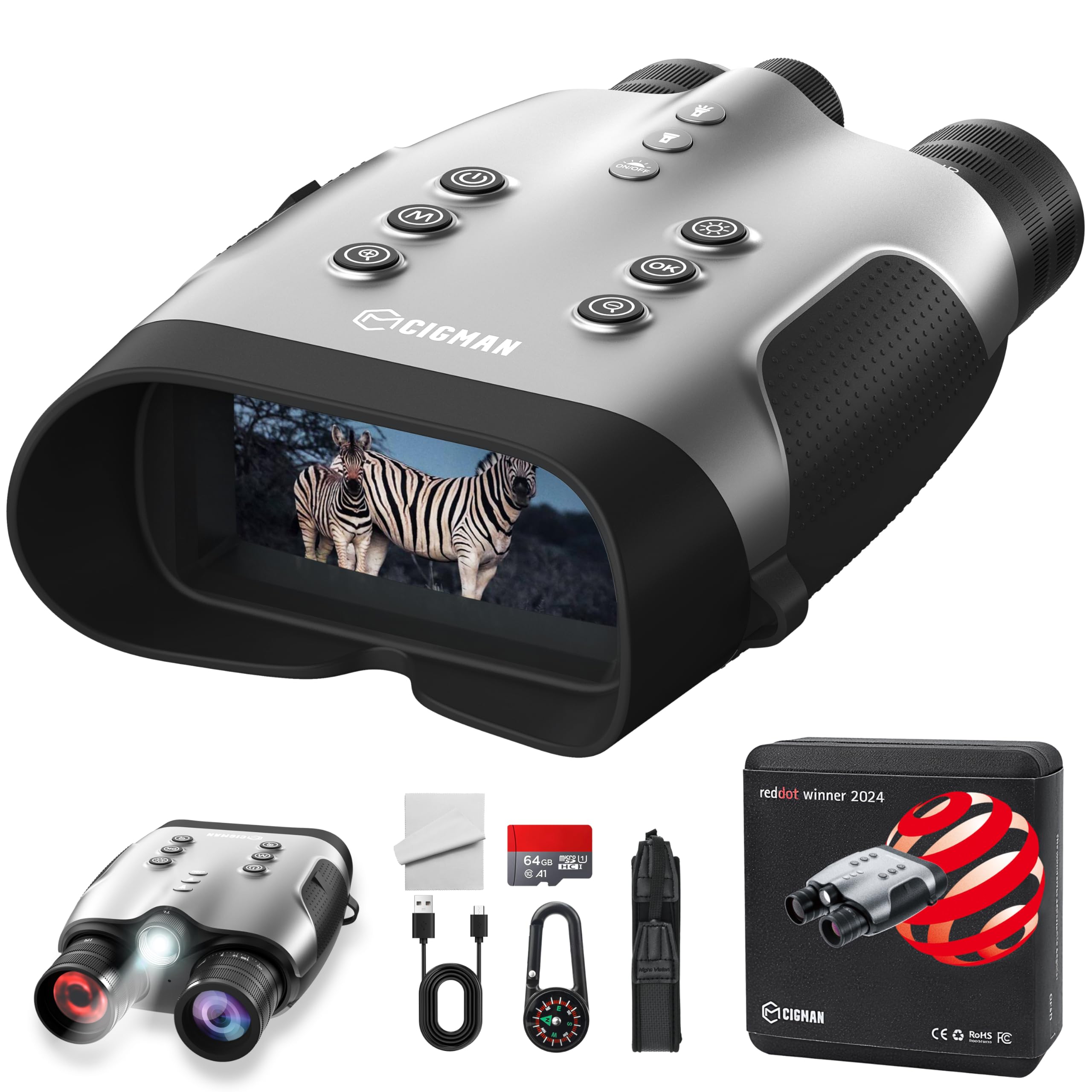
The true 4K binocular that sees over half a mile in pitch black.
You get a starlight-grade CMOS sensor that captures native 4K video (with audio) and 52MP still images — not interpolated upscaling. The 7-layer coated spherical glass lenses reduce glare and resist scratches, and the device has won both Red Dot and IDEA Awards for its industrial design. A high-power adjustable IR illuminator provides superior clarity beyond 3,900 ft (1200 m), with four selectable infrared levels that stay invisible to the naked eye. The IP54 water and dust resistance means rain or dirt will not stop you, and the 5100mAh battery keeps you running for up to 18 hours on a single charge. A 64GB memory card and carrying case are included.
Buyers report: “I can see crisp like as in daytime over 1/2 mile in total darkness.” One reviewer used the CNVPRO to spot a mountain lion his dogs were barking at — something he could not see with his naked eyes five feet away. The main trade-off is weight: at 1.49 kilograms, this is a tripod or two-hand binocular, not a helmet-mount. A reviewer also noted the Wi-Fi signal is weak beyond 10–15 feet through walls, so live-streaming to a phone inside a house is unreliable. The lens cap is loose and may need a standard 40mm replacement.
What stands out
- True 4K native resolution with 52MP still images
- 18-hour battery life on a single charge
- High-power IR illuminator visible beyond 3,900 ft
- IP54 water and dust resistance
Watch for
- Heavy at 1.49 kg — not for head-mounting
- Weak Wi-Fi signal limits live viewing range
- Loose lens cap; may need aftermarket 40mm replacement
Who it fits: The serious spotter who needs 4K recording of wildlife or security threats at extreme range, and can handle the weight of a binocular form factor.
The honest limit: The weak Wi-Fi and loose lens cap are annoyances on an otherwise capable device — budget for a separate lens cap and plan to transfer files via SD card.
2. VisioGear Night Thunder X1 (NTX1)
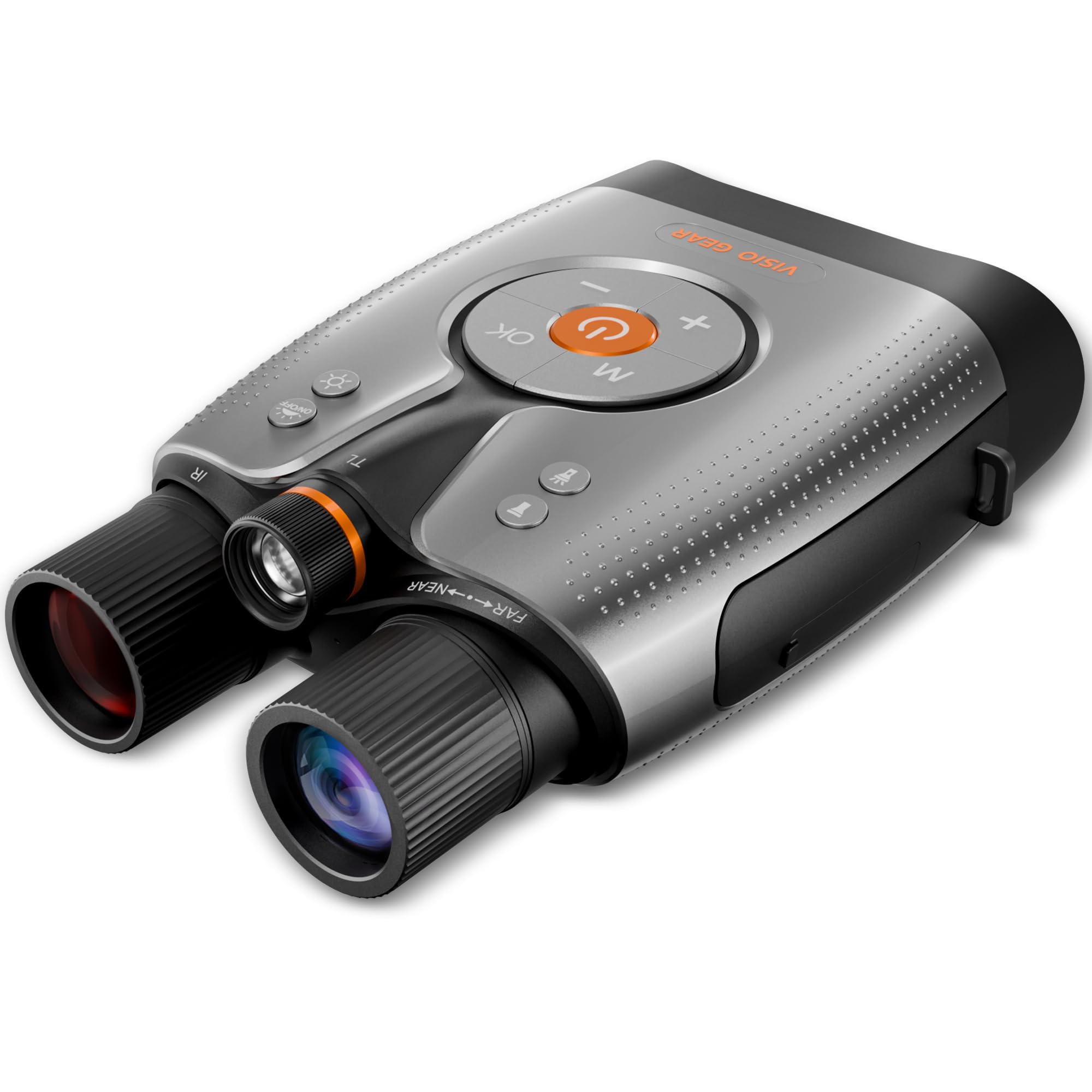
A true 4K binocular that fights rain, dust, and darkness equally well.
The NTX1 uses a military-grade STARVIS 2 sensor to capture true 4K video and 52MP images. Its 3940-foot viewing range and 8x zoom pair with a 42mm objective lens and a 13-degree field of view. The AI Color+ system gives you full-color night vision in low light, while four levels of 850nm infrared let you go into total darkness. An IP67 rating means the body survives submersion in shallow water, and the 5000mAh battery runs up to 18 hours without IR or 10 hours with it. Built-in Wi-Fi and a free app let you stream, record, and share footage remotely. You also get a built-in speaker for audio recording, a tactical flashlight, a tripod mount, a temperature sensor, and backlit buttons.
Owners mention that the zoom quality is genuinely sharp, calling the “fixed optical zoom” focus “really nice.” One buyer described it as bringing “light to the nite.” On the downside, a reviewer found the image “very grainy, noisy, and blurry even with ambient light,” which suggests unit-to-unit variance in sensor quality. Another buyer wished the instruction manual offered more depth on the features. The field of view (13 degrees) is tighter than some competitors — you sweep more to cover a wide area. The NTX1 packs more features per dollar than any other device here, assuming you get a good unit.
Pluses
- STARVIS 2 military-grade sensor for true 4K
- IP67 waterproof — survives submersion
- 18-hour battery life without IR
- Full-color AI Night Vision plus 4-level IR
Minuses
- Some units have grainy or noisy image quality
- Narrow 13-degree field of view
- Instruction manual lacks detailed operation guides
Best for: The buyer who wants every modern feature — app streaming, tactical light, temperature sensor, and true 4K recording — in a waterproof binocular that can handle any weather.
Heads-up: The image quality varies between copies. Buy from a seller with a solid return policy so you can test the sensor clarity right away.
3. AKASO Seemor-200 Night Vision Goggles

A lightweight 4K binocular that fits in a daypack and works all night.
The Seemor-200 uses AI-ISP technology to produce full-color images with 99% color accuracy in low light. Its 16x digital zoom brings subjects from centimeters away to 3,280 feet clear, and seven infrared modes give you options between full-color and black-and-white viewing. Two rechargeable batteries with a separate charger keep you running for up to eight hours continuous use. The IPX5 rating means the housing withstands rain and splashes, and a built-in 6-axis gyroscope plus compass keep orientation steady. The body weighs under 500 grams — lighter than the CIGMAN and VisioGear — and packs 1/4-inch mounting nuts on the top and bottom for tripods, lanyards, or helmet straps.
Customers note the Seemor-200 “far exceeded expectations” for the price, praising the color accuracy and the snappy photo and video capture. One reviewer confirmed it is excellent for spotting deer and owls at night with minimal brightness. The catch: in a wide-open field, the image becomes grainy beyond a few dozen feet (one reviewer called it “not a serious functional working device” and rated it a 3/5). The 16x zoom is digital, not optical, so magnifying a distant subject also magnifies sensor noise. The power button sits on the same side and has the same texture as the zoom rocker, causing confusion in the dark.
Why it wins
- AI-ISP full-color night vision with 99% color accuracy
- Lightweight at under 500 g with tripod/helmet mounting
- Two batteries and charger included for 8-hour runtime
- IPX5 waterproof for wet conditions
Room for improvement
- Grainy image beyond a few dozen feet in open fields
- Digital zoom magnifies noise along with the subject
- Power and zoom buttons are too similar to feel apart in the dark
Ideal for: Hikers, campers, and casual wildlife watchers who want a portable, color-capable night vision binocular under 500 grams with easy app sharing.
skip it if: You need to identify animals at 300+ yards in a wide field — the grain becomes distracting beyond close-to-mid range.
4. GOYOJO Night Vision Goggles NVG10

The 237-gram digital monocular that punches well above its price.
At 237 grams, the NVG10 is the lightest device in this list and uses a CMOS sensor for clear black-and-white night vision up to 200 meters (656 ft) with 3x magnification. Reviewers point out that on a new moon it “sees 200+ yards without IR,” which is exceptional for this price tier. The removable 18650 battery avoids the problem of a sealed battery that cannot be replaced. The unit records 1080p video and 1280×720 photos, though the manufacturer notes iPhone users cannot export and store video — only Android users get that function.
Shoppers say the build quality is “premium aluminum” with “crisp AR-coated glass.” One owner described the FOV as “25% better than naked eye.” The downsides: the IR illuminator emits visible red light at level 2+, and the control arm for the helmet mount is described as “poor.” Battery life runs about 4–5 hours per charge. The exit pupil diameter is 4.38mm, and the focal length is 20mm; the GNG2K has a focal length of 108mm, which means it is built for closer-range work.
Impressive for the money
- Weighs only 237 g — the lightest pick here
- Removable 18650 battery for easy replacement
- Premium aluminum build with AR-coated glass
- Sees 200+ yards even without IR on a new moon
Real trade-offs
- IR illuminator emits visible red light at level 2+
- No iOS video export — Android only for file saving
- Control arm for helmet mount is poorly designed
Reach for this if: You want a rugged, ultra-light monocular for close-range scouting or airsoft that costs less than a night out — and you are fine with Android-only file export.
Look elsewhere if: You need iOS video saving or a completely invisible IR — the red glow at higher power levels is noticeable to animals.
5. GOYOJO Night Vision Goggles GNG2K
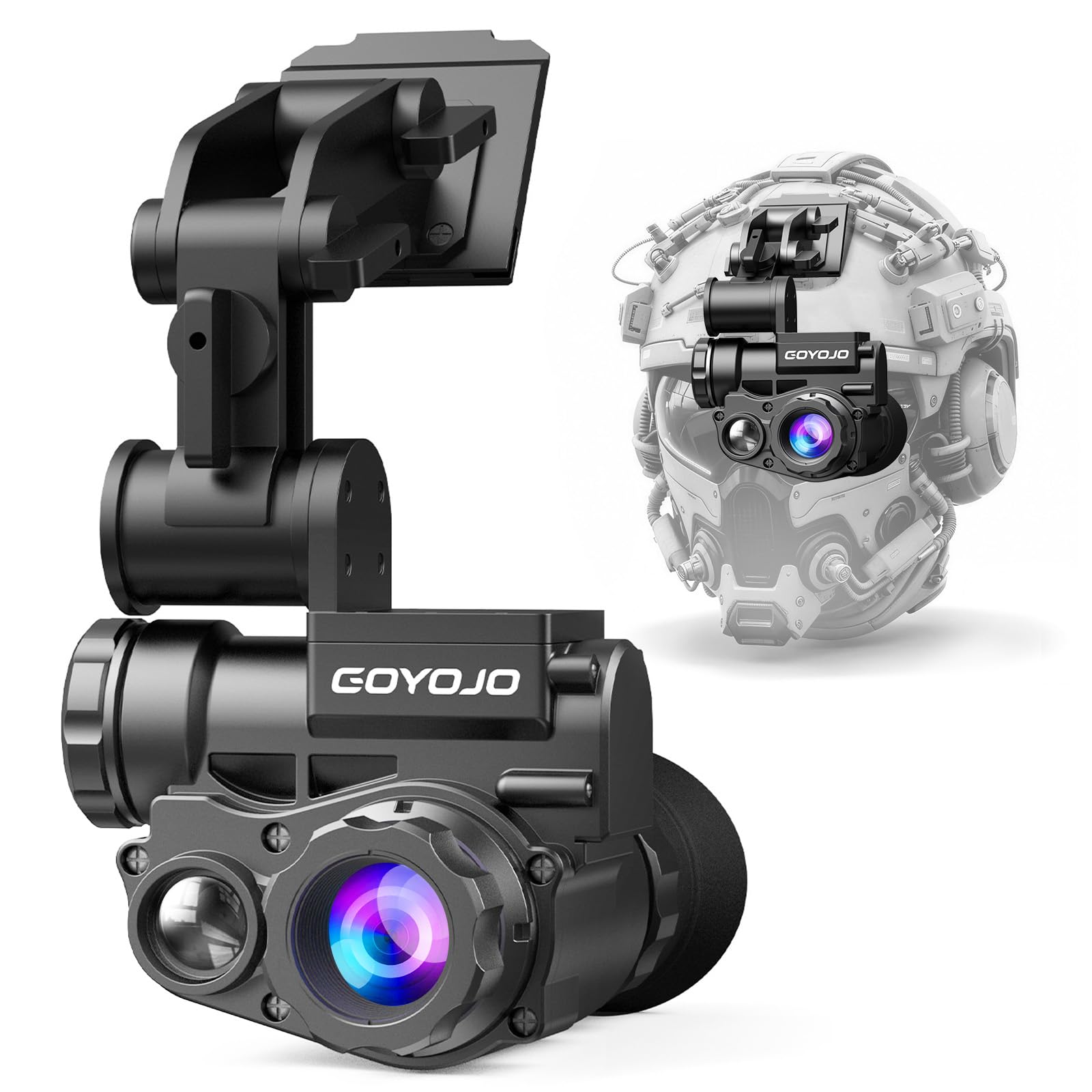
A helmet-mountable monocular with 108mm focal length for zoomed detail.
The GNG2K gives you a 108mm focal length — more than 5x longer than the NVG10 (20mm) — which means better magnification for spotting distant objects without moving closer. It records 1080p HD video and photos, offers three image color modes (color, B&W, fluorescent green), and has a 3-level adjustable 850nm IR illuminator (1W power) for total darkness. The IP66 waterproof rating means rain or hose spray will not kill it. A built-in electronic compass and a 25.5-degree field of view (the NVG10 has a 15-degree FOV) help you orient and track. The 12mm exit pupil diameter makes it more comfortable for users who wear glasses.
Buyers report that the GNG2K is “well-packaged, user-friendly,” but note a “limited range (80-100 yards depending on moonlight).” One reviewer calls it “good for close-range or budget use” but says a better unit is needed for serious hunting. The image has slight lag and auto-adjusting contrast that can be distracting. The helmet mount works well, but the narrow field of view at close distances — about one foot at four feet — feels tunnel-like. This is a solid first NVG for night hiking or camp navigation, not for long-range identification.
Good points
- 108mm focal length for improved magnification over typical budget units
- IP66 waterproof — survives heavy rain
- 25.5-degree FOV is 70% wider than the NVG10
- Three color modes and built-in compass
Not so great
- Limited range of 80–100 yards in typical moonlight
- Image has slight lag and auto-contrast that can confuse
- Very narrow close-up FOV (1 ft at 4 ft)
Fits the: Night hiker or property patrol who needs a waterproof, head-mounted unit with better reach than a toy, and does not expect to ID animals beyond 100 yards.
The main catch: The 80–100 yard range is a hard ceiling — do not buy this expecting to scan a 300-yard field for predators.
6. Oneleaf.ai Commander NV100

A 1080p clip-on monocular that turns your rifle scope into a night vision system.
The NV100 uses a 1080p FHD CMOS sensor with a 0.4-inch panel delivering 3.69 million dots at a smooth 60 fps refresh rate — faster than most budget scopes, which helps reduce blur on moving targets. It mounts in front of your day scope via three included adapters, converting it for nighttime use without re-zeroing your main optic. The built-in IR illuminator provides clear viewing up to 328 yards in complete darkness. It also records HD video and slow-motion footage. The housing is waterproof and shock-resistant, and comes with a 2-year warranty.
Owners mention the NV100 gives “300-yard visibility” with the IR and works well for static hunting and scouting. The downsides: panning introduces noticeable lag and blur, and the unit is “bulky, heavy.” One reviewer calls it “great for fun” but not suitable for rapid movement or business use. Battery life is around 6 hours. The focal length is 350mm (very long), and the field of view is 20 degrees — wider than the budget GOYOJO units but still tunnel-like.
Strong points
- 60 fps Micro-OLED display for smoother motion
- Clip-on design works with existing rifle scopes
- Up to 328 yards visibility with built-in IR
- Records HD video and slow-motion footage
Weak points
- Significant panning lag and motion blur
- Heavy and bulky for a clip-on system
- Not suitable for rapid target tracking
Best suited for: The hunter who wants an affordable clip-on night vision solution for a stationary stand or blind, and does not need to scan quickly.
If you need: Fast action tracking or a lightweight unit for still-hunting, the lag and weight will frustrate you.
7. Bushnell Equinox Z2 Monocular
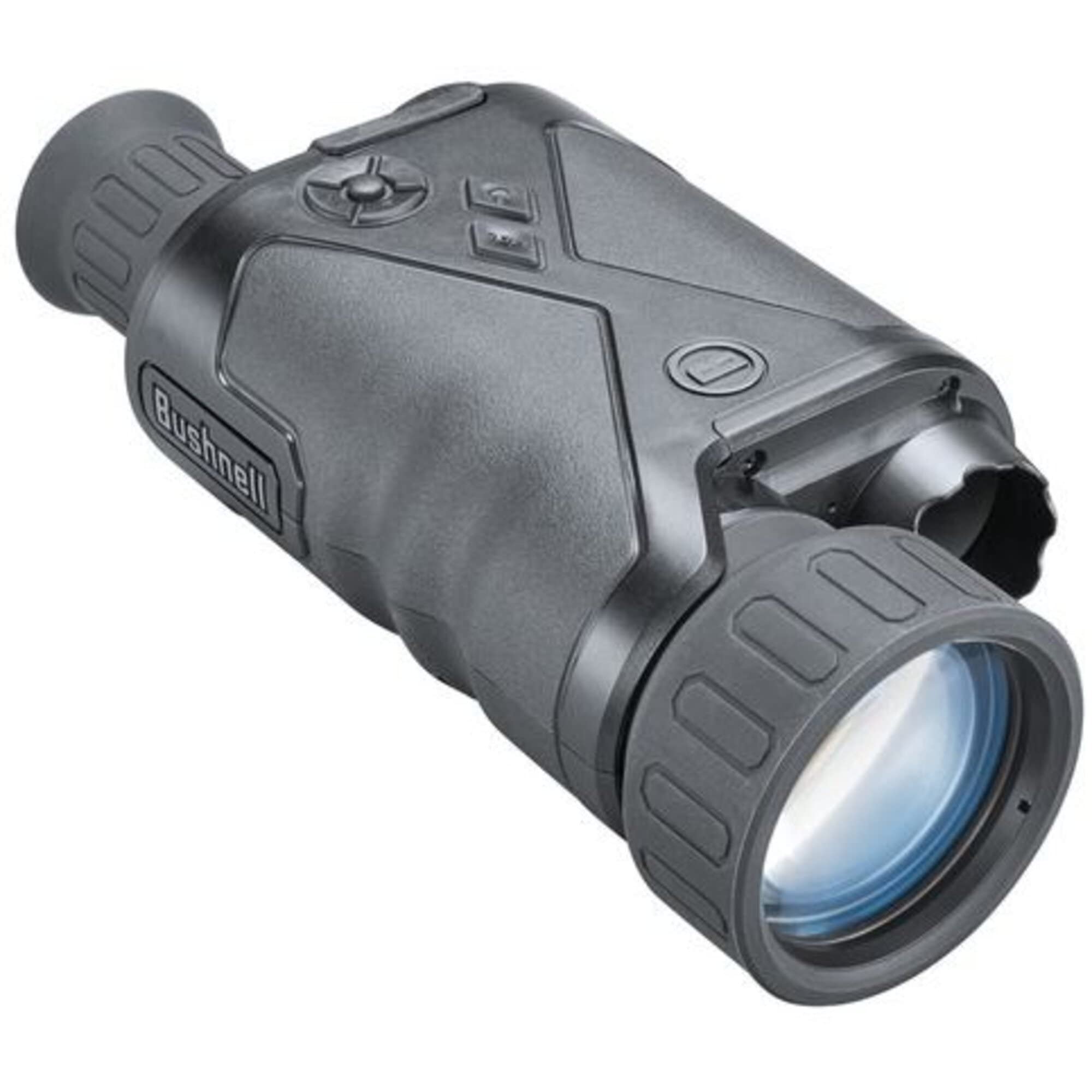
A 6x monocular with a powerful 850nm IR for long-distance spotting.
The Equinox Z2 is a digital monocular with 6x magnification and a 50mm objective lens. It sees targets over 1,000 feet away both day and night using a built-in IR illuminator. It captures 1080p video and streams live video to your mobile device via Wi-Fi, where you can control zoom, video recording, image capture, and IR brightness. The battery runs on standard AA batteries, but reviewers warn that alkaline cells last only about 20 minutes — rechargeable Li-ion AAs provide several hours.
Customers note the “built-in illuminator is very bright” and recommend it for “spotting deer in yard at night.” The built-in 850nm IR is useful out to 286 yards, and an external 940nm IR flashlight can extend covert range to 560 yards. The big trade-offs: the 1080p sensor feeds a 640×480 display, so the internal screen is low-resolution and grainy. One reviewer called the screen “so bright it blinds you and destroys your natural night-vision.” The diopter adjustment is very limited, making it unusable for some people with presbyopia. The battery cap is prone to cross-threading.
Why consider it
- 6x magnification with a 50mm objective lens
- Streams live video to your phone with remote controls
- Built-in 850nm IR is very bright for stationary spotting
- Captures 1080p video day or night
The downsides
- Internal display is only 640×480 — grainy and low-res
- Screen brightness damages natural night vision
- Battery life is abysmal with alkaline cells (~20 min)
- Diopter adjustment very limited for eyeglass users
Best deployed as: A stationary spotting scope on a tripod where you can use the phone app to view a crisp 1080p image — ignore the internal screen.
Not for: Handheld scanning or anyone who needs to preserve dark-adapted eyes — the bright screen kills your ambient vision.
8. DNT Optics Zulus HD V2 Rifle Scope
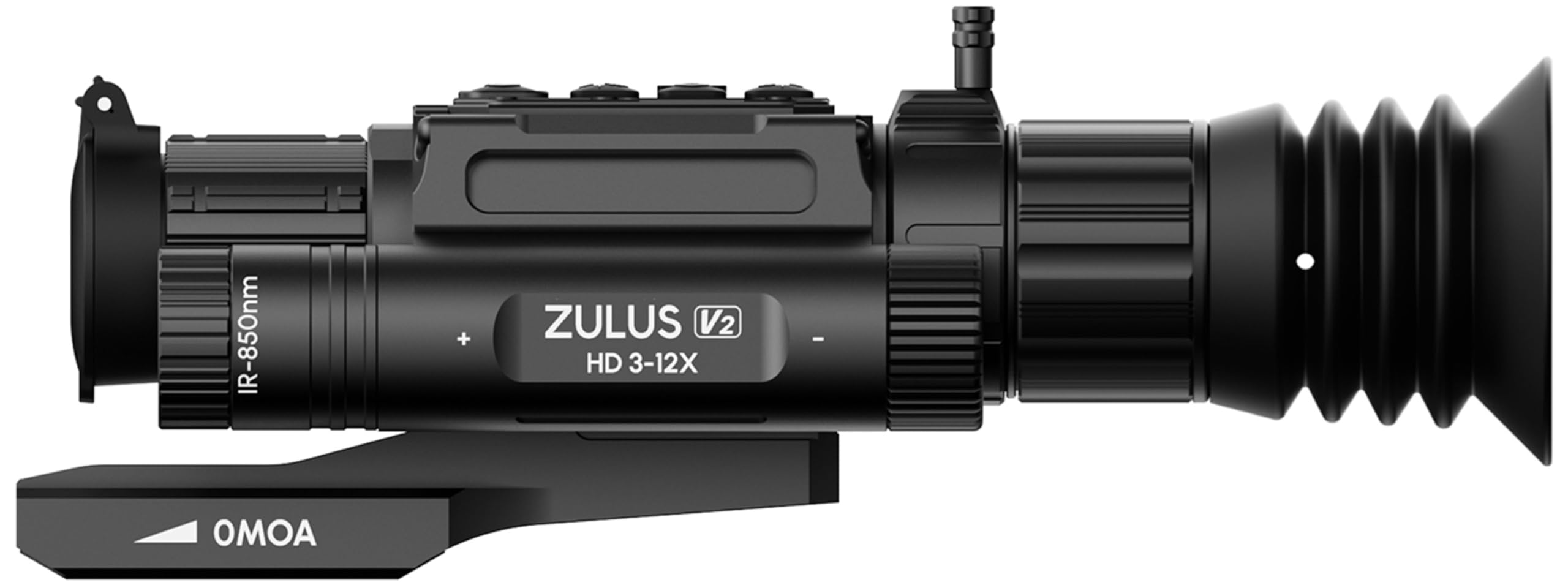
A 12x day/night scope with a Sony STARVIS 2 sensor and 1800-nit OLED display.
The Zulus HD V2 combines a Sony STARVIS 2 sensor with ED glass lenses and AI image algorithms to deliver crisp 1920×1080 imagery on a 60Hz Micro-OLED display. The display peaks at 1800 nits with five adjustable brightness levels so you can tune it from midday sun to total darkness. Magnification ranges from 3x to 12x. The housing is machined aluminum and weighs 16 ounces; the ATN scope weighs 3 pounds. The built-in infrared illuminator is effective out to 300+ yards and invisible to animals; it auto-shuts off after 30 minutes of inactivity to save battery. The scope runs on a single 21700 battery with hot-swap support.
Buyers call this scope “vastly superior to ATN X-sight 4K” — half the size and weight with clearer optics and a better IR. One reviewer successfully used it for nighttime hog hunting up to 300 yards. A minor complaint: the battery cap is tight, and one scope turned off after the second shot (the reviewer suspected a connection loss during recoil). The 21700 charger is picky — a 20W Anker power brick works, but other bricks may not. The V2 model adds better battery life, smoother controls, and a 60Hz refresh that reduces blur compared to older digital scopes.
Why it leads
- STARVIS 2 sensor with ED glass and AI algorithms for razor-sharp clarity
- 1800-nit Micro-OLED display usable in full daylight
- Lightweight aluminum build at 16 oz
- 3–12x magnification with hot-swappable 21700 battery
Edge cases
- Battery cap may loosen under recoil and cut power
- Charger compatibility is finicky — not all power bricks work
- Digital zoom at 20x (in V2) can feel awkward under 100 yards
For the serious hunter: If you want a daytime-clear, nighttime-capable rifle scope that weighs less than a pound and rivals traditional glass in sharpness, this is the pick.
Watch the cap: Check that the battery cap is fully seated before firing — a loose connection can cause the scope to shut off during recoil.
9. ATN X-Sight LTV 3-9x Rifle Scope

A 3–9x digital scope that gives you night vision without the thermal price tag.
The ATN X-Sight LTV features a QHD+ sensor and an HD display with a comfortable 3-inch eye relief (76mm). It shoots in 720p video quality, which is below the 1080p standard of most competitors, but the sensor excels in low light. The One Shot Zero function lets you sight in quickly after your first shot group — reviewers report stacking “7.08 rounds at 100 yards” after using it. The stock IR illuminator identifies predators, deer, and pigs out to 800 yards, with clear shot placement to 200–300 yards. The scope mounts on any platform with standard 30mm rings and weighs 3 pounds.
Reviewers point out it is “great for night deer/hog hunts under 100 yards with IR,” and that it is easy to use with “very clear images at night and day time.” One reviewer has shot five coyotes in a single winter with it. The main drawbacks: the 720p video is dated, and the LTV model lacks a mil-dot reticle (it comes with a basic reticle only). The battery lasts 1–2 hours before sleep mode activates — use an external 20,000mAh charger for 4–6 hour sessions. Sun glare at low angles can wash out the image, so a scope hood is recommended.
What works
- QHD+ sensor provides clear low-light images
- One Shot Zero for fast, accurate sight-in
- Stock IR identifies animals at 800 yards
- Classic ergonomics with 3-inch eye relief
What does not
- Records only 720p video — below current standard
- No mil-dot reticle on the LTV model
- Internal battery life is short (1–2 hrs) without external pack
- Sun glare at low angles requires a hood
Great entry point for: The budget hunter who wants a dedicated day/night rifle scope with reliable low-light performance and does not need 4K video recording.
Worth knowing: You will need an external battery pack for all-night sessions, and the 720p video is fine for shot verification but won’t produce sharable 4K clips.
Understanding the Specs
Sensor Type and Resolution
The sensor determines how much light the device can capture. A STARVIS 2 or starlight-grade CMOS sensor is built for low-light sensitivity and allows full-color viewing even in dim moonlight. Resolution (1080p vs true 4K) affects how detailed the image is at range: a true 4K sensor lets you zoom in digitally without the image turning to mush, while a 1080p sensor is fine for close-to-mid range work. Watch out for “interpolated 4K” on cheap units — it is just a 1080p image stretched, not real extra detail.
IR Illuminator Wavelength and Power
The infrared illuminator is your light source in total darkness. The two main wavelengths are 850nm (bright, reaches 300+ yards, but emits a faint red glow visible to animals and people) and 940nm (invisible to the naked eye, shorter effective range). Multi-level IR adjustment lets you dial down the power to save battery and reduce over-illumination on close targets. If you need covert observation, prioritize 940nm or an external IR add-on.
Field of View (FOV)
FOV is measured in degrees and tells you how wide a scene you can see at a glance. A wider FOV (20–25 degrees) makes it easier to scan a field or woods without moving the device. A narrow FOV (13–15 degrees) feels like looking through a tube and requires more head movement to track moving subjects — acceptable for a rifle scope but frustrating for handheld binoculars. For general scanning, aim for at least 15 degrees.
Exit Pupil Diameter
Exit pupil is the diameter of the light beam that hits your eye, measured in millimeters. A larger exit pupil (7mm+) delivers a brighter image to your eye in low light and is more forgiving if the device shifts slightly on your head. A smaller exit pupil (below 3mm) means you must hold the device very steady and aligned with your pupil. Eyeglass wearers benefit from larger exit pupils because the eye relief is usually more generous.
FAQ
What is the difference between digital night vision and traditional analog night vision?
How far can civilian night vision actually see?
Will night vision work in complete darkness with no moon?
Can I use civilian night vision during the daytime?
Is the IR light from night vision visible to animals?
What does IP67 or IP66 mean for night vision?
Can I mount night vision on a helmet or a rifle?
How long do night vision batteries last?
Is 4K night vision worth the extra money?
Can I record video with civilian night vision?
Final Thoughts: The Verdict
If you want one dependable pick, the best civlian night vision winner is the VisioGear Night Thunder X1 because it combines a STARVIS 2 sensor, true 4K recording, IP67 waterproofing, and the richest feature set (app streaming, tactical light, temperature sensor) at a mid-range price that leaves little to want. If you need extreme detection range and 4K detail for serious wildlife or security observation, grab the CIGMAN CNVPRO. And for a lightweight, everyday-carry option that records in color and fits in a pack, the standout is the AKASO Seemor-200.
How We Picked
We do not accept paid placement. Every pick is matched to a real buyer and a real use-case; we do not hands-on test units.
Sources & Methodology
Specifications: manufacturer listings and product documentation. Review insights: verified customer reviews, as of July 2026. Pricing: not shown on this page (it changes often); check the current price via the retailer link.
As an Amazon Associate, WellFizz earns from qualifying purchases. This does not affect which products we feature.
Related Guides

Mo Maruf
I created WellFizz to bridge the gap between vague wellness advice and actionable solutions. My mission is simple: to decode the research and give you practical tools you can actually use.
Beyond the data, I am a passionate traveler. I believe that stepping away from the screen to explore new environments is essential for mental clarity and physical vitality.