Our readers keep the lights on and my smoothie glass nicely filled. As an Amazon Associate, I earn from qualifying purchases.
A circular saw’s job is simple: convert your intended line into a perfect splinter-free split in under two seconds. Yet the difference between a sloppy, burning tear-out and a clean, accurate cut comes down to the motor’s torque curve, the baseplate’s rigidity, and the blade’s tooth geometry—details most buyers overlook until the saw binds mid-cut. This guide stacks seven contenders against the real-world challenges of framing, sheet goods, and multi-material work.
I’m Mohammad Maruf — the founder and writer behind WellFizz. I’ve spent hundreds of hours dissecting circular saw specifications, consumer test results, and field reviews to isolate the hardware choices that actually determine cut quality, runtime, and long-term durability.
Whether you are a framer chasing maximum depth-of-cut or a weekend DIYer looking for a lightweight helper, this breakdown of the best circular saw will help you match the right tool to your exact cutting conditions.
How To Choose The Best Circular Saw
Choosing the right circular saw comes down to understanding three interconnected systems: the motor and gearbox, the baseplate and adjustment hardware, and the blade interface. Ignoring any one of them leads to frustrating kickback, premature motor burn-out, or inaccurate bevel cuts.
Blade Orientation: Left vs. Right
The blade side relative to the motor determines whether you can see your cut line without leaning. Left-blade saws (like the Bosch CS5 and DEWALT FLEXVOLT) position the blade between the user and the motor, providing an unobstructed view of the cut line for right-handed users. Right-blade saws (like the Metabo HPT and SKILSAW) put the blade on the opposite side, which can force you to peek around the motor housing. For sheet goods and finish work, left-blade orientation is often preferred because it aligns the cut line with your dominant eye.
Motor Power and Torque
Corded saws are rated by amperage—15 amps is the standard for professional-grade 7-1/4-inch models. The higher the amp rating, the more sustained torque the motor can deliver through dense hardwood or pressure-treated lumber without bogging down. For cordless saws, look at maximum watt output (MWO) and voltage. A 20V brushless motor (like the DEWALT DCS590B’s 1,700 MWO) can match many corded 15-amp motors in light framing but will fade faster under continuous heavy cuts. Worm-drive gearboxes (found on the DEWALT FLEXVOLT DCS577X1) trade higher weight for superior low-end torque, making them ideal for repeated deep cuts in engineered lumber.
Depth-of-Cut and Bevel Capacity
A 7-1/4-inch blade typically cuts up to 2-9/16 inches at 90° and around 1-7/8 inches at 45°. That’s enough for most dimensional lumber (2x material is 1-1/2 inches thick), but if you regularly cut LVL, glulam, or pressure-treated 4x4s, you need a saw with a deeper cut capacity. The bevel range—usually 45° to 56°—dictates whether you can cut compound angles for rafters or stair stringers. Positive stops at 22.5° and 45° eliminate guesswork when repeating angled cuts on a job site.
Weight, Balance, and Vibration
A heavy saw (10+ pounds) provides stability for long straight cuts on sheet goods but causes forearm fatigue during overhead work. A lightweight saw (under 9 pounds) is easier to maneuver one-handed but can chatter on thick material if the baseplate is thin. Cast aluminum and magnesium shoes (found on premium models) dampen vibration better than stamped steel, resulting in cleaner cuts and less hand numbness over a full day of work.
Quick Comparison
On smaller screens, swipe sideways to see the full table.
| Model | Category | Best For | Key Spec | Amazon |
|---|---|---|---|---|
| DEWALT FLEXVOLT 60V DCS577X1 | Premium | Heavy framing, all-day cordless torque | 53° bevel, worm-drive gearbox | Amazon |
| DEWALT 20V MAX DCS590B | Mid-Range | Versatile cordless framing & remodel | 1,700 MWO brushless motor | Amazon |
| BOSCH CS5 7-1/4-Inch | Premium | Line-of-sight finish cuts | Blade-left, 15-amp motor | Amazon |
| SKILSAW SPT67WL-01 | Mid-Range | Lightweight professional corded use | 8.6 lb, Dual-Field motor | Amazon |
| Evolution R185CCS | Mid-Range | Multi-material (steel, wood, plastic) | 20-tooth TCT blade, 15A motor | Amazon |
| CRAFTSMAN V20 CMCS551B | Budget | Portable cordless quick cuts | 56° bevel, brushless motor | Amazon |
| Metabo HPT C7SB3 | Budget | Entry-level corded framing value | 9.5 lb, heavy baseplate | Amazon |
In‑Depth Reviews
1. DEWALT FLEXVOLT 60V MAX DCS577X1
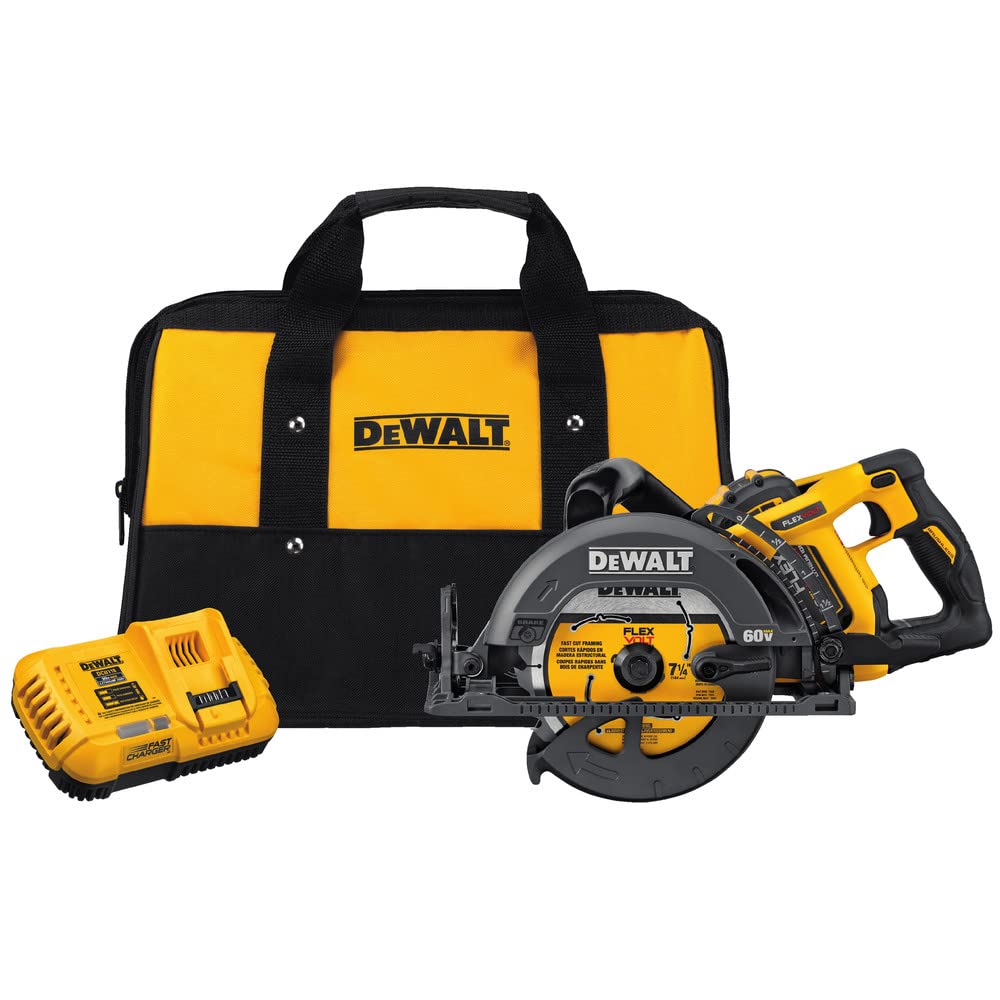
The DCS577X1 brings worm-drive torque to a cordless platform, delivering the low-end grunt needed for ripping through LVL, 4x4s, and pressure-treated decking all day. Its 60V FLEXVOLT battery powers a brushless motor that spins a 7-1/4-inch blade at 5,500 RPM, with an electronic brake that stops the blade within seconds after the trigger is released—a critical safety feature for job-site production work.
The magnesium shoe and blade-left orientation make line-of-sight cuts on sheet goods surprisingly easy despite the saw’s 10.9-pound heft. The 53-degree bevel capacity with positive stops at 22.5 and 45 degrees covers virtually any roof rafter or stair stringer angle. A rafter hook and onboard blade wrench storage are thoughtful additions for framers who need quick blade changes on ladders.
User reviews consistently praise the all-day battery life on a single 9.0Ah charge, but note that the dust ejection blows chips toward the user’s face—a face shield is recommended. The saw is also heavier than any sidewinder, which can fatigue the forearm during overhead cutting. Contractors who bought multiple units report excellent durability, with one crew replacing all corded worm drives with this kit.
Why it’s great
- Worm-drive gearbox for unmatched cordless torque
- 53° bevel range with reliable positive stops
- Blade-left orientation for clear cut-line visibility
Good to know
- Dust blower ejects chips toward user; face shield needed
- Heavy at 10.9 pounds, fatiguing for overhead work
- Rain exposure may void warranty; store dry
2. DEWALT 20V MAX XR DCS590B

The DCS590B is the most powerful 20V MAX circular saw DEWALT makes, with a brushless motor producing 1,700 maximum watt output—enough to bury the 7-1/4-inch blade into 2x pressure-treated lumber without noticeable bog down. The electric brake halts blade coasting within a second, a feature that matters when you are working on a ladder or near finished surfaces.
With a depth-of-cut of 2-9/16 inches at 90 degrees and 2 inches at 45 degrees, this saw handles most framing and sheathing tasks. The rubber overmold grip and 9.2-pound weight keep it manageable for one-handed rip cuts on plywood. Users report getting 368 cuts per charge with a 6.0Ah battery, though heavy continuous use drains a 4.0Ah battery in about 10 minutes of runtime.
Experienced carpenters note that the brushless motor’s stall behavior is different from older DC motors—when the blade pinches on a large sheet, the motor cuts out rather than cogging down. Proper material support eliminates this issue. Overall, the DCS590B is a strong cordless alternative to a 15-amp corded saw for remodelers and light framers.
Why it’s great
- 1,700 MWO brushless motor matches corded power
- Fast electric brake prevents dangerous coasting
- Light enough for one-handed operation
Good to know
- Battery sold separately; 4.0Ah drains quickly under load
- Motor stalls on pinched blades if material isn’t supported
- No blade included; buy a quality aftermarket blade
3. BOSCH CS5 7-1/4-Inch Circular Saw

The Bosch CS5 is a blade-left sidewinder built for users who prioritize cut-line visibility above all else. By positioning the blade on the left side, the motor and housing stay out of your line of sight, letting you follow a pencil mark naturally without craning your neck—a huge advantage when cutting long rip lines in plywood or melamine.
The 15-amp motor spins the 7-1/4-inch blade at 5,600 RPM, providing solid torque for hardwood and engineered lumber. The cast-metal baseplate feels rigid and stays square, and the depth and bevel adjustments lock firmly with no play—important for repeating accurate cuts. The built-in wrench clips directly to the saw, so you never lose the hex key when swapping blades on site.
Some users report that the bevel plate is hard to square precisely, and there is no dust chute or blower—sawdust blows directly toward the operator’s feet and face. The included 24-tooth blade has a wide kerf that can scorch hardwoods; swapping to a thin-kerf finishing blade transforms this saw into a precision sheet-good cutter. Despite these quirks, the CS5 remains a favorite among cabinetmakers and finish carpenters.
Why it’s great
- Unobstructed cut-line view for precise rip cuts
- Rigid cast-metal base stays square over time
- Built-in wrench clips to the saw for easy blade changes
Good to know
- No dust collection port; chips blow toward user
- Bevel plate adjustment can be tricky to square
- Stock blade scorches on dense hardwoods
4. SKILSAW SPT67WL-01 Sidewinder

The SKILSAW SPT67WL-01 weighs only 8.6 pounds—the lightest professional-grade corded circular saw in class—yet packs a 15-amp Dual-Field motor that stays cooler under sustained load than conventional armature designs. The Dual-Field technology dissipates heat more efficiently, extending motor life when cutting pressure-treated wood or dense hardwood for an entire workday.
The 56-degree bevel capacity with a positive stop at 45 degrees provides extra angular range for compound miters and rafter cuts. The 10-foot cord is unusually long, reducing the need for extension cords on large sheet goods. The cast aluminum baseplate has a wide 5-inch fence contact area, making it easy to square up to a guide for straight rip cuts on plywood.
Long-term owners report eight years of consistent service with no mechanical issues. The saw lacks an electric blade brake, so the blade continues coasting for a few seconds after release—a safety consideration for users who make rapid cuts. The plastic housing feels durable enough for job-site drop tests, and the rubber grip insert stays comfortable even after hours of use.
Why it’s great
- Lightest pro corded saw at 8.6 pounds
- Dual-Field motor runs cool under continuous load
- 56° bevel range for compound angles
Good to know
- No blade brake; blade coasts after cut
- Plastic housing less impact-resistant than metal
- Not ideal for wet or treated lumber long-term
5. Evolution R185CCS Multi-Material

The Evolution R185CCS is engineered for one job that most circular saws cannot handle: cutting steel. Its 15-amp motor drives a special 20-tooth tungsten carbide tipped blade through mild steel solid round up to 1-1/4 inches thick in under 30 seconds, with no heat discoloration and virtually no sparks. The optimized gearbox keeps the blade running at the correct RPM for steel while also delivering smooth cuts in wood with embedded nails.
The electronic brake stops the blade within 4 seconds, and the blade guard closes in 0.3 seconds—critical safety features when cutting metal where the blade can grab. The rubberized soft-grip handle reduces vibration transfer during extended steel cutting. Weighing 9.4 pounds, it is comparable to a standard sidewinder, though the gearbox adds noticeable bulk at the front.
Users report that the stock TCT blade wears out faster than a dedicated steel-cutting blade, so buying a quality replacement blade is recommended early. The saw also produces chips rather than fine dust when cutting wood, which is easier on a shop vac. For fabricators, welders, and remodelers who regularly encounter embedded nails or rebar, this saw is uniquely capable.
Why it’s great
- Cuts steel solid round without heat or sparks
- Electronic brake stops blade in under 4 seconds
- Handles wood, plastic, and metal with one blade
Good to know
- Stock TCT blade wears quicker on frequent steel cuts
- Gearbox adds front-end weight
- Not optimized for fine wood finishing cuts
6. CRAFTSMAN V20 RP CMCS551B
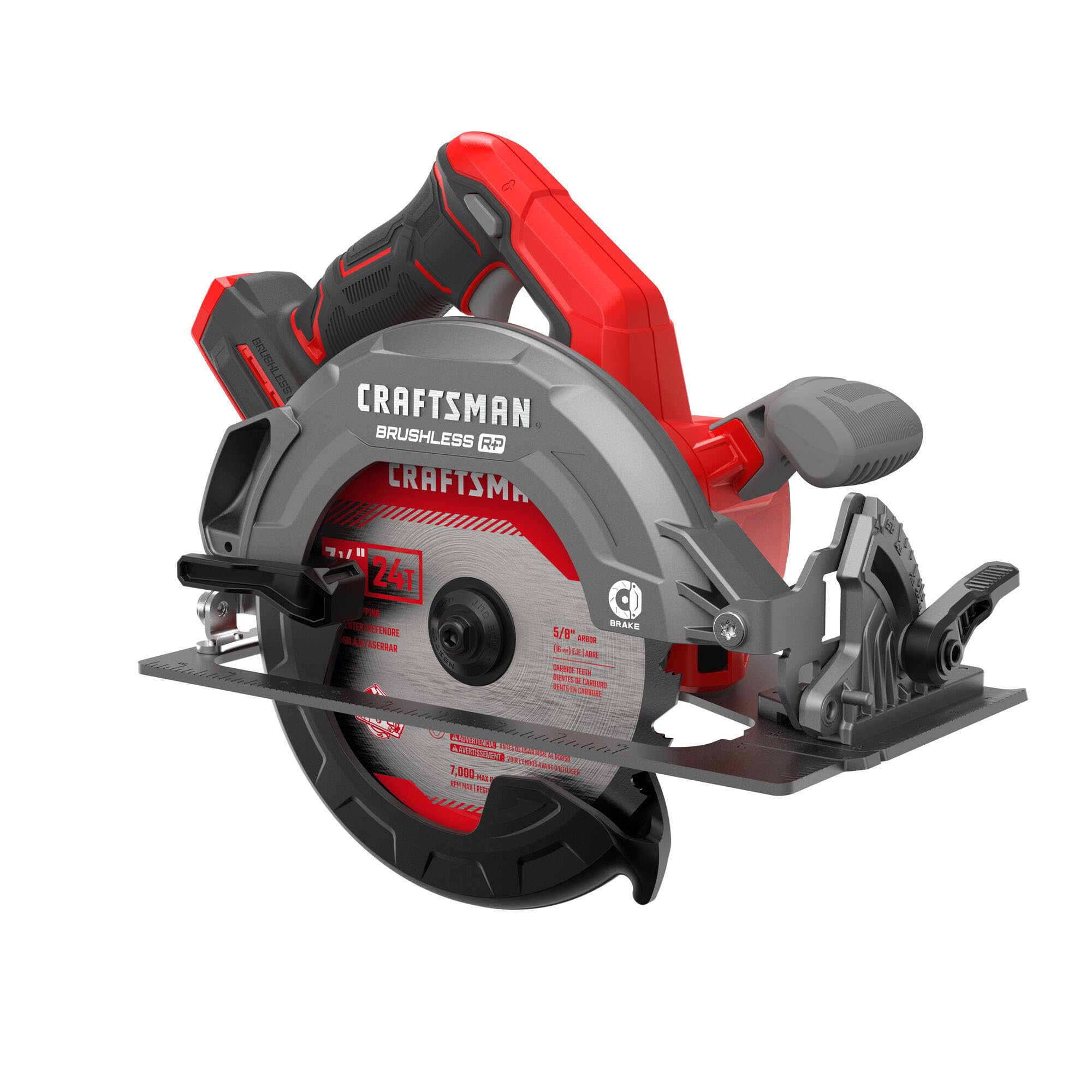
The CRAFTSMAN V20 RP brushless circular saw boasts a 56-degree bevel capacity—matching top-tier pro saws—with positive stops at 22.5 and 45 degrees. The brushless motor delivers up to 75 percent more power than previous brushed Craftsman models, making this cordless saw capable of cutting 3/8-inch plywood and 2x dimensional lumber without complaint. An LED light illuminates the cut line, helping when working in dim attic or crawlspace conditions.
The upper metal guard adds resilience against job-site drops and prevents guard binding. At 9.3 pounds, it is slightly heavier than the SKILSAW but feels well-balanced with a 4.0Ah battery attached. Users report excellent torque for a 20V platform, though runtime is limited—three 8-foot cuts through 1-inch lumber drained a fully charged 4.0Ah battery in about 10 minutes.
The brushless motor’s stall behavior can be surprising: when the blade pinches on a large sheet, the motor cuts out instead of grinding through. Proper material support eliminates this. The tool-only format (battery sold separately) lets existing Craftsman V20 owners adopt this saw without new battery investment. For occasional repairs, remodeling, and quick cuts where an outlet is unavailable, this saw is a solid choice.
Why it’s great
- 56° bevel range with positive stops
- LED light improves visibility in low-light areas
- Brushless motor offers strong cordless torque
Good to know
- Battery drains quickly under heavy use; large battery required
- Motor stalls on pinched blades without proper support
- Battery and charger sold separately
7. Metabo HPT C7SB3

The Metabo HPT C7SB3 is a 15-amp, 6,000 RPM sidewinder that earned “Best Corded Budget Circular Saw for Pros” from Pro Tool Reviews. Its 9.5-pound weight provides heft that helps the saw track straight through rip cuts, and the heavy-duty aluminum baseplate has scales on both the front and side for accurate measurement without a separate tape. The included 24-tooth premium framing/ripping blade cuts OSB and 2x4s cleanly straight out of the box.
The integrated dust blower clears sawdust from the cut line, maintaining visibility as you work. The cord holder routes the power cord away from the blade path, reducing the risk of accidental cord severing—a thoughtful safety detail. Depth-of-cut reaches 2-7/16 inches at 90 degrees and 1-7/8 inches at 45 degrees, adequate for standard framing and sheathing tasks.
Users note that the depth adjustment lever loosens too easily, making fine-tuning difficult when switching between material thicknesses. The carrying bag included is a nice storage solution but lacks a dust port for vacuum attachment. For the DIY-er or apprentice framer seeking a reliable corded circular saw without spending pro-level money, the C7SB3 delivers solid performance and durability.
Why it’s great
- Powerful 15-amp motor with 6,000 no-load RPM
- Heavy aluminum baseplate aids straight cuts
- Includes quality 24-tooth framing blade
Good to know
- Depth adjustment lever loosens easily during use
- No dust port for vacuum attachment
- Carrying bag only; no hard case included
FAQ
What does blade-left orientation do for a circular saw?
Why would I choose a worm-drive saw over a sidewinder?
How important is an electric brake on a circular saw?
Final Thoughts: The Verdict
For most users, the best circular saw winner is the DEWALT FLEXVOLT 60V DCS577X1 because it combines worm-drive torque with cordless freedom and a blade-left design for clear line-of-sight. If you want a lightweight corded saw for professional use, grab the SKILSAW SPT67WL-01. And for cutting steel and multi-material on the same day without switching tools, nothing beats the Evolution R185CCS.

Mo Maruf
I created WellFizz to bridge the gap between vague wellness advice and actionable solutions. My mission is simple: to decode the research and give you practical tools you can actually use.
Beyond the data, I am a passionate traveler. I believe that stepping away from the screen to explore new environments is essential for mental clarity and physical vitality.