Our readers keep the lights on and my smoothie glass nicely filled. As an Amazon Associate, I earn from qualifying purchases.
A circular saw blade that burns, wanders, or dulls in a week turns a quick cut into a frustrating project. The difference between a smooth, glue-ready edge and a ragged, splintered mess comes down to the tooth geometry, carbide quality, and kerf design of the blade spinning on your arbor. Choosing the right one for your saw and material stops the guessing and delivers consistent results cut after cut.
I’m Mohammad Maruf — the founder and writer behind WellFizz. This guide is built from hours of cross-referencing tooth counts, carbide grades, plate thicknesses, and real-world user feedback across the most popular circular saw blade options available today.
Every blade reviewed here was selected because it represents a genuinely useful balance of build quality, cutting performance, and value for a specific task. Whether you are ripping framing lumber or trimming veneer plywood, the best circular saw blade for your saw is the one that matches its arbor size, RPM rating, and your material without compromise.
How To Choose The Best Circular Saw Blade
Selecting a blade is not about brand loyalty — it is about matching the blade’s physical parameters to your saw’s arbor, RPM range, and the material you cut most often. A mismatched blade wastes power, creates dangerous kickback, and burns your workpiece.
Tooth Count Determines Cut Quality
Fewer teeth (18T to 24T) clear material faster and are ideal for ripping dimensional lumber, but leave a rougher edge. More teeth (60T to 80T) produce a finer finish for crosscuts, plywood, and trim work, but cut slower and generate more heat in thick stock. Choose 24T for framing and demolition; choose 80T for cabinetry and fine woodworking.
Kerf Width Affects Power and Waste
Thin kerf blades (around 0.07 inches) remove less material, require less motor torque, and cut faster — ideal for cordless saws and underpowered bench saws. Full kerf blades (0.098 inches and above) are more stable, resist deflection in dense hardwoods, and produce a wider cut that reduces blade binding.
Carbide Grade and Plate Material Dictate Longevity
High-density TiCo carbide (titanium-cobalt) tips hold an edge longer than standard C3/C4 carbide. The steel body matters too — hardened 75Cr1 steel resists bending and keeps the blade true under heavy side loads. A Perma-SHIELD non-stick coating prevents pitch buildup and keeps cuts cool.
Quick Comparison
On smaller screens, swipe sideways to see the full table.
| Model | Category | Best For | Key Spec | Amazon |
|---|---|---|---|---|
| Diablo D0736GPA | Premium | Wood & metal combo cutting | 36 C-ATB teeth, 0.067″ kerf | Amazon |
| BOSCH DCB760 | Premium | Extra-fine finish on plywood | 60 ATB teeth, C3/C4 carbide | Amazon |
| Foxbc 10″ 80T | Mid-Range | Ultra-finish crosscuts | 80 teeth, 0.098″ kerf | Amazon |
| UXACE 10″ 80T | Mid-Range | Thin kerf plywood cutting | 80 teeth, 2.4 mm kerf, 6000 RPM | Amazon |
| DEWALT DW3112 | Entry-Level | General purpose ripping | 24 ATB teeth, 0.07″ thin kerf | Amazon |
In‑Depth Reviews
1. Diablo D0736GPA
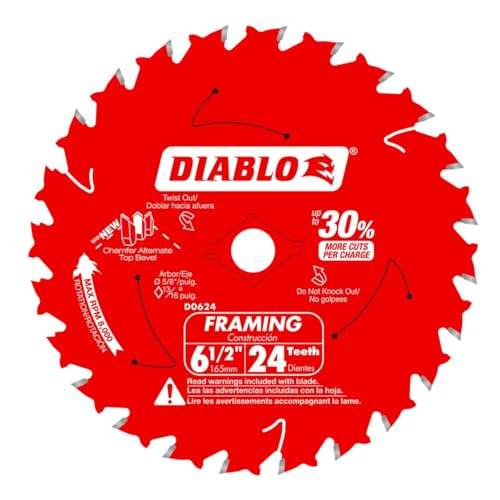
The Diablo D0736GPA is a 7-1/4-inch blade designed for both wood and metal, a rare combination that saves you a tool change on mixed-material job sites. Its 36 C-ATB teeth strike a smart balance between cut speed and edge finish, and the Tri-Metal Shock Resistant brazing keeps carbide tips locked in place when you hit a nail, threaded rod, or embedded fastener.
The Perma-SHIELD non-stick coating actively repels pitch and resin, so the blade runs cooler and stays sharp longer than uncoated alternatives. With a 5-degree hook angle and 0.067-inch thin kerf, this blade loads the motor lightly and produces smooth, accurate cuts in plywood, 2x4s, and even 1/4-inch threaded rod without burning or wandering.
Users consistently report exceptional blade life on cordless saws, noting that the Diablo outperforms stock blades by a wide margin in both cut quality and edge retention. It fits DeWalt, Milwaukee, and Makita saws with a 5/8-inch arbor and handles up to 8000 RPM without vibration.
Why it’s great
- Cuts both wood and metal without swapping blades
- Non-stick coating reduces heat and pitch buildup
- Thin kerf design maximizes battery runtime on cordless saws
Good to know
- 7-1/4″ size limits use on 10″ miter or table saws
- 36-tooth count not ideal for ultra-fine finish work
2. BOSCH DCB760

The Bosch DCB760 is a 7-1/4-inch, 60-tooth carbide blade engineered for extra-fine finish cuts on plywood, melamine, and crosscut lumber. Its ATB (Alternate Top Bevel) tooth grind shears the wood fibers cleanly, producing a chip-free edge that reduces sanding time on cabinet-grade work.
Bosch uses an upgraded C3/C4 micrograin carbide formulation it calls Brute Carbide, which delivers noticeably better impact resistance than standard carbide. The Speed Coat anti-friction finish reduces drag and prevents burning even during long rips in dense hardwood. The thinner kerf design removes less material, meaning less waste and less strain on the saw motor.
Reviewers consistently compare the DCB760 to premium Freud blades, praising its quiet, smooth cutting action on a cordless miter saw. The extra-hard steel body resists deflection, keeping cuts true even when feeding material aggressively. It is a strong upgrade over any stock blade for users who demand a glue-ready edge.
Why it’s great
- 60-tooth ATB grind produces near-zero tear-out on plywood
- Brute Carbide tips hold edge longer than standard carbide
- Speed coat prevents resin buildup and blade burn
Good to know
- Not meant for ripping thick hardwood or nail-embedded lumber
- 7-1/4″ size limits use to smaller circular and miter saws
3. Foxbc 10″ 80-Tooth Ultra Finish

The Foxbc 10-inch 80-tooth blade delivers ultra-fine crosscuts on oak, pine, melamine, and plywood at a price that undercuts most premium finishing blades by a wide margin. High-density tungsten carbide tips and a 0.098-inch kerf plate provide a combination of durability and smoothness that rivals blades costing three times as much.
Users report zero tear-out on hardwood crosscuts and remarkably quiet, vibration-free operation on miter saws and table saws. The ATB tooth geometry produces a clean shear cut that leaves edges ready for joinery without sanding. It fits 5/8-inch arbors and is compatible with DeWalt, Skil, Metabo, and Makita 10-inch saws.
The only caveat is the kerf — at 0.098 inches, it is not an ultra-thin blade, so it requires slightly more motor power than a thin-kerf alternative. For anyone doing finish carpentry or cabinet work on a budget, this blade offers an exceptional balance of cut quality and cost.
Why it’s great
- 80-tooth finish rivals premium blades at a fraction of the cost
- Smooth, quiet cuts with no vibration on hardwood
- Widely compatible with 5/8″ arbor saws
Good to know
- Full kerf design demands more motor torque than thin-kerf blades
- Not designed for ripping thick lumber or nail-embedded material
4. UXACE 10-Inch 80-Tooth Professional
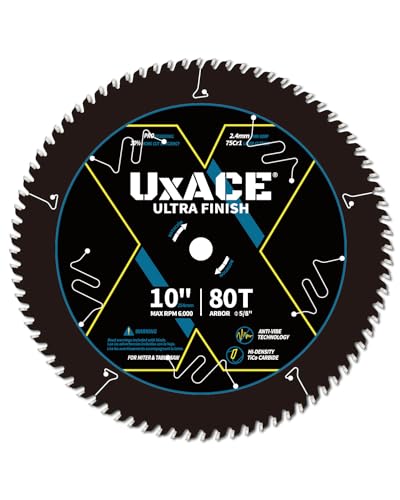
The UXACE 10-inch 80-tooth blade combines TiCo hi-density carbide tips with a 75Cr1 hardened steel body for a professional-grade build that resists bending and maintains a super clean cutting surface. Its laser-cut thin kerf (2.4 mm) saves up to 30% power consumption, making it an excellent match for underpowered or cordless table saws and miter saws.
Anti-Vibe Technology reduces noise and vibration noticeably during cuts, and users report that this blade cuts through plywood and dimensional lumber with exceptional smoothness — even on older, less powerful saws. The 6000 RPM rating ensures safe operation on most 10-inch saws.
Real-world reviews highlight how the blade handles plywood with little to no shredding against the grain, and several users noted a marked improvement over stock blades that came with their saws. The thin kerf does trade some lateral stability, so it is best suited for crosscuts and sheet goods rather than deep ripping in thick hardwoods.
Why it’s great
- Thin kerf reduces power draw by up to 30%
- TiCo carbide stays sharp across many cuts
- Anti-Vibe Technology keeps operation smooth and quiet
Good to know
- Thin kerf can deflect under heavy side load in dense hardwoods
- Not ideal for ripping thick, nail-filled lumber
5. DEWALT DW3112

The DEWALT DW3112 is a 10-inch, 24-tooth thin-kerf blade built for fast, aggressive ripping in dimensional lumber, pressure-treated 4x4s, and hardboard. Its computer-balanced plate reduces vibration noticeably, and the exclusive Wedge Shoulder design puts more steel behind each carbide tip, increasing durability on demolition cuts where hidden nails are a real risk.
Despite its entry-level price point, this blade has surprised users with its performance on Brazilian walnut and other demanding hardwoods — no burning, no vibration, and cuts comparable to premium Freud blades. The thin kerf (0.07 inches) keeps cuts fast and battery-friendly on miter saws and table saws.
Users appreciate that the DW3112 can be resharpened economically (often for under per blade), extending its useful life well beyond what the initial price suggests.
Why it’s great
- Thin kerf delivers fast, clean cuts with less motor strain
- Computer-balanced plate minimizes vibration
- Wedge Shoulder design adds tip durability for nail-impact cuts
Good to know
- 24-tooth count leaves a rougher edge than finish blades
- High-speed steel tips wear faster than TiCo carbide on abrasive materials
FAQ
Can I use a 10-inch blade on a 7-1/4 inch saw?
What does the T in 24T or 80T mean?
How do I know if a blade fits my saw arbor?
Final Thoughts: The Verdict
For most users, the best circular saw blade winner is the Diablo D0736GPA because it cuts wood and metal without a tool change, its Perma-SHIELD coating prevents pitch buildup, and the 36 C-ATB teeth deliver a smooth finish on both framing lumber and sheet goods. If you want an extra-fine finish on plywood and melamine, grab the BOSCH DCB760. And for a budget-friendly ripping blade that outperforms its price point, nothing beats the DEWALT DW3112.

Mo Maruf
I created WellFizz to bridge the gap between vague wellness advice and actionable solutions. My mission is simple: to decode the research and give you practical tools you can actually use.
Beyond the data, I am a passionate traveler. I believe that stepping away from the screen to explore new environments is essential for mental clarity and physical vitality.