Our readers keep the lights on and my smoothie glass nicely filled. As an Amazon Associate, I earn from qualifying purchases.
Specs are compiled from manufacturer listings and verified buyer reviews and can change over time — please confirm the key details on the product page before buying.
Running a standard wood blade through aluminum is a shortcut to melted edges, grabbing, chatter, and a dead blade. You need a special tooth grind and hook angle to slice through aluminum cleanly, leaving a smooth edge that needs almost no work after the cut. This guide breaks down the best options for table saws, miter saws, and circular saws, focusing on what matters: tooth count, blade diameter, and arbor size (the center hole that fits onto your saw’s shaft).
I’m Mohammad Maruf — the founder and writer behind WellFizz. This guide is built by comparing the manufacturers’ published specifications and the patterns across verified customer reviews, so you get each pick’s real strengths and trade-offs instead of marketing spin.
Picking the right circular saw blade for aluminum means matching the tooth design to your material thickness and your saw type for a clean, safe cut every time.
Our Picks at a Glance

How To Choose The Best Circular Saw Blade For Aluminum
Picking the right blade for aluminum is less about brand and more about matching three key specs to your saw and the material you cut. Get these right, and you get clean, safe cuts without fighting the saw.
Tooth Grind: TCG is the Standard
Look for Triple Chip Grind (TCG) teeth. Unlike a standard alternate-top-bevel (ATB) wood blade, a TCG tooth has a flat top that breaks the aluminum chip into manageable pieces instead of catching it. This means less vibration and a cleaner finish on the metal.
Tooth Count: More Teeth, Smoother Cut
An 80-tooth blade is the balance for medium-thickness aluminum and general non-ferrous work. For thinner material like sheet metal or trim, a 100-tooth or 128-tooth blade produces a finer, almost polished edge. For heavy extrusions or thick bar stock, 60 to 80 teeth are still effective and less likely to clog up.
Hook Angle: Stay Negative
A negative hook angle (-5° is common) is critical for aluminum cutting. This means the tooth hits the material more flatly, which prevents the blade from “grabbing” or self-feeding — a dangerous situation that can kick the workpiece back at you. Positive hook angles are for wood only.
Quick Comparison
| Model | Best For | Diameter | Teeth | Weight | Amazon |
|---|---|---|---|---|---|
| Diablo D1080N★ Best Overall | Versatile pro cutting | 10″ | 80 | 1.45 lbs | Amazon |
| Diablo D1296NPro Finish | Large-diameter & high-volume | 12″ | 96 | Not listed | Amazon |
| Oshlun SBNF-100100 | Ultra-fine finish cuts | 10″ | 100 | 2.05 lbs | Amazon |
| TWIN-TOWN TTA1080 | Heavy & thick aluminum extrusions | 10″ | 80 | 1.7 lbs | Amazon |
| TOMAX TMA10801 | DIY miter saw work | 10″ | 80 | 0.91 kg | Amazon |
| OA-BRES YJPJL1080 | Budget 10″ cutting | 10″ | 80 | Not listed | Amazon |
| IVY Classic 35050 | Thin sheet & light cutting | 7.25″ | 128 | 0.19 kg | Amazon |
In‑Depth Reviews
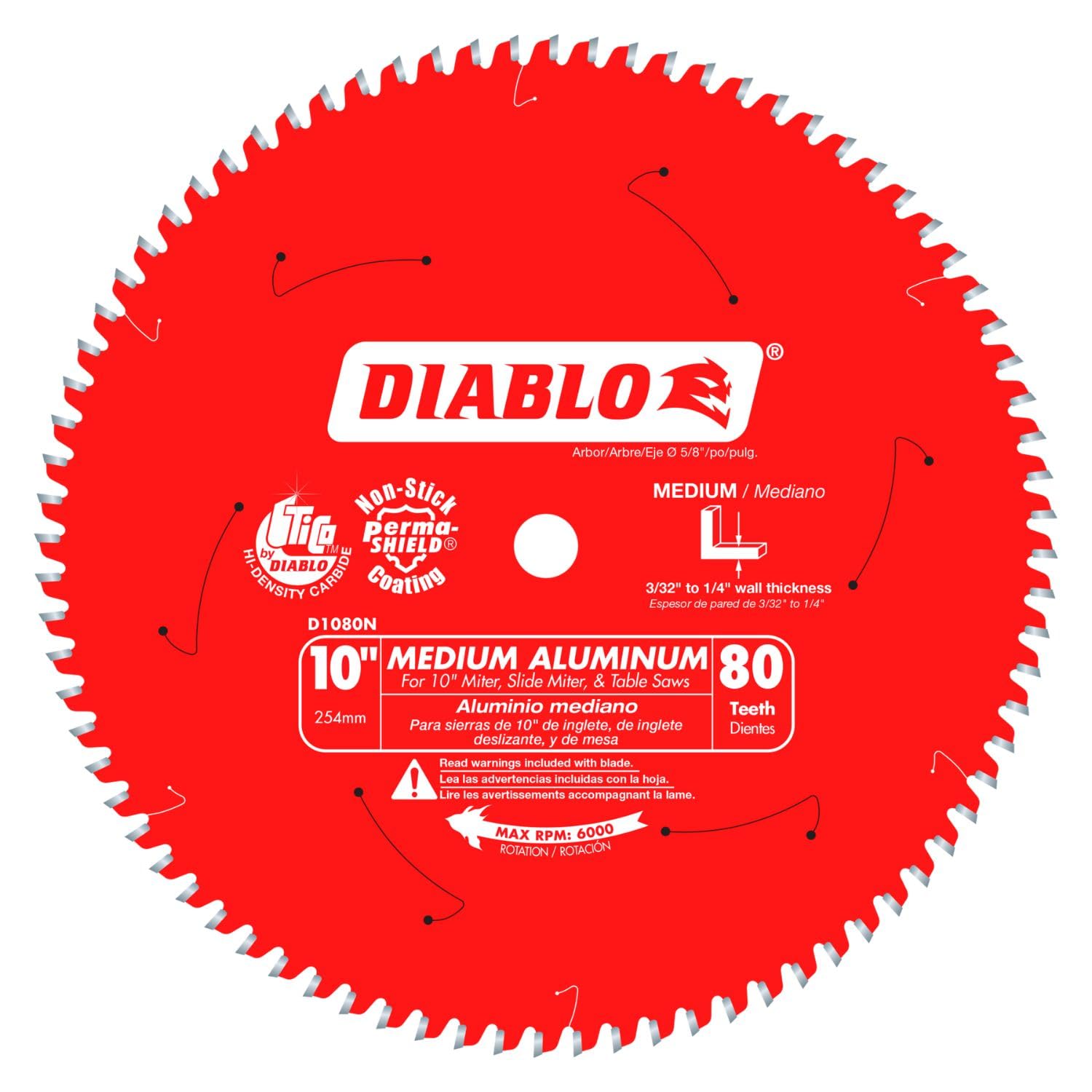
1. Diablo Saw Blade for Medium Aluminum – 10″ Diameter, 80 TCG Teeth (D1080N)
Our pick — over 4.5★ from 750+ verified ratings; the strongest balance of quality and price.
You get a pro-grade blade that handles aluminum, plastics, and thin sheet metal without dulling fast.
The Diablo D1080N uses Triple Chip Grind (TCG) teeth, where each tooth has a flat top that breaks the aluminum chip cleanly instead of catching it. This gives you a burr-free finish right off the saw. The Perma-SHIELD non-stick coating (a coating that helps prevent heat buildup and corrosion) keeps the blade gum-free when cutting plastics or softer metals. One buyer reports it “cuts 0.093″ ABS, splintery plywood, and melamine perfectly” and that it outperforms a Forrest combo blade on aluminum and plastics, which is high praise in woodworking circles.
The Tri-Metal shock-resistant brazing (a process that bonds carbide tips with a tough alloy) handles the sudden impacts from cutting aluminum extrusions without losing a tooth. At 1.45 pounds, it is lighter than the 1.7-pound TWIN-TOWN blade below. The.094-inch kerf (the width of the cut) is typical for a 10-inch blade and works on most table and miter saws with a 5/8-inch arbor (the hole size that fits the saw shaft). Buyers report that a miter saw needs a rigid setup and careful clamping to get truly square cuts on aluminum T-slot. The 80 teeth are plenty for medium work but not as fine as the 100-tooth Oshlun SBNF-100100 for visible-edge finishing.
Why It Earns the Top Spot
- Tri-Metal brazing gives excellent impact resistance for aluminum extrusions
- Perma-SHIELD coating protects against gumming from plastic and heat
- 80 TCG teeth produce clean, sanding-free cuts on most gauge thicknesses
Things to Keep in Mind
- Rigid saw setup and clamping matter for square cuts on T-slot
- Not the best choice for extremely thin or finicky visible-edge work vs 100T
Grab it if: you need a single do-it-all non-ferrous blade for a table or miter saw that handles aluminum, copper, and plastics without swapping.
Look elsewhere if: you only cut thin sheet metal — a higher tooth count like 96 or 100 will give a finer edge from the start.
2. Diablo Saw Blade for Medium Aluminum – 12″ Diameter, 96 TCG Teeth (D1296N)
The big-saw solution for cutting thick plate and long extrusions with a fine finish.
If your miter saw or radial arm saw accepts a 12-inch blade, the D1296N brings 96 TCG teeth and the same Tri-Metal brazing found on the smaller Diablo. You get a very smooth cut surface on heavy material like a 3/4-inch x 8-inch 6061 aluminum plate — a common size for boat transoms and structural brackets. Owners mention it “cuts 14″x1/2″ aluminum fast and mirror-smooth with water cooling,” meaning it handles large cross-sections without bogging down or leaving burrs.
The Perma-SHIELD coating and laser-cut stabilizer vents (slots cut into the steel body that reduce noise and vibration) are the same tech that makes the 10-inch D1080N a favorite. This blade runs at a max of 5000 RPM (rotations per minute), which is lower than the 6000 RPM max of the 10-inch D1080N. That is fine for miter saws, but check your saw’s speed before buying.
Built for Big Jobs
- 96 TCG teeth deliver a finer, more polished edge on thick aluminum and brass
- Tri-Metal brazing withstands impact on heavy-duty cuts
- Non-stick coating resists gumming from copper and plastics
Just Be Aware
- Only fits saws with a 1-inch arbor and 12-inch capacity
- Lower max RPM (5000) requires checking your saw’s compatibility
The takeaway: if you have a 12-inch miter or chop saw and regularly cut thick aluminum plate or wide extrusions, this is the blade that will give you the cleanest edge with the least rework. Not for standard 10-inch saws.
3. Oshlun SBNF-100100 10-Inch 100 Tooth TCG Saw Blade

The 100-tooth specialist treats aluminum like plastic, giving you a near-machined surface quality.
When you need a finish that looks machined rather than saw-cut, the 100-tooth count on the Oshlun is tough to top. More teeth means more cuts per inch, which leaves a smoother surface and fewer burrs on thin materials like 1×1-inch aluminum angle or 2×3-inch extrusions. Customers note it “cuts through aluminum like cutting through cheese” on a miter saw and that it does not grab or kick the part, making clamping simpler.
The negative hook angle (the tooth faces backward slightly so it does not pull itself into the cut) is a key safety feature that prevents the blade from grabbing the material. The copper plugged expansion slots (small plugs in the blade body that dampen vibration and reduce noise) add stability during long cuts. At 2.05 pounds, this blade is noticeably heavier than the 1.45-pound Diablo D1080N, which adds stability but also puts more load on your saw motor.
Where It Shines
- 100 TCG teeth produce a near-machined finish on aluminum and brass
- Negative hook angle keeps the cut safe and prevents grabbing
- Copper plugs reduce noise and vibration for smoother operation
Trade-offs
- Heavier construction (2.05 lbs) may be too much for some smaller saws
- Premium price tag compared to mid-range 80T options
Ideal for: finishing work where the cut edge will be visible — window frames, trim, and decorative extrusions. Overkill if you are just cutting stock for welding or rough projects.
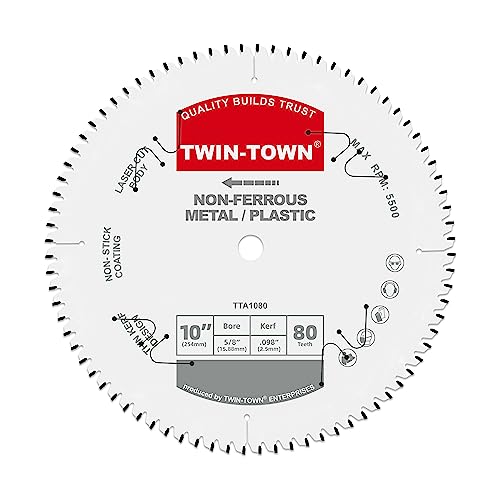
4. TWIN-TOWN 10-Inch 80 Tooth TCG Aluminum Cutting Saw Blade
A mid-range heavyweight that cuts thick aluminum extrusions with authority and no melting.
The TWIN-TOWN uses C4 grade ultra-fine grain carbide (a high-density carbide that holds its edge longer) and, according to the brand, stays sharp for up to 2X longer than standard blades. Real-world feedback is consistent: it cuts heavy aluminum shower door headers and thick extrusions easily on a miter saw. Reviewers point out it is a “heavy, solid blade” that is not thin-kerf, meaning it removes more material but produces less deflection.
At 1.7 pounds, compared to the Diablo D1080N at 1.45 lbs, it has more inertia and stability in the cut but also requires a saw with enough torque to spin it up. The electrophoretic coating (an anti-rust coating applied with an electric charge) protects against corrosion, useful in a damp shop. One reviewer noted that the finish was “not super smooth” on a table saw, producing fine particles, so it may not be the best for high-visibility work.
Strong Points
- Heavier mass provides stable cuts in thick aluminum without vibration
- C4 carbide is durable for repeated cuts in extrusion and tube
- Electrophoretic coating resists rust in humid shops
Weaknesses
- Finish not as polished as high-tooth-count blades for visible parts
- Heavier weight may be too much for underpowered saws
Reach for this if: you cut thick aluminum extrusions all day — the heavier body and C4 carbide are built for volume. Pass if you need a glass-smooth finish on thin stock without secondary deburring.
5. TOMAX 10-Inch 80 Tooth TCG Aluminum and Non-Ferrous Metal Saw Blade

A well-priced 80T TCG blade that delivers clean cuts on a miter saw without costing much.
TOMAX uses construction-grade carbide teeth and the same TCG grind found on more expensive brands, making this a legitimate option for the home shop. At 0.91 kilograms (roughly 2 pounds), it is the heaviest 10-inch blade in this review, weighing 0.91 kg versus the IVY Classic’s 0.19 kg, which gives it good momentum through thick cuts. Shoppers say it “cuts 1/4″ aluminum cleanly on chop saw with clamp” and that the cut finish on 1.5-inch aluminum extrusions is “outstanding” on a Ryobi miter saw.
The electrophoretic coating reduces rust, and the limited lifetime warranty offers some confidence. Buyers mention that the labeling is on the wrong side of the blade — a minor annoyance that does not affect performance. Some users found noise and vibration when ripping on an older table saw, so a miter saw or a high-quality table saw is the better platform for this blade.
What Works
- TCG grind produces clean, burr-free cuts on extrusions and angle
- Low cost with a limited lifetime warranty
- Construction-grade carbide teeth hold up for DIY use
Shortfalls
- Vibration and noise on older or less rigid table saws
- Labeling on the wrong side is confusing during installation
Who it fits: the weekend DIYer who needs to cut aluminum extrusions or PVC on a miter saw and wants a reliable, affordable blade without overpaying. skip it if you need consistent results on an old, flexible table saw.
6. 10 Inch 80T Aluminum Non-Ferrous Metal Saw Blade with 5/8-Inch Arbor (OA-BRES)

An entry-level 80-tooth blade that cuts 1/4-inch aluminum plate without complaint.
The OA-BRES uses C-4 construction-grade tungsten carbide (a dense carbide material for tough cutting) and an upgraded TCG grind, the same tooth profile used by premium brands. Despite the budget price, buyer feedback is strong: one reviewer cut 1/4-inch aluminum plate and said the cut was smooth and the blade remained sharp. Another reviewer said it “cut through aluminum easily” with a nice smooth finish.
The electrophoretic coating helps prevent rust, and laser-cut stabilizer vents reduce noise and vibration during use. The 10-inch diameter with a 5/8-inch arbor makes it compatible with almost any 10-inch table or miter saw. The trade-off: the C-4 carbide is a step below the C-1 or micro-grain carbide used on professional-grade blades, so it may not hold an edge as long under heavy daily use, but for a few occasional jobs it is a solid deal.
Unexpectedly Capable
- 80 TCG teeth deliver smooth cuts in 1/4-inch aluminum plate
- Stabilizer vents reduce vibration and noise for the price
- Very affordable price for a 10-inch non-ferrous blade
Limitations
- C-4 carbide may dull faster than premium micro-grain carbide under heavy use
- No long-term durability data from high-volume users
Best for: the casual user who needs a 10-inch aluminum blade for a single project or occasional cuts and does not want to spend much. Not the pick for a pro who needs the blade to last hundreds of cuts.
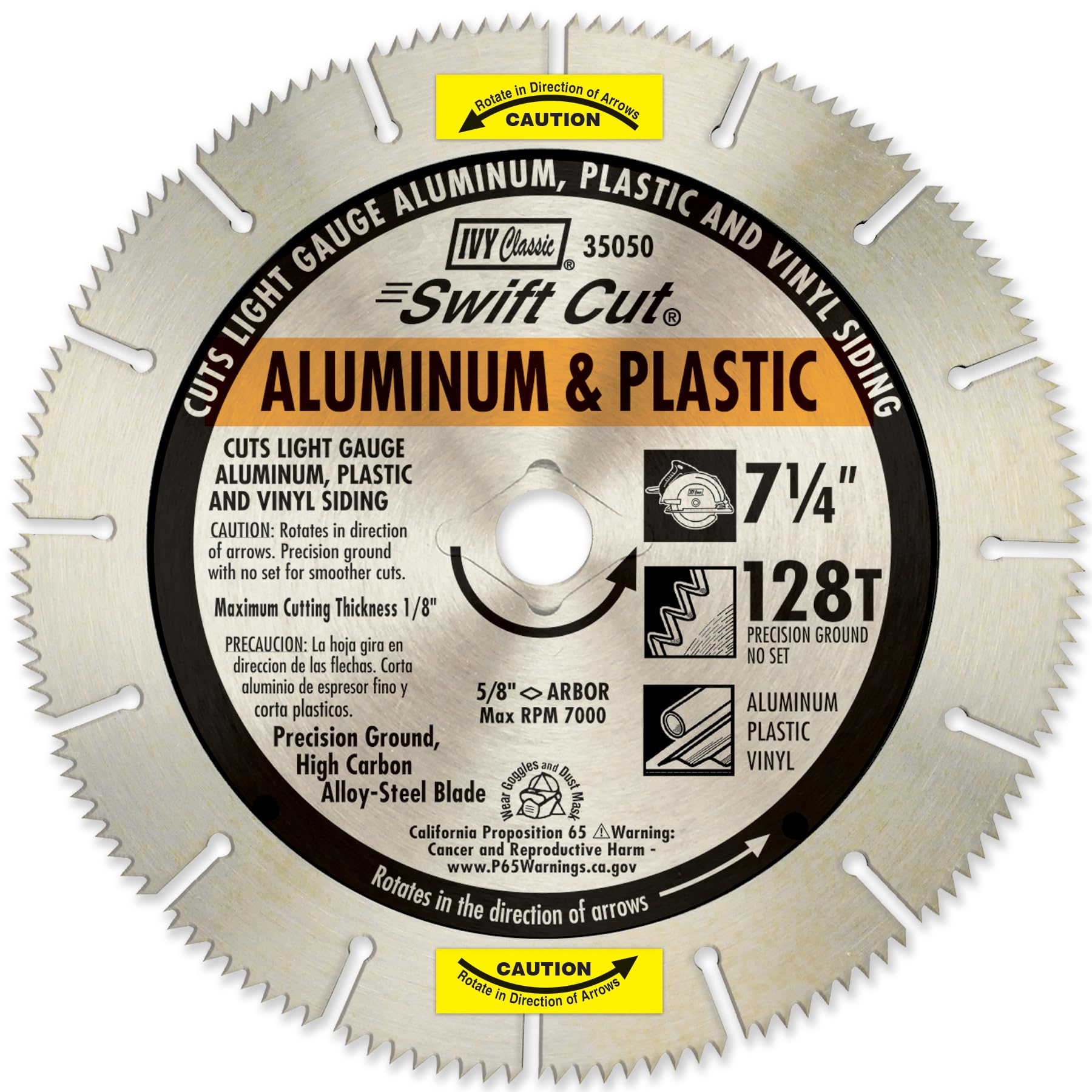
7. IVY Classic 35050 Swift Cut 7-1/4″ 128 Tooth Aluminum & Plastic Cutting Circular Saw Blade
A featherlight 128-tooth blade made specifically for very thin aluminum and plastics up to 1/8 inch.
The IVY Classic is radically different from every other blade here. It is a high-carbon alloy-steel blade (not carbide-tipped), which makes it extremely lightweight at 0.19 kilograms (compared to the TOMAX blade at 0.91 kilograms). The 128 precision-ground teeth have no set, meaning the teeth are not offset, so the cut is very narrow and clean on thin materials. The manufacturer is clear: this blade is designed for light gauge aluminum, plastic, and vinyl siding up to 1/8-inch thick.
Buyers report it “cuts plexi cleanly on table saw” with no melting unless you slow the feed rate too much. The 7.25-inch diameter with a 5/8-inch diamond knockout arbor (a removable insert that adjusts the hole size) fits most circular saws and compact table saws. The expansion slots reduce heat build-up, which is critical when cutting thin metal that can warp from friction. The key limitation: it is limited to 1/8-inch material, so it is useless for thicker extrusions or plate.
Where It Excels
- 128 teeth produce an extremely smooth, chip-free cut on thin sheet and plastic
- Very lightweight (0.19 kg) reduces fatigue in a handheld circular saw
- Expansion slots prevent warping from heat on long cuts
Its Limits Are Clear
- Only for material up to 1/8-inch thick — not for extrusions or plate
- Steel construction will dull faster than carbide-tipped blades on heavier use
Use it for: cutting vinyl siding, thin aluminum sheet, plexiglass, and plastic trim with a handheld circular saw or compact table saw. Do not reach for it if you are cutting 1/4-inch plate or thick extrusions.
Understanding the Specs
Triple Chip Grind (TCG)
Most wood-cutting blades use an Alternate Top Bevel (ATB) where teeth are angled left and right. TCG teeth have a flat top with a chamfer on each corner. For aluminum, that flat top breaks the metal chip into manageable pieces instead of catching it, which prevents vibration, grabbing, and melted edges. Every blade in this review uses TCG because it is the right pattern for non-ferrous metal.
Negative Hook Angle
The hook angle is the tilt of the tooth face relative to the center line. A positive hook angle pulls the material into the blade, which is fine for wood but dangerous for aluminum — it can self-feed and kick the workpiece back at you. A negative hook angle (like -5° found on Diablo and Oshlun blades) pushes the material down and keeps the cut under your control. Always look for a negative or at least zero hook angle on an aluminum blade.
Tooth Count vs Material Thickness
More teeth give a finer finish, but only up to a point. For thin aluminum sheet (under 1/8 inch), 100 to 128 teeth prevent chattering and produce a polished edge. For thick extrusions and bar stock (1/4 inch and up), 60 to 80 teeth are more efficient because the gullet — the space between teeth — is larger and clears the chips better. If the gullet fills up, the blade binds and overheats.
Arbor Size and Diameter
The arbor is the hole in the center of the blade that fits onto the saw’s shaft. Most 10-inch blades use a 5/8-inch arbor, which fits nearly all 10-inch table saws, miter saws, and circular saws. The 12-inch Diablo uses a 1-inch arbor, so it only fits saws designed for that size. Some blades also include a diamond knockout arbor — a removable insert that lets you adjust the hole size. Always check your saw’s arbor size before buying.
FAQ
Can I use a regular wood-cutting blade for aluminum?
What does TCG stand for on a saw blade?
How many teeth do I need for cutting aluminum extrusions?
Is a negative hook angle really necessary?
Can I cut aluminum on a miter saw with standard blade speed?
Will a 10-inch blade fit my table saw?
How long does a carbide-tipped aluminum blade last?
Do I need lubricant when cutting aluminum with a saw blade?
Final Thoughts: The Verdict
For most buyers, the circular saw blade for aluminum winner is the Diablo D1080N because it combines a proven TCG grind, Tri-Metal brazing for impact resistance, and an 80-tooth count that handles everything from thin plate to medium extrusions with a clean finish. If you need a larger 12-inch blade for heavy plate or long extrusions, the Diablo D1296N offers 96 teeth and the same build quality. And for the best finish on visible-edge work, the Oshlun SBNF-100100 with its 100 teeth and negative hook angle is the specialist that makes aluminum cuts look machined.
How We Picked
We do not accept paid placement. Every pick is matched to a real buyer and a real use-case; we do not hands-on test units.
Sources & Methodology
Specifications: manufacturer listings and product documentation. Review insights: verified customer reviews, as of July 2026. Pricing: not shown on this page (it changes often); check the current price via the retailer link.
As an Amazon Associate, WellFizz earns from qualifying purchases. This does not affect which products we feature.
Related Guides

Mo Maruf
I created WellFizz to bridge the gap between vague wellness advice and actionable solutions. My mission is simple: to decode the research and give you practical tools you can actually use.
Beyond the data, I am a passionate traveler. I believe that stepping away from the screen to explore new environments is essential for mental clarity and physical vitality.