Our readers keep the lights on and my smoothie glass nicely filled. As an Amazon Associate, I earn from qualifying purchases.
Specs are compiled from manufacturer listings and verified buyer reviews and can change over time — please confirm the key details on the product page before buying.
Standing in a basement with a breaker panel that looks like a wall of identical switches is frustrating. You plug a lamp in upstairs, flip a breaker, and run back to check — only to find the wrong light is off. A circuit tracer ends that back-and-forth by letting you pinpoint the exact breaker from one spot. This guide compares six models that do exactly that, so you can pick the right tool for your electrical work.
I’m Mohammad Maruf — the founder and writer behind WellFizz. This guide is built by comparing the manufacturers’ published specifications and the patterns across verified customer reviews, so you get each pick’s real strengths and trade-offs instead of marketing spin.
The best circuit tracer for most people combines a clear screen, GFCI testing, and a sensitive receiver that locks onto the right breaker fast, saving you time on every job.
Our Picks at a Glance

How To Choose The Best Circuit Tracer
The right circuit tracer saves you from flipping breakers blindly. Look for a model that matches your typical panel setup, the voltage range in your home, and whether you also need to test GFCI outlets. Here are three factors to consider before buying.
Display type and signal strength feedback
Basic tracers use only a beep or a flashing light when you are over the right breaker. Models with an LCD screen (a digital display that shows numbers and text) show you the real-time voltage and signal strength, which helps you confirm the match even on a noisy panel with multiple circuits running close together.
Minimum operating voltage and compatibility
Most household circuits run at 120V. Some tracers start working at 90V, while others require at least 120V. If you work on older wiring or circuits that dip below 120V, a model that works down to 90V gives you more flexibility.
GFCI testing and accessory kit
A built-in GFCI outlet tester (a device that checks if a ground-fault circuit interrupter outlet will trip properly) saves you from carrying a second tool. Models with additional adapters — like a light socket adapter or alligator clips — let you trace circuits in light fixtures and on bare wires, not just standard outlets.
Quick Comparison
| Model | Best For | Operating Voltage | Display | Weight | Amazon |
|---|---|---|---|---|---|
| Klein Tools ET310★ Best Overall | Reliable classic | 90–120V | None (audio/visual only) | 7.2 Oz | Amazon |
| KAIWEETS KT301PAlso Great | Pro-grade full kit | 30–150V | LCD with backlight | — | Amazon |
| KAIWEETS KT301 | Value with LCD | 30–150V | LCD with backlight | — | Amazon |
| focemta FTCT01 | Budget LCD pick | 90–135V | LCD | 0.9 Lbs | Amazon |
| AstroAI ABCBFET120BK | Best accessory bundle | 90–120V | None (audio/visual) | — | Amazon |
| NOYAFA NF-827 | Sensitivity adjustable | 90–120V | None (audio/visual) | — | Amazon |
In‑Depth Reviews
1. Klein Tools ET310 AC Circuit Breaker Finder
Our pick — over 4.5★ from 24,000+ verified ratings; the strongest balance of quality and price.
The lightweight two-piece tracer that 24,000+ buyers trust to identify breakers fast.
At just 7.2 ounces, the Klein ET310 is the lightest unit in this comparison. Its two-piece system — a transmitter that plugs into the outlet and a receiver that scans the panel — is straightforward: visual and audible cues (a beep and a flashing light) let you know when you have landed on the right breaker. It operates on 90–120V AC circuits, which covers standard US household wiring. The transmitter docks directly into the receiver for compact storage, keeping the two parts together.
The built-in GFCI outlet tester (a device that checks if a ground-fault circuit interrupter will trip) on the transmitter lets you inspect wiring conditions and test GFCI devices without grabbing a separate tool. This is a simpler, more tactile approach than the LCD-based KAIWEETS KT301P — you get a beep and a light instead of numbers on a screen. Reviewers consistently call it reliable and easy to use. The catch is that the ET310 starts at 90 volts, while the KAIWEETS models go down to 30 volts, so the Klein does not work on lower-voltage circuits.
At 10.96 x 2.16 x 1.39 inches, the receiver is long and slim — about 26% more in length compared to the focemta FTCT01. That makes it easy to hold but means the receiver does not have an LCD screen (a digital display). If you prefer a classic, no-fuss tool that thousands of homeowners have already verified, this is the one.
Why it stands out
- Extremely light at 7.2 ounces for easy handling
- Transmitter docks in the receiver for tidy storage
- Over 24,000 ratings with a 4.7/5 average
What to consider
- No digital display — relies on audio and visual beeps only
- Minimum operating voltage of 90V, so not for low-voltage work
Best for: Homeowners and DIYers who want a simple, lightweight tracer backed by a huge number of positive reviews.
skip it if: You need to trace circuits below 90 volts or want a digital readout of voltage and signal strength.
2. KAIWEETS KT301P Circuit Breaker Finder
The full-kit pro model that shows you voltage and signal strength on a backlit screen.
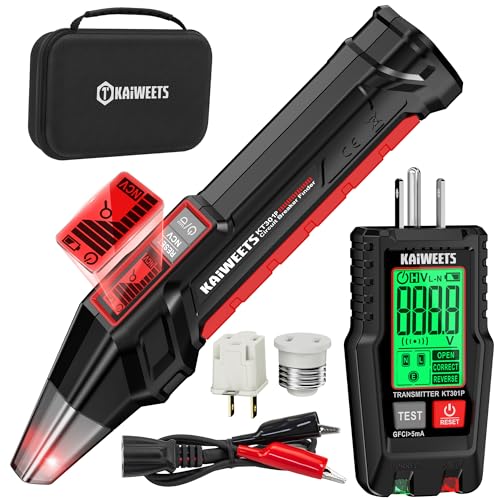
The KAIWEETS KT301P handles a voltage range of 30–150V, which is wider than most others here — it works on low-voltage circuits and standard household lines alike. Its large LCD screen (a digital display) has a backlight, so you can still read signal strength when you are working in a dim basement panel. The receiver also includes a non-contact voltage test (NCV) function (a sensor that detects live wires without touching them), so you can check if a wire is live before you touch anything.
Unlike the Klein ET310, which relies only on beeps and lights, the KT301P shows you exact numbers on screen — real-time voltage and signal strength — so you are not guessing. The transmitter doubles as a GFCI outlet tester (a device that checks if a ground-fault circuit interrupter will trip) with an auto trip feature, and the auto-hold function saves your last reading after you unplug. Buyers report that the accessory kit — which includes a light socket adapter, alligator clip adapter, and a 3-to-2 prong adapter — makes this a true all-in-one setup.
The trade-off is that this is the priciest model in the roundup. If you rarely work on panels with tricky wiring and do not need the extra adapters, you might be fine with a simpler kit. But for professionals or serious DIYers who want every tool in one case, this is the full package.
Reasons to buy
- Large LCD with backlight shows voltage and signal strength
- Non-contact voltage test adds an extra layer of safety
- Complete accessory kit with light socket and alligator clip adapters
Trade-offs
- Premium price compared to basic beeper-only tracers
- No weight listed in specs, but the kit with case feels substantial
Who it suits: Electricians and serious DIYers who want a single tool that traces breakers, tests GFCI outlets, and detects live wires without contact.
One real limitation: The full accessory kit adds bulk, so it is not the most pocket-friendly tool for quick trips up a ladder.
3. KAIWEETS KT301 Circuit Breaker Finder
The LCD-equipped tracer that keeps a mid-range price while adding NCV detection and a flashlight.
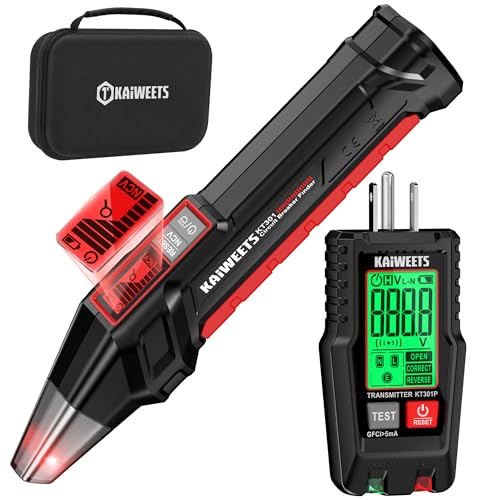
The KAIWEETS KT301 shares the same core features as the KT301P — the large LCD screen (a digital display) with backlight, the real-time voltage display from 30–150V, and the GFCI outlet tester (a device that checks if a ground-fault circuit interrupter will trip) that diagnoses 7 common wiring faults — but it skips the full accessory kit. You still get a non-contact voltage test (NCV) function (a sensor that detects live wires without touching them), plus an auto-hold function that keeps your last reading on screen.
This is a smart middle ground. You get the same digital clarity as the premium KT301P — eliminating the guesswork of beep-only tracers like the Klein ET310 — at a lower cost. The built-in flashlight helps when the breaker panel is in a dark corner. Owners mention that the carrying case keeps the transmitter and receiver organized in the same spot. The main difference versus the KT301P is the accessory bundle: the KT301 does not include the light socket adapter, alligator clip adapter, or 3-to-2 prong adapter. If you only need to trace standard outlets, that is not a problem.
When compared directly to the Klein ET310, the KT301 gives you far more visual data for roughly the same price. The Klein is lighter at 7.2 ounces and has a more established reputation, but the KT301’s LCD screen and wider 30–150V range make it a stronger technical choice for complex panels.
Highlights
- Large backlit LCD shows voltage and signal strength
- Non-contact voltage test adds safety
- Works on a wider 30–150V range than the Klein ET310
Drawbacks
- No light socket or alligator clip adapters included
- Ratings count of 180 is lower than the ET310’s 24k+
Pick this for: Anyone who wants the digital readout and wider voltage range of a pricier model but does not need the full accessory kit.
The compromise: You do not get adapters for light fixtures or bare wires, so stick to tracing through standard outlets.
4. focemta FTCT01 Circuit Breaker Finder

The lightweight LCD tracer that packs a voltage readout, carries case, and batteries right in the box.
The focemta FTCT01 weighs just 0.9 pounds and measures 8.7 x 5.1 x 1.8 inches, making it more compact than the slimmer but longer Klein ET310. Its dual-function LCD screen (a digital display) displays real-time voltage from 90–135V and signal strength, so you know exactly which breaker is the match. The transmitter doubles as a GFCI tester (a device that checks if a ground-fault circuit interrupter will trip) with an automatic trip test that shows the time it took to trip — a detail most basic testers skip. Red and green indicator lights combine with the large screen to diagnose 6 common wiring faults, including open circuit and reverse polarity.
This is a ready-to-use kit: it ships with a 9V battery for the receiver, two AAA batteries for the transmitter, a screwdriver, a user manual, and a carrying case. It is also ETL certified (a safety certification from a testing lab) with a CAT II 135V safety rating (a measurement category for low-voltage electrical equipment). Customers note that the anti-slip design on the receiver makes it comfortable to hold over a busy panel. The trade-off is that the voltage range tops out at 135V — which is fine for standard US homes but narrower than the KAIWEETS models that go to 150V. It also does not have a non-contact voltage test (NCV), so you cannot check for live wires without plugging in.
At 8.7 inches long, it is about 26% shorter than the Klein ET310, which is 10.96 inches long. That makes it easier to maneuver in a tight panel.
What works
- LCD screen shows voltage and signal strength
- GFCI tester displays trip time for detailed diagnostics
- Comes with batteries, screwdriver, and carrying case
Limitations
- No non-contact voltage detection
- Maximum voltage is 135V compared to 150V on some rivals
Who should grab it: DIYers who want a digital readout and a complete starter kit without spending on a premium model.
Keep in mind: Without NCV detection, you will need a separate voltage tester for safety checks on exposed wires.
5. AstroAI ABCBFET120BK Circuit Breaker Finder
The budget-friendly bundle that stuffs four adapters, a flashlight, and an EVA case into one kit.
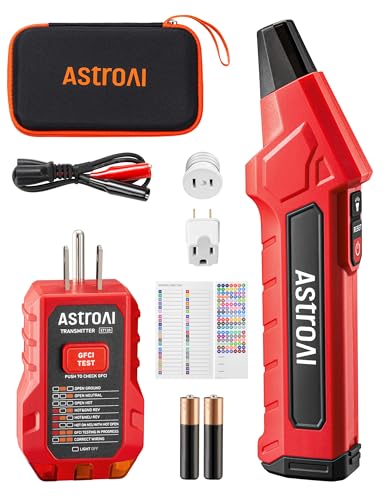
The AstroAI circuit breaker finder runs on 90–120V AC at 50/60Hz, covering standard US household circuits. The receiver beeps and flashes red when you are over the correct breaker, and it has a built-in LED light (a small light-emitting diode lamp) to illuminate dark panels. The transmitter includes a GFCI outlet tester (a device that checks if a ground-fault circuit interrupter will trip) so you can check wiring and confirm GFCI protection. Auto-shutdown and low-battery alerts help prevent interruptions — the tool turns itself off rather than running flat mid-job.
What sets this apart from the Klein ET310 at a lower price is the accessory kit. It comes with four adapters: a light socket adapter, a 3-to-2 prong adapter, alligator clips, and labels — plus an EVA storage case (a case made from ethylene-vinyl acetate foam) that keeps everything tidy. That makes it useful for tracing circuits through light fixtures and on bare wires, not just outlets. Reviewers point out that the included adapters make this a versatile starter set for the price. The trade-off is that there is no LCD screen, so you rely entirely on audio and visual indicators without digital voltage readings.
Compared to the NOYAFA NF-827, the AstroAI does not have sensitivity adjustment. But for roughly the same price, you get all the adapters right in the box rather than buying them separately.
Reasons to choose
- Includes 4 adapters, labels, and a storage case
- Built-in flashlight for low-light panels
- Auto-shutdown and low-battery alerts
Reasons to look elsewhere
- No LCD screen — uses beeps and lights only
- No sensitivity adjustment for fine-tuning on noisy panels
For: Budget shoppers who want a full adapter kit for tracing circuits through outlets, light fixtures, and bare wires without spending on a premium model.
Not for: Anyone who needs a digital voltage readout or fine sensitivity control on a crowded breaker panel.
6. NOYAFA NF-827 Circuit Breaker Finder

The tracer that lets you dial up the sensitivity to zero in on the exact breaker on a crowded panel.
The NOYAFA NF-827 works on 90–120V AC circuits at 50/60Hz. Its standout feature is the adjustable sensitivity on the receiver. You start scanning at a lower sensitivity, and as the beeping gets stronger near a breaker, you increase the sensitivity to lock on precisely. That is helpful when circuits run close together in a panel and a fixed-sensitivity tracer might give you a false positive. The receiver also includes a non-contact voltage detection (NCV) function (a sensor that detects live wires without touching them), so you can verify live wires without touching them.
The transmitter doubles as a GFCI tester (a device that checks if a ground-fault circuit interrupter will trip) with a visual LED panel (a set of small indicator lights) that shows test status. Additional accessories include a 3-prong to 2-prong grounding adapter, a light socket adapter for fixtures, and alligator clip adapters for bare wires. The kit comes in a high-quality EVA storage case (a case made from ethylene-vinyl acetate foam). Shoppers say that the automatic shutdown feature saves battery life, and the flashlight on the receiver makes it usable in dark spaces. The main downside is the lack of an LCD display (a digital screen) — you get beeps, a flashing light, and an LED status panel, but no digital voltage readout.
Compared to the AstroAI ABCBFET120BK, the NOYAFA adds non-contact voltage testing and adjustable sensitivity, which gives you more control when tracing through complex wiring. It also meets UL 61010-1, CE, ETL, and NIST safety standards (a set of industry safety certifications) for added confidence.
What is good
- Adjustable sensitivity reduces false positives on busy panels
- Non-contact voltage detection for safe live-wire checks
- Includes light socket and alligator clip adapters
Shortcomings
- No digital LCD screen — relies on audio and LED indicators
- Rated 4.3/5 from 768 reviews, slightly lower than the Klein and KAIWEETS models
Buy this if: You often work on panels with closely spaced circuits and need adjustable sensitivity to avoid misidentifying breakers.
The trade-off: Without an LCD screen, you get less detailed feedback than digital models — just beeps, lights, and the sensitivity dial.
Understanding the Specs
Minimum and maximum operating voltage
This is the range of electrical voltage a tracer can handle. Most US homes run on 120V circuits. A model that starts at 90V works on circuits that dip below standard voltage, while a wider range like 30–150V covers both low-voltage lines and standard household circuits. If you work on older wiring or specialized systems, a wider range is safer.
Non-contact voltage (NCV) detection
This is a safety feature that lets you detect live wires without touching them. The receiver senses the electric field around a wire and alerts you with a flash or beep. It confirms whether a circuit is live before you plug in the transmitter or start working near exposed wiring.
FAQ
Do circuit tracers work on any breaker panel?
Can I use a circuit tracer on a live panel?
What is the difference between a circuit tracer and a voltage tester?
Does an LCD screen make a big difference versus beep-only models?
Can I trace circuits through light fixtures and not just outlets?
What is a GFCI outlet tester in a circuit tracer used for?
How do I reduce false positives on a busy breaker panel?
Do I need batteries for the receiver and transmitter?
Will a circuit tracer work on a 240V dryer or oven outlet?
Can I use a circuit tracer if all the breakers are unlabeled?
Final Thoughts: The Verdict
For most people, the best circuit tracer is the KAIWEETS KT301P because its wide 30–150V range, backlit LCD screen, and complete accessory kit give you everything you need for tracing breakers and testing GFCI outlets in one case. If you want a lighter, simpler tool with a massive track record of reliability, grab the Klein Tools ET310. And for the best value set that includes adapters for outlets, light fixtures, and bare wires, the AstroAI ABCBFET120BK is tough to top.
How We Picked
We do not accept paid placement. Every pick is matched to a real buyer and a real use-case; we do not hands-on test units.
Sources & Methodology
Specifications: manufacturer listings and product documentation. Review insights: verified customer reviews, as of July 2026. Pricing: not shown on this page (it changes often); check the current price via the retailer link.
As an Amazon Associate, WellFizz earns from qualifying purchases. This does not affect which products we feature.
Related Guides

Mo Maruf
I created WellFizz to bridge the gap between vague wellness advice and actionable solutions. My mission is simple: to decode the research and give you practical tools you can actually use.
Beyond the data, I am a passionate traveler. I believe that stepping away from the screen to explore new environments is essential for mental clarity and physical vitality.