Our readers keep the lights on and my smoothie glass nicely filled. As an Amazon Associate, I earn from qualifying purchases.
Specs are compiled from manufacturer listings and verified buyer reviews and can change over time — please confirm the key details on the product page before buying.
Tracing a live wire behind drywall or through a concrete floor without cutting into anything is the difference between a clean day and a costly mistake. A good circuit tracer lets you pinpoint breakers, find buried cables, and check for dead shorts without guesswork — the real trick is knowing which tracer can handle the job without bleeding signal into neighboring wires.
I’m Mohammad Maruf — the founder and writer behind WellFizz. This guide is built by comparing the manufacturers’ published specifications and the patterns across verified customer reviews, so you get each pick’s real strengths and trade-offs instead of marketing spin.
If you need to trace a live 480-volt 3-phase circuit or just map out a messy home panel, this guide breaks down the real-world quirks of each circuit tracer for electricians so you pick the right one the first time.
Quick Picks
- Ideal Electrical SureTrace Pro Circuit Tracer (61-950) — Top Performer
- Triplett 3388 Fox & Hound HotWire Live Wire Tone and Probe Wire Tracing Kit — Long-Range Specialist
- Ideal Electrical SureTrace Digital Circuit Tracer (61-946) — Best Overall
- Fluke BK120 SmartTrace Breaker Finder and Socket Tester — Smart Compact Pick
- Klein Tools Circuit Breaker Finder and GFCI Outlet Tester Bundle — Entry-Level Pro
- Focemta Circuit Breaker Finder Kit with GFCI Outlet Tester — Budget Champion
How To Choose The Best Circuit Tracer For Electricians
A circuit tracer sends a signal down a wire, and a handheld receiver picks it up — simple in theory, but real-world factors like voltage range, material density, and circuit length separate a tool that works from one that frustrates. Focus on these three things first.
Voltage range and safety rating
Every tracer is rated for a specific AC and DC voltage range. For standard residential 120V panels, a 90-135V unit works fine. If you work on commercial 3-phase or industrial gear, you want a tracer that handles up to 480V or 600V with a CAT III safety rating. A unit rated for higher voltage lets you tackle a wider variety of jobs without risking damage to the tool or your safety.
Sensitivity and tracing depth
Not all walls are the same. Drywall is easy; concrete, rebar, and buried cable require a tracer with adjustable sensitivity. Look for a receiver with multiple sensitivity levels or a thumbwheel control so you can dial in the signal strength. A tracer that claims to find wires through 6 inches of concrete is a different beast from one that only works on exposed Romex.
One-person tracing features
If you work alone — and most electricians do — you need a tracer that lets you verify the correct breaker without running back and forth. Technologies like CertainCircuit (on Ideal models) visibly indicate when the circuit is deenergized at both the panel and the far end. A loud audible tone and a clear visual signal-strength display also save time when you are crouched in a dusty crawlspace.
Quick Comparison
| Model | Best For | Max Voltage | Weight | Tracing Depth | Amazon |
|---|---|---|---|---|---|
| Ideal SureTrace Pro (61-950) | Heavy commercial / industrial | 600V AC/DC | 10.88 lbs | Not specified | Amazon |
| Triplett 3388 Fox & Hound HotWire | Buried / long-run wire tracing | 250V AC | Not specified | Up to 6 inches | Amazon |
| Ideal SureTrace (61-946) | Versatile pro tracer / breaker finder | 480V AC/DC | 2.95 lbs | Not specified | Amazon |
| Fluke BK120 SmartTrace | Quick breaker ID + NCV checks | 110V AC | Not specified | Not specified | Amazon |
| Klein Tools Breaker Finder + Tester | Residential / DIY breaker hunting | 90-120V AC | Not specified | Not specified | Amazon |
| Focemta Circuit Breaker Finder | Budget-friendly home troubleshooting | 90-135V AC | 3 oz | Not specified | Amazon |
In‑Depth Reviews
1. Ideal Electrical SureTrace Pro Circuit Tracer (61-950)

The do-it-all workhorse that replaces three tools at the panel.
This ETL Certified CAT III tracer handles up to 600V AC/DC, so it steps into commercial 3-phase and industrial panels without hesitation. The patent-pending rechargeable inductive/sensing clamp measures AC amperage up to 600A — that means you can trace a circuit and check load in one pass. The transmitter also reads voltages from 24-600V AC and 12-600V DC, confirms DC polarity, and verifies outlet wiring.
Two high-visibility 90° rotating OLED displays, including a TightSight bottom display, let you read readings in cramped panels without contorting your neck. The receiver packs an NCVT (non-contact voltage tester), a work light, and adjustable volume. One-person tracing is handled by CertainCircuit technology — it visibly lights up when the correct breaker is deenergized at both ends, ending the walk-back-and-forth game. Overmolded industrial design protects against drops up to 6.6 feet.
It is heavy at 10.88 pounds, and the 19 x 17 x 5-inch case is substantial, so plan for a dedicated spot in your truck. But if your daily work mixes high-voltage tracing with amperage checks and continuity tests, this is the only tool you pull from the bag.
Heavyweight capabilities
- 600V AC/DC range covers industrial 3-phase work
- AC amperage measurement up to 600A with the inductive clamp
- Two rotating OLED displays visible in tight spaces
- CertainCircuit confirms breaker kill at both ends
Consider the bulk
- Weighs 10.88 pounds — not a pocket tool
- Premium-level investment for occasional users
Grab it if: You run commercial or industrial calls above 480V and want voltage, amperage, and tracing in one box.
Think twice if: You only need residential breaker hunting — the weight and cost are overkill for basic 120V panels.
2. Triplett 3388 Fox & Hound HotWire Live Wire Tone and Probe Wire Tracing Kit
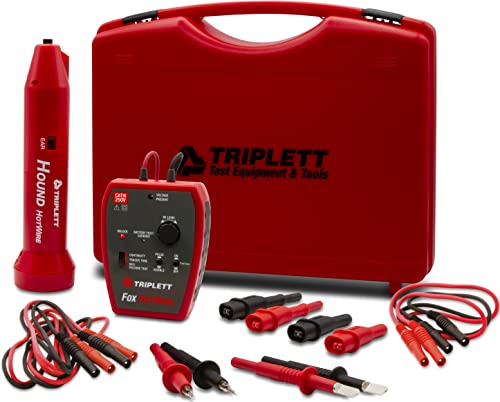
Finds buried wire through concrete where digital tracers give up.
Buyers report this kit traced roughly 200 feet of 15-gauge wire through a concrete floor and wall with rebar — a scenario that stumps many digital circuit finders. The Fox HotWire transmitter generates multiple tones (Pulse or Warble) and works on live circuits from 0 to 250V AC, including both 120V and 220V lines. The Hound HotWire receiver has a thumbwheel sensitivity control and a signal strength LED so you can fine-tune the pickup as you walk a long run.
It locates buried wires up to 6 inches deep and traces runs up to 1000 feet in length, which is a meaningful advantage over the 32% larger dimensions of the Ideal SureTrace (61-946) — this kit fits a tighter form factor while delivering deeper penetration. The downside: owners mention it struggles as a dedicated circuit breaker finder and is prone to bleedover (signal jumping to adjacent wires) on live circuits with high loads. Unplugging heavy appliances often solves the interference, but it is not a “press and find” breaker tool like the Klein ET450 or Fluke.
One owner who has used this kit reliably for six years reports battery life exceeding a year, and the tone generator is loud enough to hear across a jobsite. For tracing long underground or in-wall cable runs where signal penetration matters more than breaker ID, this is the pick.
Pro-level penetration: Buried wires up to 6 inches deep and 1000-foot runs make this the right tool for renovation and site work where walls are concrete.
Not a breaker finder: Live high-load circuits cause bleedover; better suited for tone tracing and continuity checks than panel mapping.
Reach for it when: You need to trace a cable through a concrete floor or underground more than 200 feet.
Look elsewhere if: Your primary job is identifying which breaker feeds a specific outlet — the Fox & Hound is a tone tool, not a breaker finder.
3. Ideal Electrical SureTrace Digital Circuit Tracer (61-946)
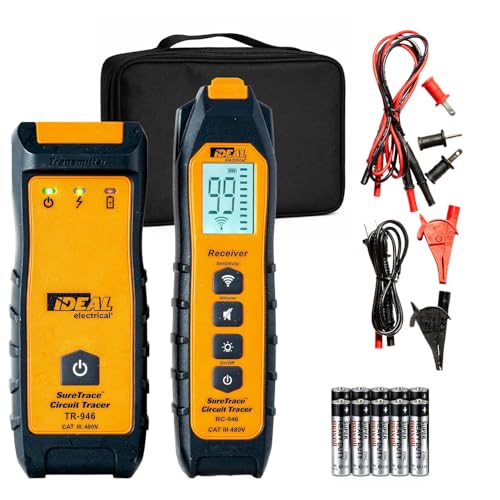
The professional tracer that works as well as Klein for less — with better long-circuit performance.
Customers note this unit “works as well as Klein ET450 for less; better on long circuits with many junctions.” That is a strong claim, and the specs back it up. Rated for 0-480V AC/DC, including 3-phase systems, with ETL CAT III certification, it traces breakers, conductors, fuses, dead shorts, and splice errors. Four sensitivity levels on the receiver let you tune through drywall, cement block, and underground — the same versatility as the Triplett, but in a digital package that reads signal strength and sensitivity on a backlit display.
CertainCircuit technology makes one-person tracing real: the receiver visibly shows when the correct breaker is deenergized at the panel and at the far end. The receiver has a mute button for noise-sensitive environments and shows both analog and digital signal strength. It is overmolded with drop protection up to 6.6 feet. The kit ships with a carrying case and batteries, but one reviewer notes it requires 10 AA batteries — recommend rechargeable to avoid leaks. At 2.95 pounds, it is far lighter than the 10.88-pound Pro model but still handles 480V work.
The receiver has a selectable backlit display for low-light panel work, and 3D interactive instructions are available through a free downloadable app. If you need one tracer that does residential, commercial, and light industrial without the bulk of the Pro model, this is the smart middle path.
Right-size power
- 480V AC/DC covers 3-phase and commercial panels
- Four sensitivity levels for different materials
- CertainCircuit one-person confirmation works as advertised
- Weighs only 2.95 pounds — easy to carry all day
Battery appetite
- Requires 10 AA batteries; rechargeable recommended
- No built-in amperage measurement like the 61-950 Pro
Who it beats: Pros who want Klein ET450 performance for less cash, with better results on long multi-junction circuits.
Who it does not: Anyone who needs amperage clamping or 600V industrial range — step up to the 61-950 Pro for that.
4. Fluke BK120 SmartTrace Breaker Finder and Socket Tester

A 4-in-1 tool that finds breakers, checks for live wires, and lights up dark panels.
The Fluke BK120 combines a breaker finder, non-contact voltage detector (NCV), socket tester, and a bright LED flashlight in a single compact unit. The transmitter has built-in socket tester LEDs that verify correct wiring on both standard and GFCI outlets. The receiver offers a unique dual-sensitivity NCV mode for detecting voltage on terminal strips and supply cords — a feature you do not see on most breaker finders. Audible and visual alerts remove guesswork when scanning a crowded panel.
Minimum operating voltage is 110V AC, which makes it strictly a 120V residential tool. That is 22% higher than the 90V floor of the Focemta, so it will not work on low-voltage signal circuits or some older 100V panels. But for standard 120V homes, the BK120 is fast: you plug in the transmitter, scan the panel with the receiver, and the tone and lights guide you to the right breaker. The integrated flashlight is surprisingly useful in dim basements and unfinished attics.
At 11 x 6 x 2.25 inches, it slips into a pouch without hogging space. The Fluke build quality is excellent, and the NCV mode adds an extra layer of safety before you touch a wire. It is not a tone tracer for long underground runs — stick with the Triplett for that — but for daily residential service calls and outlet troubleshooting, this is the fastest pocket tool on the list.
Panel-speed special: The NCV mode with dual sensitivity catches live wires on terminal strips where basic finders miss, and the flashlight saves you fumbling for a headlamp.
Residential-only: A 110V minimum and no tone tracing (audible signal for identifying wires) means it stays home on industrial jobs — but for service work, it is tough to top the speed.
Grab it for: Daily residential service calls where you need to ID breakers fast and also check for live wires without touching them.
skip it if: You need to trace buried wires, work on low-voltage circuits, or handle 220V panels — the voltage range is too narrow.
5. Klein Tools Circuit Breaker Finder and GFCI Outlet Tester Bundle

A reliable two-piece bundle for mapping a residential panel without fuss.
The Klein bundle pairs a transmitter and receiver for locating breakers with a dedicated GFCI outlet tester that shows voltage and trip time on a clear LCD readout. The transmitter operates on 90-120V AC circuits — standard US residential — and the receiver locks onto the signal with a steadily increasing tone as you near the correct breaker. The GFCI tester detects open neutral, open ground, reverse polarity, and other common wiring faults, with built-in GFCI testing to verify protection devices function correctly.
Unlike the Fluke BK120, the Klein does not include an NCV detector or flashlight. It is a focused solution: breaker finder plus outlet tester. The Cat II 135V safety rating covers residential use but stops short of the commercial 480V range of the Ideal 61-946. For an apprentice or a homeowner who needs to label a messy panel and verify outlet wiring, this is a straightforward, no-nonsense kit. Corded electric operation means no extra batteries to replace on the transmitter side.
One thing to note: the bundle does not include a carrying case or accessories like the light socket adapter found on the Focemta kit. You get the breaker finder and the tester — that is it. If you need to trace underground wires or identify dead shorts in commercial conduit, this is not the tool. But for the price, it is a dependable entry into professional-grade breaker hunting.
Simple and focused
- Accurate breaker ID with clear LCD voltage and trip-time readout
- GFCI tester diagnoses six common wiring faults
- No batteries needed on the transmitter (corded)
Limited scope
- No NCV detector, no flashlight, no tone tracing
- Cat II 135V rating max — not for commercial 3-phase
Right for: Apprentices, DIYers, and homeowners who want a trustworthy breaker finder and outlet tester in one affordable bundle.
Not for: Commercial electricians who need volt/amp tracing, NCV detection, or 480V capability — the Klein stays in residential territory.
6. Focemta Circuit Breaker Finder Kit with GFCI Outlet Tester
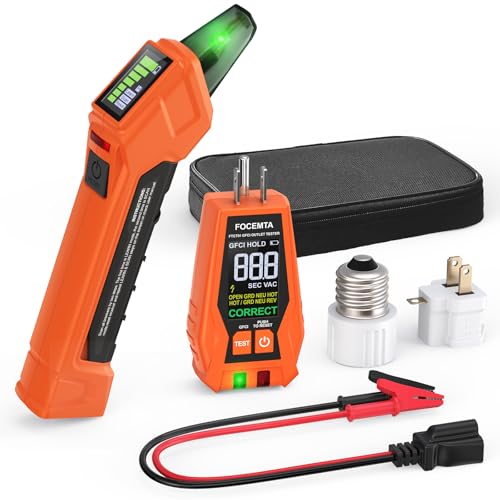
A full accessory kit at a fraction of the cost — ideal for first-time troubleshooters.
This Focemta kit packs a transmitter, receiver, light socket adapter, 3-prong to 2-prong grounding adapter, and alligator clip adapter into a sturdy carrying case — everything you need to start tracing right from the start. The dual-function LCD screen shows real-time voltage (90-135V) and signal strength, with audio and visual alerts to guide you. The GFCI tester goes further than basic pass/fail: it displays testing duration on the screen and uses bright red/green LEDs for instant results. It diagnoses six common wiring faults including open circuits and reverse polarity.
At 3 ounces, it is the lightest unit on this list by a wide margin — compared to the 2.95-pound Ideal 61-946, you barely notice it in a tool pouch. The all-in-one metal-plastic fusion clip adapter prevents slippage and short circuits, a thoughtful upgrade over two-piece designs. The minimum operating voltage is 90V, so it works on circuits where the Fluke BK120 (110V min) would not. ETL certified with a CAT II 135V rating, it is safe for residential and light commercial use within that voltage range.
The catch: at 90-135V, it cannot handle 220V or 480V commercial systems. And unlike the Triplett Fox & Hound, it does not trace buried wires or long runs through concrete. For a homeowner mapping a panel or an apprentice getting started, the Focemta is a complete, low-risk entry point.
Ready-to-run kit: Light socket adapter, grounding adapter, clip adapter, screwdriver, and case included — no extra purchases needed.
Voltage-limited: Stops at 135V, so 240V dryers and commercial 3-phase are outside its range. Stay residential.
Best for: Homeowners and new apprentices who want a full accessory kit to trace outlets and label a panel without spending pro-level money.
Not for: Anyone working on 220V appliances, commercial circuits, or needing to trace buried wire — the voltage cap and lack of deep-tracing feature hold it back.
Understanding the Specs
Voltage rating and CAT safety class
The maximum operating voltage tells you the highest AC or DC circuit the tracer can handle without damage or safety risk. A CAT II rating is for residential outlets; CAT III covers distribution panels and commercial wiring up to higher voltages. If you work on 3-phase or industrial gear, look for a tracer rated 480V or 600V with CAT III certification. A 90-135V tool is safe for household outlets but will not work on a 240V oven circuit.
Sensitivity levels and signal strength
Adjustable sensitivity lets the receiver filter out background noise and lock onto the specific wire you are tracing. More levels (four on the Ideal 61-946, thumbwheel on the Triplett) mean you can dial in the right range for drywall versus concrete versus underground. Signal strength displays — analog, digital, or LED — give you real-time feedback as you move the receiver toward the target. A tracer without sensitivity adjustment will be useless on bundled cables or behind dense materials.
FAQ
Can a circuit tracer find wires behind concrete or through rebar?
What is the difference between a tone tracer and a digital circuit tracer?
Will a circuit tracer work on live circuits?
How do I trace a wire that is hidden in a wall without cutting drywall?
What does CertainCircuit technology do?
Can I use a circuit tracer to find a dead short?
How many batteries does a typical circuit tracer need?
Is a circuit tracer the same as a breaker finder?
What does CAT III safety rating mean on a circuit tracer?
Can I trace ethernet or low-voltage cables with a circuit tracer?
Final Thoughts: The Verdict
For the majority of shoppers, the best circuit tracer for electricians winner is the Ideal SureTrace (61-946) because it balances 480V capability, four sensitivity levels, CertainCircuit one-person tracing, and a portable 2.95-pound build — beating the Klein ET450 on price and long-circuit performance according to buyers. If you need to trace wires through concrete or underground runs up to 1000 feet, grab the Triplett 3388 Fox & Hound HotWire. And for commercial or industrial pros who want a single tool that traces, measures voltage, and clamps amperage, the Ideal SureTrace Pro (61-950) does all three in one unit.
How We Picked
We do not accept paid placement. Every pick is matched to a real buyer and a real use-case; we do not hands-on test units.
Sources & Methodology
Specifications: manufacturer listings and product documentation. Review insights: verified customer reviews, as of July 2026. Pricing: not shown on this page (it changes often); check the current price via the retailer link.
As an Amazon Associate, WellFizz earns from qualifying purchases. This does not affect which products we feature.

Mo Maruf
I created WellFizz to bridge the gap between vague wellness advice and actionable solutions. My mission is simple: to decode the research and give you practical tools you can actually use.
Beyond the data, I am a passionate traveler. I believe that stepping away from the screen to explore new environments is essential for mental clarity and physical vitality.