Our readers keep the lights on and my smoothie glass nicely filled. As an Amazon Associate, I earn from qualifying purchases.
Specs are compiled from manufacturer listings and verified buyer reviews and can change over time — please confirm the key details on the product page before buying.
If you want movie-quality aerial footage without hiring a Hollywood crew, the real battle is between camera sensor size, flight time, and how well the drone flies itself so you can focus on the shot. Plenty of drones capture 4K video, but “cinematic” means smooth gimbal stabilization, a big sensor that handles changing light, and a smart obstacle-avoidance system that keeps your expensive gear safe. This guide breaks down the four best options that actually deliver professional-grade video and photos straight from the start.
I’m Mohammad Maruf — the founder and writer behind WellFizz. This guide is built by comparing the manufacturers’ published specifications and the patterns across verified customer reviews, so you get each pick’s real strengths and trade-offs instead of marketing spin.
You want a cinematic drone that makes your footage look like it was shot by a pro, not a toy. That means balancing image quality, battery runtime, and smart flight modes that help you frame the shot instead of fighting the wind.
Quick Picks
- DJI Mavic 4 Pro Drone Fly More Combo — Professional Cinema
- Autel Robotics EVO 2 PRO V3 Rugged Bundle — Low-Light Master
- SKYROVER X1 Fly More Combo with Screen Controller — Best Overall
- DJI Mavic 2 Pro Drone Quadcopter — Hasselblad Classic
How To Choose The Best Cinematic Drone
A cinematic drone needs three things: a gimbal-stabilized camera (a 3-axis mount that keeps the lens level even when the drone tilts), a sensor that handles low light without turning into static, and smart flight features that let you focus on framing instead of fighting wind gusts. Many buyers focus on video resolution first, but the sensor size (measured in inches, like 1-inch or larger) and the bit-depth (like 10-bit or 12-bit color) actually determine if your footage looks film-like or just like a smartphone taped to a kite.
Sensor Size and Video Resolution
The sensor is the heart of a cinematic drone. A 1-inch CMOS sensor (the type of image chip found in high-end compact cameras) captures significantly more light and detail than the smaller sensors in toy drones. For video, 4K is the baseline for cinematic work, but 6K resolution gives you room to crop and reframe in editing without losing sharpness. The data shows that a drone with a 1-inch sensor and a 6K capture capability, like the Autel Robotics EVO 2 PRO V3, can produce footage that works on large screens without looking pixelated. For still photos, an effective resolution of 48 MP or 100 MP lets you print large landscapes without grain.
Flight Time and Battery Strategy
No drone flies forever. The advertised max flight time (like 31 minutes or 51 minutes) is under perfect calm conditions — real-world wind cuts that down noticeably. The key number to look for is the total battery system. Some models, such as the SKYROVER X1, sell bundles with three batteries that give a combined 96 minutes of flight, which is vastly more useful for a day of shooting than a single battery that needs to be recharged on location for two hours. Reviewers across every product note that buying at least one extra battery is essential, so check whether the bundle includes them before purchasing.
Obstacle Avoidance and Autonomous Tracking
Crashing a drone is every pilot’s nightmare. Obstacle-avoidance systems use sensors placed around the drone (like the 12 visual sensors on the Autel and the 360-degree obstacle sensing on the SKYROVER) to detect trees, buildings, and power lines. The most advanced systems, like ActiveTrack 360 on the DJI Mavic 4 Pro, can navigate around obstacles autonomously while tracking a moving subject. For cinematic shooting of a running person, a mountain biker, or a car, this feature means you can get a complex tracking shot without needing two operators. For night flying, look for low-light sensors (0.1-lux sensitivity) that work even in almost-pitch-black conditions.
Quick Comparison
| Model | Best For | Video Resolution | Max Flight Time | Obstacle Avoidance | Amazon |
|---|---|---|---|---|---|
| DJI Mavic 4 Pro Fly More Combo | Professional triple-camera cinema | 6K60 HDR | 51 min | Omnidirectional + LiDAR | Amazon |
| Autel Robotics EVO 2 PRO V3 | 6K HDR with superior low-light color | 6K | 40 min | 360° (12 visual sensors) | Amazon |
| SKYROVER X1 Fly More Combo | Budget-friendly 4K travel drone | 4K/60fps | 96 min (3 batteries) | 360° obstacle sensing | Amazon |
| DJI Mavic 2 Pro | Hasselblad color science on a budget | 4K HDR | 31 min | Omnidirectional Obstacle Sensing | Amazon |
In‑Depth Reviews
1. DJI Mavic 4 Pro Drone Fly More Combo
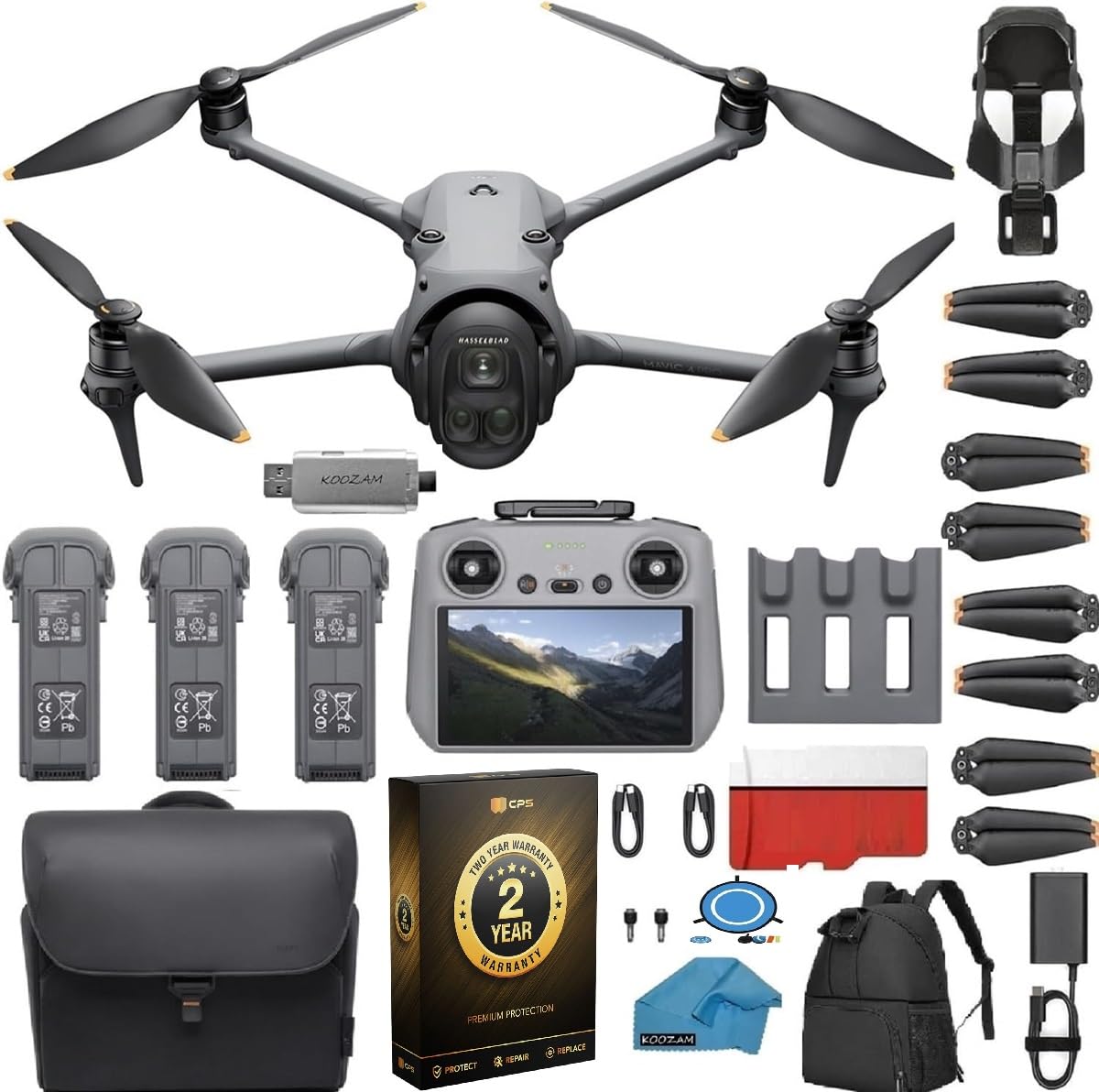
The triple-camera rig that plans its own flight path while you frame the hero shot.
This is the most complete cinematic drone in the list, built for professionals who need three different lenses in one flight. The Infinity Gimbal carries a 100MP Hasselblad wide-angle lens that shoots 6K60 HDR video with HNCS color (a technology that gives footage a natural, film-like look without heavy grading), plus a 48MP medium telephoto for portraits and a 50MP telephoto for sharp long-range shots. All three cameras support 4K slow motion at 120 frames per second on the wide and medium lenses, so you can get that smooth, dramatic slo-mo of a vehicle on a mountain road.
The standout upgrade here is ActiveTrack 360, which lets the drone track a subject while autonomously planning its navigation around obstacles. It has an up to 656-foot range for vehicles, making it ideal for automotive cinematography. With 51 minutes of max flight time (the longest on this list), you can shoot a whole scene without landing to swap batteries. Buyers report that the Fly More bundle’s three batteries and hard case make it a no-brainer for commercial real estate photographers who need reliable gear on set.
Flagship Camera Trio
- Triple-camera system (100MP wide, 48MP medium tele, 50MP tele) covers every focal length in one flight
- ActiveTrack 360 with autonomous obstacle navigation — the drone steers itself around trees and poles while tracking a subject
- 51-minute max flight time gives you the longest uninterrupted shooting window available here
- Omnidirectional obstacle sensing with 0.1-lux sensitivity for safe night filming, plus forward-facing LiDAR for braking in pitch black
Premium Cost & Weight
- The price is the highest in this roundup, targeting working professionals and serious filmmakers
- At 5 pounds, it is noticeably heavier than sub-250g drones, which may require FAA registration and extra travel planning
- Some owners mention the included backpack and tablet holder feel less premium than the drone itself, so you may want a third-party case
Reach for this if: you shoot professionally and need interchangeable focal lengths (wide, portrait, tele) plus autonomous subject tracking that works at night — this is the only drone here with all three cameras and LiDAR-assisted obstacle avoidance.
Look elsewhere if: you are a first-time flyer on a limited budget, or you need a drone under 250g to avoid FAA registration and want something that packs into a small daypack.
2. Autel Robotics EVO 2 PRO V3 Rugged Bundle
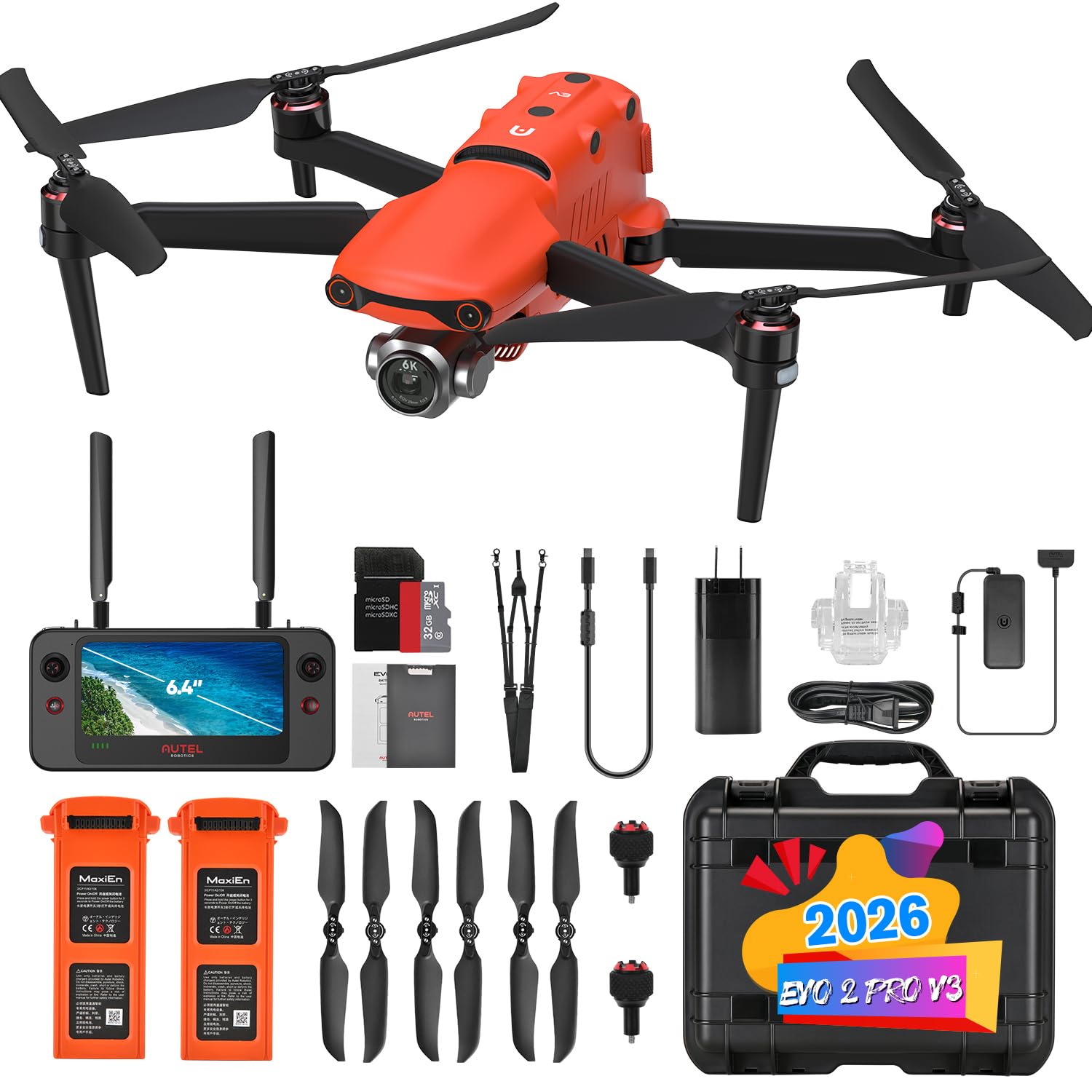
The 1-inch sensor drone that turns twilight into golden-hour footage, no filter needed.
If your shooting day starts before sunrise and ends after sunset, this is the drone that handles the full range of light. The Autel EVO 2 PRO V3 has a 1-inch CMOS sensor that captures 6K HDR video with 12-bit color depth, meaning it can record up to 68.6 billion colors — 64 times the color information of the 10-bit EVO 2 Pro V2. The Moonlight Algorithm 2.0 pushes the ISO to 44000, so your night shots retain detail in the shadows without the bright highlights blowing out into white blobs.
In a direct comparison, this one shoots 6K video while the DJI Mavic 2 Pro maxes out at 4K. The SkyLink 2.0 transmission system pushes a clear 2.7K live view feed from up to 15 kilometers away over tri-band frequencies (2.4GHz, 5.8GHz, and 900MHz). Customers note that the 360° obstacle avoidance with 12 visual sensors works confidently even in tight forested areas, and the 40-minute flight time gives you real coverage without rushing.
Color Science & Post: The 12-bit DNG photos capture enormous color data, which one reviewer described as “precision engineered” for professional mapping and real estate work where every shadow detail matters. The adjustable aperture from f/2.8 to f/11 is a rare feature that lets you control depth of field and exposure without neutral-density filters — a big deal for filmmakers who want a shallow focus look or need to cut light on bright days.
One Catch: A few buyers mention that the charging process for the batteries can be fussy, sometimes requiring a restart of the power cycle to start charging. The included hard case and spare battery in the rugged bundle offset this by giving you plenty of flight time (three batteries total) between charges.
Grab this for: night-time and golden-hour cinematography where the 12-bit color depth and ISO 44000 Moonlight Algorithm keep shadows clean — the adjustable aperture is a huge bonus for controlling exposure without extra filters.
Skip this if: you want the simplest out-of-box experience and prefer DJI’s polished app interface and larger ecosystem of accessories and support.
3. SKYROVER X1 Fly More Combo with Screen Controller
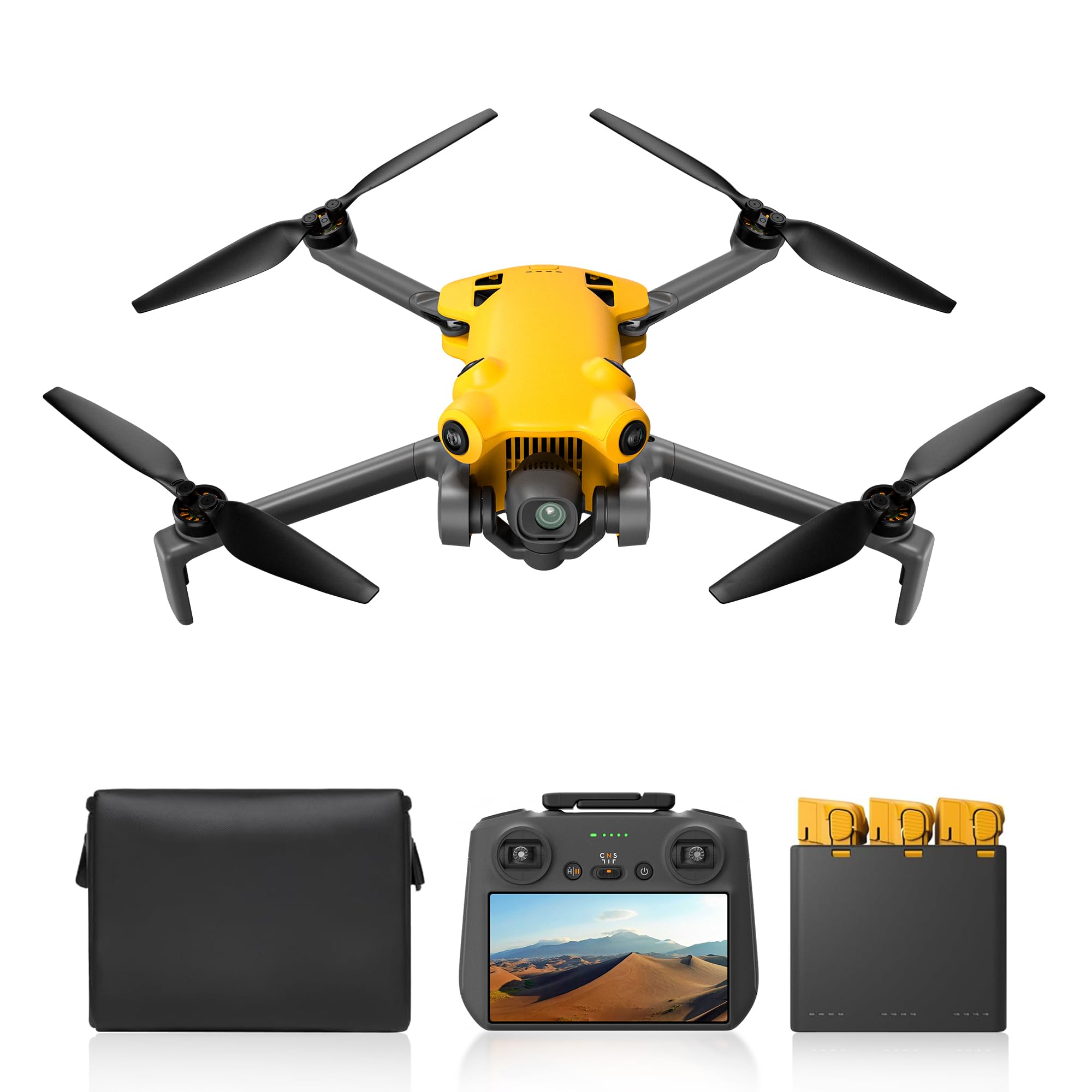
The sub-250g travel drone that skips FAA registration and still packs a sharp 4K punch.
This is the drone that proves you do not need to spend a fortune for a cinematic setup. The SKYROVER X1 captures smooth 4K/60fps HDR video and 48MP photos from a 1/1.32-inch CMOS sensor with an f/1.7 aperture that lets in plenty of light for twilight shots. It is under 249 grams, so you can fly it without FAA registration, and the 5.5-inch HD touchscreen remote (700 nits of brightness) means you never have to rely on your phone’s screen in direct sunlight.
The biggest practical win here is the total flight system: three batteries give you a combined 96 minutes of flight time, versus the DJI Mavic 2 Pro’s single-battery 31-minute max. That means a whole afternoon of landscape shooting without stopping to recharge. Reviewers point out that the 1080p/60fps live view feed stays stable even at the drone’s 50,000-foot range (9.32 miles), and the 360° obstacle avoidance makes flying through park trees and around landmarks feel much safer than at this price range.
Travel-Ready Barrier Breaker
- Under 249g — no FAA registration required, fits in a shoulder bag alongside a water bottle and jacket
- 96-minute total flight time with the included 3-battery combo — the longest total shooting window in this list by a wide margin
- 48MP photos and 8K photo mode (via sensor shift) give you print-quality stills, versus the 20MP Hasselblad on the Mavic 2 Pro
- 4K/100fps slow motion and timelapse modes let you add cinematic style directly in-camera for social-ready content
Sensor Size Trade-off
- The 1/1.32-inch sensor is smaller than the 1-inch sensors on the more expensive Autel and DJI Mavic 4 Pro, so low-light performance won’t match those models
- Some buyers mention that while the obstacle avoidance works great with audible alerts, the battery life per single battery (32 minutes) can feel short if you forget to bring all three
- The controller is snug with a large phone (some users with an iPhone 17 Pro Max needed a larger mount), but the built-in screen bypasses that issue entirely
Best for: travelers and weekend adventurers who want a real cinematic drone under that fits in a daypack, avoids FAA registration, and still delivers 48MP stills plus 4K/60fps video with 360° obstacle avoidance.
Not for: night-time professional shoots where low-light sensor performance is critical — the DJI Mavic 4 Pro or Autel EVO 2 PRO with their larger 1-inch sensors handle darkness far better.
4. DJI Mavic 2 Pro Drone Quadcopter

The classic that brought Hasselblad color science to the sky, still earning its spot today.
This is the drone that set the standard for consumer cinematic flight. The L1D-20c Hasselblad camera with a 20MP 1-inch CMOS sensor delivers those natural, film-like colors that made Hasselblad famous in professional photography. The adjustable aperture (f/2.8 to f/11) gives you direct control over depth of field — you can blur the background for a subject or stop down to f/11 for a landscape where everything from the rocks below to the mountain peaks is sharp. It shoots 4K HDR video with a 3-axis gimbal, and buyers consistently call the image quality “beautiful” and “crispy,” especially the natural color rendition that needs minimal grading.
The catch is that with a 31-minute max flight time and real-world reports of 20-25 minutes in wind, you will definitely want extra batteries. The standard remote gives you up to 135 minutes of battery life itself, which is generous, but the drone’s own battery is the bottleneck. It weighs 907 grams (just under 2 pounds), so you need FAA registration, and while it is still compact enough for a camera bag, it is not as travel-friendly as the sub-250g SKYROVER X1.
Sensor & Lens Legacy: The 1-inch 20MP sensor captures excellent RAW photos that one reviewer described as “close to a Nikon Z6” in quality. The adjustable aperture is a rarity in this price tier — it means you can control light without stacking on neutral-density filters for every shot. The Omnidirectional Obstacle Sensing with ActiveTrack 2.0 makes tracking a moving subject relatively straightforward.
The Trade-off: At this price point, the Mavic 2 Pro is competing with drones that shoot 6K video (the Autel EVO 2 PRO V3) or have triple-camera systems (the DJI Mavic 4 Pro). It maxes out at 4K resolution, so the footage will not have the same cropping flexibility in editing. It is a proven workhorse for those who value the Hasselblad color profile over raw pixel count.
Pick this if: you specifically want Hasselblad’s color science and a 1-inch sensor at a mid-range price, and you are okay with 4K resolution (not 6K) and 31-minute flights.
Consider something else if: you need 6K for cropping in post, or you want a drone that weighs under 250 grams to avoid FAA registration — the SKYROVER X1 gives you more flight time and 48MP stills for a similar or lower cost.
Understanding the Specs
Sensor Size and Bit Depth
Sensor size is the single most important factor in image quality, especially in low light. A 1-inch CMOS sensor (like those in the DJI Mavic 2 Pro, DJI Mavic 4 Pro, and Autel EVO 2 PRO V3) is larger than the 1/1.32-inch sensor in the SKYROVER X1. Bit depth (the amount of color information per pixel) matters too: 10-bit video records about 1 billion colors, while 12-bit records over 68 billion. That extra color data gives you far more room to adjust shadows and highlights in video editing software without the image breaking apart into banding or noise.
Transmission Range and Gimbal Stability
Transmission range (measured in miles or kilometers) tells you how far the drone can fly from the controller while maintaining a live video feed. The DJI Mavic 4 Pro claims 18.6 miles, the SKYROVER X1 claims 9.32 miles, and the Autel EVO 2 PRO V3 claims 15 kilometers (about 9.3 miles) with SkyLink 2.0. Real-world range is always less than advertised due to interference from buildings and trees, but a longer advertised range means a stronger signal at closer distances. A 3-axis gimbal is non-negotiable for cinematic footage — it physically moves the camera to counter every tilt, yaw, and roll of the drone, so your video looks like it was shot on a tripod even when the drone is fighting a 20 mph wind.
FAQ
Do I need FAA registration to fly a cinematic drone?
What is the difference between HDR video and regular video on a drone?
Can I use a cinematic drone for real estate photography?
How does obstacle avoidance actually work in a forest or around power lines?
Is a 48MP photo really better than a 20MP photo on a drone?
How long do drone batteries actually last in windy conditions?
What does “ActiveTrack 360” mean on the DJI Mavic 4 Pro?
Can I fly a cinematic drone at night?
Final Thoughts: The Verdict
For most buyers, the best cinematic drone winner is the SKYROVER X1 Fly More Combo because it delivers 4K/60fps HDR video, 48MP stills, and a combined 96 minutes of flight from three batteries—all under 249 grams so you skip FAA registration. If you want professional-grade 6K video with an adjustable aperture and superior low-light color from a 1-inch sensor, grab the Autel Robotics EVO 2 PRO V3. And for the absolute best in class with a triple-camera system that can track subjects autonomously through complex terrain in near-dark conditions, the standout is the DJI Mavic 4 Pro Fly More Combo.
How We Picked
We do not accept paid placement. Every pick is matched to a real buyer and a real use-case; we do not hands-on test units.
Sources & Methodology
Specifications: manufacturer listings and product documentation. Review insights: verified customer reviews, as of July 2026. Pricing: not shown on this page (it changes often); check the current price via the retailer link.
As an Amazon Associate, WellFizz earns from qualifying purchases. This does not affect which products we feature.

Mo Maruf
I created WellFizz to bridge the gap between vague wellness advice and actionable solutions. My mission is simple: to decode the research and give you practical tools you can actually use.
Beyond the data, I am a passionate traveler. I believe that stepping away from the screen to explore new environments is essential for mental clarity and physical vitality.