Our readers keep the lights on and my smoothie glass nicely filled. As an Amazon Associate, I earn from qualifying purchases.
A massive action sequence lands with a thud that vibrates your couch, a whispered line stays crystal clear, and a helicopter pan feels like it’s circling your living room. That’s the difference a properly engineered cinema sound system makes over a stock TV setup. The challenge is picking the right configuration of channels, subwoofers, and driver technology to match your space without wasting money on specs you cannot hear.
I’m Mohammad Maruf — the founder and writer behind WellFizz. My research for this guide involved cross-referencing hundreds of real owner experiences, decoding amplifier specs like GaN efficiency and DSP channel counts, and measuring the physical footprint of satellite speakers against typical room sizes.
The goal is simple: help you identify the best cinema sound system that delivers genuine immersion, dialogue clarity, and bass authority for your specific room and budget.
How To Choose The Best Cinema Sound System
Building a home theater audio setup means balancing channel count, subwoofer performance, driver materials, and room acoustics. These four criteria separate a genuinely immersive system from one that simply plays loud.
Channel Configuration and Height Channels
The first number (5.1, 7.1, 11.1) counts the horizontal surround channels. The second number (the .1) is the subwoofer channel, and the third (.2, .4, .6) is the number of overhead or up-firing height channels. For a convincing 3D sound bubble, you want at least two height channels. Systems with four or six discrete height channels create more precise overhead imaging, making rain or aircraft sound like it’s truly passing above you rather than just bouncing off the ceiling.
Subwoofer Architecture and Low-Frequency Extension
A single 8-inch subwoofer can produce respectable bass, but dual 10-inch or 12-inch drivers with flared ports deliver the tactile chest-thump that defines cinema bass. Look for a frequency response that reaches down to at least 20Hz — lower numbers mean deeper, more physical bass. Dual-opposing subwoofer designs cancel cabinet vibration for cleaner low end at high volumes.
Driver Materials and Tweeter Technology
Horn-loaded tweeters, like Klipsch’s Tractrix design, provide higher sensitivity and clearer high frequencies, which helps dialogue cut through loud action scenes. Air Motion Transformer (AMT) tweeters, found on the Nakamichi Dragon, offer even lower distortion and faster transient response. For the midrange and woofers, look for drivers with rigid cones (copper-spun or woven fiberglass) to minimize breakup at high output levels.
Amplifier Power and Room Calibration
Peak wattage figures are marketing numbers, but sustained RMS power matters for clean output without distortion. Systems with dedicated DSP engines — like the ULTIMEA Skywave X70’s triple-core DSP — can process 24-bit/192kHz audio and automatically calibrate to your room’s reflections. Automatic room calibration (found on the Samsung Q990F and LG S95TR) adjusts channel levels and crossover points based on the specific dimensions of your space.
Quick Comparison
On smaller screens, swipe sideways to see the full table.
| Model | Category | Best For | Key Spec | Amazon |
|---|---|---|---|---|
| Samsung Q990F | Soundbar System | Immersive 3D audio | 11.1.4 channels, 4 up-firing | Amazon |
| Nakamichi Shockwafe 11.2.6 | Soundbar System | Theater-scale bass | Dual 10″ subs, 6 height ch | Amazon |
| Nakamichi Dragon 11.4.6 | Soundbar System | Ultimate cinema reference | Quad 8″ subs, AMT tweeters | Amazon |
| Klipsch Reference 5.2 | AVR + Speakers | Traditional hi-fi home theater | Dual 12″ subs, floorstanding | Amazon |
| Sonos Arc Ultra | Soundbar System | Multi-room + home theater | 9.1.4 spatial audio | Amazon |
| LG S95TR | Soundbar System | LG TV synergy + wireless rear | 9.1.5 channels, triple up-firing | Amazon |
| JBL Bar 700MK2 | Soundbar System | Detachable wireless surrounds | 10″ sub, detachable rears | Amazon |
| ULTIMEA Skywave X70 | Soundbar System | Budget wireless Atmos | 10″ sub, 20Hz low frequency | Amazon |
| Sony BRAVIA Theater System 6 | Soundbar System | Sony TV pairing + dialogue | 5.1ch, Voice Zoom 3 | Amazon |
| Klipsch Reference Cinema 5.1.4 | Satellite System | Entry-level Atmos satellite setup | 4 Atmos satellites, horn tweeters | Amazon |
| Amazon Fire TV Soundbar Plus 5.1 | Soundbar System | Budget 5.1 with surround speakers | 5.1ch, dedicated center channel | Amazon |
In‑Depth Reviews
1. Samsung Q990F 11.1.4ch

The Samsung Q990F delivers a fully immersive 11.1.4-channel experience with four dedicated up-firing drivers that create convincing overhead effects without requiring ceiling-mounted speakers. The 8-inch wireless subwoofer produces deep, tactile bass that fills medium to large rooms, and the system automatically calibrates to your room dimensions using built-in microphones. Setup is streamlined through the SmartThings app, and the Q-Symphony feature lets compatible Samsung TVs use their own speakers alongside the soundbar for a wider front soundstage.
Dialogue clarity is excellent across varied content, with an emphasis algorithm that adjusts based on ambient noise in your room. The rear speakers are truly wireless, requiring only a power outlet, which makes placement flexible. HDMI eARC handles lossless Dolby TrueHD and DTS-HD Master Audio without compression, and the three HDMI inputs support 4K passthrough for gaming consoles and streaming devices. The subwoofer, while compact for its output level, may not match the physical authority of dual-driver setups in very large rooms.
Bluetooth streaming works seamlessly, and the system supports Alexa built-in, Google Cast, and Apple AirPlay 2. The included remote is basic, but the app provides granular control over channel levels, EQ, and sound modes. For a premium-priced soundbar system, the Q990F comes closer than most to replicating a dedicated AVR-based setup.
Why it’s great
- 11.1.4 channel count with four height drivers delivers precise overhead sound
- Automatic room calibration optimizes sound for your specific space
- Wireless rear speakers simplify surround placement without running cable
Good to know
- Only two HDMI inputs may require a switcher for multiple sources
- No headphone jack for private listening
2. Nakamichi Shockwafe 11.2.6ch
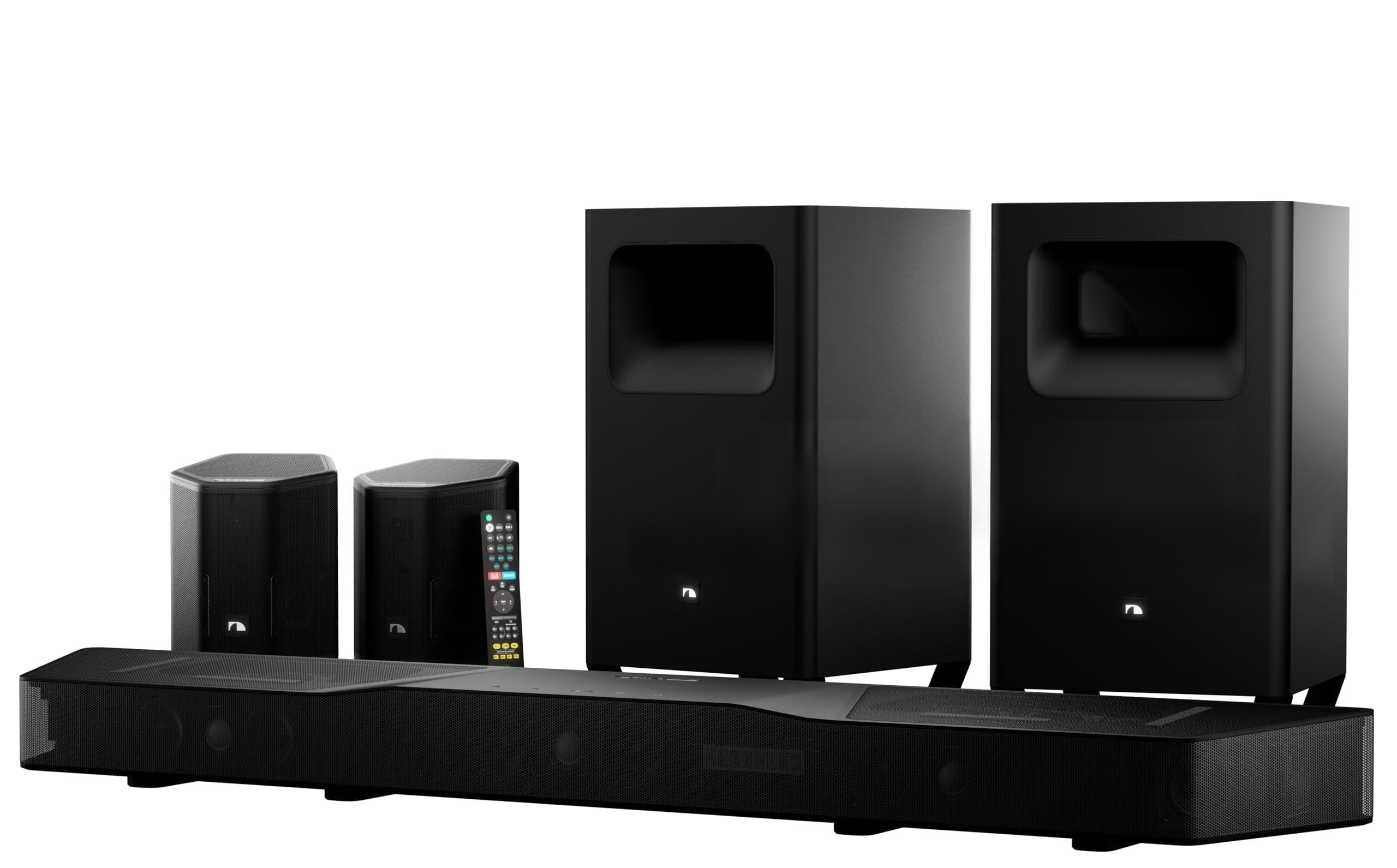
The Nakamichi Shockwafe 11.2.6ch system uses dual 10-inch wireless subwoofers with flared port designs to produce deep, fast bass that maintains composure even during extended action sequences. The 54-inch soundbar houses an array of drivers that project a wide front soundstage, while the bipolar surround speakers fire sound from both sides and above to simulate the presence of six discrete surround channels. The six dedicated height channels create a more layered overhead effect than typical up-firing-only designs, making rain and atmospheric effects feel genuinely three-dimensional.
Dialogue remains crisp even at high volume levels, thanks to the dedicated center channel processing in the AHD Ultra engine. The system supports HDMI eARC with two HDMI 2.1 inputs that pass 4K 120Hz Dolby Vision and HDR10+, making it suitable for gaming alongside movie watching. The backlit remote and companion app provide granular control over individual channel levels and surround modes. Setup is straightforward for a system of this complexity, with the subwoofers and surrounds pairing automatically to the soundbar.
The physical footprint is substantial — the soundbar weighs 32.5 pounds and each subwoofer adds another 32.7 pounds, so sturdy furniture is required. Owners report that the system ships in three large boxes, so delivery logistics matter. The default volume scale tops at 30, but most users find normal listening levels between 5 and 12, with room to spare for house-shaking movie nights.
Why it’s great
- Dual 10-inch subwoofers deliver deep, clean bass with low distortion
- Six discrete height channels for precise overhead imaging
- HDMI 2.1 inputs support 4K 120Hz gaming
Good to know
- Very large and heavy system requires substantial furniture space
- Some users report initial app connection quirks that a restart resolves
3. Nakamichi Dragon 11.4.6ch
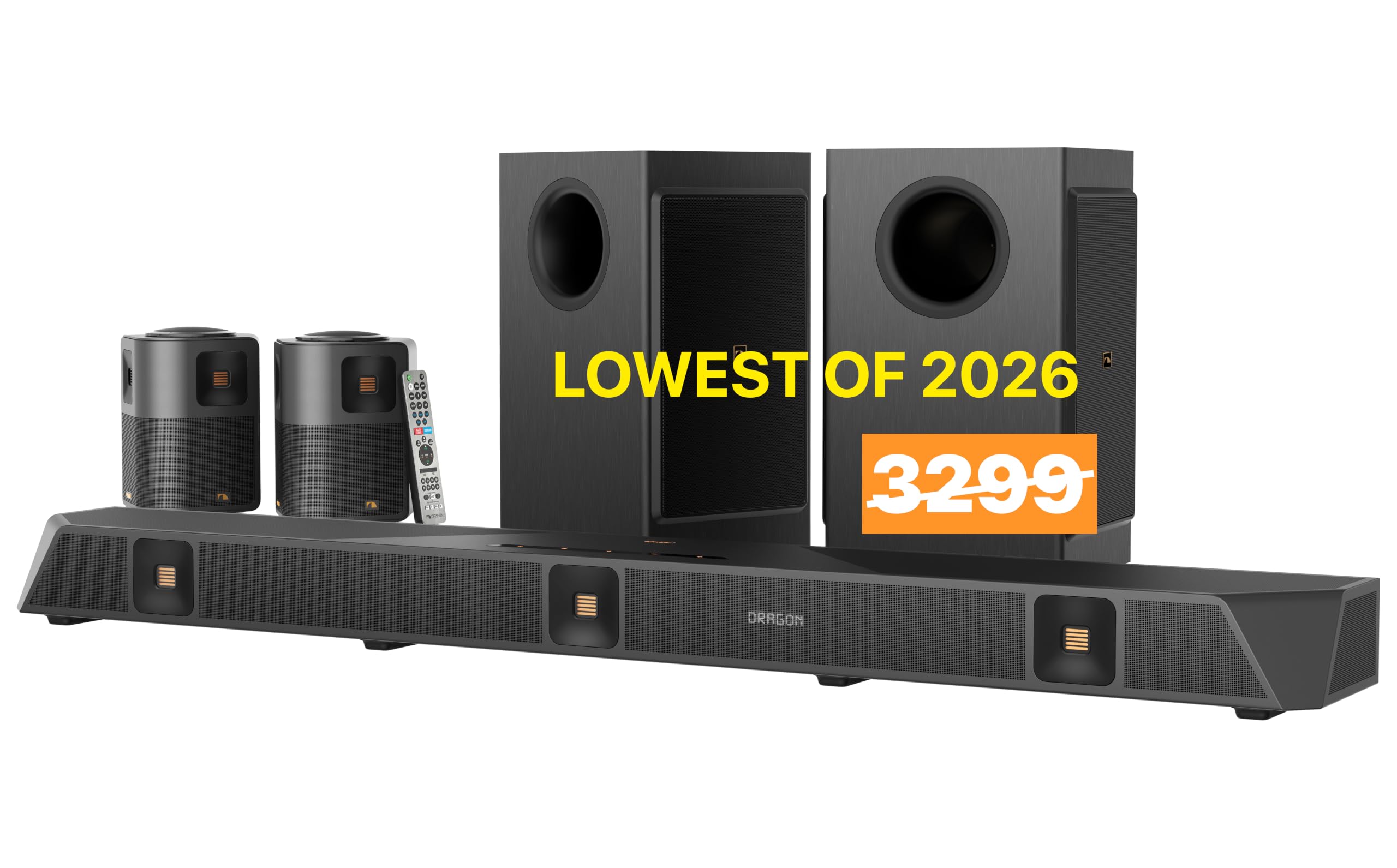
The Nakamichi Dragon 11.4.6ch represents the ceiling of soundbar-based home theater, with a 58-inch main unit housing Air Motion Transformer tweeters that deliver distortion-free highs with exceptional transient speed. The dual-opposing 8-inch subwoofers — two of them, for a total of four 8-inch drivers — cancel out cabinet vibration for cleaner low-frequency reproduction that reaches down to 20Hz. The Pro Cinema Engine processes Dolby Atmos up to 24.1.10 and DTS:X Pro up to 30.2, meaning the Dragon operates at the same decode depth as flagship AVRs.
The Omni-Motion surround speakers use the PerfectHeight Mechanism to physically adjust the angle of the up-firing drivers, locking overhead effects to the listening position regardless of ceiling height. The system includes three HDMI 2.1 inputs with full 4K 120Hz and 8K passthrough support. Dialogue remains focused even at peak volume, with the AMT tweeters preserving sibilance and vocal articulation without harshness. Setup involves pairing the soundbar with the dual subwoofers and surrounds, which connect wirelessly and synchronize automatically.
At 3000 watts of peak output, the Dragon can pressurize a large room easily. Owners consistently report that the system outperforms traditional AVR-based setups at similar price points, particularly in terms of ease of setup and spatial coherence. The system lacks built-in Wi-Fi, so firmware updates require a USB thumb drive. The physical weight — each subwoofer is 34.4 pounds and the soundbar is 32.2 pounds — demands a robust entertainment center.
Why it’s great
- Quad 8-inch dual-opposing subwoofers deliver room-loading bass with minimal cabinet vibration
- AMT tweeters provide ultra-low distortion and fast transient response
- PerfectHeight Mechanism on surrounds optimizes overhead effects for any ceiling
Good to know
- No built-in Wi-Fi; firmware updates require USB drive
- Extremely heavy components need sturdy furniture and two-person setup
4. Klipsch Reference 5.2 with Yamaha RX-A2AB
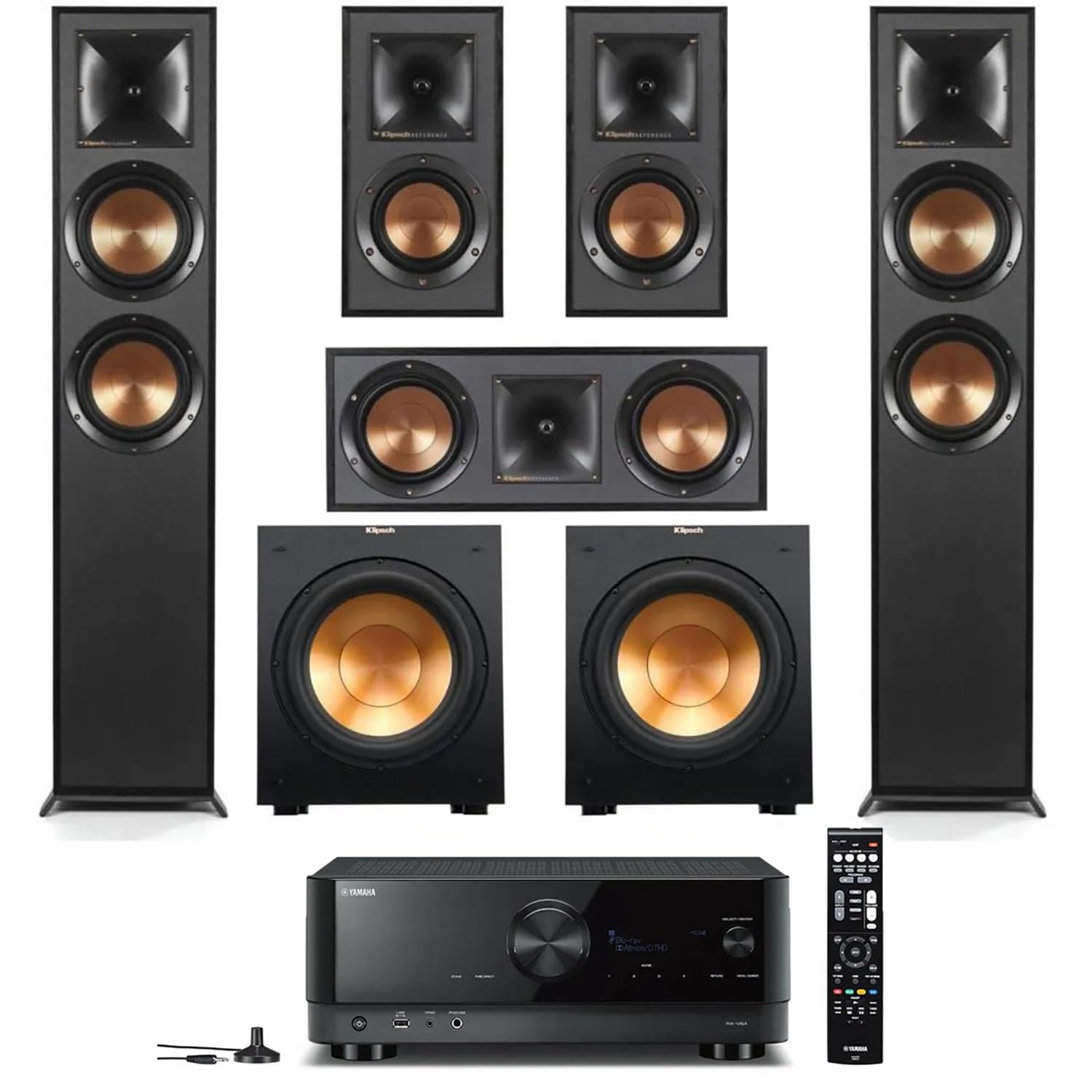
The Klipsch Reference 5.2 system is a traditional component-based setup that pairs R-625FA Dolby Atmos floorstanding speakers with dual R-12SW 12-inch subwoofers, an R-52C center channel, and R-41M bookshelf surrounds, all powered by a Yamaha RX-A2AB 7.2-channel AV receiver. The floorstanding speakers include built-in up-firing drivers for Atmos height effects, while the horn-loaded Tractrix tweeters provide the high sensitivity and dynamic impact that Klipsch is known for. The dual 12-inch subwoofers produce deep, physical bass that pressurizes medium to large rooms effectively.
The Yamaha receiver includes YPAO room calibration, which measures speaker distances and adjusts EQ for your specific listening position. The system supports Dolby Atmos and DTS:X, and the receiver’s 4K passthrough with HDR10+ and Dolby Vision ensures compatibility with modern sources. Dialogue is exceptionally clear thanks to the dedicated center channel with a horn-loaded tweeter, which cuts through dense action sequences without sounding fatiguing. Owner reports highlight that the included speaker wires are sufficient for basic placement, but banana plugs make connections cleaner.
This is not a plug-and-play system — you will need to connect each speaker wire, configure the receiver, and run YPAO calibration. The floorstanding speakers are large, requiring about 8 inches of clearance from the wall for proper bass port performance. For buyers willing to invest in setup time, this system delivers audio fidelity that soundbars cannot match, particularly in two-channel music playback where the tower speakers shine with better soundstage depth and imaging.
Why it’s great
- Floorstanding speakers with horn tweeters deliver high sensitivity and dynamic range
- Dual 12-inch subwoofers produce room-pressurizing bass
- Yamaha receiver with YPAO provides professional room calibration
Good to know
- Requires significant setup time with manual speaker wire connections and receiver configuration
- Large floorstanding speakers need substantial floor space and wall clearance
5. Sonos Arc Ultra

The Sonos Arc Ultra uses Sound Motion technology — an all-new acoustic architecture that packs more drivers into a slim chassis while producing wider sound dispersion than previous Sonos soundbars. With a 9.1.4 spatial audio configuration and Dolby Atmos decoding, the Arc Ultra creates a convincing sound bubble that places effects accurately around the listener. The built-in AI-powered Speech Enhancement detects human voices and clarifies dialogue automatically, which is particularly useful for mixed-content viewing where whispered conversations and loud explosions alternate.
Setup is handled entirely through the Sonos app, which guides you through HDMI eARC connection and Trueplay tuning — a process that uses the soundbar’s microphones to measure room reflections and adjust EQ. The Arc Ultra supports Apple AirPlay 2, Spotify Connect, and Sonos Voice Control alongside Amazon Alexa. For a full surround experience, you can add Sonos Sub (or Sub Mini) and Era 300 rear speakers, which integrate wirelessly with the soundbar to create a seamless multi-room and home theater ecosystem. The design is sleek and low-profile, measuring just under 3 inches tall, which makes it fit below most TVs without blocking the screen.
Music reproduction is a strong point for the Arc Ultra, with the spatial audio processing creating a wide, immersive soundstage even from stereo sources. The main limitation is that the full 9.1.4 experience requires adding the Sub and Era 300 surrounds, which increases the total investment significantly. Without the rear speakers, the height effects are less directional than systems with dedicated physical surround channels. Owners consistently praise the app stability and the ability to group the Arc Ultra with other Sonos speakers throughout the home for whole-house audio.
Why it’s great
- Seamless integration into the Sonos multi-room ecosystem
- AI-powered Speech Enhancement clarifies dialogue automatically
- Sleek low-profile design fits under most TVs
Good to know
- Full 9.1.4 experience requires adding Sub and Era 300 surrounds
- Premium price point compared to similarly specced soundbars
6. LG S95TR 9.1.5ch

The LG S95TR is a 9.1.5-channel soundbar system that includes a unique up-firing center channel driver, which LG claims improves dialogue clarity in Atmos mixes by projecting vocal information upward to reflect off the ceiling and down toward the listening position. The system ships with wireless rear speakers that include their own up-firing drivers, creating a total of three height channels for overhead effects. The bundled wireless subwoofer uses an 8-inch driver and produces solid, if not earth-shaking, bass that works well in medium-sized rooms.
The WOW Orchestra feature synchronizes the soundbar with compatible LG TVs so that the TV’s built-in speakers act as an additional center channel, widening the front soundstage. WOWCAST allows wireless Dolby Atmos transmission from the TV to the soundbar without an HDMI cable, though for best latency-free performance, HDMI eARC is recommended. The system supports Dolby Atmos and DTS:X, and includes VRR and ALLM passthrough at 120Hz for gaming. The advanced room calibration uses the soundbar’s microphones to detect rear speaker placement and optimize the surround field.
Setup is straightforward with the rear speakers requiring only power connections. The LG Soundbar app provides access to EQ presets, room calibration, and firmware updates. Some owners note that the default sound profile can sound slightly hollow with voices, but adjusting the EQ in the app resolves this. The rear speakers are larger than many competing systems, which contributes to their fuller sound but requires more physical space.
Why it’s great
- Triple up-firing drivers including dedicated center height channel for dialogue
- WOW Orchestra integrates LG TV speakers for wider soundstage
- VRR and ALLM passthrough up to 120Hz for gaming
Good to know
- Rear speakers are large and need significant shelf or stand space
- Default EQ may need adjustment for optimal dialogue clarity
7. JBL Bar 700MK2 7.1ch

The JBL Bar 700MK2 solves a common problem with surround sound placement: the need for power outlets near rear speakers. Its detachable wireless surround speakers lift off the main soundbar and can be placed behind the listening position without any wires or power connections. Each speaker has a built-in rechargeable battery that lasts for several movie sessions, and they automatically recharge when docked back onto the soundbar. The main unit delivers 780 watts of peak power through a 10-inch wireless subwoofer and the soundbar’s driver array, producing deep bass and clear high frequencies.
Dolby Atmos decoding is handled through MultiBeam 3.0 technology, which uses multiple beam-forming drivers to create virtual height effects. While not as precisely directional as dedicated up-firing drivers, the system creates a convincing sense of overhead space in rooms with flat ceilings. JBL’s PureVoice 2.0 technology automatically adjusts dialogue levels based on the ambient sound in the scene, ensuring spoken lines remain clear even during loud action sequences. The system supports HDMI eARC, optical, Bluetooth, and Wi-Fi streaming, and integrates with Amazon Alexa and Google Assistant for voice control.
The Night Listening mode is a standout feature: place the detachable speakers in front of you on a table, activate the mode, and the soundbar and subwoofer mute while the speakers deliver intimate, clear audio — perfect for late-night viewing without disturbing others. The JBL ONE app provides a 10-band EQ for fine-tuning the sound profile. Owner feedback highlights that the bass can feel overwhelming with the default EQ setting, requiring adjustment of the subwoofer level to suit personal preference.
Why it’s great
- Truly wireless detachable surrounds need no power outlet or cables
- PureVoice 2.0 automatically optimizes dialogue against scene volume
- Night Listening mode lets you watch late without disturbing others
Good to know
- Default bass EQ may be too heavy for some listeners and needs adjustment
- Virtual height effects less precise than systems with physical up-firing drivers
8. ULTIMEA Skywave X70 7.1.4ch
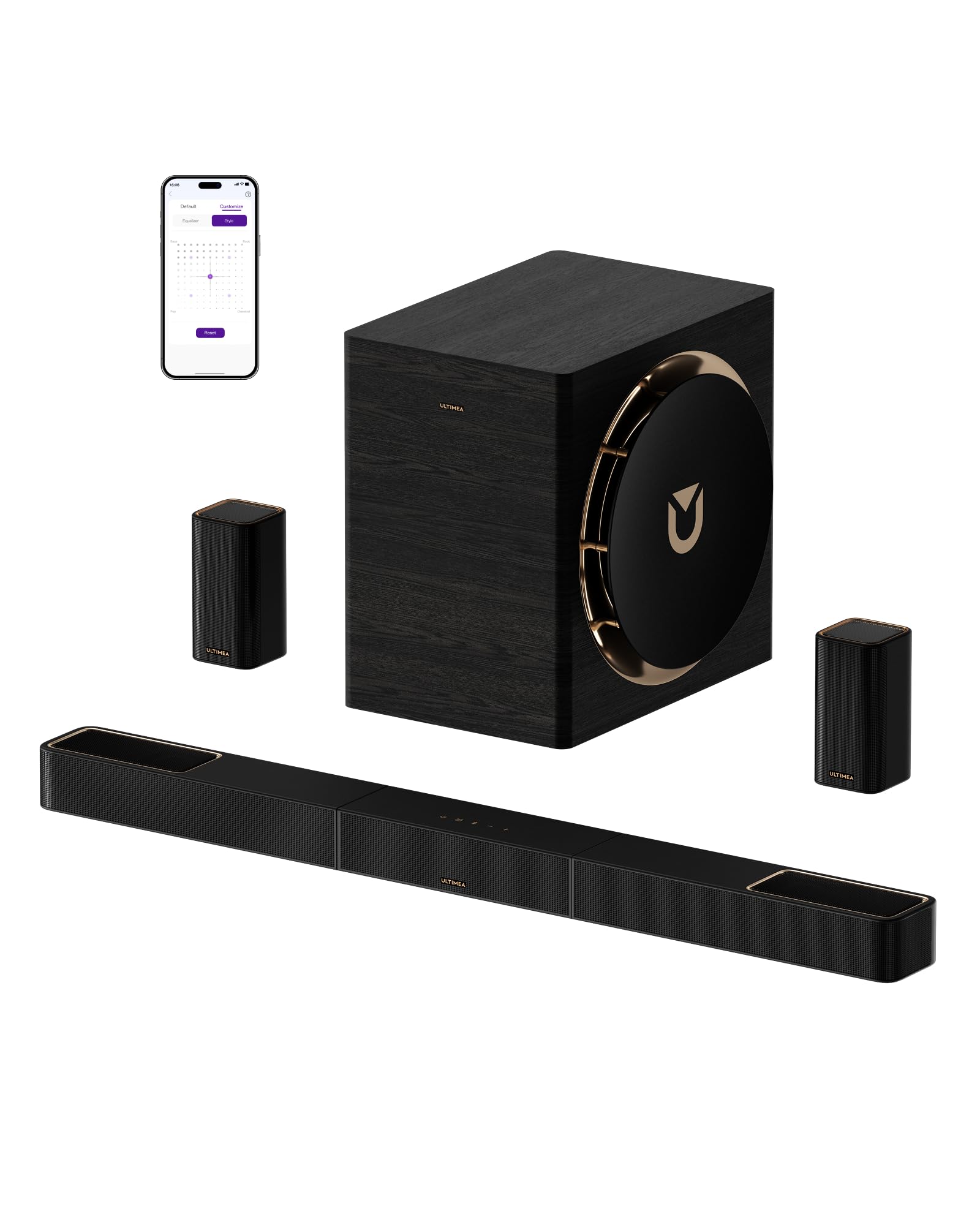
The ULTIMEA Skywave X70 is a 7.1.4-channel system that uses a Gallium Nitride (GaN) amplifier for higher efficiency and lower heat output compared to traditional silicon-based amplifiers. The 10-inch wireless subwoofer with Gravus Ultra-Linear Bass technology reaches down to 20Hz, which is notably deep for this price tier. The NEURACORE multi-channel audio engine uses a triple-core DSP and dual-core MCU to process 24-bit/192kHz audio with less than 0.5% total harmonic distortion, supporting up to 17 channels for future expandability.
Wireless connectivity uses dual 5GHz transmission bands for stable communication between the soundbar, subwoofer, and rear speakers, minimizing dropouts even in Wi-Fi-dense environments. The system includes HDMI eARC, optical, Bluetooth, and USB inputs, with 4K HDR passthrough support. The ULTIMEA app provides a 10-band EQ with 121 sound presets, OTA firmware updates, and individual channel level control. The three-piece soundbar design (main unit plus two detachable end sections) allows for flexible width adjustment to match different TV sizes.
Owner reviews consistently note the strong bass output and clear dialogue at both low and high volumes. The rear speakers are wireless but require power connections, and the included speaker wires for the surrounds are thin. The system lacks automatic room calibration, meaning you’ll need to manually adjust channel levels based on your seating position. For the price, the Skywave X70 packs an impressive array of features including a GaN amp, 20Hz subwoofer extension, and app-based EQ control that competes well with systems costing significantly more.
Why it’s great
- GaN amplifier provides 98% efficiency with minimal heat generation
- 10-inch subwoofer extends to 20Hz for deep, physical bass
- App-based 10-band EQ with 121 presets offers extensive customization
Good to know
- No automatic room calibration requires manual channel level adjustment
- Rear speakers need power outlets; included surround wires feel thin
9. Sony BRAVIA Theater System 6

The Sony BRAVIA Theater System 6 is a 5.1-channel soundbar system with dedicated center, left, and right front channels plus two rear speakers and a wireless subwoofer. The included rear speakers are powered by a wired amplifier box that sits near the subwoofer, which acts as the central hub for all speaker connections. Voice Zoom 3 technology, available when paired with a compatible BRAVIA TV, automatically analyzes dialogue and adjusts the vocal emphasis in real-time, making it one of the most effective dialogue enhancement systems available.
Dolby Atmos and DTS:X support ensure the system can decode object-based audio formats, with the DSEE up-mixing algorithm restoring acoustic details in compressed music streams. The Multi Stereo mode plays the same audio from all speakers simultaneously, creating a room-filling sound field that works well for parties or background listening. Sony’s BRAVIA Connect app provides access to volume control, sound profiles, and advanced settings from your smartphone. The system’s frequency response extends down to 20Hz, providing solid low-end extension from the subwoofer.
The wired connection requirement for the rear speakers is a notable limitation — the subwoofer acts as a hub that requires wires running to each rear speaker, which complicates placement. Some owners report occasional HDMI-ARC handshake issues that cause audio dropouts, particularly with Sony TVs, which can usually be resolved by switching to the optical input. The center channel does an excellent job anchoring dialogue to the screen, and the system sounds authoritative for its size in medium-sized rooms.
Why it’s great
- Voice Zoom 3 provides class-leading dialogue enhancement with BRAVIA TVs
- 20Hz frequency response from the subwoofer delivers deep bass
- Multi Stereo mode fills the room with sound for parties and gatherings
Good to know
- Rear speakers require wired connection to the subwoofer hub, limiting placement flexibility
- HDMI-ARC handshake issues reported with some Sony TV configurations
10. Klipsch Reference Cinema 5.1.4

The Klipsch Reference Cinema 5.1.4 system includes four satellite speakers — two front and two rear — each equipped with up-firing Dolby Atmos drivers, plus a center channel and a powered subwoofer. The Tractrix 90×90-degree horn-loaded tweeters deliver the high sensitivity and crisp high-frequency response that Klipsch is known for, ensuring dialogue and effects cut through without sounding harsh. The aluminum tweeters provide greater extension and lower distortion than soft-dome alternatives, making this system one of the more affordable ways to get discrete Dolby Atmos height channels.
The all-digital subwoofer amplifier delivers ample power with high efficiency, though the subwoofer itself is the system’s weakest link, lacking the punch and extension of larger or more expensive options. The satellite speakers produce impressive bass for their size thanks to the 5.25-inch woofers, which allows them to blend well with the subwoofer at crossover points around 90-100Hz. The system requires a separate AV receiver with at least 7.1 channel processing — the included speakers have no amplification built in, so this is a component-based setup, not a soundbar.
No speaker wiring is included, so you’ll need to purchase 14- or 16-gauge speaker wire separately. The push-locking speaker terminals accept bare wire or small banana plugs but may not fit larger connectors. The up-firing Atmos effects work best with flat ceilings between 8 and 12 feet high; vaulted or textured ceilings diminish the reflected height effect. Owners praise the system as a gateway into discrete Atmos at an accessible cost, particularly for users who already own a compatible AV receiver.
Why it’s great
- Four satellite speakers with dedicated up-firing Atmos drivers for discrete height channels
- Tractrix horn tweeters deliver high sensitivity and clear high frequencies
- Affordable entry point into component-based Dolby Atmos systems
Good to know
- Requires a separate AV receiver with 7.1 channel processing
- Subwoofer lacks punch and extension compared to larger options
- No speaker wire included; 16-gauge wire is recommended for the tight terminals
11. Amazon Fire TV Soundbar Plus 5.1

The Amazon Fire TV Soundbar Plus 5.1 system delivers a full 5.1-channel surround experience with a dedicated center channel for dialogue, a wireless subwoofer, and two wireless rear surround speakers — all at a budget-friendly price point. The dedicated center channel significantly improves vocal clarity over standard stereo soundbars, with a five-level dialogue boost that makes whispered conversations audible even during loud action sequences. The system supports Dolby Atmos and DTS:X decoding, processing object-based audio into its 5.1 channel layout for a wider sound field.
Setup is remarkably simple: the subwoofer and rear speakers pair with the soundbar automatically after plugging them into power, and HDMI-ARC connection handles both audio and control from your TV remote. The system includes Movie, Music, Sports, and Night modes that optimize EQ and dynamic range for different content types. Bluetooth streaming lets you play music from your phone or tablet, and the system works with any TV, not just Fire TV models, though Fire TV devices integrate for unified control through one remote.
Owner feedback highlights the excellent value proposition, with many upgrading from older Vizio and entry-level soundbars and noticing immediate improvements in dialogue clarity and surround immersion. The subwoofer benefits from being placed more than 12 inches from walls to avoid boomy bass. Some units arrive with defective components (dead subwoofers reported), so testing all speakers immediately upon arrival is recommended. The system cannot decode Dolby TrueHD over eARC, so lossless Atmos from Blu-ray sources may not work at full quality.
Why it’s great
- Full 5.1 surround with dedicated center channel at a budget-friendly price point
- Five-level dialogue boost significantly improves vocal clarity
- Simple plug-and-play setup with automatic speaker pairing
Good to know
- Some units arrive with defective subwoofers; test immediately upon delivery
- Subwoofer needs more than 12 inches of wall clearance to avoid boomy bass
- No Dolby TrueHD decoding for lossless Atmos from physical media
FAQ
What is the minimum channel count I need for a convincing Dolby Atmos experience?
Do up-firing Atmos speakers work with vaulted or textured ceilings?
Can I mix and match different speaker brands in a cinema sound system?
How important is HDMI eARC for a cinema sound system?
What does a GaN amplifier do that a traditional amplifier cannot?
Final Thoughts: The Verdict
For most users looking for the best cinema sound system, the Samsung Q990F is the winner because it combines 11.1.4-channel immersion, automatic room calibration, and easy wireless rear speaker placement in a single package that works without a separate receiver. If you want authoritative, room-pressurizing bass from dual subwoofers, the Nakamichi Shockwafe 11.2.6 delivers theater-level low-end rumble that you can feel in your chest. And for the absolute reference-level experience with AMT tweeters and quad-opposing subwoofers, nothing beats the Nakamichi Dragon 11.4.6 for pure, uncompromised cinema sound in your living space.

Mo Maruf
I created WellFizz to bridge the gap between vague wellness advice and actionable solutions. My mission is simple: to decode the research and give you practical tools you can actually use.
Beyond the data, I am a passionate traveler. I believe that stepping away from the screen to explore new environments is essential for mental clarity and physical vitality.