Our readers keep the lights on and my smoothie glass nicely filled. As an Amazon Associate, I earn from qualifying purchases.
The jump from mirrorless to a dedicated cinema body isn’t about a higher megapixel count—it’s about color science, codec flexibility, and a body designed for a multi-hour shoot, not a tourist snapshot. The market now offers everything from compact full-frame sensors with built-in ND filters to rugged 6K boxes with 32-bit float audio, making the choice deeply dependent on your rigging philosophy and post-production pipeline.
I’m Mohammad Maruf — the founder and writer behind WellFizz. I’ve spent countless hours parsing specification sheets, customer feedback, and real-world shoot data to separate marketing fluff from the sensor-level truths that actually matter to a working cinematographer.
Whether you are building a rental fleet or buying your first dedicated body, the difference between a good image and a great one starts with a cinema camera that matches your workflow rather than competing with it.
How To Choose The Best Cinema Camera
Your choice should be driven by three pillars: sensor architecture and codec capability, ergonomics and accessory ecosystem, and the specific shooting scenarios you face most often. A documentary rig has different cooling and audio requirements than a commercial studio body.
Sensor Size and Dynamic Range
A full-frame sensor gives you wider native ISOs and shallower depth of field, while Super35 sensors often read out faster and provide more forgiving lens coverage with vintage glass. Dynamic range above 14 stops separates pro cameras from consumer bodies—this is what allows you to recover shadow detail without introducing noise.
Codec and Recording Flexibility
Raw internal recording (Blackmagic RAW, REDCODE RAW, or Cinema RAW Light) gives maximum grading latitude but demands fast media and powerful computers. If your workflow prioritizes speed, look for cameras that also offer efficient long-GOP formats like H.264 or ProRes for proxy generation.
Built-in ND and Audio
Internal variable ND filters (like the Sony FX6’s 1/4 to 1/128 range) eliminate the need for bulky matte boxes in run-and-gun scenarios. Similarly, XLR inputs with 32-bit float audio recording can save a shoot when loud sounds unexpectedly peak, giving you headroom that standard 24-bit cannot.
Quick Comparison
On smaller screens, swipe sideways to see the full table.
| Model | Category | Best For | Key Spec | Amazon |
|---|---|---|---|---|
| Canon EOS R5 C | Hybrid | 8K RAW internal + 45MP stills | 8K/60p internal RAW | Amazon |
| Sony FX6 | Box/Doc | Internal ND + XLR handle | Electronic variable ND 1/4-1/128 | Amazon |
| Sony FX3 (Body) | Compact | Low-light, gimbal work | 4K 120p 10-bit 4:2:2 | Amazon |
| Sony FX3 + 24-70mm | Kit | All-in-one run-and-gun | 24-70mm f/2.8 GM II included | Amazon |
| Blackmagic 6K FF (L-Mount) | Full-Frame | Grading flexibility | 12-bit BRAW 6K full-frame | Amazon |
| Nikon RED Z C (ZR) | Compact RAW | 32-bit float & R3D workflow | 6K full-frame 15+ stops | Amazon |
| Sony FX2 | Entry FF | Full-frame cinema intro | 33MP FF, 15+ stops DR | Amazon |
| Blackmagic Pocket 6K (EF) | Budget Body | Super35 raw, EF glass | 6K 50 fps, S35 sensor | Amazon |
| Sony FX30 Bundle | APS-C kit | Complete starter cinema setup | 26.1MP APS-C, 4K 120p | Amazon |
In‑Depth Reviews
1. Canon EOS R5 C

The Canon EOS R5 C is the hybrid king that does not compromise on video. It writes 8K/60p internally using Cinema RAW Light, and its active cooling fan means you can actually sustain that data rate without thermal shutdown. The 45MP stills capability at 20 fps with mechanical shutter gives you a second camera in one body for multi-day shoots where switching gear is impractical.
Its Dual Pixel CMOS AF with ITR AF X is a class leader—eye detection on moving subjects feels telepathic, and the 13 assignable buttons let you build a personalized menu in minutes rather than hours. The body-integrated fan is the unsung hero here: shoot 8K for hours during a corporate event without a single shutdown, a feat few mirrorless hybrids can claim.
On the downside, battery life is the weakest link—expect to swap NP-F batteries frequently, especially when recording high-bitrate 8K. The mini HDMI port is fragile and should be secured with a clamp. If you need continuous 4K 120p without crop and raw internal recording, this is the most complete hybrid cinema camera under mid-range price territory.
Why it’s great
- Internal 8K/60p RAW with active cooling allows uninterrupted high-bitrate recording
- 45MP sensor delivers pro-grade stills at 20 fps, making it a true hybrid
- Dual Pixel AF with ITR AF X is highly reliable for fast-moving subjects
Good to know
- Battery life is poor; a battery grip or V-mount solution is almost required for long shoots
- Mini HDMI port is fragile—use a cable clamp to avoid damage
- No internal RAW beyond 8K; 4K 120p has a sensor crop
2. Sony FX6

The Sony FX6 is the body that professional doc shooters and corporate videographers build their kit around. Its 10.2MP full-frame sensor delivers 4K DCI up to 60p and 4K 120p in QFHD with a 15+ stop dynamic range. The internal electronic variable ND filter (1/4 to 1/128) is a production-triple—you can adjust exposure mid-shot without attaching or swapping glass filters.
Fast Hybrid AF with 627 phase-detection points and Eye-AF tracking means a single operator can rely on autofocus while adjusting framing, a huge advantage in run-and-gun scenarios. The XLR handle provides two balanced audio inputs with phantom power, eliminating the need for a separate audio recorder for many shoots.
The menu system, however, is more complex than the A7S III or FX3, and the quick menu is not customizable out of the box. There is no 3.5mm audio input on the body or handle—you must use the XLR handle or an external module. If you prioritize internal ND and professional audio integration in a compact body, the FX6 is a staple for demanding field work.
Why it’s great
- Electronic variable ND filter eliminates the need for external matte boxes in most lighting conditions
- Dual base ISO and 15+ stops of dynamic range deliver clean images in low light
- XLR handle with phantom power simplifies audio capture for run-and-gun documentary style
Good to know
- No 3.5mm audio jack on the body or handle limits certain wireless mic setups
- Menu system is less intuitive than Sony’s consumer mirrorless line; take time to learn it
- 4K Super 35mm mode is limited to 1080p, not full 4K readout
3. Sony FX3 + 24-70mm f/2.8 GM II

The Sony FX3 is already a favorite among gimbal operators for its compact, cage-free design and internal cooling fan that prevents overheating during long 4K 120p recordings. Paired with the 24-70mm f/2.8 GM II, this bundle covers the most critical focal range for interviews, weddings, and commercial projects with fast, silent autofocus and the S-Cinetone color profile derived from the VENICE cinema camera.
The full-frame sensor delivers 15+ stops of dynamic range and an impressive dual base ISO of 800/12800, making it a standout choice for low-light events where you cannot add lights. The 24-70mm f/2.8 GM II is remarkably sharp across the frame and focuses quickly even in dim environments, ensuring you never miss critical shots.
This bundle also includes a 128GB memory card, 82mm filter kit (UV, CPL, ND2x), shoulder bag, and cleaning kit, making it a near-complete rig for filmmakers who want to start shooting immediately. The main trade-off is that the FX3 lacks the internal ND of the FX6 and the raw recording options of the Canon R5 C, but for pure run-and-gun gimbal work, this combo is hard to beat.
Why it’s great
- Compact body with active fan allows uninterrupted 4K 120p recording on a gimbal without overheating
- S-Cinetone and dual base ISO 12800 deliver excellent low-light performance and pleasing skin tones
- 24-70mm f/2.8 GM II is one of the sharpest standard zoom lenses available, with fast autofocus
Good to know
- Lacks internal variable ND, so external NDs or matte box are needed for outdoor shoots
- No internal raw recording; maximum is 10-bit 4:2:2 via XAVC S-I
- Rolling shutter can be noticeable during fast pans or whip movements
4. Sony FX3 (Body Only)

The Sony FX3 body is the same sensor and processing engine as the bundle version, but sold without lens or accessories, making it a smart purchase if you already own E-mount glass. Its 4K full-frame sensor with dual base ISO (800/12800) lets you shoot in near-darkness without noise, and the S-Cinetone profile gives you a cinematic look straight out of camera with minimal grading.
The compact body weighs under 2 pounds, which is revolutionary for a full-frame cinema camera with active cooling. You can rig it on a lightweight gimbal or fly it on a drone without feeling the weight penalty of a larger box. The XLR top handle provides two balanced audio inputs with phantom power, a rarity in this form factor.
The main downside is that stills are not its strength—the 12MP sensor is video-focused, and the electronic shutter can struggle with fast-moving subjects. Storage is expensive due to the need for high-speed CFexpress Type A media for 4K 120p 10-bit 4:2:2. For videographers who prioritize low-light performance and portability above all else, the FX3 body is the cleanest image-per-dollar proposition.
Why it’s great
- Exceptional low-light performance with dual base ISO 12800 and clean 4K 120p
- Compact, lightweight body with active cooling for extended gimbal use
- S-Cinetone delivers cinema-quality skin tones and color science out of the box
Good to know
- 12MP sensor is video-only; stills are acceptable but not a primary feature
- Requires fast, expensive CFexpress Type A media for maximum bitrate recording
- Rolling shutter is present during fast pans; 4K 120p readout is not full-pixel
5. Blackmagic Cinema Camera 6K (L-Mount)

The Blackmagic Cinema Camera 6K is a full-frame beast in a compact body. Its 6048 x 4032 sensor with Leica L-mount gives you access to some of the finest glass available, and the built-in OLPF (optical low-pass filter) reduces moiré and aliasing without sharpness loss. It records 12-bit Blackmagic RAW internally, giving you the grading latitude of cameras costing four times as much.
The 1500 nit 5-inch tilting HDR monitor is bright enough for outdoor work, and the carbon fiber polycarbonate composite body keeps weight low without sacrificing durability. DaVinci Resolve Studio comes included, so you are not paying extra for pro-grade color correction software. The dual gain ISO up to 25600 ensures decent low-light performance despite the high resolution.
On the downside, battery life is poor—you will want an external V-mount battery plate for all-day shoots. The CFexpress Type B media is fast but expensive, and while the L-mount is excellent, the lens ecosystem is smaller than Sony E or Canon RF. For filmmakers who want raw flexibility without breaking the bank, this is the best value raw cinema camera at this price tier.
Why it’s great
- Records 12-bit Blackmagic RAW internally for maximum grading flexibility
- Full-frame 6K sensor with L-mount provides excellent dynamic range and lens options
- Includes DaVinci Resolve Studio license, saving on post-production software costs
Good to know
- Battery life is very limited; an external V-mount battery is almost essential for professional workflows
- CFexpress Type B media is required for high-frame-rate recording, which is expensive
- L-mount lens ecosystem is growing but still smaller than Sony E or Canon RF
6. Nikon RED Z C (ZR)

The Nikon RED Z C is the first fruit of the Nikon-RED partnership, and it is a genuine compact cinema camera. It packs a 6K full-frame sensor with 15+ stops of dynamic range, dual base ISO, and the same RED color science (R3D RAW) used on professional RED cinema bodies, all in a chassis that weighs just 1.18 pounds. This is a camera built for filmmaker mobility—it integrates with standard rigs, cages, and control grips without weight penalties.
Industry-leading 32-bit float audio recording is a standout feature: you can record audio so cleanly that even clipping-heavy peaks can be recovered in post without distortion. The 4-inch DCI-P3 touchscreen is bright and accurate, and the Nikon Z-mount is the widest and shallowest full-frame lens mount available, giving you maximum adaptability with third-party glass via adapters.
The primary downside is that file sizes are enormous—R3D RAW at 6K fills storage quickly, and you will need the fastest CFexpress Type B media available. There is no in-body image stabilization, so handheld shots require a gimbal or a stable base. For indie filmmakers who want RED color science and professional audio in a lightweight, customizable body, the Nikon RED Z C is a groundbreaking option.
Why it’s great
- 32-bit float audio recording provides unprecedented headroom for post-production audio recovery
- Lightweight 1.18 lbs body with full RED color science (R3D RAW) for cinema-grade footage
- Widest, shallowest full-frame lens mount (Z-mount) for maximum lens adaptability
Good to know
- R3D RAW file sizes are massive, requiring expensive, high-speed CFexpress Type B storage
- No in-body image stabilization; you’ll need a gimbal or tripod for shake-free handheld shots
- The cooling system relies on passive airflow; heavy indoor use may require monitoring
7. Sony FX2

The Sony FX2 bridges the gap between hybrid mirrorless and dedicated cinema, offering a 33MP full-frame sensor with 15+ stops of dynamic range and dual base ISO (800/4000) in a compact form factor. Its BIONZ XR processor and AI autofocus system with 759 phase-detection points provide reliable tracking for fast-moving subjects, making it an excellent choice for content creators moving from consumer cameras.
The “BIG6” interface and angle-adjustable EVF improve ergonomics compared to previous Sony cinema bodies, and the Cine EI Quick mode lets you toggle between ISO and exposure index rapidly for consistent exposure across shots. The 10-bit 4:2:2 recording in XAVC S-I gives you good latitude for color grading without needing raw workflows.
The main limitation is that 4K 60p comes with a sensor crop, and there is no internal raw recording. Low-light performance is decent but not on par with the FX3’s 12800 base ISO. For newcomers to full-frame cinema who value autofocus, color science, and a compact body at a lower entry point, the FX2 is a compelling starting camera.
Why it’s great
- Full-frame 33MP sensor with 15+ stops dynamic range offers great flexibility for grading
- AI autofocus with 759 phase-detection points is highly reliable for fast-moving subjects
- Compact and lightweight body with a bright EVF for single-operator documentary style
Good to know
- 4K 60p has a sensor crop, limiting wide-angle lens choices at higher frame rates
- No internal raw recording; maximum is 10-bit 4:2:2 XAVC S-I
- Low-light performance is good but not exceptional compared to dual-base 12800 cameras like the FX3
8. Blackmagic Pocket Cinema Camera 6K (EF)
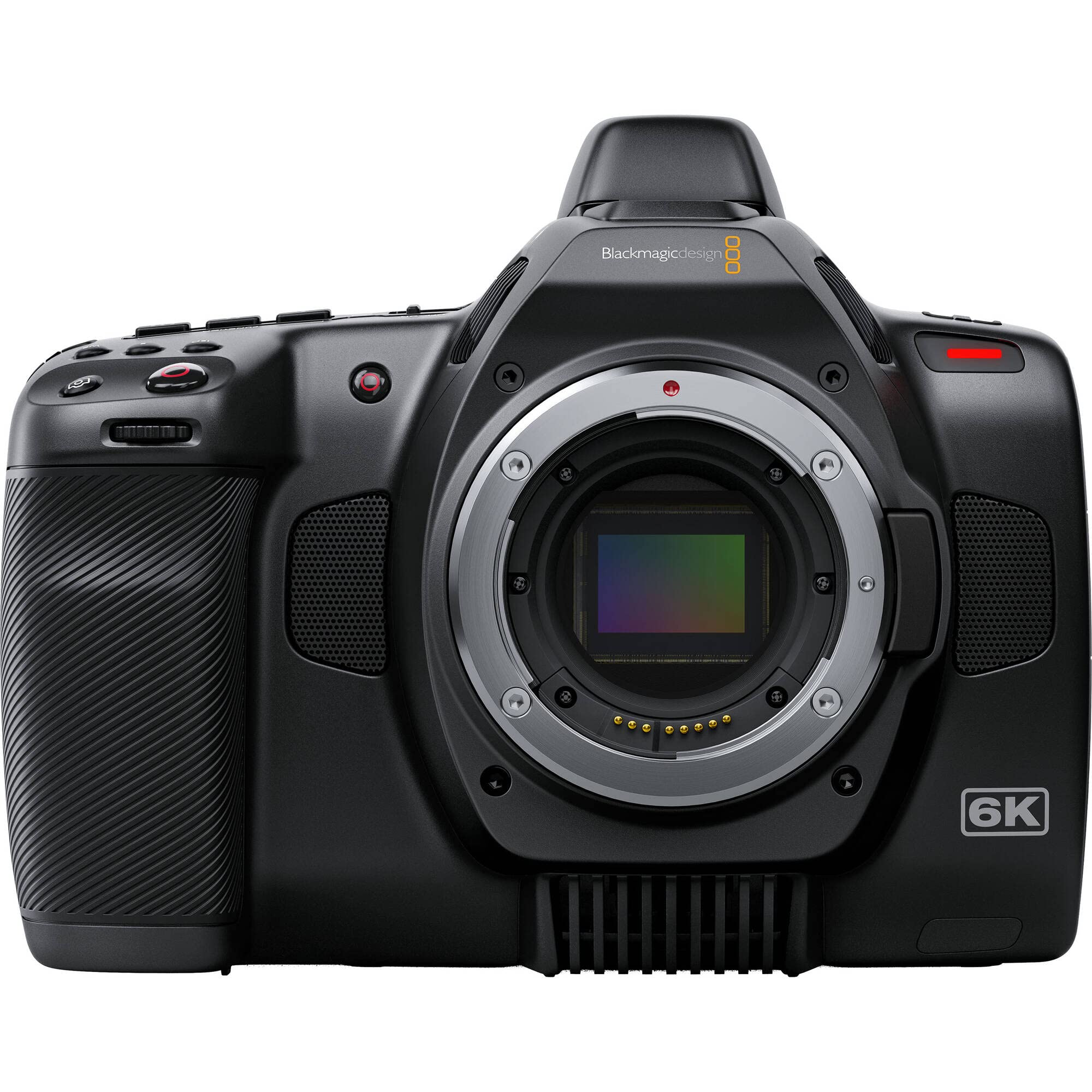
The Blackmagic Pocket Cinema Camera 6K is the camera that democratized raw filmmaking. Its Super35 6144 x 3456 sensor with an active EF mount means you can use Canon EF and third-party lenses with native electronic communication, making it the most accessible raw cinema body for filmmakers who already own DSLR glass. Shooting resolutions go up to 6K at 50 fps and 2.8K at 120 fps, giving you professional slow-motion options.
The 5-inch touchscreen is bright and responsive, and the built-in DaVinci Resolve Studio license means you have a full post-production suite ready. The SD card recording is decent, but for high-bitrate 6K, you will want to use an external SSD via the USB-C port, which is a cheap and reliable solution.
The biggest drawbacks are battery life—the included LP-E6 style battery lasts only about 30-40 minutes—and the lack of built-in autofocus. You rely on manual focus or a follow-focus system. The menu system is also a learning curve. For indie filmmakers who want raw quality on a budget and are comfortable with manual focus and external power, this remains a cult-classic choice.
Why it’s great
- Records Blackmagic RAW internally up to 6K 50 fps, providing professional-grade grading latitude
- Active EF mount allows native use of Canon and third-party lenses with electronic control
- Small and lightweight form factor makes it easy to rig on a gimbal or for handheld work
Good to know
- Battery life is very short; external NP-F or V-mount battery is almost mandatory
- No autofocus; manual focus or follow-focus system is required for smooth operation
- Menu system can be complex; budget time to learn the interface before production
9. Sony FX30 Bundle

The Sony FX30 bundle is the most complete entry-level cinema kit on this list, pairing a 26.1MP APS-C BSI CMOS sensor with the Sony FX30 body, Sigma 30mm f/1.4 DC DN lens, a 128GB memory card, LED light, microphone, tripod, cage, filters, and software. For someone looking to start a filmmaking journey with everything needed to shoot, this is a single-box solution that genuinely saves sourcing time.
The FX30 body itself records 4K up to 120p in 10-bit 4:2:2, with dual CFexpress Type A/SDXC slots and S-Cinetone color. The Sigma 30mm f/1.4 lens is sharp and fast, giving you a 45mm full-frame equivalent field of view that is excellent for interviews and narrative work. The dual base ISO 800/2500 keeps noise manageable.
The included accessories vary in quality—the tripod is decent but not professional-grade, and some extras feel generic. The camera itself, however, is a true workhorse for its class. If you need a complete APS-C cinema setup out of the box and can accept some accessory compromises, this bundle saves significant money compared to buying separately.
Why it’s great
- Complete all-in-one kit includes camera, lens, light, mic, tripod, and software—start shooting immediately
- Sony FX30 body records 4K 120p 10-bit 4:2:2 with S-Cinetone and dual CFexpress/SD slots
- Sigma 30mm f/1.4 lens is optically excellent and pairs well with the APS-C sensor
Good to know
- Included tripod and some accessories are entry-level and may need replacement for professional use
- APS-C sensor limits low-light performance compared to full-frame options like the FX3
- Sigma 30mm lens is a fixed prime; you will eventually want a zoom for versatility
FAQ
Do I need internal raw recording for professional work?
What does dual base ISO actually do for low-light shooting?
Should I choose an EF mount or L-mount for lens compatibility?
Final Thoughts: The Verdict
For most users, the best cinema camera winner is the Canon EOS R5 C because it delivers internal 8K/60p RAW, active cooling, true hybrid stills, and industry-leading autofocus in a single body, covering almost every scenario from doc to narrative. If you prioritize low-light performance and portability on a gimbal, grab the Sony FX3. And for uncompromising raw grading and RED color science in a lightweight body, nothing beats the Nikon RED Z C.

Mo Maruf
I created WellFizz to bridge the gap between vague wellness advice and actionable solutions. My mission is simple: to decode the research and give you practical tools you can actually use.
Beyond the data, I am a passionate traveler. I believe that stepping away from the screen to explore new environments is essential for mental clarity and physical vitality.