Our readers keep the lights on and my smoothie glass nicely filled. As an Amazon Associate, I earn from qualifying purchases.
Chromatography work demands supplies that deliver consistent separation, minimal background noise, and zero contamination. A failing column or a batch of leaky vials can ruin days of work, making your solvent choice and glassware integrity the true gatekeepers of your data quality.
I’m Mohammad Maruf — the founder and writer behind WellFizz. I’ve spent countless hours analyzing chemical specifications, customer feedback loops, and real-world failure patterns across the most common lab consumables to build this guide.
From high-purity solvents to robust glassware, the right best chromatography lab supplies start with understanding which grades and joints can handle your specific workflow without introducing artifact peaks or retention time drift.
How To Choose The Best Chromatography Lab Supplies
Selecting supplies for your lab bench means navigating purity labels, joint sizes, and frit porosities that directly affect your chromatographic results. A mismatch here will cost you time, solvent, and column bed integrity.
Solvent Purity Grade — ACS vs. Lab Grade
ACS Reagent Grade solvents meet American Chemical Society specifications with the tightest impurity limits, making them essential for trace analysis, HPLC, and spectroscopy where UV cutoff and residue matter. Lab Grade solvents offer acceptable purity for extractions, sample prep, and general organic synthesis but may introduce ghost peaks in sensitive detection.
Glass Column Joints, Frits, and Stopcocks
Standard 24/40 ground glass joints ensure compatibility across most lab glassware. The fritted disc porosity — expressed as G1 (coarse, 100–160 µm) through G4 (fine, 5–15 µm) — determines your flow rate versus separation resolution. PTFE stopcocks provide chemical inertness and smooth flow control, but poor machining here is the primary source of leakage in budget columns.
Autosampler Vial Compatibility and Septa
Vials must match your autosampler tower geometry — Agilent, Shimadzu, and Thermo systems each have specific neck finishes (9-425, 8-425, crimp top). The septa material (PTFE/silicone) must reseal cleanly after needle puncture to avoid evaporation and sample loss. Borosilicate glass construction minimizes free ion leaching that can corrupt ionic chromatography runs.
Quick Comparison
On smaller screens, swipe sideways to see the full table.
| Model | Category | Best For | Key Spec | Amazon |
|---|---|---|---|---|
| FOUR E’S SCIENTIFIC 2 mL Autosampler Vial 1000 Pack | Consumables | High-throughput HPLC/GC injection runs | 9-425 screw cap, PTFE/silicone septa | Amazon |
| StonyLab Borosilicate Glass Column 250ml | Glassware | Preparative scale liquid chromatography | 250ml capacity, 24/40 joint, G2 frit | Amazon |
| Lab Alley Hexanes Lab Grade Solvent | Solvent | Non-polar extractions and organic synthesis | 4 x 1 Quart, low-residue performance | Amazon |
| Alliance Chemical Methanol ACS Reagent Grade | Solvent | Trace analysis and precision cleaning | 2 Quarts, ACS Reagent Grade purity | Amazon |
| StonyLab Borosilicate Glass Column 50ml | Glassware | Small-scale column chromatography | 50ml capacity, 24/40 joint, G2 frit | Amazon |
In‑Depth Reviews
1. FOUR E’S SCIENTIFIC 2 mL Autosampler Vial 1000 Pack

Made from borosilicate glass with a low coefficient of expansion and minimal free ion content, these 2 mL vials are engineered for standard HPLC and GC applications. The 9-425 screw design paired with a PTFE/silicone septa combination provides reliable resealing across extended injection sequences on Agilent, Shimadzu, and Thermo autosampler platforms.
The large writing patch and white printed graduations at 0.5 mL increments simplify sample tracking and volume estimation without requiring a separate marker. The 1000-pack count brings the per-unit cost down significantly for high-throughput labs, though a small percentage of caps may arrive with thread defects that prevent secure closure.
Some users have reported high sodium and chloride contamination when attempting ion chromatography, making these vials less suitable for ionic applications. For routine reversed-phase HPLC and GC-MS work, however, the vials consistently produce clean chromatograms with no detectable carryover or ghost peaks.
Why it’s great
- Borosilicate glass construction resists chemical attack and thermal shock
- Compatible with most major autosampler tower geometries
- Cost-effective bulk packaging for high-volume workflows
Good to know
- Some caps have threading defects that prevent proper sealing
- Not suitable for ion chromatography due to Na/Cl contamination
2. StonyLab Borosilicate Glass Chromatography Column 250ml

This 250 mL borosilicate glass column from StonyLab pairs a 40 mm outer diameter with a 203 mm effective bed length, offering significant volume for preparative separations. The integrated G2 fritted disc (40–80 µm nominal pore size) retains fine stationary phase particles while allowing reasonable flow rates under gravity or low-pressure pumping.
The 24/40 outer joint at the top connects directly to standard glassware, and the PTFE stopcock provides chemically inert flow control. The reservoir above the column bed allows continuous solvent addition without disturbing the packed phase, which is a practical advantage during long separation runs.
Multiple customer reports describe persistent leakage from the PTFE piston even when fully closed, which can compromise separation consistency and waste valuable sample. The column arrives well-packaged, but the stopcock quality appears inconsistent across units — a careful leak test before packing is advised.
Why it’s great
- Large 250 mL capacity suitable for preparative chromatography
- G2 frit provides balanced flow and particle retention
- Built-in reservoir simplifies mobile phase delivery
Good to know
- PTFE stopcock leakage is a recurring complaint
- Higher price point without guaranteed seal reliability
3. Lab Alley Hexanes Lab Grade Solvent
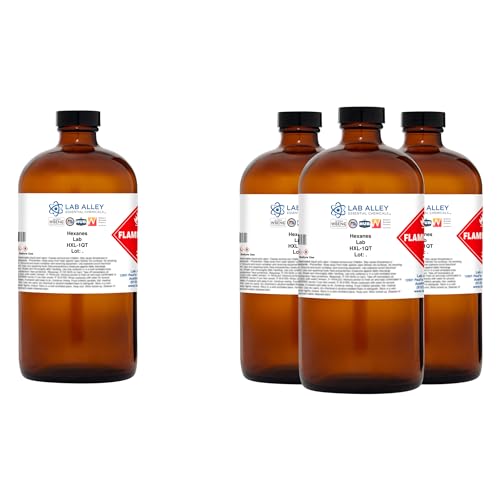
Lab Alley’s hexanes mixture comes in a four-quart bundle, delivering 1 gallon of non-polar solvent ideal for extractions, sample preparation, and organic synthesis workflows. Lab Grade classification means it is suitable for general laboratory use where ACS-grade impurity tolerances are not required, making it a cost-effective choice for high-volume procedures.
The solvent is clear and colorless with low residue after evaporation, which supports clean recoveries in extraction protocols. The packaging is notably robust — the dispenser container is engineered to remain gas-tight, preventing hexane vapor loss that can skew concentration measurements in sensitive applications.
Customers consistently praise the shipping integrity and the solid sealing mechanism. This product is not intended for food, drug, or household use, and its purity level is best matched to educational, industrial, or academic labs that prioritize volume economy over trace-analysis specifications.
Why it’s great
- Excellent value per gallon for routine extractions
- Leak-proof, vapor-tight container preserves solvent integrity
- Consistent Lab Grade quality for non-trace applications
Good to know
- Lab Grade purity not suitable for HPLC or UV-detection work
- Not approved for food or pharmaceutical contact
4. Alliance Chemical Methanol ACS Reagent Grade

Alliance Chemical’s methanol is certified ACS Reagent Grade, meeting the highest American Chemical Society specifications for assay purity and maximum impurity limits. This makes it a dependable choice for spectroscopy, HPLC mobile phases, chromatography cleaning protocols, and any analytical method where solvent background must be near zero.
The 2-quart bottle provides a convenient volume for routine instrument maintenance and small-batch synthesis without committing to a large drum. The liquid is packed in a durable container designed to survive shipping without rupture, though some customers have reported inconsistency in the grade actually received — receiving technical grade instead of the advertised reagent grade.
Several lab users noted that the product left a visible residue after evaporation when used on coated optics, suggesting that quality control may vary between batches. For most analytical chemistry applications, however, the purity is sufficient, and the company has a responsive support record for resolving grade disputes.
Why it’s great
- ACS Reagent Grade certification ensures low impurity baselines
- Compact 2-quart size fits limited bench space
- Responsive manufacturer support for order issues
Good to know
- Inconsistent grade labeling reported in some shipments
- Visible residue after evaporation on sensitive optics
5. StonyLab Borosilicate Glass Chromatography Column 50ml
This 50 mL StonyLab column shares the same 24/24 joint system and G2 fritted disc design as its larger sibling but in a more compact form with a 25 mm outer diameter. The smaller bed volume is well suited for rapid method scouting, teaching demonstrations, and small-scale purifications where sample quantity is limited.
The PTFE stopcock provides reliable flow modulation for gravity-fed separations, and the borosilicate glass body can withstand thermal cycling during solvent changes. The included reservoir allows uninterrupted solvent flow, making this column a practical choice for routine lab work that does not require high throughput.
As with the 250 mL version, the most frequently reported issue is leakage from the PTFE piston assembly. Some units arrive with the stopcock dripping even when fully closed, which can render the column unusable for fine separations. A thorough inspection upon arrival and immediate replacement request for defective units is recommended.
Why it’s great
- Compact 50 mL size for small-scale and teaching applications
- Standard 24/40 joint fits existing lab glassware setups
- Integrated reservoir prevents column drying during runs
Good to know
- PTFE stopcock leaks are a known quality inconsistency
- Limited bed depth for challenging separations
FAQ
What does ACS Reagent Grade mean for chromatography solvents?
Why does my glass chromatography column keep leaking at the stopcock?
How many autosampler vials come in a standard pack and which septa material is best?
Can I use Lab Grade hexane for HPLC mobile phase preparation?
Final Thoughts: The Verdict
For most users, the best chromatography lab supplies winner is the FOUR E’S SCIENTIFIC 2 mL Autosampler Vial 1000 Pack because it offers reliable sealing, borosilicate construction, and broad instrument compatibility at a volume that supports daily injection workflows. If you need a robust solvent for non-polar extractions and synthesis, grab the Lab Alley Hexanes Lab Grade Solvent. And for small-scale preparative column work on a budget, nothing beats the StonyLab Borosilicate Glass Column 50ml — provided you inspect the stopcock upon arrival.

Mo Maruf
I created WellFizz to bridge the gap between vague wellness advice and actionable solutions. My mission is simple: to decode the research and give you practical tools you can actually use.
Beyond the data, I am a passionate traveler. I believe that stepping away from the screen to explore new environments is essential for mental clarity and physical vitality.