Our readers keep the lights on and my smoothie glass nicely filled. As an Amazon Associate, I earn from qualifying purchases.
The scrape and scream of an abrasive wheel tearing through steel is a familiar sound in any shop, but it doesn’t have to be the only option. A high-quality chop saw blade for metal changes the entire cutting experience, trading clouds of dust, constant sparks, and burned edges for clean, square cuts that need little to no cleanup before welding or assembly.
I’m Mohammad Maruf — the founder and writer behind WellFizz. I dig deep into the metallurgy, tooth geometry, and material science that separate a blade that dulls after a dozen cuts from one that survives hundreds of cycles without losing its edge.
Whether you are fabricating steel frames, cutting conduit, or trimming rebar on a jobsite, understanding what makes a blade last matters. This guide breaks down the best chop saw blade for metal based on real-world cutting data, tooth counts, and material compatibility so you can cut with confidence.
How To Choose The Best Chop Saw Blade For Metal
Selecting a metal-cutting blade is less about brand loyalty and more about matching the blade’s construction to the materials you cut most often. Two blades with the same diameter can perform completely differently based on tooth geometry, carbide grade, and plate stiffness.
Tooth Count and Geometry
A higher tooth count, typically 66 to 72 teeth, produces smoother, burr-free finishes on thin-wall tubing and sheet metal. Lower tooth counts around 36 to 40 teeth clear chip waste faster and are better suited for thick-walled angle iron and solid bar stock. Modified Alternate Top Bevel (MATB) tooth geometry handles the impact of ferrous cutting without chipping.
Carbide, Cermet, or Diamond
Standard carbide-tipped blades offer a good balance of cost and durability for moderate use. Cermet carbide blends add ceramic particles that increase heat resistance and edge retention, often outlasting standard carbide by several times on abrasive materials like steel. Diamond-coated blades are the longest-lasting option, surviving up to 100 standard abrasive wheels, but they cut slower and cost more upfront.
Quick Comparison
On smaller screens, swipe sideways to see the full table.
| Model | Category | Best For | Key Spec | Amazon |
|---|---|---|---|---|
| DeWalt DWA7747 | Premium | Heavy fab shop use | 66 teeth, stiff plate | Amazon |
| Evolution RAGE355BLADE | Premium | Multi-material versatility | 36 teeth, multi-material | Amazon |
| Diamond Extreme 14″ | Premium | Extreme longevity | Diamond grit, solid steel core | Amazon |
| CRALY C1466MC | Mid-Range | Light to medium fabrication | 66 teeth, cermet carbide | Amazon |
| OSTTE 72-Tooth | Mid-Range | Smooth burr-free cuts | 72 teeth, cermet-blend | Amazon |
| Makita B-57598-5 (5-Pack) | Mid-Range | Heavy pipe and angle iron | Abrasive, 3/32″ thin kerf | Amazon |
| MinCHI257 10-Pack | Budget | High-volume disposability | Abrasive, 1/8″ thick | Amazon |
In‑Depth Reviews
1. DeWalt DWA7747 14″ 66T Heavy-Gauge Stiff Plate Ferrous Metal Cutting Saw Blade

The DeWalt DWA7747 is the blade that shop owners rely on when production volume and cut quality both matter. Its stiff plate design minimizes blade flutter, which directly translates to straighter cuts and less stress on the carbide tips. In daily fabrication of steel tube and angle iron, users report roughly 1,000 cuts before the edge needs a touch-up, and the blade can be resharpened multiple times before tooth loss becomes a factor.
The tri-foil braze technology used to attach the titanium carbide tips absorbs the shock of interrupted cutting, reducing the risk of tip loss when you hit a weld seam or a hard spot in the material. At 66 teeth with a modified ATB grind, this blade leaves a burr-free edge on 1/4-inch wall tubing and 3/8-inch angle iron alike, eliminating secondary grinding before welding.
This blade is intended for low-RPM metal-cutting saws, with a maximum safe speed around 1,300 RPM. Installing it on a standard high-RPM abrasive chop saw will quickly overheat the tips and shorten blade life. For any shop cutting ferrous metals daily, the DWA7747 delivers the lowest cost per cut among premium blades.
Why it’s great
- Stiff plate design reduces vibration and extends tip life.
- Capable of 500+ cuts on 1/4-inch steel angle before dulling.
- Resharpenable multiple times for sustained value.
Good to know
- Requires a low-RPM metal saw (1,300 RPM max) to perform safely.
- Premium investment that pays off only with regular use.
2. Evolution RAGE355BLADE 14″ Multi-Material Blade

The Evolution RAGE355BLADE is the most versatile blade in this guide, cutting through steel, aluminum, copper, wood, and plastic without requiring a blade change or coolant. Its 36-tooth pattern clears chips quickly, which prevents the binding issues common with higher tooth counts when cutting thicker materials like 3/8-inch carbon steel angle or solid bar stock.
Users who switched from abrasive discs report a dramatic difference: the blade produces virtually no heat, burrs, or sparks, which means the cut edge is immediately ready for assembly or welding. In one documented test, the same blade cut 459 times through 2.5-inch oak and then went on to cut 3x3x3/16-inch carbon steel angle without issue the next day.
The blade is designed for Evolution saws such as the Rage2 and Evosaw380, but it fits any standard 14-inch chop saw with a 1-inch arbor. While it doesn’t hold its edge as long as a dedicated ferrous-metal blade on heavy daily steel cutting, for anyone who works with mixed materials, this single blade replaces an entire rack of dedicated disks.
Why it’s great
- Cuts steel, aluminum, wood, and plastic without changing blades.
- Virtually no burrs, sparks, or heat on cut edges.
- Perfect for fabrication shops handling varied materials.
Good to know
- Not a dedicated steel blade; edge retention is moderate on thick ferrous material.
- Best performance on Evolution saws with matched RPM.
3. Diamond Extreme 14 Inch Metal Cut Off Wheel
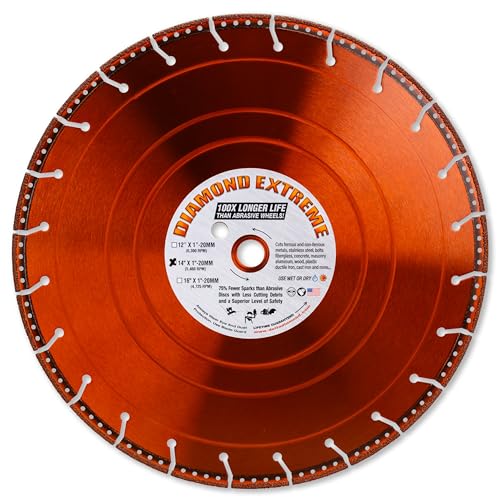
The Diamond Extreme blade redefines longevity for a chop saw blade for metal by using a vacuum-brazed industrial diamond coating permanently bonded to a high-strength steel core. The manufacturer rates it to outlast up to 100 standard abrasive cut-off wheels, which means fewer downtime interruptions for blade changes and less waste in the scrap bin.
The solid steel core eliminates the shatter risk inherent in bonded abrasive wheels, creating a safer cutting environment with far fewer sparks and dust particles. In real-world testing, this blade survived 8+ hours of cutting 1/2-inch mild steel and grade 8 bolts, and continued cutting even after accidental drops and brief contact with aluminum — events that would destroy a standard carbide blade.
The trade-off is cutting speed: the diamond grit removes material more slowly than a sharp carbide tooth, so it is better suited for production environments where blade life matters more than seconds-per-cut. It also handles light grinding and weld cleanup on concrete and stone, adding versatility beyond simple cut-off work.
Why it’s great
- Rated to outlast 100 abrasive wheels, drastically reducing blade changes.
- Solid steel core will not shatter, improving safety.
- Lifetime warranty against material defects and warping.
Good to know
- Cuts slower than a carbide-tipped blade on thick steel.
- Higher initial cost requires high-volume use to break even.
4. CRALY 14 Inch 66 Teeth Steel and Ferrous Metal Cutting Circular Saw Blade (C1466MC)
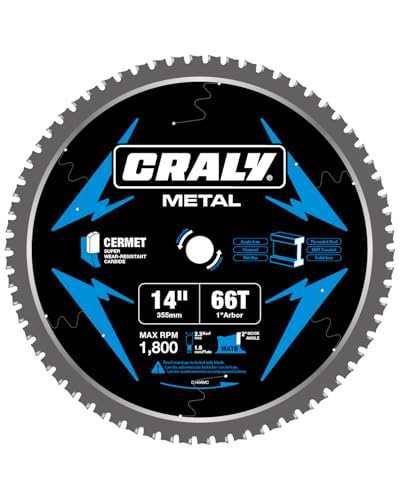
The CRALY C1466MC brings cermet carbide technology — a ceramic-metal composite that handles high heat better than standard carbide — to a mid-range price point. The 66-tooth MATB grind produces a burr-free finish on angle iron, channel, flat bar, and threaded rod, which is critical for jobs where the cut edge goes directly into a threaded fitting or weld joint.
The thin kerf design, measuring 2.3 mm, reduces material waste and lowers the power draw on the saw motor, making this blade compatible with both corded and cordless low-RPM metal saws. Laser-cut stabilizer vents in the hardened steel body trap vibration and noise, keeping the cut path straight even when the workpiece is not perfectly clamped.
Reviews indicate excellent initial sharpness on 1.5-inch solid steel and 1/2-inch conduit, but heavy commercial use that demands 30 blades per week may wear out the cermet tips faster than pricier alternatives. For light to medium fabrication, this blade offers professional cut quality at a reasonable investment per blade.
Why it’s great
- Cermet carbide tips resist heat and stay sharp longer than standard carbide.
- Thin kerf design reduces vibration and motor strain.
- Laser-cut vents keep cuts straight and quiet.
Good to know
- Not ideal for high-volume commercial cutting; tips wear faster than premium options.
- Best on low-RPM metal saws, not abrasive chop saws.
5. OSTTE 14-Inch 72-Tooth Carbide Tipped Metal Cutting Saw Blade
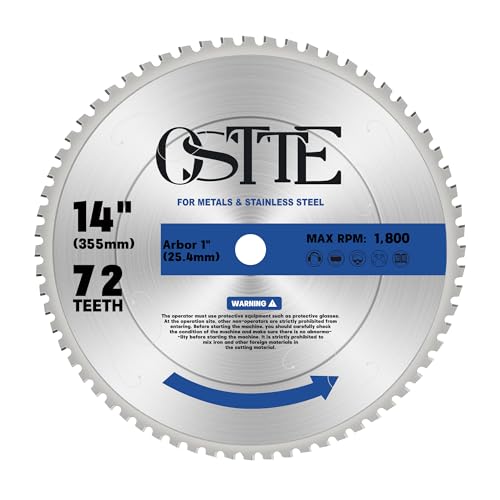
The OSTTE 72-tooth blade is built for the user who prioritizes surface finish above all else. With 72 cermet-blend teeth and a fine-finish grind, this blade leaves a smooth edge on steel studs, angle iron, pipe, unistrut, and tubing that requires no deburring before assembly. The cermet blend adds ceramic reinforcement to the carbide tips, which improves impact resistance and reduces premature wear.
Laser-cut stabilizer vents in the blade body manage heat buildup and vibration, a critical feature when making a large number of cuts in quick succession on thin-wall material. The blade is compatible with Evolution S355MCS, S380CPS, Evosaw models, and all standard 14-inch metal-cutting saws with a 1-inch arbor.
Users report great results on raised floor projects requiring around 100 cuts, with no burning or burr formation. The 72-tooth count does mean slower chip clearing on thick material, so this blade is best suited for material up to 1/2-inch wall thickness where cut quality is the primary goal.
Why it’s great
- 72 teeth deliver exceptionally smooth, burr-free cuts on thin-wall tubing.
- Cermet-blend carbide resists chipping and impact.
- Stabilizer vents reduce noise and heat for consistent cuts.
Good to know
- Not optimized for thick solid bar or heavy structural steel.
- High tooth count can clog on gummy or thick materials.
6. Makita B-57598-5 14″ x 1″ x 3/32″ Abrasive Cut-Off Wheel (5-Pack)

The Makita B-57598-5 represents the best of traditional abrasive wheel technology for users who own an abrasive chop saw and want better performance than generic wheels. Each wheel is double-reinforced with a special bond that Makita claims delivers up to twice the life of a standard 7/64-inch thick abrasive wheel, while cutting up to 20 percent faster.
The 3/32-inch thin kerf reduces material waste and puts less strain on the saw motor, which is important when cutting heavier gauge metal such as pipe and angle iron. Users report cutting 4-inch pipe with a 1/4-inch wall in roughly one minute, losing only 1/16-inch of wheel diameter per cut, compared to 15 minutes and heavy wear on budget abrasive blades.
The 5-pack provides a sensible inventory for moderate shop use, and the wheels fit any standard 14-inch chop saw with a 1-inch arbor. These are bonded abrasive wheels, not carbide-tipped blades, so they produce sparks and dust — the trade-off for a significantly lower upfront cost.
Why it’s great
- Double-reinforced construction extends life compared to standard abrasive wheels.
- Thin kerf cuts faster with less motor strain.
- 5-pack offers good value for frequent abrasive cutting.
Good to know
- Produces sparks and dust; not a cold-cutting solution.
- Abrasive wheels wear out and need replacement, unlike carbide blades.
7. MinCHI257 14-Inch Cut-Off Wheel (10-Pack)

The MinCHI257 10-pack is an entry-level abrasive wheel set designed for users who need a large quantity of disposable blades for occasional cutting of ferrous metals, steel, angle iron, and brass. At 1/8-inch thickness with 40-grit aluminum oxide grain, these wheels will cut through most common metal stock, making them suitable for light hobbyist use or jobs where blade damage is expected.
The 10-pack packaging provides a low per-wheel cost for high-volume situations where you might burn through several wheels in a day. User feedback confirms adequate performance for basic cutting tasks, with several buyers noting good value for the money in home garage settings.
The primary concern is consistency: one user reported a wheel failure on a Husqvarna K750 demo saw, where the blade deformed on 3/16-inch wall steel tube, raising safety concerns. These wheels are best reserved for lower-power saws and lighter-duty work where wheel integrity under heavy side loads is not critical.
Why it’s great
- 10-pack delivers the lowest cost per wheel for bulk usage.
- 40-grit aluminum oxide cuts common ferrous metals effectively.
- Suitable for light hobbyist and home garage work.
Good to know
- Quality control issues reported; some wheels may deform under heavy load.
- Not recommended for high-RPM saws or continuous professional use.
FAQ
Can I use a carbide-tipped blade on my abrasive chop saw?
How many cuts should I expect from a good ferrous metal blade?
What does cermet mean on a metal cutting blade?
Is a diamond blade better than a carbide blade for cutting steel?
Final Thoughts: The Verdict
For most users, the chop saw blade for metal winner is the DeWalt DWA7747 because it combines a stiff plate design, titanium carbide tips, and 66-tooth geometry to deliver consistent burr-free cuts through hundreds of cycles before needing a sharpening. If you work across multiple materials and need one blade to do it all, grab the Evolution RAGE355BLADE. And for a high-volume production shop where every minute counts and blade changes are a major downtime cost, nothing beats the longevity of the Diamond Extreme 14-inch blade.

Mo Maruf
I created WellFizz to bridge the gap between vague wellness advice and actionable solutions. My mission is simple: to decode the research and give you practical tools you can actually use.
Beyond the data, I am a passionate traveler. I believe that stepping away from the screen to explore new environments is essential for mental clarity and physical vitality.