Our readers keep the lights on and my smoothie glass nicely filled. As an Amazon Associate, I earn from qualifying purchases.
Adding chlorine to your pool only to watch it vanish under the afternoon sun is a frustrating cycle. A chlorine stabilizer, made of cyanuric acid, acts as a UV shield, binding to free chlorine so it stays active in the water for hours instead of burning off in minutes. Without it, maintaining a consistently sanitized pool requires constant chemical top-ups and higher operating costs.
I’m Mohammad Maruf — the founder and writer behind WellFizz. I’ve spent hundreds of hours analyzing consumer chemical formulations, customer performance logs, and dissolution behavior to identify the stabilizers that deliver lasting UV protection without the common headaches.
For this guide, I evaluated cleaning power, dissolution speed, compatibility with saltwater systems, and long-term value to find the best chlorine stabilizer for keeping your water clear and balanced all season.
How To Choose The Best Chlorine Stabilizer
Not all stabilizer products are created equal — differences in particle size, purity, and packaging all affect how well your pool holds chlorine. Here are the key factors to consider.
Particle Size and Dissolution Speed
Coarse granules take longer to dissolve but are less likely to cloud your water when applied through a skimmer sock. Finer powders dissolve quickly but may require careful pre-dissolving to avoid settling on pool surfaces. For most pool owners, a medium-grain stabilizer offers the best balance of speed and safety.
Purity and Additives
Look for 99%+ cyanuric acid content without fillers or anti-caking agents. Some budget stabilizers contain inert binders that don’t dissolve, leaving white residue on pool floors. Pure CYA will fully dissolve over 24–48 hours in circulation.
Compatibility with Saltwater Chlorinators
Saltwater systems generate chlorine through electrolysis and are particularly sensitive to low CYA levels. A suitable stabilizer for salt pools should dissolve cleanly without clogging the salt cell plates. Many premium stabilizers are explicitly labeled as saltwater-compatible.
Quick Comparison
On smaller screens, swipe sideways to see the full table.
| Model | Category | Best For | Key Spec | Amazon |
|---|---|---|---|---|
| Bliss Pool Stabilizer | Premium | Saltwater pools & app-guided dosing | 4 lb granular | Amazon |
| Robelle 7-Pound | Premium | Large pools & seasonal bulk dosing | 7 lb bag | Amazon |
| Clorox Pool&Spa 4LB | Mid-Range | Saltwater systems & UV-heavy areas | 4 lb granular | Amazon |
| HTH 67061 | Mid-Range | Hot tubs & small pools | 4 lb powder | Amazon |
| Pool Mate 4-Pound | Value | Budget-friendly seasonal maintenance | 4 lb granular | Amazon |
In‑Depth Reviews
1. Bliss Pool 4 lb Chlorine Stabilizer
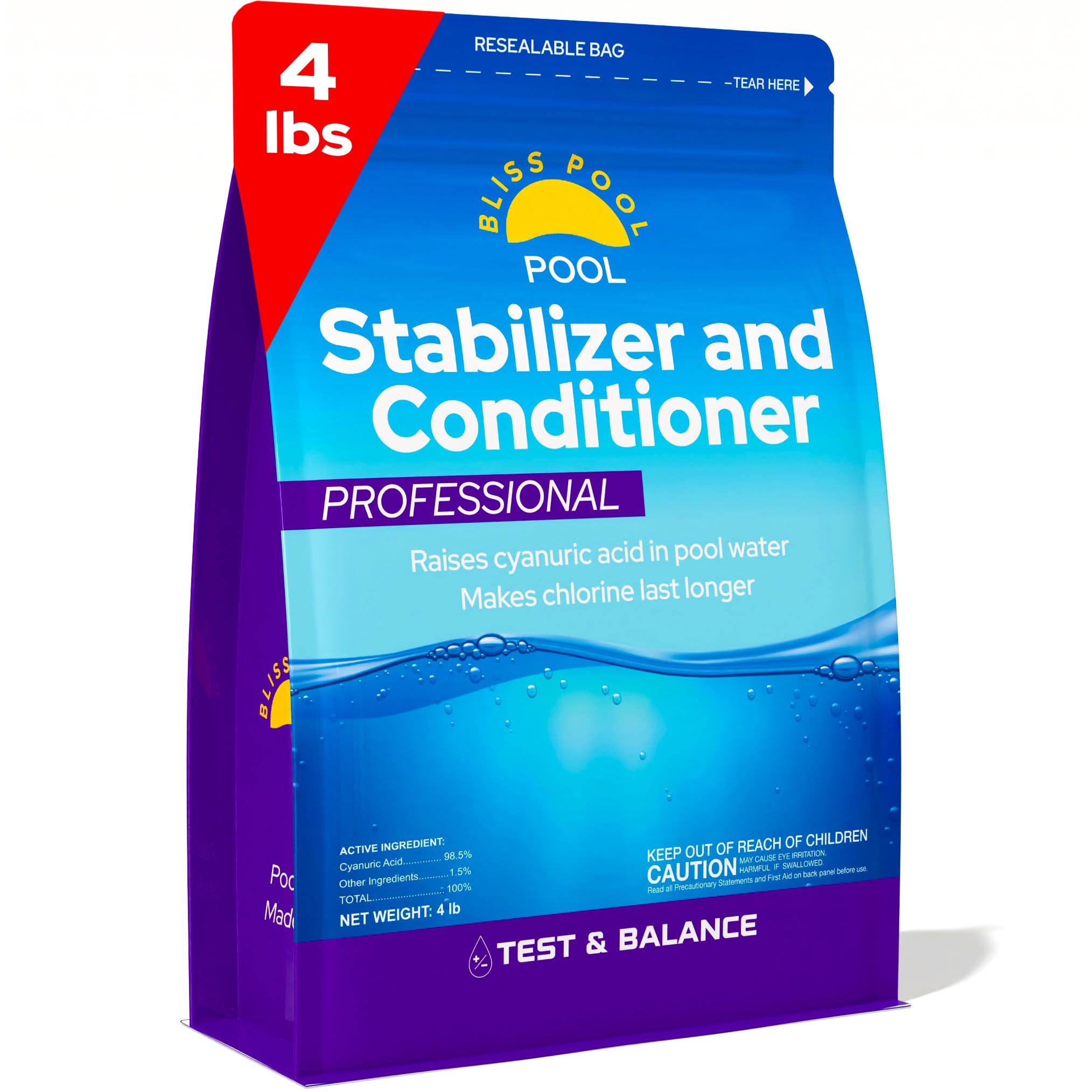
The Bliss Pool stabilizer is engineered specifically for saltwater systems, where maintaining consistent CYA levels is critical to protect the salt cell from overworking. Its pure cyanuric acid formula dissolves reliably when pre-soaked in a bucket, avoiding the pipe-clogging issues that plague coarser brands. Users report visibly clearer water and a noticeable drop in chlorine demand after raising CYA from below 30 ppm to the 40–60 ppm range.
Dosing is simplified by clear package guidance and the optional Bliss Pool App, which provides tailored recommendations when paired with test strips. The granular size sits in the sweet spot — fine enough to dissolve within 24 hours when broadcast across the deep end, yet coarse enough to stay in a skimmer sock without turning into dust. Multiple customer reviews confirm that this stabilizer works effectively in both inground saltwater pools and traditional chlorine setups.
One recurring note is the need for patience: like all pure CYA products, it does not dissolve instantly. The recommended method is to add it via a nylon sock hung in front of a return jet, then squeeze the sock periodically to accelerate dissolution. For pool owners who prioritize long-term chlorine savings and equipment protection, this stabilizer delivers measurable results with minimal chemical side effects.
Why it’s great
- Designed for saltwater pools with clear CYA dosing chart
- Dissolves cleanly without leaving residue when pre-soaked
- Compatible with Bliss Pool App for precise monitoring
Good to know
- Must be pre-dissolved to avoid clogging filter plumbing
- Granular form requires 24+ hours for full dissolution
2. Robelle 7-Pound Chlorine Stabilizer

Robelle’s 7-pound bag is the go-to option for large residential pools and anyone who wants to buy once for the entire season. At 6 ounces raising CYA by 10 ppm per 5,000 gallons, this bag provides enough stabilizer to treat a 20,000-gallon pool to a full 50 ppm boost. Customers with 30,000-gallon pools report hitting their target CYA of 40 ppm with just over half a bag, making it highly economical for bigger bodies of water.
The dissolution behavior is where Robelle stands apart. Multiple verified buyers note that this stabilizer dissolves faster than other brands when placed in a mesh bag hung in front of a return jet — with one reviewer reporting near-complete dissolution in just two hours. The granular consistency is uniform, with minimal dust, reducing the risk of inhalation during application. Reviewers also confirm that using the sock method avoids the pump-clogging that can occur with stabilizers poured directly into the skimmer.
The 7-pound bulk format means you don’t need to repurchase mid-season, but it also requires proper dry storage to prevent clumping. If you have a smaller pool (under 10,000 gallons), the bag may last multiple seasons, which could lead to caking if the seal isn’t airtight. For large pools and annual dosing, however, this stabilizer is nearly impossible to beat on cost-per-pound and dissolution speed.
Why it’s great
- Large 7 lb bag ideal for seasonal bulk dosing
- Dissolves noticeably faster than many competitors
- Uniform granules reduce risk of clogging when using sock method
Good to know
- Overpacked for small pools — may clump if stored opened
- Must be kept in dry, sealed container after opening
3. Clorox Pool&Spa 4LB Chlorine Stabilizer

Clorox Pool&Spa is one of the most recognizable names in pool care, and their 4-pound stabilizer delivers reliable UV protection without any surprises. The formula is specifically designed to reduce the sun’s impact on chlorine, with multiple customer reports indicating a 20–30% reduction in daily chlorine loss after raising CYA to 40–50 ppm. It is explicitly labeled as saltwater-compatible, making it a safe choice for salt chlorinator owners who need to protect their cells from overwork.
A standout feature is the integration with the Clorox Pool App, which provides personalized dosing recommendations based on test strip results. This takes the guesswork out of figuring out how much stabilizer to add for a given pool volume. The granules dissolve well when added through a skimmer or a filter sock, though several reviewers note that full dissolution takes one to two days — typical for pure cyanuric acid. Users appreciate that the product leaves no white residue on pool surfaces.
Its mid-range pricing positions it as a solid everyday option for pool owners who value brand reliability and app support. While it lacks the economy of bulk bags, the 4-pound size is manageable for most residential pools and easy to store. If you want a trusted brand with digital dosing tools and proven results under intense sun exposure, this stabilizer performs exactly as advertised.
Why it’s great
- Clorox Pool App offers personalized dosage guidance
- Effectively reduces chlorine loss by 20–30% in sunny conditions
- Works well with both chlorine and saltwater systems
Good to know
- Full dissolution takes 24–48 hours
- Smaller package size means more frequent repurchases for large pools
4. HTH 67061 Pool Care Stabilizer

HTH’s stabilizer is a versatile entry that works across all pool types, but it has earned a devoted following among hot tub and small pool owners. Its powder-like consistency dissolves faster than coarser granular stabilizers when added via skimmer, making it convenient for smaller water volumes where dispersion is quicker. One verified review specifically highlights its effectiveness in a 2700-gallon pool, noting that the stabilizer reduced daily chlorine loss dramatically once fully dissolved.
The 4-pound size is compatible with HTH’s recommended target CYA range of 20–25 ppm, which is slightly lower than the industry norm. This makes it a good choice for seasonal top-ups rather than initial heavy dosing. Users who own salt chlorinators also report successful results, with one reviewer crediting this stabilizer with extending the life of their salt cell by keeping chlorine demand lower throughout the season. The packaging is resealable, which helps maintain freshness between uses.
Where this product falls short for some is its dissolution quirks. Users without skimmers or those with low-flow pumps find the powder can settle and take days to fully dissolve unless blended into a dust first. Additionally, its lower recommended CYA range means you may need a secondary stabilizer product if your pool requires levels above 30 ppm. For spa owners and small pool operators who want an affordable, fast-acting stabilizer, this remains a solid choice.
Why it’s great
- Powder consistency dissolves faster than granular alternatives
- Works excellently in hot tubs and pools under 5,000 gallons
- Resealable packaging preserves product between uses
Good to know
- Target CYA range (20–25 ppm) lower than industry standard
- May require blending into dust for pools without skimmers
5. Pool Mate 4-Pound Premium Stabilizer

Pool Mate’s 4-pound stabilizer offers the lowest cost-per-pound in this comparison without sacrificing the essential function of raising CYA. For a 15,000-gallon pool, users report a 20–25% reduction in chlorine loss on sunny days after dosing to the recommended 40–100 ppm range. The granular consistency is straightforward to apply — simply broadcast across the deep end or pour into a skimmer sock — and dissolves within 24 hours under normal circulation.
Where Pool Mate earns its value badge is the combination of price and performance. Several verified buyers note that it is cheaper than pool store equivalents and performs identically. The recommended dosing is clear: 6 ounces raises CYA by 10 ppm per 5,000 gallons. For seasonal maintenance, a single bag can buffer a standard 15,000-gallon pool for an entire summer, with one top-up after heavy rainfall. Users also praise the fact that it leaves no residue on pool surfaces when properly dissolved.
The primary drawback reported across multiple reviews is the lack of a measuring scoop, making it necessary to weigh doses if you don’t have a kitchen scale. Additionally, the stabilizer can be difficult to dissolve if poured directly into the skimmer without a sock — one reviewer had to use a drill and bucket to achieve full dissolution. If you are comfortable with the sock method or have a scale on hand, this stabilizer delivers exceptional value for maintaining clear, balanced pool water.
Why it’s great
- Lowest cost-per-pound among comparable stabilizers
- Delivers measurable 20–25% reduction in chlorine loss
- Dissolves cleanly within 24 hours when using sock method
Good to know
- No measuring scoop included — requires separate scale
- Granules can be stubborn to dissolve without sock or pre-mixing
FAQ
How do I add chlorine stabilizer without clouding my pool?
Can I use chlorine stabilizer in a saltwater pool?
What happens if my CYA level is too high?
Final Thoughts: The Verdict
For most users, the best chlorine stabilizer winner is the Bliss Pool 4 lb Stabilizer because it combines crystal-clear dosing guidance with saltwater compatibility and reliable dissolution behavior. If you want maximum seasonal value for a large pool, grab the Robelle 7-Pound Stabilizer. And for hot tubs and small pools where fast dissolution matters most, nothing beats the HTH 67061 Stabilizer.

Mo Maruf
I created WellFizz to bridge the gap between vague wellness advice and actionable solutions. My mission is simple: to decode the research and give you practical tools you can actually use.
Beyond the data, I am a passionate traveler. I believe that stepping away from the screen to explore new environments is essential for mental clarity and physical vitality.