Our readers keep the lights on and my smoothie glass nicely filled. As an Amazon Associate, I earn from qualifying purchases.
A chisel that skips, tears, or refuses to bite cleanly into end grain isn’t a tool failure — it’s a geometry failure. Hand-sharpening freehand introduces micro-variations in bevel angle that compound with every pass, robbing you of the square, consistent edge your work demands. The gap between a frustrating session and a glass-smooth paring cut is measured in fractions of a degree.
I’m Mohammad Maruf — the founder and writer behind WellFizz. I’ve spent hundreds of hours cross-referencing user reports, studying machining tolerances, and comparing clamping mechanisms across every meaningful chisel sharpening jig on the market to find the setups that deliver repeatable, dead-square edges without guesswork.
Whether you restore vintage irons, maintain a daily-use set of bench chisels, or dial in plane blades for joinery work, the best chisel sharpening system must lock the blade rigidly, index the angle precisely, and roll true over the stone without chatter — every single time.
How To Choose The Best Chisel Sharpening System
Every sharpening jig performs the same basic job — hold a blade at a fixed angle while you move it across an abrasive surface — but the difference between a frustrating tool and a precision instrument lives in the details of the clamp, the roller, and the angle-setting mechanism. Here are the four factors that separate a keeper from a frustration.
Clamp Design and Jaw Geometry
The clamp is the only thing holding your chisel in place. Look for a wide, flat jaw surface that contacts the full width of the blade. Many budget jigs use V-shaped or beveled interior faces that struggle with chisels that have tapered sides or compound bevels. The best systems use parallel, flat jaws with a single central screw that applies even pressure across the blade, preventing the chisel from canting or twisting during the stroke.
Roller Configuration and Surface Contact
The roller determines how the jig tracks across the stone. A single wide roller distributes pressure evenly and stays on the stone better than two narrow rollers spaced far apart. Dual-roller designs can cause the jig to rock if the rollers ride off the edge of a narrow water stone. Brass rollers resist corrosion and provide smooth, quiet rolling, while steel or stainless steel rollers are harder and wear longer but can be noisier on diamond plates.
Angle Setting System
There are two approaches to setting the bevel angle: projection-based (you measure how far the blade protrudes from the jig) and fixture-based (you place the jig onto a dedicated angle block). Fixture-based systems are faster and more repeatable because they eliminate the need for calipers or rulers. The best angle fixtures include a positioning block that indexes the blade tip to a specific groove, guaranteeing the same angle every time you swap a chisel.
Build Materials and Long-Term Alignment
The jig body must resist flex under clamping pressure. Machined aluminum alloy and stainless steel are the gold standard — they won’t corrode, warp, or develop slop over years of use. Avoid jigs with painted or plated mild steel parts, as the coating chips and the bare metal rusts. Brass and bronze bearing surfaces for the roller shaft reduce friction and prevent the roller from developing a flat spot over time.
Quick Comparison
On smaller screens, swipe sideways to see the full table.
| Model | Category | Best For | Key Spec | Amazon |
|---|---|---|---|---|
| Gohelper LLT1059US | Mid-Range | Accuracy with wide blades | Wide single roller, CNC aluminum, 0.1″–2.8″ clamp | Amazon |
| HONGDUI DH-29-1345 | Premium | Auto-lock angle fixture | Dual brass rollers + 2 spares, 0.1″–3.2″ clamp | Amazon |
| GOINGMAKE G8 | Mid-Range | Complete angle fixture kit | All-metal body, dual brass rollers, 5/32″–3″ | Amazon |
| Sharp Pebble 792481369195 | Mid-Range | Stainless build, single wheel | Stainless steel body, sealed bearing wheel | Amazon |
| KAKURI KBS-50 | Premium | Japanese plane blades | Carbon steel body, ash wood handles, 1/8″–1-5/8″ | Amazon |
| AUXTUR guide+stone+chisel | Budget | All-in-one starter set | Alloy steel body, includes stones + chisels | Amazon |
| G Sharp Tools SHA-001 | Premium | Compact guided diamond system | Diamond hones 200–1500 grit, blades 3mm–85mm | Amazon |
In‑Depth Reviews
1. Gohelper LLT1059US Chisel Sharpening Jig
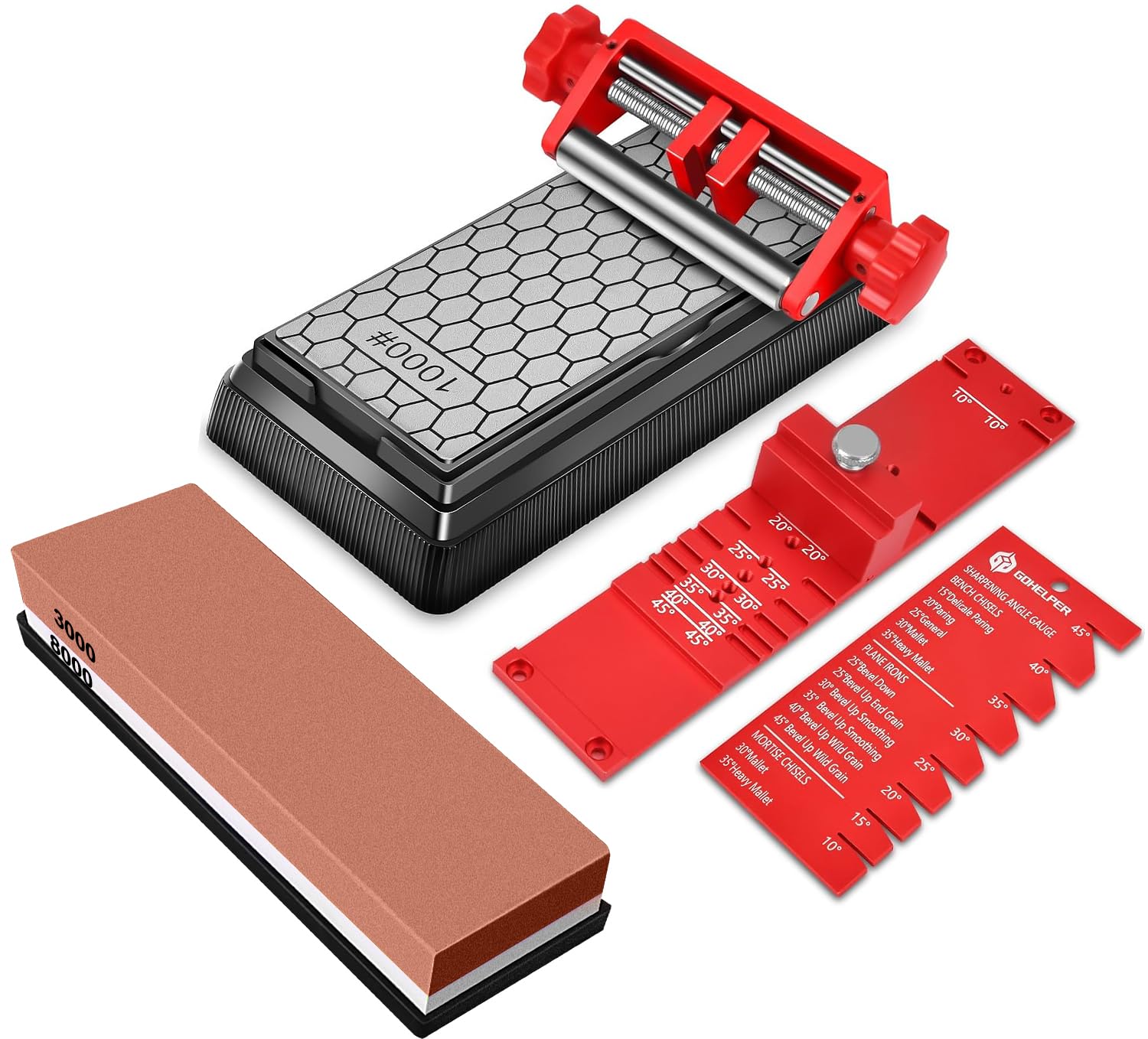
The Gohelper jig stands out because of its wide, single-roller design that rides the full width of a standard water stone without tipping. CNC-machined anodized aluminum body resists corrosion, and the stainless steel clamp jaw accepts blades from 0.1 to 2.8 inches. The included angle fixture with a positioning block eliminates guesswork — set the fixture to your desired angle, drop the jig onto the block, adjust the blade tip to the groove, and tighten. Setup takes seconds, not minutes.
The kit also includes a 400/1000 grit diamond stone for reshaping and a 3000/8000 grit stone for finishing, so you can go from a chipped edge to a mirror polish without buying extra abrasives. Customer reviews consistently note that the jig delivers edges sharper than factory, with one user reporting that a chisel sharpened on this system cuts cherry end grain like butter. The laser-etched markings on the angle fixture remain readable even in low workshop light.
The only catch is that the angle fixture is calibrated in half-degree increments, and user measurements show a consistent 0.5-degree offset. For absolute precision work, you may need to compensate by one click. That minor quibble aside, the combination of build quality, wide roller stability, and complete stone set makes this the most well-rounded system for the serious woodworker.
Why it’s great
- Wide single roller prevents tipping on narrow stones
- CNC aluminum body with stainless steel clamp is rigid and rust-resistant
- Includes 4-grit diamond stones for complete edge progression
- Angle fixture with positioning block speeds up blade swaps
Good to know
- Angle fixture has a confirmed 0.5-degree offset in the markings
- Roller is polished stainless steel, not brass — surface dulls over time
2. HONGDUI DH-29-1345 Chisel Sharpening Jig Kit
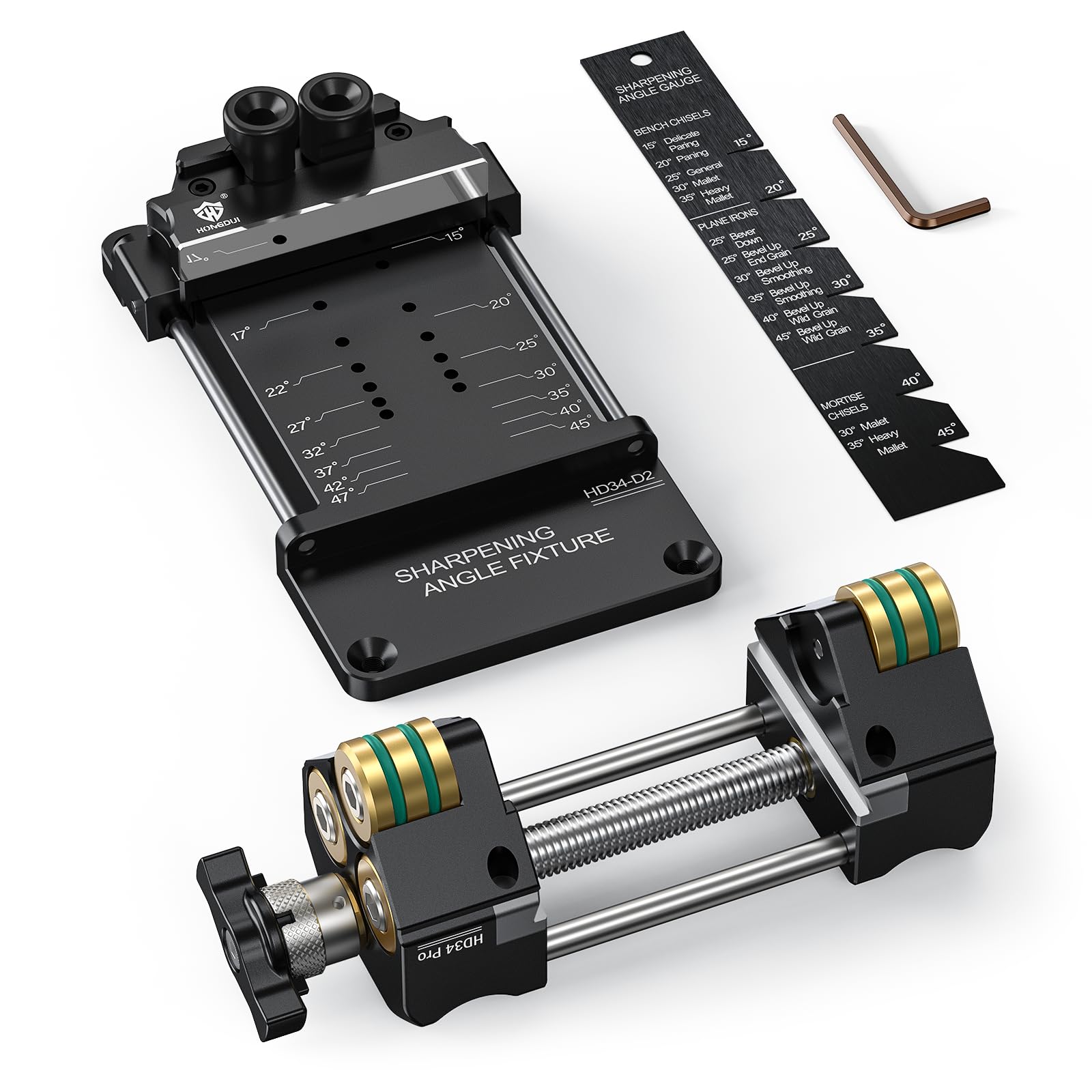
The HONGDUI kit redefines convenience with its auto-lock angle fixture. Instead of measuring blade projection or reading a scale, you rotate the fixture to your desired bevel between 15 and 47 degrees, and the positioning block locks automatically. Drop the jig onto the parallel dual rails, insert the blade until the tip contacts the groove, and clamp. The entire process takes under ten seconds per chisel, and the repeatability is excellent.
The jig body is machined from alloy steel, and the clamp uses a metal stud lock integrated into the ergonomic knob — no plastic threads to strip over time. Dual brass rollers can be mounted outboard for wide plane blades or inboard for narrow chisels, giving you flexibility that single-roller systems lack. HONGDUI includes two replacement brass rollers and four rubber rings, extending the lifespan of the jig significantly beyond the competition.
Some users note that with the rollers in the outboard position, the jig can be difficult to keep on a narrow water stone because the roller spacing exceeds the stone width. Moving the rollers inboard solves the issue, but the adjustment requires a hex key and a few seconds of fiddling. Overall build quality feels on par with premium brands like Woodpeckers at a fraction of the cost.
Why it’s great
- Auto-lock angle fixture eliminates projection measurement entirely
- Included spare brass rollers double the useful life of the jig
- Alloy steel construction and metal thread lock in the clamp knob
- Roller position adjustable for narrow or wide stones
Good to know
- Outboard roller spacing may exceed narrow water stone width
- Adjusting roller position requires a hex key
3. GOINGMAKE G8 Honing Guide System

GOINGMAKE packs surprising quality into a mid-range price bracket. The jig body is machined from aluminum alloy with brass roller assemblies and stainless steel clamp components — no plastic or painted mild steel anywhere. The clamp accepts chisels and plane blades from 5/32 inch to 3 inches, covering the full range of standard bench chisels and most hand plane irons. Four brass rollers (two short, two long) ship in the box, giving you options for different stone widths.
The included angle fixture offers preset positions at 15, 20, 25, 30, 35, 40, and 45 degrees, plus the secondary micro-bevel positions at 17, 22, 27, 32, 37, and 42 degrees. The angle gauge lets you verify the existing bevel on vintage chisels before you start. The entire kit stores in a compact plastic case with foam cutouts, making it easy to keep organized on the bench or in a tool chest drawer.
Reviewers praise the consistent clamping pressure and the smooth rolling action of the brass wheels on diamond plates. The only downside is that the angle fixture uses discrete preset slots rather than a continuous adjustment range, so you cannot dial in an exact intermediate angle like 33 degrees. For most woodworkers who work with standard bevels between 25 and 35 degrees, this is a non-issue.
Why it’s great
- Fully metal construction with brass rollers — no plastic parts
- Includes angle gauge and storage case for organization
- Dual sets of rollers accommodate different stone widths
- Micro-bevel angle positions built into the fixture
Good to know
- Angle fixture uses discrete preset slots, not continuous adjustment
- Storage case is plastic, not as durable as a metal box
4. Sharp Pebble Honing Guide

Sharp Pebble takes a minimalist approach — no angle fixture, no storage case, just a solid stainless steel body with a single wheel riding on a sealed bearing. The single-wheel design is an advantage when working on thick diamond plates or water stones because there is no risk of the jig body or a second wheel scraping against the side of the stone. The knurled brass adjustment knob provides good grip even with oily fingers.
Setting the bevel angle is projection-based: you measure how far the blade protrudes from the jig using the included reference chart. This requires a caliper or ruler, which adds a step compared to fixture-based systems. The stainless steel body will never rust, and the sealed bearing keeps the wheel spinning smoothly without requiring lubrication. Customer reviews from experienced woodworkers note that the jig holds plane irons securely and produces consistent results across multiple sharpenings.
The main limitation is that the interior jaw faces are beveled, which can cause clamping issues with chisels that have tapered or compound bevels on their sides. Users report that the jig works best with rectangular-profile blades and plane irons. If you primarily sharpen standard straight-sided bench chisels, this jig delivers excellent value in a compact, corrosion-proof package.
Why it’s great
- Stainless steel body will never rust or chip paint
- Single wheel on sealed bearing clears thick diamond plates
- Compact, lightweight design for portable use
- Knurled brass knob provides secure grip during adjustment
Good to know
- Beveled jaw faces struggle with tapered-side chisels
- Angle setting requires a separate measuring tool (caliper/ruler)
5. KAKURI KBS-50 Honing Guide

KAKURI’s honing guide is a specialist tool designed first and foremost for Japanese plane blades (kanna) and large bench chisels. The body is heavy carbon steel, and the two ash wood handles provide a secure, comfortable grip that keeps your hands away from the blade edge. The single tension screw at the top clamps the blade against the flat steel bed, and the integrated roller at the front makes the jig roll smoothly across the water stone.
The design excels with plane irons from 1-5/8 to 2-3/4 inches wide because the roller shape and handle position allow you to apply even pressure across the full width of the blade, including the corners. The jig accepts chisels from 1/8 to 1-5/8 inches, but the top-grip clamping mechanism provides less surface contact on narrow chisels under 1/2 inch, making it difficult to keep the blade square. Users with smaller chisels may need a side-grip jig for those tasks.
There is no built-in angle scale or fixture — you set the blade projection using a ruler or the included reference table. The lack of a 90-degree alignment reference means that squaring the blade to the jig requires careful manual adjustment. Despite these limitations, the KAKURI is beloved by traditional Japanese woodworkers for its ergonomics and the quality of edge it produces on large plane irons.
Why it’s great
- Excellent ergonomics for large plane irons with ash wood handles
- Carbon steel construction with heavy-duty feel
- Roller design allows corner beveling on plane blades
- Safety handle keeps fingers away from the blade edge
Good to know
- Performs poorly on chisels under 1/2 inch wide
- No angle scale or 90-degree squaring reference built in
6. AUXTUR Sharpening Stone Kit

AUXTUR offers the most complete all-in-one package for beginners: a honing guide, two sharpening stones, and even a set of chisels. The honing guide body is made from alloy steel with a hardened steel roller wheel, and the cast aluminum frame provides reasonable rigidity for the price point. The included stones cover coarse and fine grit ranges, allowing you to start sharpening immediately without buying additional accessories.
The jig uses a single tension screw to clamp the blade, and the jaw opening is wide enough to accommodate standard chisels and plane blades. The angle setting is projection-based, with a simple instruction card that lists common bevel angles and their corresponding blade protrusion lengths. Customer reviews confirm that the jig works effectively for putting a fresh edge on dull chisels, and the included chisels are functional for basic woodworking tasks.
The limitations reflect the entry-level price point. The stones are smaller than standard water stones, measuring approximately 8 by 3 inches, which means you need more passes to cover the full blade width. The jig body is shorter than dedicated honing guides, which can make it less stable on larger plane irons. For a woodworker who wants a single purchase to start sharpening immediately, this kit delivers acceptable results without requiring extra investment.
Why it’s great
- Complete set includes stones, jig, and chisels for immediate use
- Alloy steel and aluminum construction is durable for the price
- Hardened steel roller rolls smoothly on included stones
- Simple projection-based angle setting for beginners
Good to know
- Stones are smaller than standard; require more passes on wide blades
- Short jig body can feel less stable on large plane irons
7. G Sharp Tools SHA-001 Chisel Sharpener

The G Sharp system breaks the mold of roller-style jigs. Instead of rolling a guide across a stone, this compact unit holds the chisel stationary while you slide a set of diamond-coated hones across the blade. The four included hones — 200, 400, 800, and 1500 grit — cover the full sharpening progression from reshaping to finishing. The angle adjustment mechanism uses a simple pivot and locking screw, allowing you to set any bevel from 22 to 90 degrees.
The unit is extremely portable, weighing only 1.76 ounces and small enough to fit in a tool bag pocket. The diamond hones cut aggressively on hardened steel and never need flattening or dressing. A set of diamond micro-foils is included for final polishing to a mirror finish. Users report that the system restores badly worn chisels to near-factory sharpness with minimal effort, and the guided hone path ensures a consistent bevel angle across the entire blade width.
The trade-off is that the system only works with blades from 3mm to 85mm wide — wider plane irons may not fit. The stone movement is not as smooth as a roller jig on a water stone, and some users note a slight drag that requires a firm, even stroke. For the woodworker who sharpens in the field, has limited bench space, or prefers a self-contained system that doesn’t need water or oil, the G Sharp delivers reliable, repeatable results.
Why it’s great
- Ultra-compact and lightweight for portable use
- Four diamond hones cover full grit progression
- Adjustable angle from 22 to 90 degrees with simple pivot
- Diamond micro-foils produce a mirror finish
Good to know
- Maximum blade width 85mm — may not fit very wide plane irons
- Hone movement feels slightly draggy compared to roller jigs
FAQ
Can a chisel sharpening jig fix a chipped or damaged edge?
Will a single roller jig work on narrow water stones?
What is the difference between a honing guide and a chisel sharpening system?
Can I use these jigs with diamond plates instead of water stones?
How do I square a chisel blade when using a honing guide?
Final Thoughts: The Verdict
For most users, the best chisel sharpening system winner is the Gohelper LLT1059US because it combines a rigid CNC aluminum body, a stable wide single roller, a fast fixture-based angle setter, and a complete set of diamond stones in one package. If you want an auto-lock angle fixture that eliminates setup time entirely, grab the HONGDUI DH-29-1345. And for a portable, self-contained diamond hone system that fits in your tool bag, nothing beats the G Sharp Tools SHA-001.

Mo Maruf
I created WellFizz to bridge the gap between vague wellness advice and actionable solutions. My mission is simple: to decode the research and give you practical tools you can actually use.
Beyond the data, I am a passionate traveler. I believe that stepping away from the screen to explore new environments is essential for mental clarity and physical vitality.