Our readers keep the lights on and my smoothie glass nicely filled. As an Amazon Associate, I earn from qualifying purchases.
Nothing ruins a lush green lawn faster than the telltale yellow-brown patches of a chinch bug invasion. These tiny pests suck the life out of grass blades, leaving behind brittle, straw-like dead spots that spread rapidly in the summer heat. Without the right insecticide, you’re just watering a buffet for the very bugs that are destroying your yard.
I’m Mohammad Maruf — the founder and writer behind WellFizz. This guide is the result of dozens of hours spent cross-referencing active ingredients, application methods, coverage data, and verified user reports to identify which granular and liquid treatments actually deliver on their promise of chinch bug elimination.
From fast-contact concentrates to season-long granular barriers, these results will help you choose the best chinch bug killer for your specific lawn and infestation level.
How To Choose The Best Chinch Bug Killer
Chinch bugs hide deep in the thatch layer near the soil line, making contact power and residual duration your two most important buying criteria. A product that simply sits on the surface will fail to reach the nymphs feeding at the grass base.
Active Ingredient First
Lambda-Cyhalothrin is a synthetic pyrethroid that provides rapid knockdown on contact and lasting residual protection. Bifenthrin works similarly but tends to be more photostable, holding up better in direct sunlight. Products with these active ingredients consistently earn the highest kill rates for chinch bugs. Avoid generic organics if you are dealing with a confirmed infestation — they rarely penetrate the thatch layer deep enough.
Granules vs. Liquid Concentrate
Granules are easier to apply with a broadcast spreader and create a slow-release barrier across large areas. Liquids offer better penetration into dense turf and thatch, reaching the soil line where chinch bugs feed. For active chinch bug damage, a liquid concentrate mixed with a hose-end sprayer gives you the most immediate knockdown. Granules are better for preventative season-long control after you have killed the existing population.
Coverage Format and Square Footage
A 10-pound bag typically covers around 10,000 square feet. A 20-pound bag treats roughly 20,000 to 25,000 square feet. Measure your lawn before you buy — buying too small a bag leaves untreated border zones where chinch bugs survive and repopulate. Over-application wastes product and increases chemical runoff risk.
Quick Comparison
On smaller screens, swipe sideways to see the full table.
| Model | Category | Best For | Key Spec | Amazon |
|---|---|---|---|---|
| Ortho BugClear Lawn Insect Killer | Granules | Large lawn protection | 20 lbs, covers 20,000 sq ft | Amazon |
| Sevin Lawn Insect Granules | Granules | Perimeter & tree protection | 20 lbs, kills 30+ listed pests | Amazon |
| Ortho Bug B Gon Max | Granules | 100-insect prevention | 10 lbs, kills 100+ insects | Amazon |
| BioAdvanced Complete Insect Killer | Granules | Below & above ground control | 20 lbs, treats 25,000 sq ft | Amazon |
| Martin’s Cyonara Lawn & Garden | Liquid Concentrate | Targeted spot treatment | 32 oz, 0.5% Lambda-Cyhalothrin | Amazon |
In‑Depth Reviews
1. Ortho BugClear Lawn Insect Killer
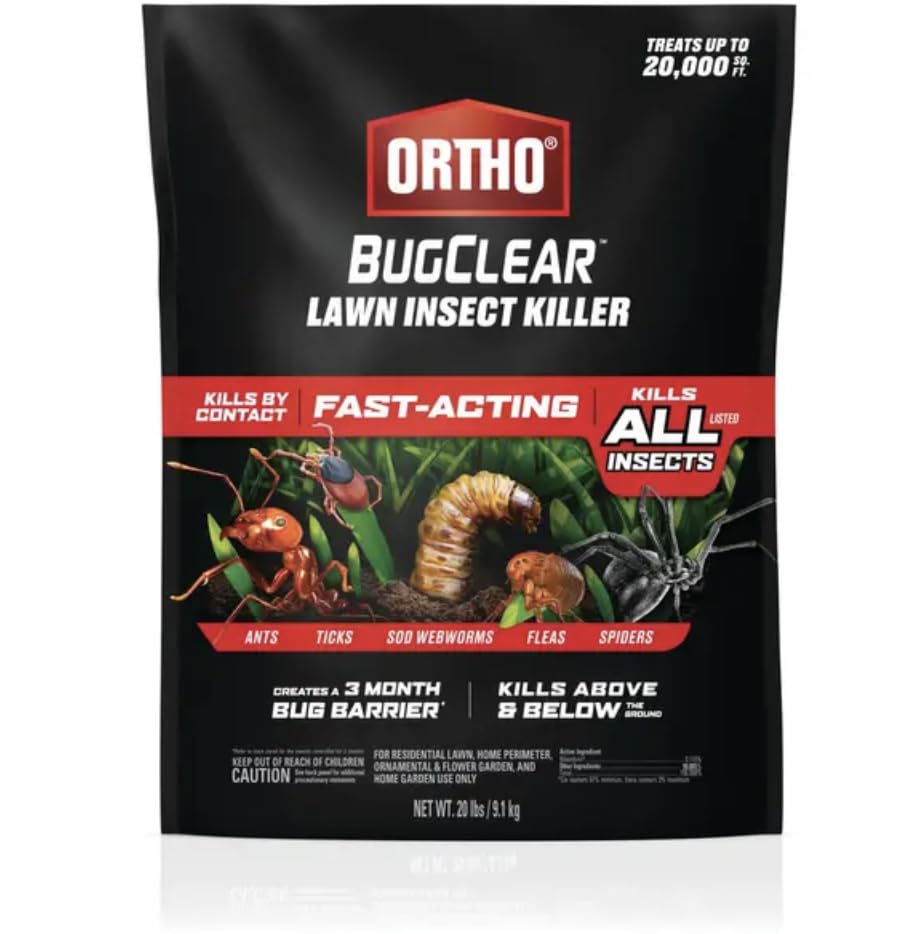
Ortho BugClear delivers fast-acting knockdown above and below the soil line using a broad-spectrum formula that targets chinch bugs, ants, ticks, armyworms, and sod webworms. The 20-pound bag covers up to 20,000 square feet, making it a strong choice for quarter-acre properties. Users consistently report noticeable reduction in visible lawn insects within 24 hours of watering in the granules.
One of the standout advantages is the dual-layer protection. The active ingredient kills insects that are actively feeding on grass blades while also creating a barrier in the thatch layer where chinch bug nymphs develop. Homeowners in warm climates like Florida have relied on this product for multiple seasons, citing consistent results against tough pest pressure during summer months.
The product is designed to work with standard drop and broadcast spreaders, so no specialized equipment is required. It is safe for use around ornamentals, flower beds, and vegetable gardens when applied per the label directions. For anyone managing a large lawn facing both chinch bugs and secondary pests like fleas or ticks, this is the most complete single-bag solution.
Why it’s great
- Fast knockdown visible within 24 hours
- Creates a protective barrier that eliminates mole food sources
- Spreads easily with a standard broadcast spreader
Good to know
- Some users reported fleas returning after two months in high-pressure areas
- Requires thorough watering for activation
2. Sevin Lawn Insect Granules, 20 Pounds

Sevin Lawn Insect Granules contain bifenthrin, a photostable pyrethroid that holds up longer in direct sunlight compared to some other active ingredients. This makes it particularly effective for perimeter treatments around trees, shrubs, and home foundations where UV exposure is highest. The 20-pound bag treats a generous area, though exact square footage varies by target pest.
Long-time users report that this product has saved trees from ant infestations that were severe enough to require removal. The granules settle into the soil around the root zone and provide a residual barrier that keeps pests from climbing up trunks. For chinch bugs, it works well when applied to the lawn edge where grass meets paved surfaces — a common entry point for migrating chinch bugs.
Sevin’s brand has been a household name in garden pest control for decades, and this granular formulation maintains the same reliability. It is labeled for use on vegetables and ornamentals, adding versatility beyond just lawn care. The main trade-off is that granules require more precise watering to move the active ingredient into the thatch layer compared to a liquid concentrate.
Why it’s great
- Excellent photostability for sun-exposed areas
- Proven track record for protecting trees from ant damage
- Versatile use on lawns, ornamentals, and vegetables
Good to know
- One reviewer noted it did not work, though majority report success
- Requires thorough watering to push granules into the thatch layer
3. Ortho Bug B Gon Max Insect Killer for Lawns

Ortho Bug B Gon Max markets itself against more than 100 listed insect species, including chinch bugs, and promises up to three months of residual protection. The granular formulation treats up to 10,000 square feet, which fits a typical suburban front and backyard without requiring multiple bags. Users who have stuck with this product for nearly a decade report it consistently suppresses ant colonies and reduces tick populations on pets.
The product kills both above-ground and below-ground insects, meaning it handles chinch bugs feeding on grass blades as well as grubs and sod webworms tunneling through the root zone. Application is straightforward with a standard spreader, followed by watering to activate the granules. Several reviews note that after two months, ant activity began returning, especially after heavy rain, suggesting the three-month claim is optimistic in wet climates.
One of the most appreciated features among dog owners is that after watering the lawn and letting it dry, the treated area is safe for pets to walk on. The product is also safe for use in flower beds and around vegetable gardens, making it a solid general-purpose lawn insecticide that handles chinch bugs effectively as part of its broad-spectrum profile.
Why it’s great
- Kills over 100 insect types including chinch bugs
- Safe for pets after drying
- Long-time users report consistent results for years
Good to know
- May require reapplication before the three-month mark in rainy conditions
- Ants and some chinch bugs may survive if application is too light
4. BioAdvanced Complete Brand Insect Killer for Lawns
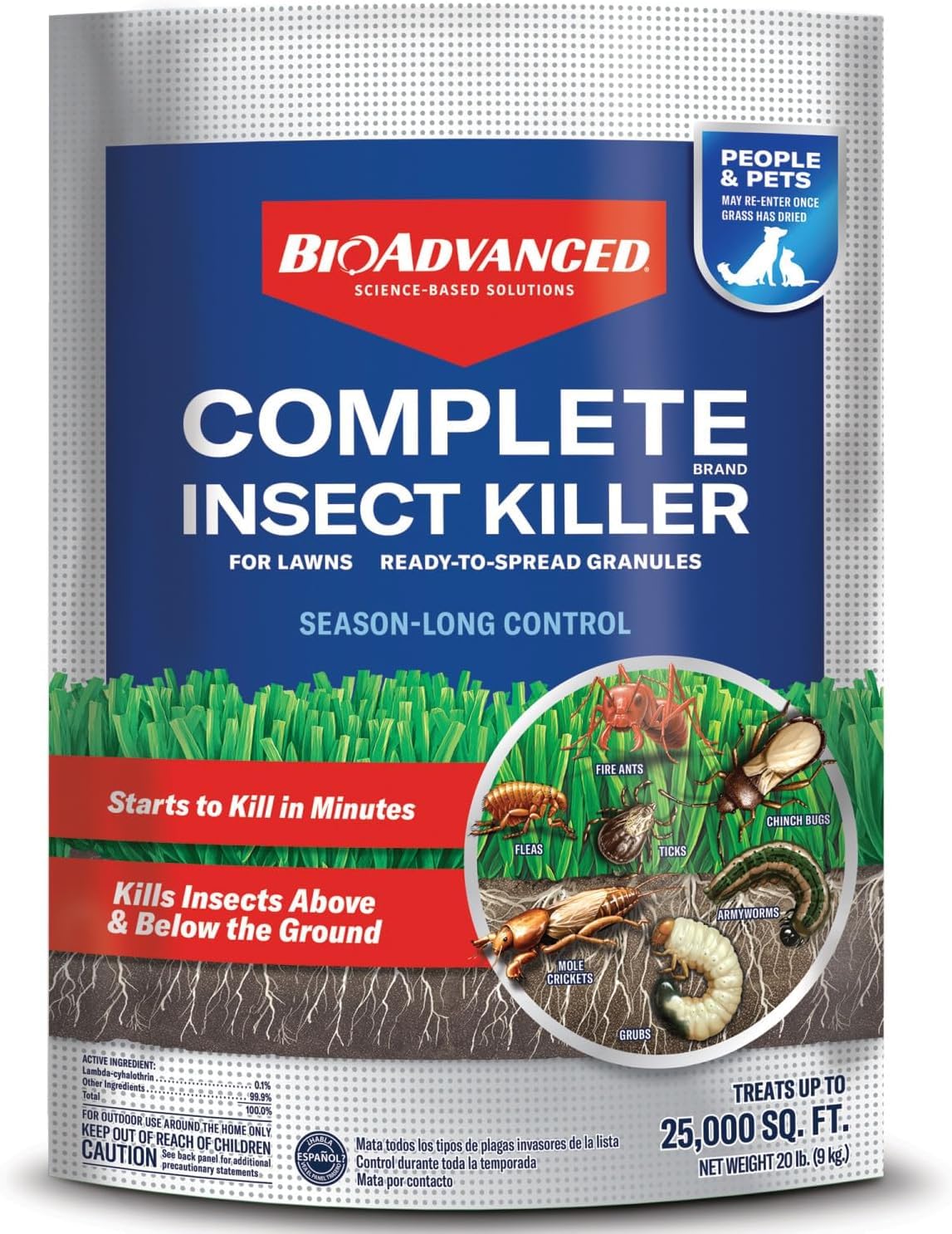
BioAdvanced Complete is designed for homeowners who want a single application to last the entire growing season. The 20-pound bag treats up to 25,000 square feet, giving it the largest coverage of any product in this lineup. It kills insects both above and below ground, targeting chinch bugs, mole crickets, grubs, ants, fleas, and ticks with a fast-contact formula that starts working as soon as the granules are watered in.
Users in South Florida with St. Augustine grass — a common chinch bug host — report that a single application in early spring provides roughly three months of protection during the hottest part of the year. The granules are easy to spread with a broadcast spreader and work on all lawn types including Bermuda, Zoysia, and Fescue. One user noted that while it eliminated most insects, it did not fully remove the mole food source, suggesting heavy infestations may need supplemental treatment.
The product is also labeled for fire ant mound treatment, which adds utility for southern homeowners dealing with both above-ground and below-ground pest problems. For anyone looking to minimize the number of applications across a large lawn, this is the most efficient granular option in terms of coverage per pound.
Why it’s great
- Highest coverage at 25,000 sq ft per bag
- Fast-acting formula kills on contact after watering
- Effective on St. Augustine grass in warm climates
Good to know
- Fleas may require additional specific treatment
- Moles may persist if secondary food sources remain
5. Martin’s 32 oz Cyonara Lawn & Garden Concentrate

Martin’s Cyonara is a liquid concentrate containing 0.5% Lambda-Cyhalothrin, a powerful synthetic pyrethroid that delivers immediate contact kill across more than 130 insect species. Unlike granular products that rely on the insect ingesting the active ingredient, this liquid coats the grass blades, stems, and thatch layer directly. Chinch bugs walking over treated surfaces absorb the chemical through their exoskeleton and die within minutes.
For gardeners dealing with chinch bugs mixed with spider mites, aphids, and squash bugs, this concentrate offers the broadest single-product spectrum in the lineup. Users report seeing dead insects around the garden perimeter within hours of application. The liquid format excels at penetrating dense turf where granules might sit on the surface, making it the best option for lawns with heavy thatch buildup.
The 32-ounce bottle mixes with water for use in a hose-end sprayer or pump sprayer. It is labeled for vegetables, roses, flowers, trees, and shrubs, giving it versatility beyond the lawn. One reviewer noted that dilution strength matters for chinch bugs — following the label rate for lawn pests ensures enough active ingredient reaches the soil line. The low-odor formula makes it more pleasant to apply than older pyrethroid concentrates.
Why it’s great
- Immediate contact kill through exoskeleton absorption
- Penetrates dense thatch better than granules
- Controls 130+ pests including chinch bugs, spider mites, and aphids
Good to know
- Liquid requires proper mixing and sprayer calibration
- Rain shortly after application can wash away the treatment
FAQ
How do I confirm chinch bugs are causing my lawn damage before buying a killer?
Should I use granules or liquid for an active chinch bug infestation?
How long after applying chinch bug killer can I let my kids and pets on the lawn?
Final Thoughts: The Verdict
For most users, the best chinch bug killer winner is the Ortho BugClear Lawn Insect Killer because it combines fast knockdown, 20,000 square feet of coverage, and a strong barrier that eliminates both above-ground and below-ground pests in a single bag. If you want deep penetration into thick thatch for an active infestation, grab the Martin’s Cyonara Liquid Concentrate. And for the largest coverage area with season-long convenience, nothing beats the BioAdvanced Complete 25,000 sq ft formula.

Mo Maruf
I created WellFizz to bridge the gap between vague wellness advice and actionable solutions. My mission is simple: to decode the research and give you practical tools you can actually use.
Beyond the data, I am a passionate traveler. I believe that stepping away from the screen to explore new environments is essential for mental clarity and physical vitality.