Our readers keep the lights on and my smoothie glass nicely filled. As an Amazon Associate, I earn from qualifying purchases.
Specs are compiled from manufacturer listings and verified buyer reviews and can change over time — please confirm the key details on the product page before buying.
You want a toy workbench your kid actually plays with—not one that sits in the corner after day one. The catch is that most children’s tool benches either feel too flimsy or lack enough real-feel action to hold a toddler’s interest beyond the first few minutes. This guide cuts through the options by focusing on the specs and real buyer feedback that matter: how many pieces are included, what age range each bench actually fits, the materials that survive enthusiastic hammering, and which ones have tools that do something (spin, drill, light up) versus just look pretty on a shelf.
I’m Mohammad Maruf — the founder and writer behind WellFizz. This guide is built by comparing the manufacturers’ published specifications and the patterns across verified customer reviews, so you get each pick’s real strengths and trade-offs instead of marketing spin.
Whether your little builder is two or six, the best children’s tool bench for your home is one that matches their current skill level, survives real play, and doesn’t leave you hunting for lost pieces every afternoon.
Quick Picks
- Step2 Handyman Kids Workbench — Top Performer
- Amazon Basics Kids Workbench Construction Toy — Best Value
- Leeshyah Wooden Kids Tool Bench — Smart Storage
- ROBUD Large Wooden Play Tool Workbench Set — Toddler-Friendly
- John Deere Kids Workbench, Power Tools Workshop — Brand Appeal
- Jovow Kids Tool Bench with Realistic Tools — Portable Play
- medoga Wooden Tool Bench with Kids Tool Belt — Complete Kit
How To Choose The Best Children’s Tool Bench
Almost every bench looks fun in the product photos. The real differences show up in how it’s built and what your child can actually *do* with it. Here is what separates a bench your kid reaches for every day from one that gathers dust.
Material: Plastic vs. Wood
Plastic benches (like the Step2 and John Deere) are lighter, easy to wipe clean, and often include electronic sounds or lights. Their trade-off is that lightweight build can tip easier during rough play. Wooden benches (like the ROBUD and medoga) feel more solid and look better in a playroom, but they are heavier to move around and can show hammer marks over time—buyers report that is expected and not a defect.
Age Range and Height
The manufacturer’s minimum age (in months) is your most honest guide. A bench rated for 36+ months will have slightly smaller, safer pieces for a toddler, while a bench rated for 60+ months is taller and has more intricate parts. Check the assembled height against your child’s standing reach: a 27-inch tall bench works for a three-year-old, whereas a 36-inch bench suits a five-year-old better.
Number of Pieces and What They Do
A set with 80 pieces sounds impressive, but what matters is variety. Look for at least one “active” tool—a drill that spins, a saw that makes noise, or a vice that actually turns. A bench with mostly static pieces (screws, nuts, blocks) relies entirely on your child’s imagination, which works for some kids but not all. Also check whether the set includes a storage box or tool belt to keep everything organized.
Quick Comparison
| Model | Best For | Material | Total Pieces | Age Range | Amazon |
|---|---|---|---|---|---|
| Step2 Handyman Workbench | Interactive Sound Play | Plastic | 35 | 36–72 months | Amazon |
| Amazon Basics Workbench | Largest Piece Count | Plastic | 80+ | 36+ months | Amazon |
| Leeshyah Wooden Tool Bench | Storage & Organization | Wood | Multi-tool set | 36–96 months | Amazon |
| ROBUD Wooden Workbench | Toddler-Friendly Wood | Engineered Wood | Multi-tool set | 36–96 months | Amazon |
| John Deere Workbench | Brand Fans & Tall Bench | Plastic | 39 | 60+ months | Amazon |
| Jovow Tool Bench | Portable Folding Set | Plastic (ABS) | 79 | 36–144 months | Amazon |
| medoga Wooden Tool Bench | Built-In Tool Belt | Wood | Multi-tool set | 36–96 months | Amazon |
In‑Depth Reviews
1. Step2 Handyman Kids Workbench

This Step2 bench gives you interactive play right away—the drill and saw make realistic sounds that grab a three-year-old’s attention.
It includes a pretend working vice, Durafoam wood pieces (a soft, spongy material safe for tiny hands), and a drill with sounds that batteries power separately. The bench stands 35.38 inches high and 36.25 inches wide, so it is a substantial play station without dominating the room. The double-walled plastic construction means it holds up to rough play—owners mention theirs survives a very active four-year-old. Reviewers report the assembly is straightforward, though one mentioned three stickers missing from the box.
The “wood” building pieces are foam, which some parents found less durable than expected, but the trade-off is that they are completely safe and quiet. The tool belt and flashlight are crowd-pleasers. One buyer did warn that the included screwdrivers are real metal tools, so you will want to supervise younger children closely with those pieces. The pegboard hooks have a tendency to let tools slide off, and the bottom drawer can fall out during play—minor frustrations against an otherwise well-made set. Unlike the taller John Deere bench (rated for 5+), the Step2 fits the 36 to 72 month range neatly, so your toddler can grow with it for a couple of years.
What Works
- Durable double-walled plastic that won’t chip or crack.
- Realistic drill and saw sounds engage kids immediately.
- Compact footprint for indoor use, easy to move outdoors.
The Shortfalls
- Durafoam wood pieces feel spongy, not durable.
- Drawer can fall out during play.
- Pegboard hooks slant, so tools slide off easily.
Best for ages 3 to 5: If your child loves cause-and-effect play (press a button, get a sound), this bench delivers that feedback every time.
Reconsider if: You want all-wood construction or a set with a storage box for the pieces—this one relies on its pegboard and a drawer.
2. Amazon Basics Kids Workbench Construction Toy

You get over 80 pieces here—a power drill, circular saw, hammer, screwdriver, pliers, wrench, handsaw, and a clamp—so siblings are less likely to argue over who gets what tool.
The bench measures 27.63 by 15.88 by 34.5 inches and is made from sturdy plastic that holds up to daily use. One reviewer noted the bolts also double as storage hangers, a clever space-saving touch. Assembly requires putting just eight main pieces together using one of the included tools, which is as easy as it gets in this category. A couple of real-world downsides emerge from buyer feedback: the included helmet and safety goggles are poor quality, with one report saying the lenses popped out and the helmet does not stay on a child’s head. The set also lacks a storage box, so the smaller pieces (screws, bolts) can get lost easily if you do not have a bag or bin handy.
On the plus side, buyers consistently call it a great value for the price given its parts count and durability. Compare this to the Jovow bench (79 pieces, 5.24 pounds): the Amazon Basics feels more substantial at 7.05 pounds and its workbench stays assembled rather than folding into a toolbox, which some families prefer for a dedicated play station.
Pieces Count Winner: At 80+ pieces it leads the category for variety, but plan your own storage solution because the box does not include one.
Reach for this if: You want the biggest accessory set for the money and your kid loves having a full “toolkit” to work with.
Look elsewhere if: The helmet and goggles are a make-or-break feature for your child—customers note those pieces disappoint.
3. Leeshyah Wooden Kids Tool Bench with Electric Drill
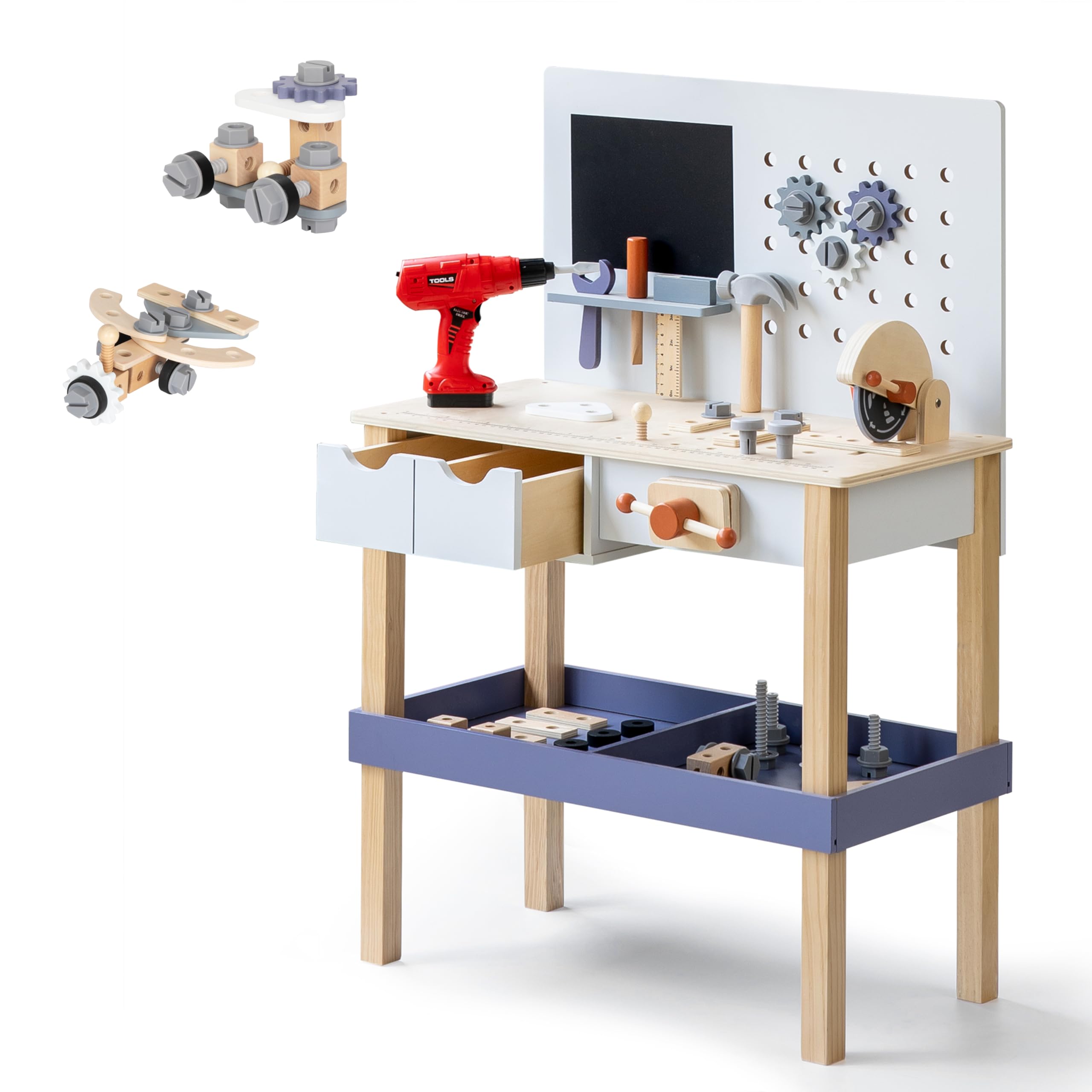
You get two real drawers and a lower storage platform on this wooden bench—so the tools actually stay put at the end of the day.
The Leeshyah workbench is built from high-quality natural wood with smooth, burr-free edges for safe play. At 34.21 inches tall, it fits children ages 3 and up comfortably. The set includes a functional electric drill (safe and easy for small hands), plus a hammer, saw, wrench, and other essentials. Reviewers point out the assembly requires no tools—just screw pieces together by hand—and the bench is sturdy enough to withstand weeks of daily play. One user did mention the included screwdriver broke when their three-year-old used it correctly, so the individual tool durability does not quite match the bench’s solid build.
Compared to the ROBUD wooden bench (which shoppers say tips easily because it is lightweight at 5.51 kilograms), the Leeshyah feels more planted at 8.01 kilograms, though both are wood. If a tidy play area matters to you, the two drawers here make a real difference.
Organizer’s Pick: The built-in storage keeps the play space neater than any other bench in this lineup—a small win that adds up daily.
Choose this bench for: A child who loves having everything in its place and a parent who does not want to pick up tools from the floor.
Note the catch: Some accessory tools (screwdriver) may not survive enthusiastic use as well as the bench itself.
4. ROBUD Large Wooden Play Tool Workbench Set

This ROBUD workbench is solid wood sized right for a two-year-old builder—it stands 40.6 inches tall and 27.6 inches wide, giving a generous play surface.
The included wooden tools (wrench, saw, hammer, screwdriver, screws) are simple but colorful, which attracts toddlers and encourages creative role-play. One buyer specifically noted it is a “good size for a 2-year-old” and “tough enough for hammering.” Buyers also mention it is lightweight (5.51 kilograms), which is great for moving around but means it tips easily during active play—something to watch with an enthusiastic toddler. The vice screws counter-clockwise (opposite of a real vice), which could confuse older kids who are learning tool directions. The back panel uses magnets to hold tools in place based on their outlines, though multiple buyers report the magnets are not strong enough, so the tools slide down.
Where the ROBUD shines is as an entry-level wooden bench. Compared to the medoga bench (which also uses wood but costs more for the included tool belt), the ROBUD gives you a solid wood experience at a more accessible tier. It is best matched to a child on the younger side of the 36-month minimum age recommendation.
Why It Works for Toddlers
- Solid wood construction with smooth, burr-free edges.
- Bright colors keep young children engaged.
- Bottom shelf provides storage space for collected tools.
Watch Out For
- Tips easily during active play due to lightweight build.
- Magnetic tool holders are weak—tools slide off their outlines.
- Vice screws counter-clockwise, opposite of a real vice.
Ideal for a 2 to 3 year old: The size and wooden durability match a toddler’s first tool bench experience well.
skip it if: Your child plays aggressively—the tipping issue becomes frustrating quickly.
5. John Deere Kids Workbench, Power Tools Workshop
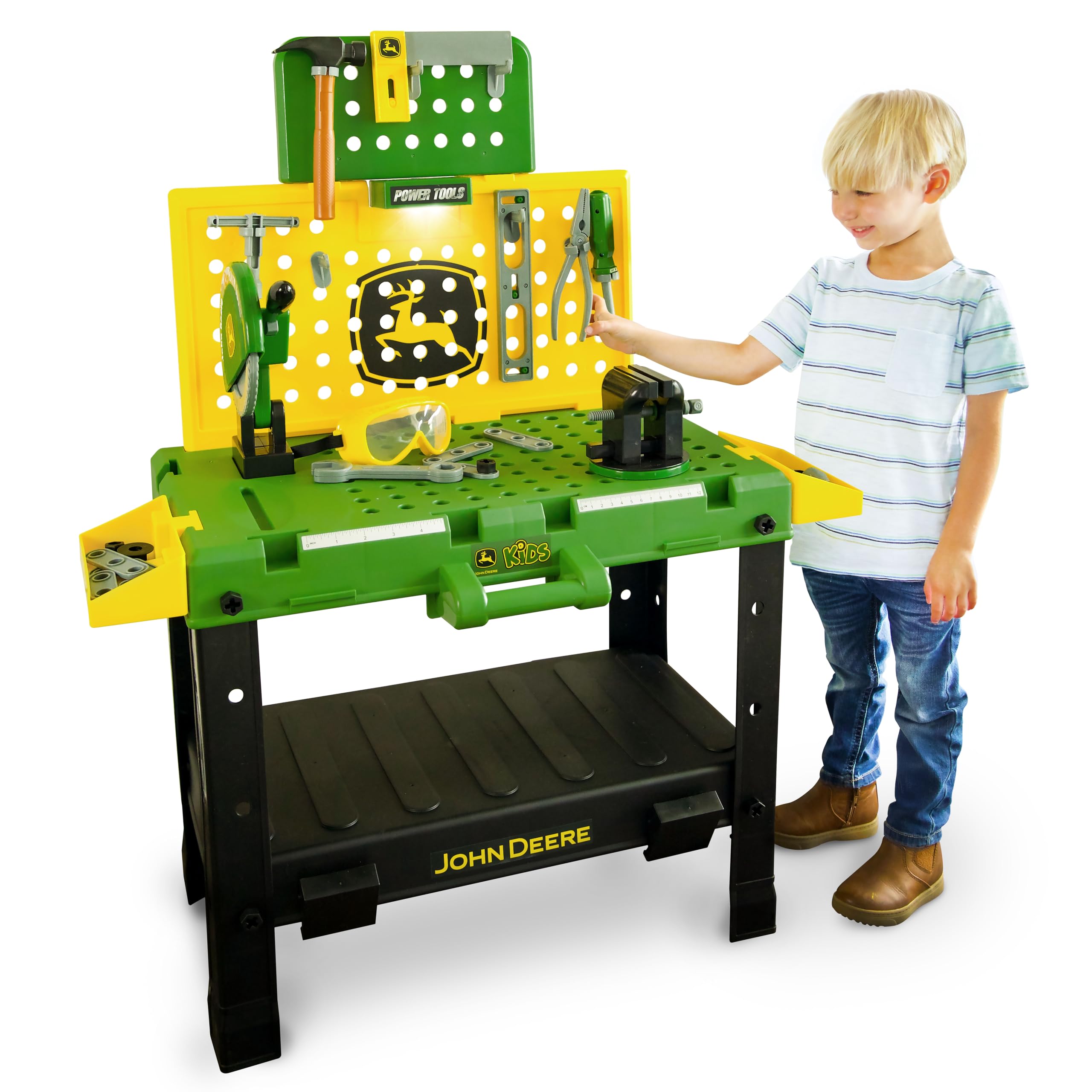
This bench stands 36.5 inches high—taller than most in this roundup—and is sized specifically for kids ages 5 and up.
It includes 39 pieces: a hammer, wrench, level, square, pliers, screwdriver with extra bit, t-wrench, saw, goggles, vice, a light, and two storage bins. The miter saw and drill press (both mounted on the bench) add pretend-play depth that younger sets lack. A bonus sheet of ten John Deere stickers lets kids personalize their bench. Owners mention the assembly takes about 20 minutes and is straightforward. The bench has a functional light and a realistic saw sound—real enough that kids love it.
There are two honest caveats from owners: the box shows more nuts and bolts than the set actually includes (you get exactly two nuts and two bolts), and the hammer is cheap enough that the instructions include a note to use it gently. One buyer mentioned the hammer breaks easily. For a set labeled for 5+ year olds, that is a weak point compared to the Step2 or the wood benches. At 8.48 pounds, it is noticeably heavier than the Jovow bench at 5.24 pounds, which makes the John Deere feel more planted during use. But the Jovow works for a 3-year-old (minimum 36 months), while the John Deere starts at 60 months—a 67% higher minimum age gap.
Built for the older builder: Its height and realistic stationary tools (miter saw, drill press) are a step up from toddler-only sets, but the included hand tools disappoint in durability.
Grab this for: A child aged 5+ who loves the John Deere brand and wants a taller bench with sound effects.
Skip it for: A younger child who needs more nuts/bolts to play with—the set only includes two of each.
6. Jovow Kids Tool Bench with Realistic Tools and Electric Drill

This 79-piece set folds into a toolbox—it fits in the car, not just the playroom, making it the only convertible bench in the lineup.
The Jovow bench is made of ABS plastic (a durable, impact-resistant plastic) with a smooth surface and no sharp edges. Assemble it into a workbench for play, then break it down into a compact toolbox your child can carry. The bench includes a variety of tools, an electric drill that rotates and makes realistic drilling sounds (though customers note the drill lacks power to screw bolts in), and even an engineering suit (clothes) for dress-up play. At 15.35 by 5.91 by 10.63 inches when folded, it is 1.9 times more compact than the John Deere bench’s shipping box, and at 5.24 pounds it is 62% lighter than the John Deere’s 8.48 pounds, so it truly is designed for carrying.
Buyer feedback is mostly positive: parents call it easy to assemble, a good size for a 3-year-old, and great for travel. But one reviewer put it plainly: “The drill isn’t even powerful enough to screw in the bolts.” The nails also fall straight through the bench surface, so there is no satisfying “hammering” action—a design shortfall for kids who want to feel like they are building. The drill’s lack of power is the biggest letdown compared to the Step2’s drill, which makes more convincing sounds and seems to engage kids better.
Travel Advantage
- Converts between workbench and carry-on toolbox in minutes.
- High piece count (79) for variety during play.
- Includes dress-up clothes for added role-play fun.
Functional Limits
- Drill lacks power to actually screw bolts in.
- Nails fall through the bench—no hammering action.
- Some reviewers point out the design could be more engaging.
Best for on-the-go families: If your child needs a toy that travels well, this is the only convertible bench in the list.
Pass on it if: Your child expects tools that “work”—the weak drill and passive hammering disappoint compared to the Step2.
7. medoga Wooden Tool Bench with Kids Tool Belt

This wooden bench includes a tool belt so your kid wears the workshop, not just stands at it—the most compact wooden bench here at 18.9 by 11.81 by 27.95 inches.
The medoga workbench includes a tool belt plus a toy drill, hammer, wrench, screwdriver, square, saw, screws, nuts, links, and creative building parts. The bench is made of wood with a non-toxic water-based paint finish and smooth, burr-free edges. Its small assembled size fits smaller playrooms or apartment living spaces. The tool belt lets your child wear the most-used tools, keeping the bench itself cleaner and the tools always within reach. Buyers confirm it is durable and has held up well to “not-so-gentle” play from an active little boy.
One owner reported the table saw and vice feel weak compared to the rest of the set, and the toy drill broke at the base when dropped by a four-year-old (it glues back together). The assembly guide has a specific quirk: the base plate hole must face front-left to align with the cabinet door—if you miss it, you will need to disassemble and restart. On the positive side, reviewers love the wooden construction and note it looks great in any playroom or living space as a decorative piece when not in use. The built-in tool belt sets this apart from every other wooden bench here—neither the ROBUD nor the Leeshyah includes one.
Wearable Workshop: The tool belt adds a dimension of mobility no other bench in this lineup offers—your child’s “workshop” goes where they go.
Get this for: A child who wants to carry tools around the house or yard, not just stand at one spot.
Be aware: The drill and some accessories (table saw, vice) are less durable than the main bench body—gentle play recommended.
Understanding the Specs
Manufacturer Minimum Age (Months)
This number tells you the youngest age the maker considers safe for the bench. A rating of 36 months means the parts are sized and shaped for a 3-year-old’s hands and mouth-safety testing. A rating of 60 months (like on the John Deere) means the bench is taller and the pieces are smaller, intended for a 5-year-old’s coordination. Always match this spec to your child’s actual age—ignoring it can mean a bench that is either too babyish or frustratingly difficult to use.
Material: Wood vs. Plastic
Plastic benches (ABS or double-walled polyethylene) are lighter, weather-resistant if you keep them outdoors, and easy to clean with a wipe. Their downside: they can tip during active play and the electronic components (sounds, lights) are a potential failure point. Wooden benches feel premium and stay planted better, but they are heavier to move and can show wear marks (hammer dents on the tabletop are common with wooden benches). Non-toxic water-based paint is a good sign on wooden sets—it means the colors are safe even if your child chews on a handle.
FAQ
What age is a children’s tool bench appropriate for?
Should I buy a plastic or a wooden tool bench for my child?
How many pieces do I actually need in a tool bench set?
How do I know if the bench will be tall enough for my child?
Are the tools and accessories safe for toddlers?
Can my child use the tool bench outdoors?
How long does it take to assemble a children’s tool bench?
What should I do if pieces get lost over time?
Final Thoughts: The Verdict
For most families, the best children’s tool bench is the Step2 Handyman Workbench because its realistic sounds, durable double-walled plastic, and 35-piece set match exactly what a 3-to-5-year-old needs to stay engaged without overwhelming the playroom. If you prioritize wood construction and organization, grab the Leeshyah Wooden Tool Bench for its two storage drawers and sturdy build. And for a child who loves to move around while playing, the medoga Wooden Tool Bench with its included tool belt lets them wear their workshop wherever they go.
How We Picked
We do not accept paid placement. Every pick is matched to a real buyer and a real use-case; we do not hands-on test units.
Sources & Methodology
Specifications: manufacturer listings and product documentation. Review insights: verified customer reviews, as of July 2026. Pricing: not shown on this page (it changes often); check the current price via the retailer link.
As an Amazon Associate, WellFizz earns from qualifying purchases. This does not affect which products we feature.
Related Guides

Mo Maruf
I created WellFizz to bridge the gap between vague wellness advice and actionable solutions. My mission is simple: to decode the research and give you practical tools you can actually use.
Beyond the data, I am a passionate traveler. I believe that stepping away from the screen to explore new environments is essential for mental clarity and physical vitality.