Our readers keep the lights on and my smoothie glass nicely filled. As an Amazon Associate, I earn from qualifying purchases.
Specs are compiled from manufacturer listings and verified buyer reviews and can change over time — please confirm the key details on the product page before buying.
Buying your kid’s first mountain bike is notable — until you realize a cheap option can turn a summer of fun into a weekend of wrenching. The real challenge isn’t finding a bike with knobby tires; it is finding one where the gears shift smoothly, the brakes stop reliably, and the frame survives more than one season of actual trail riding without falling apart. This guide covers nine children’s mountain bikes across mid-range and premium price tiers, focusing on the specs and build quality that actually keep your child riding — not fixing.
I’m Mohammad Maruf — the founder and writer behind WellFizz. This guide is built by comparing the manufacturers’ published specifications and the patterns across verified customer reviews, so you get each pick’s real strengths and trade-offs instead of marketing spin.
You will find honest breakdowns on everything from frame materials and drivetrain reliability to brake performance and real-world durability — all to help you pick the right children’s mountain bikes for your young rider.
Our Picks at a Glance


How To Choose The Best Children’s Mountain Bikes
A children’s mountain bike has to survive something an adult bike doesn’t: a rider who is still learning what “shifting under load” means. You need a bike whose drivetrain can handle a few missed shifts and whose brakes can stop a rider going too fast down a hill. Here is what actually matters.
Frame Material: Steel vs Aluminum
High-tensile steel is heavy — expect a 20-inch steel bike to weigh around 26 to 30 pounds — but it is tough and cheap to replace when your child outgrows it. Aluminum frames, found on the premium-tier picks, cut that weight significantly (often by 5 pounds or more), which makes climbing hills and lifting the bike into the car much easier. The trade-off is a higher price tag, but an aluminum bike will feel noticeably more responsive on the trail.
Drivetrain: Single-Speed vs Gears
A single-speed bike (like the JOYSTAR NEO and Contender) is simple — no derailleur to bend, no gears to skip. It works best for flat neighborhood rides and gentle dirt paths. Once your child hits real hills, even a 7-speed drivetrain makes a huge difference. Look for Shimano derailleurs (TX30, TZ500, or TX-500) on the better picks — they index precisely and survive the “I forgot to shift before I stopped” crunch better than generic no-name shifters.
Brakes: V-Brakes vs Disc Brakes
V-brakes (linear-pull brakes) are simple and cheap. They stop fine on pavement and hardpack dirt in dry conditions. Disc brakes — especially on the RoyalBaby models and the Mongoose Argus Trail — provide consistent, powerful stopping in wet mud, loose gravel, and sand. The extra cost is worth it if your child will ride in anything other than perfect dry weather.
Suspension: What to Expect
Many kids’ mountain bikes come with a suspension fork, but at this price range they are basic coil-spring units. They absorb small bumps on a groomed trail but add weight. A rigid fork (no suspension) is lighter and simpler, and many experienced riders prefer it for teaching kids to choose a line. Dual-suspension bikes (like the Air Zone Aftershock and the JOYSTAR Contender) add a rear spring shock that soaks up bigger hits but adds more weight and complexity.
Quick Comparison
| Model | Best For | Frame Material | Drivetrain | Brakes | Amazon |
|---|---|---|---|---|---|
| JOYSTAR NEO★ Best Overall | First-Time Riders | High Tensile Steel | Single-Speed | Caliper & Coaster | Amazon |
| RoyalBaby 7-17Top Performer | Premium Trail Ready | Aluminum | 8-Speed Shimano | Dual Disc | Amazon |
| RoyalBaby X9Best Value | Lightweight Versatility | Aluminum | 7-Speed | Dual Disc | Amazon |
| Mongoose Argus Trail | Fat Tire Grip | Aluminum | 7 or 16-Speed Shimano | Mechanical Disc | Amazon |
| Mongoose Flatrock | Youth Adventure | Aluminum | 7-Speed | V Brake | Amazon |
| JOYSTAR Contender | Dual Suspension Fun | Carbon Steel | Single-Speed | V Brake | Amazon |
| Air Zone Aftershock | Multi-Terrain Singletrack | Alloy Steel | 6-Speed | Linear Pull | Amazon |
| Glerc Skyline | Gear Range (21-Speed) | Carbon Steel | 21-Speed | Disc | Amazon |
| AVASTA Govet | Budget Geared Starter | Carbon Steel | 6-Speed Shimano | V Brake | Amazon |
In‑Depth Reviews
1. JOYSTAR NEO 20″ Kids Mountain Bike
Our pick — over 4★ from 900+ verified ratings; the strongest balance of quality and price.
The single-speed workhorse that trades gears for durability and simplicity for the youngest trail beginners.
The NEO is built for first-time riders ages 5-9 (44-52 inches tall) who are still learning balance and coordination. Its hi-ten steel frame (high-tensile carbon steel that is strong and inexpensive) is paired with a single-speed drivetrain — no derailleur to crash against a rock, no gear cables to snap. The 2.4-inch knobby tires (wide, with deep tread blocks) provide excellent grip on dirt and grass, giving new riders a stable platform. The dual-brake system combines a coaster brake (pedal backward to stop, impossible for a child to forget) with a front caliper handbrake (a lever that squeezes the wheel rim), giving twice the braking safety.
One customer observed that the bike was “perfect size for 7-year-old, mostly pre-assembled, durable after 1 year, adjustable seat, training wheels, slightly heavy but reasonable cost, great brakes.” Another family mentioned the bike is “bit heavy for me but good durability.” The bike includes detachable training wheels (small support wheels that bolt to the rear axle) that you can remove once your child’s balance improves. The quick-adjust saddle (a lever that lets you raise or lower the seat without tools) gives you room to grow for several years. A few reviews note the bike is “a bit heavy” at 26 pounds — about what you expect for a steel-frame 20-inch bike with training wheels — and one buyer had to return the bike for a warped front wheel (Amazon handled the return). The limited lifetime warranty on the frame provides some confidence.
The single-speed drivetrain means hills will be tough. If your neighborhood has any significant elevation, even a 6-speed geared bike like the Air Zone Aftershock will make the ride much more enjoyable for your child.
Simplicity Great for Beginners: The single-speed drivetrain and dual brake system (coaster + handbrake) let a child focus on balance and steering without worrying about shifting or forgetting how to stop.
Heavy Steel Frame: At 26 pounds, this bike is noticeably heavier than an aluminum model — your child will feel the extra weight on hills and when carrying it up stairs.
Reach for this if: You need a durable, simple bike for a first-time rider (ages 5-9) with training wheels, good brakes, and the ability to grow with the child for a few years.
Look elsewhere if: Your child already balances confidently and needs gears for hills, or you want a lighter aluminum frame to make carrying and climbing easier.
2. RoyalBaby 7-17 Kids Mountain Bike
The lightweight aluminum frame that makes trail riding feel almost easy for young riders.
This bike is built around what matters most for a child on real trails: a lightweight aluminum frame that makes hill climbs easier and a Shimano TX-500 derailleur (a rear gear shifter from a trusted brand that clicks precisely into each of 8 speeds) that delivers smooth shifts without the skipping that plagues cheaper gear systems. The dual disc brakes (two brake rotors, one on each wheel, squeezed by calipers) provide consistent stopping power even in wet mud or loose gravel — a real safety advantage over the V-brakes found on most bikes at this price.
Buyers report that the 13.5-kilogram (roughly 30 pounds) bike is “beautiful well made” and “impressive quality,” though some note the front disc brake needs a quick adjustment at a shop for about upon arrival. One owner mentioned the cranks need to be tightened to the square taper spindle (the connection between the pedal arm and the bottom bracket) — an easy fix, but worth checking before the first ride. Unlike the Glerc Skyline, which several owners mention develops gear-skipping after a few months, the RoyalBaby 7-17 comes with a limited lifetime warranty on the frame, giving you confidence this bike lasts.
This bike is 85% pre-assembled and includes the tools you need. It fits children ages 7 and up, with a quick-release seat and wheels (levers you flip without tools) so you can adjust the fit as your child grows or pop the front wheel off to fit the bike in the car.
Trail-Ready Foundation: The aluminum frame and Shimano 8-speed drivetrain give this bike a solid platform that can handle real off-road conditions without the weight penalty of a steel bike.
The Small Catch: A few buyers had minor tweaks needed at setup (brake centering, crank tightening) that a basic tool kit or a quick bike shop visit easily solves.
Reach for this if: Your child is ready for actual trail riding — hills, dirt, and the occasional root — and you want a bike that shifts smoothly and stops reliably without weighing them down.
Look elsewhere if: You only ride flat pavement, or you prefer the simplicity of a single-speed drivetrain with no adjustments ever needed.
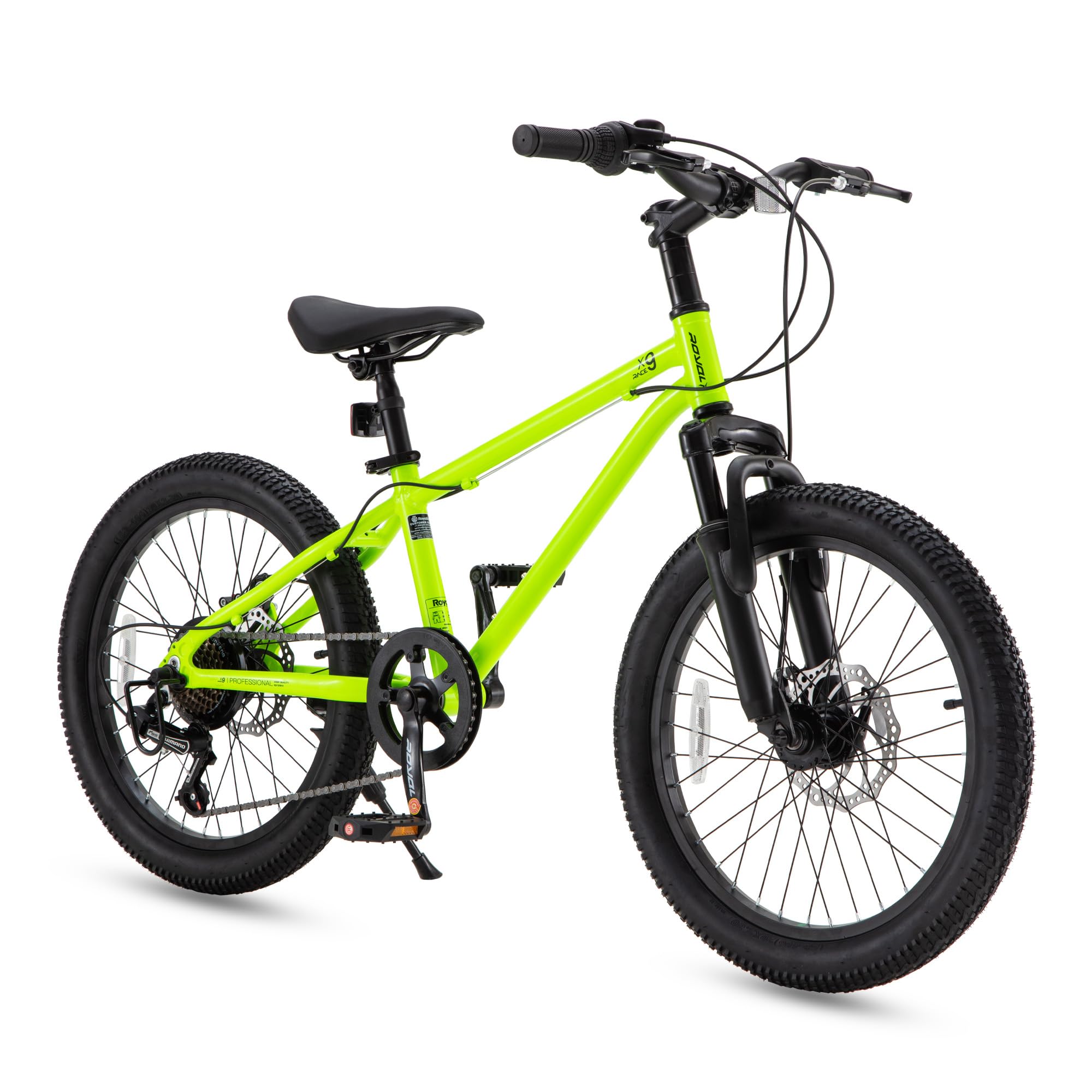
3. RoyalBaby X9 Kids Mountain Bike
An aluminum-framed mountain bike that skips the derailleur tuning headaches of cheaper geared bikes.
The X9 uses an aluminum alloy frame (lightweight but sturdy) combined with a 7-speed rear drivetrain and a suspension fork (a spring-loaded front end that soaks up bumps). This setup — a hardtail with a single front shock — keeps the weight down while still offering enough gear range for moderate hills. The dual disc brakes give you the same all-weather stopping confidence you get on the more expensive RoyalBaby 7-17, and the quick-release front wheel (a lever you flip to detach the wheel) makes it easy to fit in a car trunk for family trips.
One buyer and home bike mechanic noted the X9’s “aluminum frame with nice welds and a tapered head tube” is a remarkable value at this price, calling the frame alone worth the cost. The company says the bike complies with CPSC and EN-71 standards (U.S. and European safety requirements for children’s products). Reviewers also appreciated the Shimano derailleur — a major upgrade over the generic shifters found on the AVASTA Govet, which some customers note suffers from chain drops and pedal loosening within the first week. The X9’s 7-speed twist-grip shifter (you twist the hand grip to change gears) is simple enough for a child to learn quickly.
One trade-off mentioned in reviews: one pedal came loose and stripped the outer threads on the crank arm (the arm that connects the pedal to the bike), an issue the owner fixed by cleaning the threads and installing different pedals. It is a good idea to check pedal tightness before the first ride and again after the first week.
Light for the Trail: The aluminum frame makes this bike about 5 pounds lighter than comparable steel models, which your child will feel immediately on the first uphill climb.
One Pedal Check Needed: Some owners have reported pedal loosening — applying a small amount of threadlocker during assembly prevents this entirely.
Best for: Families who want an aluminum-framed, disc-brake mountain bike that can handle light to moderate trail riding without the premium price tag of the 8-speed model.
skip it if: Your child is still learning to balance and you need a single-speed drivetrain with zero complexity.
4. Mongoose Argus Trail Fat Tire Mountain Bike

The fat-tire bike that floats over sand and snow where other kids’ bikes sink and spin.
The defining feature of the Argus Trail is its massive 4-inch-wide knobby tires (almost twice as wide as a standard mountain bike tire). These tires grip loose surfaces — sand, gravel, snow, mud — in a way that a traditional 2.1-inch tire simply cannot. The aluminum frame keeps the weight manageable despite the huge tires, and the Shimano drivetrain (7 or 16 speeds depending on the model you choose) shifts reliably, unlike the Glerc Skyline’s 21-speed system, which multiple reviewers said developed gear-skipping and bent derailleurs within months of normal use. The mechanical disc brakes stop consistently even when the rims are wet or caked in mud.
One reviewer noted the bike is “good on soft/hard sand” and showed minimal corrosion despite regular saltwater exposure when rinsed after rides. Another parent called it “perfect for 10yo” with the fat tires, gears, and disc brakes all working well together. Reviewers also note it takes about 30 minutes to assemble — one of the quicker setups among the bikes here. The bike fits riders from 4’4″ to 6’1″ tall depending on the wheel size (20, 24, or 26 inches), so this model can grow with a child for several years. A few owners mentioned that the 4.0-inch tires have shallow tread and slip on packed snow, so it is better suited for sand and loose dirt than icy conditions.
The bike is noticeably heavy due to the large tires, and the shifting and brakes may need tuning from the start. If you plan mainly for pavement riding, the fat tires create extra rolling resistance that makes pedaling harder than it needs to be.
class-leading Surface Versatility: The 4-inch fat tires let your child ride on loose sand, deep gravel, and even light snow — terrain that stops standard mountain bike tires cold.
A Heavy Responsibility: The tire weight and rolling resistance are noticeable on paved paths and uphill climbs; this is purely an off-road adventure bike.
Reach for this if: You live near beaches, snowy trails, or loose gravel roads where standard tires would spin out and frustrate a young rider.
Look elsewhere if: Your child’s riding is mostly on pavement or dry hardpack trails where a lighter standard tire would roll faster and climb easier.
5. Mongoose Flatrock
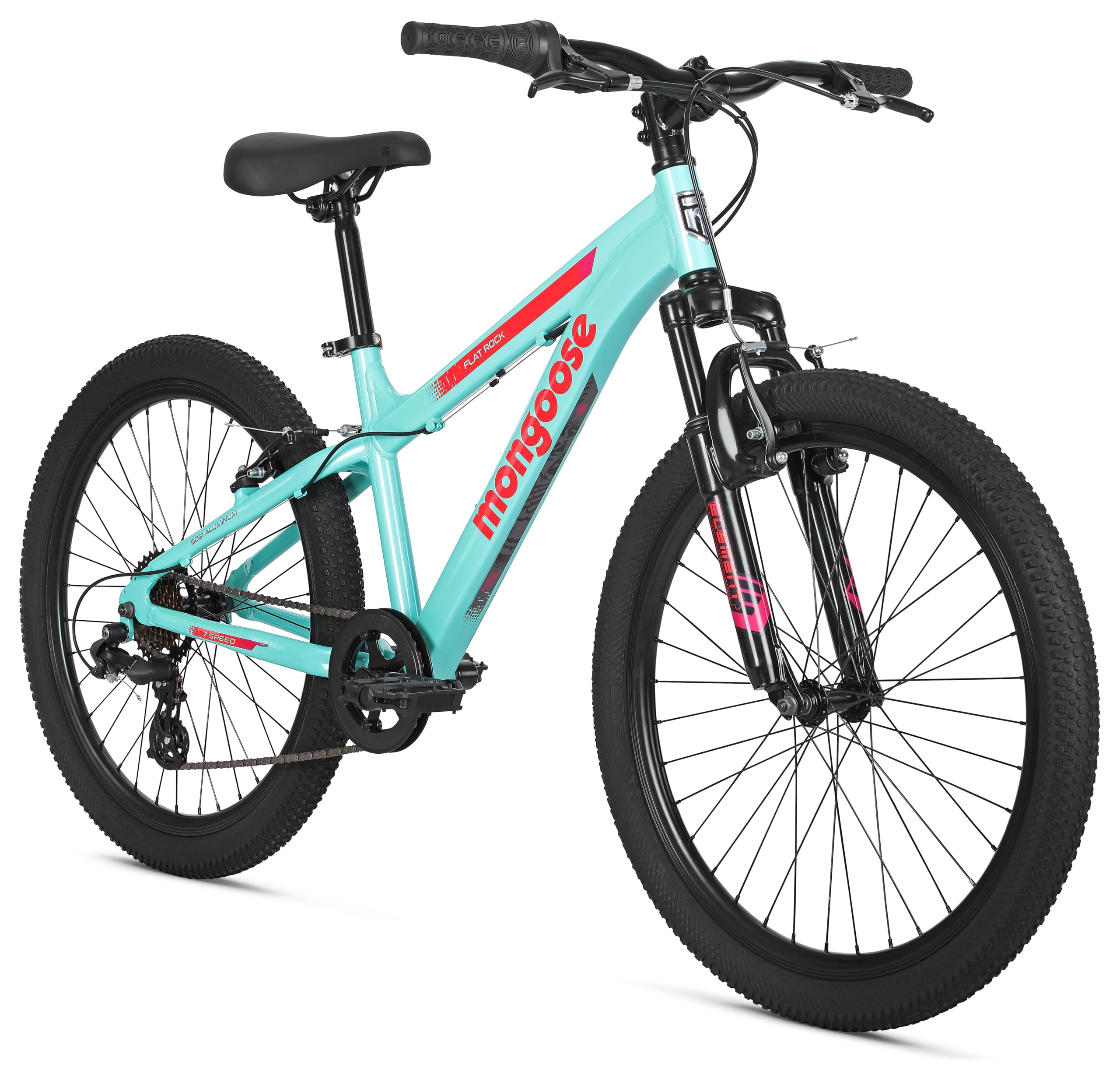
A modern aluminum hardtail that brings a grown-up look and trail-ready geometry to young riders.
The Flatrock is a legitimate trail bike scaled for youth. Its aluminum frame (lightweight and rust-resistant) is paired with a suspension fork (a front-end shock absorber) and 7-speed twist shifters (you rotate the grip to change gears). The sloping top tube (the frame bar that goes between the seat and handlebars slopes down) makes it easier for kids to stand over the bike and hop on and off. Unlike many children’s bikes with cheap steel frames that start rusting after one wet season, the Flatrock’s aluminum frame will hold up to years of outdoor storage without corrosion.
One buyer mentioned the bike has a “comfortable hardtail with front suspension, smooth 21-speed twist shifters” — though they described a 21-speed model, the version at this link is a 7-speed, so check the listing to confirm. Another buyer mentioned this is “not a high performance mountain bike but is perfect for riding around the neighborhood.” The linear-pull V-brakes (brakes that use a cable to pull two rubber pads against the wheel rim) are simpler and cheaper than disc brakes, but several owners said they needed adjustment from the start. One parent had to watch a YouTube video to get the brakes set correctly. A few reviews also noted the handlebar is narrow and the shifts can happen accidentally if your child’s grip brushes the shifter.
The Flatrock is a good choice for a youth rider who is tall enough for the 24 or 26-inch wheel option (up to 6’0″) and who wants a bike that looks like an adult mountain bike. For serious trail use, the disc brakes on the RoyalBaby models are a noticeable upgrade in stopping performance, especially in wet conditions.
Real Bike Geometry: The aluminum frame and sloping top tube give this bike a modern trail feel that is rare at this price point in youth sizing.
Brake Tuning Required: Plan on spending 15-20 minutes adjusting the V-brakes from the start, or budget for a shop to do it if you are not comfortable with barrel adjusters.
Best for: A growing youth rider (4’4″ to 6’0″) who has outgrown toy-store bikes and wants something that looks and rides like a real trail bike.
pass on it if: You need disc brakes for reliable wet-weather stopping, or your child is still learning to balance and would benefit from training wheels (the Flatrock does not include them).
6. JOYSTAR Contender 20/24 Inch Kids’ Bike

The dual-suspension single-speed that soaks up bumps without the complexity of a geared drivetrain.
This is a simple idea executed well: take a durable hi-ten steel frame (a heavy carbon steel that resists bending), add a front suspension fork and a rear spring shock (coil springs that compress to absorb impacts), and pair it with a single-speed drivetrain — no derailleur, no gear cables, nothing to bend or break. The result is a bike that rolls over roots and rocks comfortably while being mechanically dead simple. The 2.125-inch wide pneumatic tires (air-filled tires with aggressive tread) provide decent traction in wet and dry conditions.
Reviewers point out that the “bike is sturdy and easy to put together” and that the “wheels are super thick” — one family said this was a Christmas gift for a 7-year-old that fit well. Another owner noted the brakes are a little finicky to adjust (the linear-pull V-brakes track to one side easily), but they got them “good enough” without any real resistance during riding. Unlike the AVASTA Govet, where several owners reported pedals falling off and chains popping off every ride, the Contender’s single-speed design avoids those failure points by having fewer parts that can go wrong. The bike also includes fenders (curved covers over the wheels that keep mud and water off the rider), which are a nice bonus for trail riding.
The single-speed drivetrain is a limitation on hills. A 7-year-old on a single-speed will struggle on steep climbs where a geared bike would let them shift to an easier gear. The bike fits riders 44-56 inches tall and ages 6+, and it comes with a limited lifetime warranty on the frame. Expect about an hour for assembly, and check the rear tire for air — one reviewer had to replace a back tire that wouldn’t hold air.
Bump Absorption Without Complexity: The dual-suspension setup (front and rear springs) smooths out rough terrain, and the single-speed drivetrain means zero derailleur tuning or replacement costs.
Hill Climbing Limitation: Without multiple gears, steep hills will be a real challenge for young legs — this is best for flat or gently rolling terrain.
Reach for this if: You want a rugged, low-maintenance bike for neighborhood trails and rough paths, and you prefer a simple drivetrain your child cannot damage with improper shifting.
Look elsewhere if: Your area has significant hills, or your child is ready to learn how to use gears effectively on varied terrain.
7. Air Zone Aftershock 20″ Bike

A dual-suspension 6-speed with parts-bin versatility for kids ready to graduate from pavement.
The Aftershock brings together dual suspension (a front fork and a rear shock that both compress to absorb bumps) and a 6-speed grip-shift derailleur (you twist the hand grip to move the chain between gears on the rear cassette). This combination lets your child ride confidently over uneven terrain — the suspension softens the jolts, and the 6 gears provide enough range for moderate hills. The linear-pull brakes (the most common type on kids’ bikes, using cables to squeeze rubber pads against the wheel rims) offer reliable stopping on dry trails.
One owner reported a key problem: “seat position makes it hard for kids to touch ground” — the seat is taller than a typical 20-inch bike, meaning shorter children may struggle to put their feet flat on the ground at stops. The same reviewer said the bike itself is good quality but the inner tube needed immediate replacement, and assembly was difficult. Another parent said the bike was “easy to assemble good quality” and their grandson “still enjoying his bike.” The dual suspension is a real plus here compared to the JOYSTAR NEO, which has no rear spring, but the Aftershock’s alloy steel frame (the same heavy material as many budget bikes) means it is not lightweight. Shoppers say the deluxe paint finish looks sharp, which is a nice touch for kids who care about color.
Assembly is the main hurdle — several reviews mention it is more involved than the “85% pre-assembled” claims. The bike is designed for ages 6-10 and fits mountain and unpaved terrain. Check the seat height against your child’s inseam before buying.
Bump Comfort on a Budget: The dual-suspension and 6-speed drivetrain give this bike real trail capability at a price where most bikes only offer a hardtail and single speed.
Tall Seat Geometry: The seat sits higher than average for a 20-inch bike, so shorter children may not be able to touch the ground safely at stops.
Best for: A child who is tall for their age (long inseam) and ready for moderate off-road riding with both bump absorption and gear range.
it’s not for you if: Your child is on the short side for a 20-inch wheel, or you want a bike with disc brakes for wet weather confidence.
8. Glerc 20/24/26 Inch Kids Mountain Bike
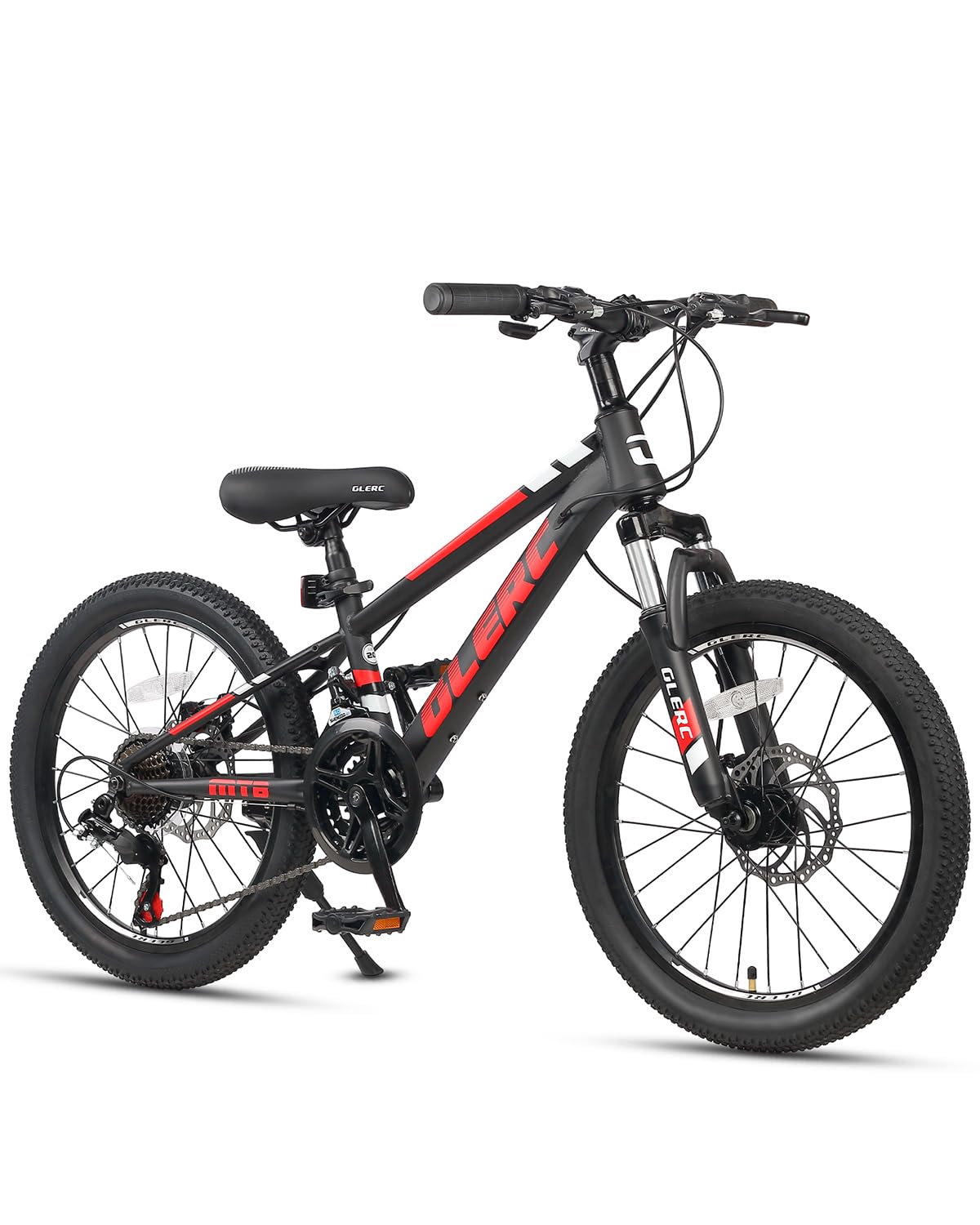
A 21-speed specs sheet that looks amazing on paper but lets down many owners within a few months.
On paper, the Glerc Skyline offers what looks like the best value in this category: a carbon steel frame, a 21-speed drivetrain (three front chainrings and seven rear sprockets for a wide gear range), disc brakes (rotors and calipers that stop in all weather), and a suspension fork — all at a mid-range price. The bike is designed for ages 6-12 (45-55 inches tall, with a 21-25 inch inseam) and weighs 30 pounds. The carbon steel frame (strong and heavy, like the JOYSTAR models) provides a solid foundation for off-road adventures.
The problem is the real-world reliability. Multiple verified buyers report the same pattern: “Bike started skipping gears a few short months of my kid riding it.” One owner said the bike “worked great for a month but broke while my son was riding it” and could not reach customer support. Another described the bike as “the worst bike I have ever purchased” after it broke multiple times and cost in repairs — only to break again within a year. A buyer pointed out that “the lower gear on it is made of plastic” — plastic components on a drivetrain that is supposed to handle 21 gears is a reliability red flag that the high-speed drivetrain reviews from the Mongoose Flatrock and RoyalBaby models do not share. Even the assembly issues noted in reviews (bent rear tire, derailleurs completely misaligned from the start) suggest inconsistent quality control.
The Glerc Skyline looks beautiful in pictures and has a nice color design, but the durability complaints are too frequent and too consistent to ignore. If you need a 21-speed kids’ mountain bike, consider whether the simpler drivetrains on other picks (the 8-speed RoyalBaby 7-17 or the 7-speed Mongoose Flatrock) might offer better long-term reliability for a similar or slightly higher investment.
Wide Gear Range on Paper: The 21-speed drivetrain offers the widest gear range of any bike here, with the potential to handle steep climbs and fast descents.
Questionable Durability: The prevalence of gear-skipping, broken drivetrain components, and poor customer support makes this a risky choice compared to simpler, more reliable brands.
Consider this if: You are comfortable with the risk that the drivetrain may need repair or replacement within the first year, and you value the widest possible gear range above long-term reliability.
look elsewhere if: You want a bike that shifts smoothly and stays rideable for more than one season without needing shop repairs — the RoyalBaby 7-17 or Mongoose Flatrock are safer choices.
9. AVASTA Govet 20″ Kids Mountain Bike
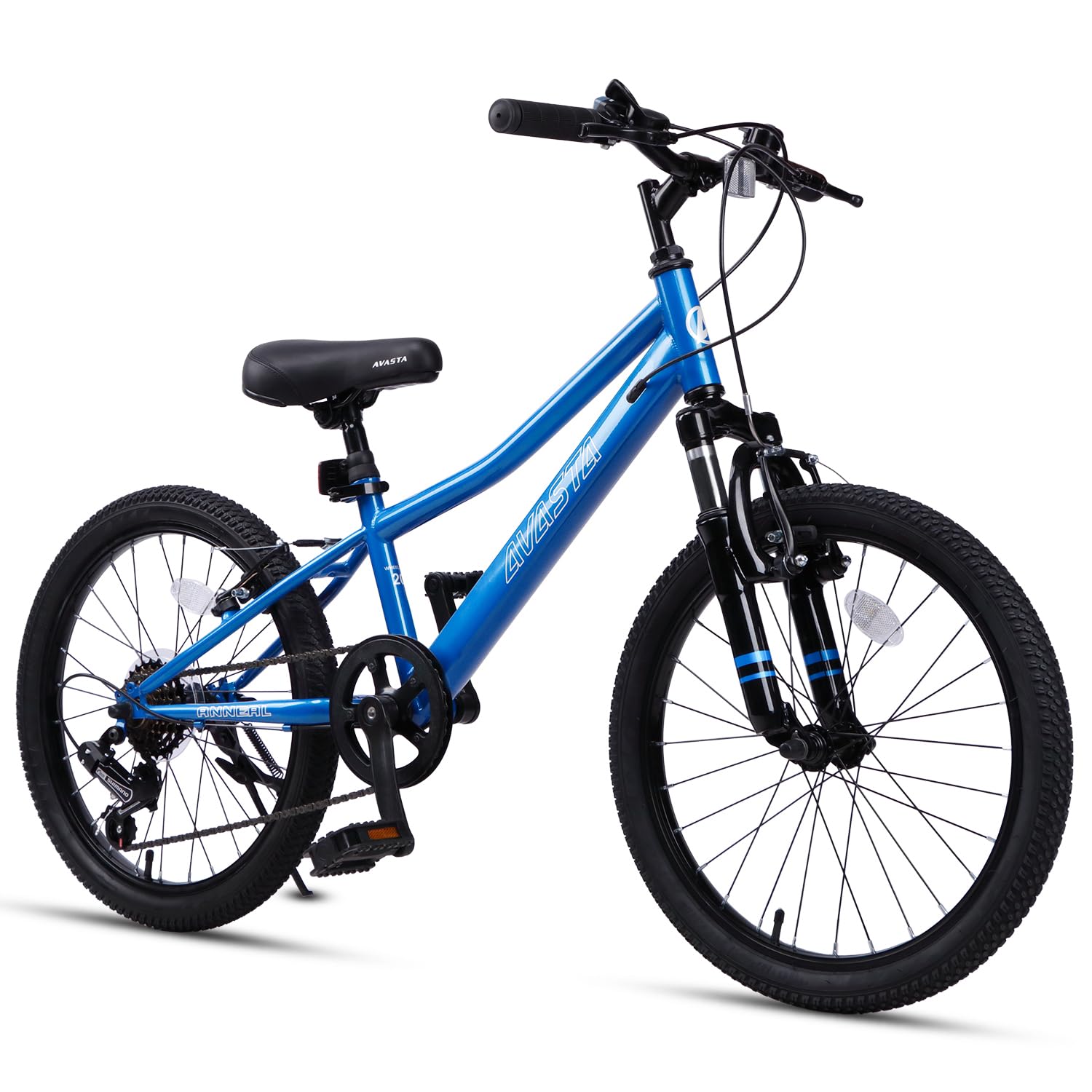
The cheapest way to get your child a bike with a Shimano drivetrain and a suspension fork, but quality control is a gamble.
The AVASTA Govet is a budget-oriented 20-inch mountain bike designed for children ages 6-13 (45-59 inches tall). It features a carbon steel frame (durable but heavy), a suspension fork (front-end shock absorber), and a Shimano TX30 trigger shifter paired with a Shimano TZ500 rear derailleur — real brand-name shifting components that you typically only find on bikes costing significantly more. The dual V-brakes (one cable-actuated brake per wheel) provide simple, serviceable stopping power. The frame has a lower standover height (the top tube sits lower), making it easier for kids to put their feet down at stops, a detail that parents of shorter riders will appreciate.
The quality control is inconsistent. One verified buyer wrote that “within one week of my six year old getting this, one pedal fell off repeatedly and the chain popped off almost every time he rode it.” This mirrors the drivetrain reliability issues seen on the Glerc Skyline, though the AVASTA uses a simpler 6-speed setup. On the other hand, many buyers had a great experience — one parent bought two bikes for grandsons, assembled the first in 35 minutes (the fastest reported assembly time in this category), and received a replacement front fork for the second bike within 5 days when it arrived defective. Another reviewer called it a “full feature bike at a great price” and noted the Shimano derailleur and trigger shifter are ideal for a starter geared bike.
The AVASTA Govet is a trade-off: you get Shimano shifting components (a genuine value for the price) and a suspension fork, but you accept the risk that you may need to deal with pedal loosening, chain drops, or wheel truing from the start. If you are handy with a wrench, this can be a rewarding budget choice. If you prefer a bike that works perfectly from the first ride, the JOYSTAR NEO (single-speed) or the Air Zone Aftershock (6-speed dual suspension) may be less stressful options at a similar price point.
Shimano Components at the Lowest Price: The Shimano TX30 shifter, TZ500 derailleur, and freewheel setup are legitimate quality parts that you would normally pay -80 more to find.
Inconsistent Assembly and Quality: A significant minority of owners mention pedals falling off, chains dropping, and wheels needing truing — expect to spend some time tuning before the bike is rideable.
Best for: A budget-conscious buyer who is comfortable doing basic bike assembly and tuning (pedal tightening, derailleur adjustment, wheel truing) and wants real Shimano shifting at the lowest possible price.
steer clear if: You want a bike that works reliably from the start, or your child is not old enough to understand that gear shifting requires a light touch rather than mashing the pedals.
Understanding the Specs
Frame Material: Steel vs Aluminum
The frame material determines how heavy the bike feels and how much effort your child needs to climb hills. High-tensile steel (HT steel) is the cheapest and heaviest — expect a 20-inch steel bike to weigh between 26 and 30 pounds. Carbon steel is similar but slightly stronger. Aluminum alloy frames cut 4-6 pounds off that total, which makes a huge difference on long rides and when your child has to carry the bike up stairs or over obstacles. Aluminum also does not rust, so the bike will look good for years if stored outside.
Drivetrain: Derailleur vs Single-Speed
A derailleur drivetrain (a mechanism that moves the chain between different-sized gears on the rear wheel — sometimes also the front chainrings) allows your child to shift into easier gears for climbing and harder gears for downhill or flat speed. The number of “speeds” (6-speed, 7-speed, 8-speed, 21-speed) refers to how many different rear sprockets the chain can move across. More speeds give finer adjustment between easy and hard gears. A single-speed drivetrain has no derailleur at all — just one front gear and one rear gear — which makes it simpler, lighter, and nearly impossible for a child to break by shifting incorrectly. For hills, a geared bike is far better. For flat neighborhoods and gentle paths, a single-speed is simpler and cheaper to maintain.
FAQ
What size children’s mountain bike do I need?
Are disc brakes better than V-brakes for kids?
How many gears does my child actually need?
Do children’s mountain bikes come pre-assembled?
What is the difference between a hardtail and full suspension kids mountain bike?
How long will a child’s mountain bike last before they outgrow it?
Are kids mountain bikes safe for pavement riding?
What maintenance does a kids mountain bike need?
Is it worth spending more on an aluminum frame kids mountain bike?
What should I do if the bike arrives damaged?
For most families, the best children’s mountain bikes pick is the RoyalBaby 7-17 because its lightweight aluminum frame, 8-speed Shimano drivetrain, and dual disc brakes deliver real trail performance without the weight and reliability issues that plague cheaper steel-framed models. If you want a more budget-friendly option that still uses real Shimano shifting components, the AVASTA Govet offers genuine value if you are comfortable tuning it from the start. And for children who need to ride on sand or snow, the standout is the Mongoose Argus Trail with its 4-inch fat tires that float over loose surfaces while providing reliable disc braking and a smooth Shimano drivetrain.Final Thoughts: The Verdict
How We Picked
We do not accept paid placement. Every pick is matched to a real buyer and a real use-case; we do not hands-on test units.
Sources & Methodology
Specifications: manufacturer listings and product documentation. Review insights: verified customer reviews, as of July 2026. Pricing: not shown on this page (it changes often); check the current price via the retailer link.
As an Amazon Associate, WellFizz earns from qualifying purchases. This does not affect which products we feature.
Related Guides

Mo Maruf
I created WellFizz to bridge the gap between vague wellness advice and actionable solutions. My mission is simple: to decode the research and give you practical tools you can actually use.
Beyond the data, I am a passionate traveler. I believe that stepping away from the screen to explore new environments is essential for mental clarity and physical vitality.