Our readers keep the lights on and my smoothie glass nicely filled. As an Amazon Associate, I earn from qualifying purchases.
The best children’s board games don’t need batteries, Wi-Fi, or a rechargeable dock. They live in a box under the coffee table, waiting for a rainy afternoon or a quiet evening when the digital hum finally fades and your kid asks for something different — something that folds out into a world of color, dice, cards, and laughter. But the shelf is crowded with gimmicks: flimsy spinners, confusing rule books, and concepts that bore a six-year-old after exactly one round.
I’m Mohammad Maruf — the founder and writer behind WellFizz. I’ve spent hundreds of hours analyzing the mechanics, material quality, and age-appropriate complexity of dozens of board games to separate the true family favorites from the forgettable filler.
In this guide, I break down the top options across skill levels and play styles so you can find the best children’s board games for your next family game night without guesswork.
How To Choose The Best Children’s Board Games
A great children’s board game bridges the gap between what your kid *wants* to do (win, move pieces, laugh) and what you *want* them to do (practice reading, counting, or cooperative thinking). The trick is picking a game that lands in the sweet spot — challenging enough to hold attention, simple enough to avoid frustration.
Match the Age Range and Reading Level
Most games list an age range on the box, but the real test is whether your child can independently read the cards or instructions. For pre-readers and early readers, look for picture-matching games or those with symbols instead of text. For ages seven and up, trivia and geography games with short sentences work well. If the game requires reading longer paragraphs, your child may need an adult reading buddy to stay engaged.
Consider the Play Time and Attention Span
Younger children (ages three to five) typically max out at ten to fifteen minutes of focused play. Games with a fast-paced, turn-based structure like Zingo or Squishyland keep them hooked. For elementary-age kids, a forty-minute game with intermittent breaks for dice rolling or card flipping can feel just right. Avoid games that take over an hour for the first playthrough — they tend to collect dust after the initial excitement wears off.
Examine the Physical Quality and Components
Children’s board games take abuse: dropped pieces, tugged cards, spilled drinks. Thick, coated cardboard tiles and boards resist warping. Plastic components should feel sturdy, not brittle. Cards should have a laminated or heavy stock finish, not thin paper that bends after one shuffle. A game that feels cheap in the hand will likely fall apart before your family gets bored of it.
Look for Multi-Ability and Inclusive Design
Games that offer multiple difficulty levels or double-sided boards (like Zingo’s “two levels of play”) grow with your child. If you have kids of different ages playing together, look for games that allow younger players to participate without needing to read, while older players face a tougher challenge. Inclusivity also matters — consider games designed to be friendly for neurodivergent kids, with tactile pieces and clear, calm instructions.
Quick Comparison
On smaller screens, swipe sideways to see the full table.
| Model | Category | Best For | Key Spec | Amazon |
|---|---|---|---|---|
| ThinkFun Zingo Bingo | Matching/Preschool | Pre-readers and early readers | 6 double-sided cards / 7 players max | Amazon |
| The Fidget Game SquishyLand | Phonics/Multisensory | Pre-K to 2nd grade literacy | 15-min play / 3.3 lb tactile pieces | Amazon |
| Game Zone Great States | Geography/Trivia | Ages 7+ learning U.S. states | 400 cards / mechanical timer | Amazon |
| Toysmith Chasing Fireflies | Active/Outdoor | Ages 3+ indoor/outdoor hunt | 2 jars / 10 fireflies / AG3 batteries | Amazon |
| The World Game | Geography/Strategy | Ages 9+ world geography | 194 countries / 1500+ facts | Amazon |
In‑Depth Reviews
1. ThinkFun Zingo Bingo Award Winning Preschool Game

Zingo has earned its place as one of the most popular children’s board games for good reason: it works across a wide developmental range without sacrificing fun. The double-sided cards offer two levels of play — one side shows simple picture matching for pre-readers, and the other introduces basic word recognition for early readers. This means the same box stays fresh from age three through early elementary without feeling too babyish or too advanced.
The Zinger device is a tactile delight — kids slide it forward to reveal two tiles at once, then race to match them to their card. The satisfying click and the element of speed keep multiple players engaged even during other players’ turns. With sturdy thick paper boards and durable plastic tiles, this game survives the kind of enthusiastic handling that destroys lesser components.
Teachers use it in classrooms and parents pull it out on rainy weekends because it rewards fast recognition without requiring reading fluency. The game encourages focus, hand-eye coordination, and vocabulary building in a format that never feels like a lesson. For a single-box solution that grows with your child, Zingo sets the benchmark.
Why it’s great
- Double-sided boards accommodate multiple skill levels in one box
- Zinger mechanism is durable and fun for small hands to operate
- Fast-paced rounds keep short attention spans locked in
- Supports up to seven players — ideal for larger families or classrooms
Good to know
- Tiles can slide out of the tray if not handled carefully during cleanup
- Word-reading level is basic — advanced readers may outgrow within a year
2. The Fidget Game SquishyLand in Rainbow Reef

SquishyLand Rainbow Reef is what happens when a board game is designed by teachers who understand exactly how early literacy works. Each element — from the squishy animal pieces to the color-coded cards and the board layout — is aligned with the Science of Reading and targets phonological awareness, phonics, blending, and syllable decoding. The game structure is simple enough that a five-year-old can jump in without reading a rulebook, yet the learning depth is substantial enough to support a second-grader working on prefixes and suffixes.
The multisensory aspect is what sets this game apart. Kids physically press squishy toys, flip colorful cards, and move their pieces across a bright rainbow reef board while practicing letter sounds. The tactile feedback keeps fidgety hands busy and helps children with ADHD, autism, or dyslexia stay engaged without feeling pressured. The “Go Back Shark” cards add a gentle risk element that teaches resilience — losing progress is part of the fun, not a punishment.
With a fifteen-minute playtime, this game fits neatly into after-school slots or quick family rounds before dinner. The board is large (nearly 17 inches across) and the pieces are thick and durable. For parents looking to sneak phonics practice into game night without a textbook in sight, SquishyLand delivers on both fun and instructional value.
Why it’s great
- Rooted in the Science of Reading with teacher-designed phonics progression
- Tactile squishy pieces support sensory learners and reduce anxiety
- Inclusive design works for neurodivergent kids without singling them out
- Short rounds keep young players from losing attention mid-game
Good to know
- Box is large — storage may require dedicated shelf space
- Reading concepts are phonics-focused; not ideal for pure picture-matching play
3. Game Zone Great States Geography Board Game

Great States turns the classic United States map into a competitive quiz game that actually makes learning geography feel like a sport. The board is printed to scale with vibrant colors and state-specific illustrations — landmarks, state birds, flowers, and other icons that give each region a visual personality. Players take turns flicking the spinner, drawing a card from one of four categories (facts, find, figure, fun), and racing against the mechanical timer to answer correctly.
The four card categories keep the gameplay varied. “Find” cards ask players to locate a state on the map, reinforcing spatial memory. “Fact” cards quiz state capitals and abbreviations. “Figure” cards challenge players to identify states by shape or outline. “Fun” cards add quirky trivia that breaks the tension. With four hundred cards in total, the replay value is substantial — you won’t see the same question twice for many sessions.
That said, the cards are printed on thin cardboard that feels underwhelming for the price point. Some families report the mechanical timer stops working after heavy use. The age recommendation starts at seven, but younger children can still participate if an adult reads the cards aloud. For homeschoolers, classroom teachers, or families planning a road trip, this game transforms passive map-gazing into active recall competition.
Why it’s great
- Four different card categories prevent the gameplay from feeling repetitive
- Map-to-scale design with state illustrations enhances visual learning
- Mechanical timer adds a pressure element that older kids enjoy
- Massive card library supports dozens of play sessions
Good to know
- Card stock is thin and may tear with frequent shuffling
- Timer mechanism has been reported to jam after extended use
4. Toysmith Chasing Fireflies Kids Game

Chasing Fireflies isn’t a traditional board game — there’s no board. Instead, it’s an active hide-and-seek experience that gets kids moving in low-light environments. The set includes two translucent plastic jars (one green, one blue) and ten glowing firefly tokens, each powered by tiny pre-installed AG3 batteries. Players take turns hiding the glowing fireflies and then hunting for them using the jars as capture tools. The soft flashing lights are gentle on the eyes and create a calming nighttime atmosphere.
The game works beautifully in both indoor and outdoor settings. In the yard at dusk, the fireflies blend into grass and bushes, creating a genuine search challenge. Indoors, they can be tucked behind couch cushions or under pillows. The light pattern is non-continuous — they flash in intervals, which forces kids to wait and watch rather than simply walk toward a steady glow. This builds patience and observational skills without feeling like instruction.
The included batteries are also the replacement type, which means you won’t need to hunt down button cells immediately. The jars and fireflies have survived drops on pavement and hardwood floors in testing. For a screen-free activity that encourages physical movement and cooperative play, especially during summer evenings or rainy-day indoor sessions, this kit punches above its price point.
Why it’s great
- Non-continuous flashing lights train patience and visual attention
- Works equally well indoors and outdoors for year-round use
- No reading required — toddlers can join on equal footing with older kids
- Replacement batteries included, extending component lifespan
Good to know
- Small firefly tokens can be lost if played in large outdoor areas
- Not a traditional board game — best as an active alternative for high-energy kids
5. The World Game – Fun Geography Board Game
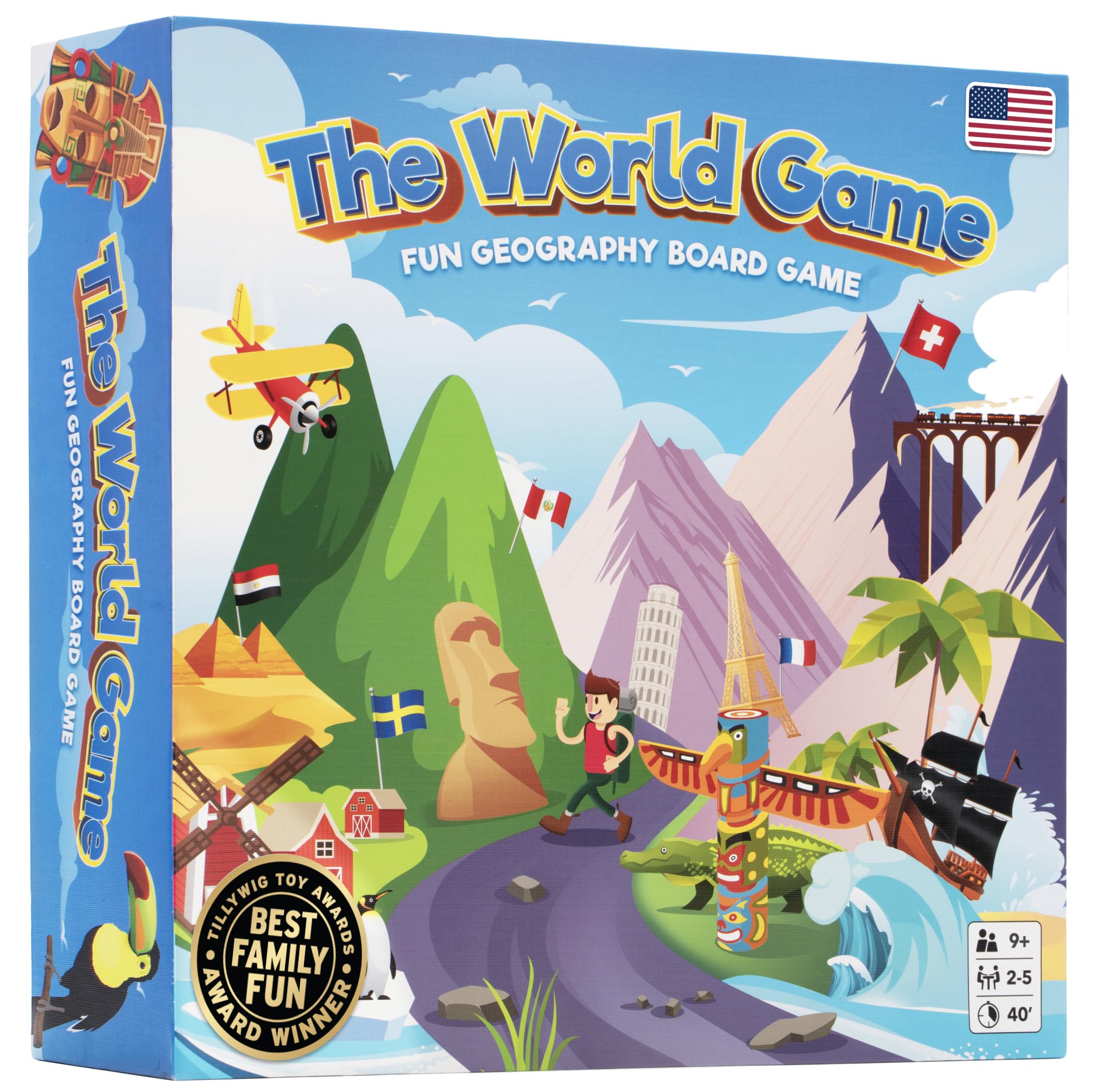
The World Game takes a global approach to geography by covering all 194 United Nations-recognized countries, not just the major ones. The game board features a world map, and players move around it by answering trivia questions about flags, capitals, country locations, and cultural facts. With over 1,500 facts packed into the card deck, this game is essentially a world atlas disguised as a race around the planet.
Gameplay involves identifying a country on the map, naming its capital, or recognizing its flag. The “Human Development Index” cards add an extra layer of depth for older players who want to understand economic and social indicators. The estimated playtime of forty minutes feels appropriate for kids ages nine and up, though younger children with strong reading skills can still participate with adult support. The cards are double-sided and can double as flash cards for independent study between game sessions.
The board and card quality are notably solid — thick cardboard with a laminated finish that resists spills and rough handling. The inclusion of all 194 countries means this game travels well conceptually: it’s equally useful for a family in New York, a classroom in London, or a homeschooling group in Tokyo. For families with older kids who have outgrown matching games and want a deeper challenge, The World Game offers legitimate educational depth without sacrificing the feel of a real board game competition.
Why it’s great
- All 194 world countries represented with regularly updated data
- Cards serve double duty as trivia and flash cards for independent learning
- Human Development Index cards add a unique analytical layer
- Durable board and card construction withstands repeated family use
Good to know
- Forty-minute playtime may feel long for younger or impatient players
- Reading-level requirement is higher — pre-readers will need a reading buddy
FAQ
What age is too young for a traditional board game?
How many players is ideal for a family game night?
Which type of game is best for a reluctant reader?
Final Thoughts: The Verdict
For most users, the best children’s board games winner is the ThinkFun Zingo Bingo because it balances broad age compatibility, durable components, and genuinely replayable mechanics that work for both pre-readers and early readers. If you want a phonics-focused multisensory experience that supports neurodivergent learners, grab the The Fidget Game SquishyLand. And for an active outdoor alternative that requires zero reading and gets kids off the couch, nothing beats the Toysmith Chasing Fireflies.

Mo Maruf
I created WellFizz to bridge the gap between vague wellness advice and actionable solutions. My mission is simple: to decode the research and give you practical tools you can actually use.
Beyond the data, I am a passionate traveler. I believe that stepping away from the screen to explore new environments is essential for mental clarity and physical vitality.