Our readers keep the lights on and my smoothie glass nicely filled. As an Amazon Associate, I earn from qualifying purchases.
Specs are compiled from manufacturer listings and verified buyer reviews and can change over time — please confirm the key details on the product page before buying.
The single biggest mistake parents make when buying children’s binoculars is treating them like toys. A flimsy plastic pair with foggy lenses frustrates a child within minutes and ends up in the back of a closet. You want binoculars that are genuinely tough, easy for small hands to focus, and sharp enough that a kid actually sees a bird, not a blur. That is what this guide sorts out: real binoculars for real kids, built for backyard exploration, hiking trails, and the occasional drop on a rock.
I’m Mohammad Maruf — the founder and writer behind WellFizz. This guide is built by comparing the manufacturers’ published specifications and the patterns across verified customer reviews, so you get each pick’s real strengths and trade-offs instead of marketing spin.
Here is what matters most: the best children’s binoculars combine a forgiving field of view, rugged construction, and optics clear enough to keep a child engaged. Without those three things, the adventure stops before it starts. This guide walks through the top picks for children’s binoculars, from indestructible multi-packs for a classroom to premium optics that could serve a budding naturalist for years.
Our Picks at a Glance


How To Choose The Best Children’s Binoculars
A child’s first binocular is a gateway to the outdoors, but the wrong specs kill the excitement fast. Too much magnification makes everything shake. A narrow field of view makes finding a bird feel like a scavenger hunt. Start with a 6x to 8x magnification, a wide objective lens, and a focus system a 5-year-old can actually turn.
Magnification and Field of View
You want a magnification that keeps the image steady in a child’s hands, so a 6.5x or 8x magnification is the balance. Higher numbers like 10x or 15x might sound better on the box, but they magnify every tiny hand tremor into a bouncing mess. The field of view — measured in feet at 1,000 yards or in degrees — is the real hero: a wider number, 7 degrees or more, means a child actually finds what they are looking at before their arms get tired.
Build Quality and Weight
Binoculars for kids need to survive drops onto concrete, gravel, and the bottom of a daypack. A rubber-armored exterior (a thick, grippy rubber coating) absorbs shock and gives a non-slip hold. Weight matters too — a pair over 12 ounces will feel heavy dangling from a child’s neck for a long hike. Aim for under 8 ounces if you can.
Focus Type: Center Wheel vs. Fixed
A central focus wheel lets a child fine-tune the view as the distance changes, which is ideal for older kids who can manage a small turnable dial. Fixed-focus binoculars are preset to a specific distance (like 50 to 100 feet) and require zero adjustment, making them perfect for young children who just want to look without fiddling. The trade-off is that anything closer or farther than the preset range is blurry.
Quick Comparison
| Model | Best For | Magnification | Objective Lens | Field of View | Amazon |
|---|---|---|---|---|---|
| Vortex Bantam HD 6.5×32★ Best Overall | Premium Build | 6.5x | 32 mm | 7.6° | Amazon |
| Carson Hawk HU-530Smart Value | Budget Starter | — | 30 mm | — | Amazon |
| Obuby 8×21Crowd Favorite | Value & Volume | 8x | 21 mm | 7.2° | Amazon |
| Carson Wild Cat WC-718 | No-Focus Simplicity | 7x | 18 mm | 430 ft | Amazon |
| Tezilon 8×21 | Classroom Set | 8x | 21 mm | 6.8° | Amazon |
| BeBison 8×21 | Durable All-Rounder | 8x | 21 mm | 7.2° | Amazon |
| Aurosports 15×25 | High-Power Zoom | 15x | 25 mm | — | Amazon |
| Yunsailing 6-Pack | Party & Play | 4x | 30 mm | — | Amazon |
In‑Depth Reviews
1. Vortex Bantam HD 6.5×32 Youth Binoculars
Our pick — over 4.5★ from 300+ verified ratings; the strongest balance of quality and price.
The youth binocular that refuses to compromise on build or clarity, backed by a lifetime warranty.
You do not have to settle for wobbly plastic because the user is a kid. This Vortex delivers HD optical system glass, XR anti-reflective coatings on every lens surface for better light transmission, and a 6.5x magnification that stays steady in small hands. The 32mm objective lens gathers enough light for crisp views even in low evening light, and the 7.6-degree field of view — the widest on this list — makes tracking a moving squirrel or a soaring hawk genuinely easy for a child. It beats the Obuby’s 7.2-degree view by a noticeable margin, and at 6.5x it gives a sharper, less shaky image than a 10x or 15x.
Buyers report the build is a standout: “lightweight, compact, rubber-armored grip, solid build.” The whole thing is nitrogen-purged and sealed, so it is both waterproof and fogproof — a rarity in youth bins. The 18.7mm of eye relief (the distance you can hold the binocular from your eye and still see the full picture) means it works well for kids who wear glasses. The focus wheel is smooth and precise, and rubber armor covers every edge to absorb drops. Critics call the eye cups a minor learning curve, and some note slight edge distortion when panning, but the chorus is undeniable: this is the best binocular for a young naturalist that money can buy right now.
The Real Deal
- True HD glass with XR coatings — images are sharp, bright, and color-accurate
- Fully waterproof and fogproof, not just splash-resistant
- Unlimited, unconditional, lifetime VIP warranty that transfers with the binocular
- Wide 7.6-degree field of view makes target acquisition much easier
The Trade-offs
- 6.5x magnification is lower than some 8x or 10x models, but more stable
- Eye cups can take a little getting used to for first-time users
- Premium price compared to budget multi-packs
A naturalist’s pick: This is the one for a child who is genuinely curious about birds, wildlife, or stargazing — it grows with them and won’t break. Not for: A family needing six cheap pairs for a party; the value here is in one pair that lasts.
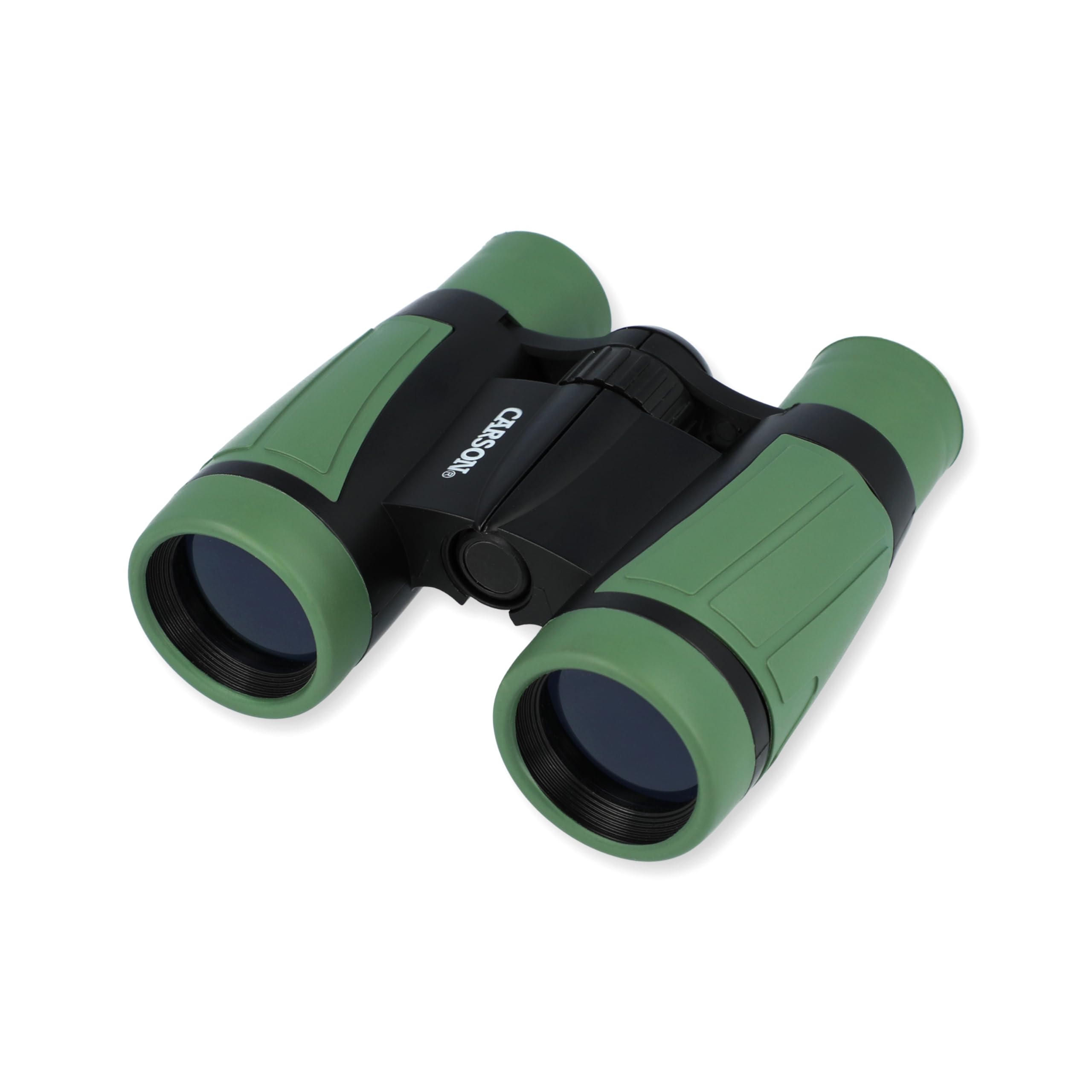
2. Carson Hawk Kids 30mm Beginner Field Binoculars (HU-530)
A lightweight 30mm starter that keeps the price low but puts real glass in front of a child’s eyes.
The big 30mm objective lens is the headline here — at 30mm versus the 21mm lenses on many kid binoculars, more light reaches the eye and the image looks brighter, especially in the shade of a tree line or at dusk. The binocular is designed for young adventurers, weighing only 0.28 pounds (about 4.5 ounces), so it won’t tire a neck or a small grip. What owners like most is the overall quality given the price — the quality is the top praised aspect, cited by 58 owners. The binoculars are simple to use with a central focus wheel, and they come with a neck strap and a manual.
The catch is durability. 29 owners flagged it as mixed, and a few found the lenses wobbly or prone to falling out. One owner summed it up bluntly: “right lens wobbly and fell out; fixed with super glue.” That is a minority experience, but it is worth knowing that the build is not tank-grade. For a 3- to 8-year-old who is careful or supervised, this is a fine entry point. For a hard-playing kid who will drop them on concrete, you might want the extra armor of the BeBison or Vortex.
The value proposition: A bright 30mm view for very little money — perfect for a first pair that you won’t feel bad if it disappears under a car seat. The reality check: The lens-on-barrel construction can be inconsistent; occasional units need a dab of glue to hold things together.
3. Obuby 8×21 Real Binoculars for Kids
Over 13,000 owners agree: this is the 8×21 that is tough enough to survive a kid’s daypack.
There is safety in numbers, and this binocular has the biggest crowd on the list. It uses BAK4 prisms and a multi-layer broadband FMC coating to cut internal reflections, so the image stays crisp and colorful even in bright sun. The 8x magnification is the balance for kids — enough reach to see a bird’s markings, not so much that every heartbeat shakes the view. The 7.2-degree field of view (which means a 378-foot span at 1,000 yards) is wide enough for a child to scan a field without losing the target. As buyers describe it: “the leaves of a tree 122ft/1000 yards away came into sharp focus.” More than 1,000 owners specifically praise the quality, and 999 mention the durability — the polycarbonate plastic and rubber armor are built for drops.
At 7.5 ounces and a 3.5 x 2.3 x 1.5-inch frame, it fits a 5-year-old’s hands but also works for an adult in a pinch. The included accessories — a carrying bag, a drawstring velvet bag, a lanyard, and a cleaning cloth — add real value. The only complaint that surfaces more than once is the nylon lanyard, which owners call cheap and uncomfortable for long wear. Swap it for a padded strap and you have a near-perfect budget binocular that can handle a 9-year-old’s curiosity and a 4-year-old’s inventiveness.
The consensus: The most-purchased kids binocular on this list for a reason — real optics, real durability, real value. A small catch: The included neck strap is a thin nylon rope; budget a few dollars for a better one if the binocular will be worn for long hikes.
4. Carson Wild Cat 7x18mm Focus Free Binoculars for Kids
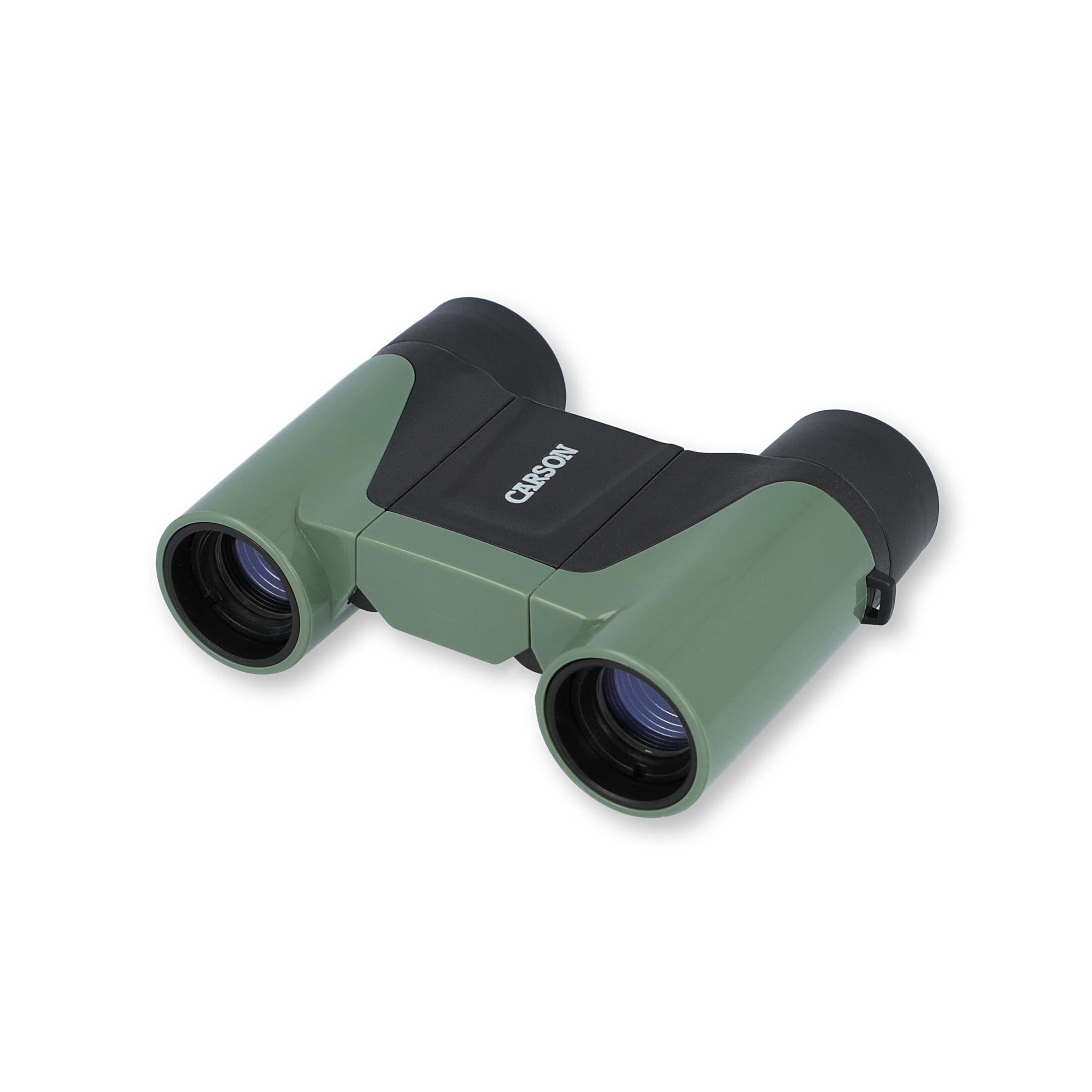
The “pick it up and look” binocular that removes the focus wheel as a point of friction for little kids.
If you have ever watched a five-year-old try to turn a stiff focus wheel, you understand why a fixed-focus binocular has a loyal audience. The Wild Cat is preset for an optimal viewing range of 50 to 100 feet — the exact distance of a bird feeder on a lawn or a squirrel climbing a tree. It uses roof BK7 prisms to deliver a sharp, high-contrast image at 7x magnification, which is low enough to be steady but high enough to see detail. The field of view is 430 feet at 1,000 yards, which is generous for this class.
Owners describe the build as “tough” and “not toy-grade,” and the adjustable bridge between the lenses lets a parent set the right interpupillary distance for any child. The 13mm eye relief is adequate, though not as generous as the Vortex. The missing case gets mentioned — there is no included storage pouch, and the neck strap is tricky to attach. But for a kid who just wants to look without asking for help focusing, this is the most frustration-free option. Keep a microfiber cloth handy and you are set for a day of backyard exploration.
Best for: A child under 7 who cannot manage a focus wheel yet, or any kid who gets impatient fiddling with knobs. Remember: Objects closer than about 50 feet or farther than 100 feet will be out of focus — this is a near-to-mid-range tool only.
5. Aurosports 15×25 Compact Binoculars for Kids
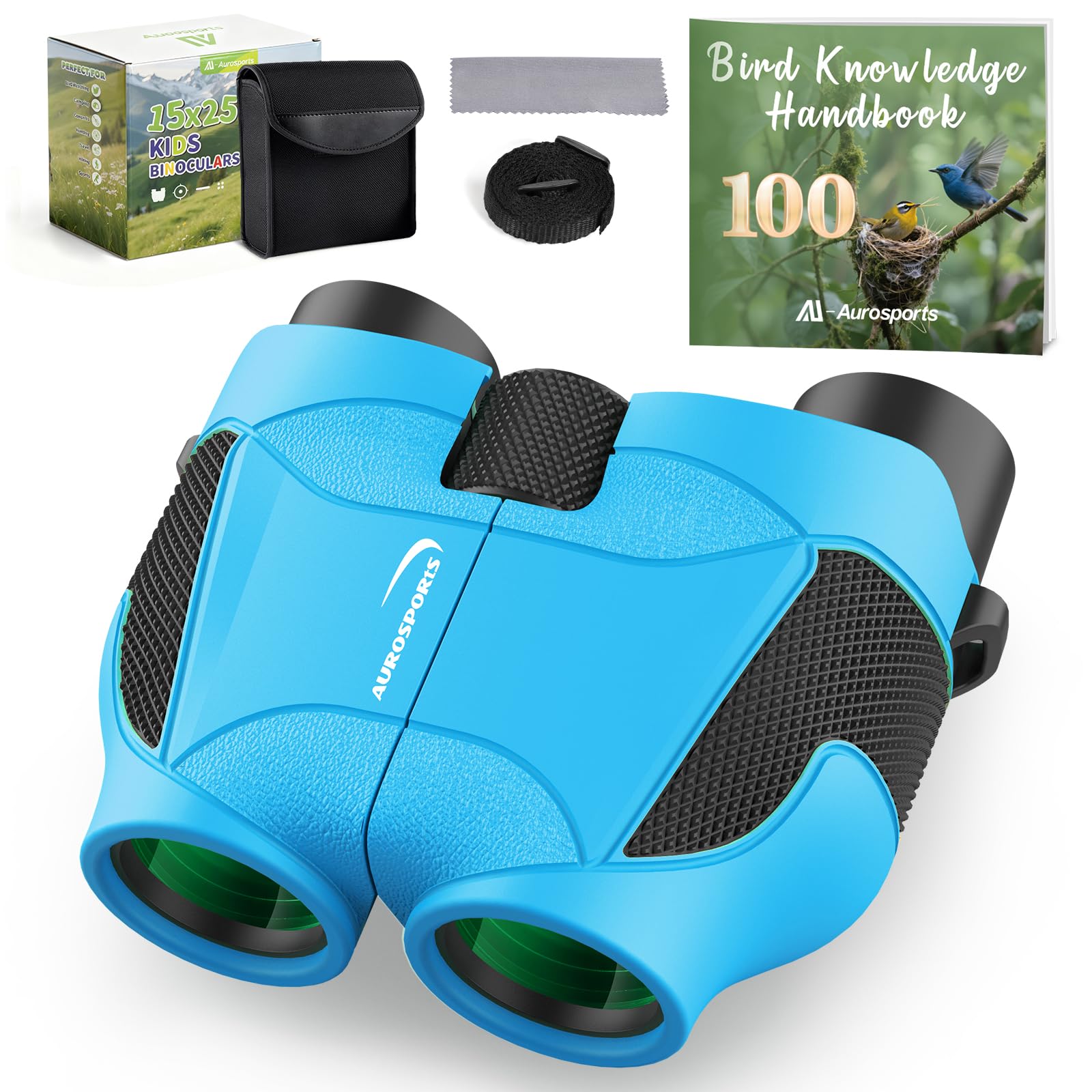
The strongest magnification on the list, ready for a child who wants to see detail across a valley.
With 15x magnification and a 25mm objective lens, this binocular is for older kids (say, 8 and up) who can hold steady or who will use it propped on a fence post. The BAK4 prism and FMC (Fully Multi-Coated) lens coatings control reflections and deliver bright, clear images. The included bird guide handbook is a nice touch that turns looking into learning. A diopter adjustment ring on the right eyepiece lets you balance the view for a child whose left and right eyes have slightly different vision — a feature almost no budget kids binocular provides.
The trade-off is that 15x makes every hand shake visible. The view edges noticeably when the binocular is not braced, so younger children will struggle with it. Owners also note that the binocular can fog up when moving between drastically different temperatures (air conditioning to hot, humid outdoor air). The solution is simple: let it acclimate slowly. At 0.9 pounds, it is the heaviest pair here, but the tripod-adaptable design helps. For a bird-obsessed 10-year-old or a child in a wide-open landscape, the reach is class-leading.
Who this fits: An older child with decent hand steadiness who wants to see details like bird markings or distant trail signs. Not for: Young kids who will shake, drop, or get frustrated by a twitchy image.
6. Tezilon 8×21 High-Resolution Binoculars for Kids
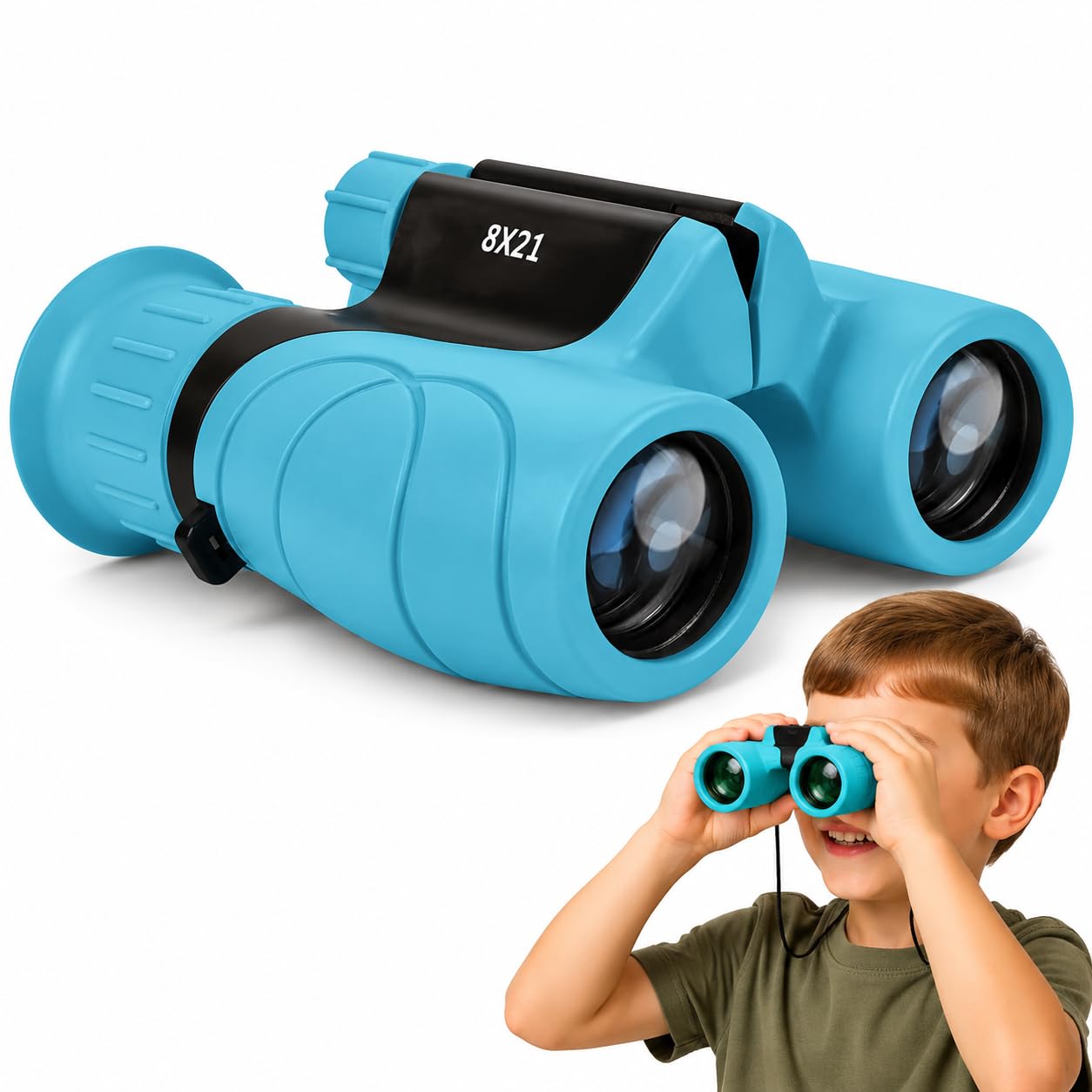
A reliable, easy-to-focus 8×21 that shows up on time and works for the price.
The Tezilon hits the standard markers: 8x magnification, a 6.8-degree field of view (just over 350 feet at 1,000 yards), and a multi-layer FMC prism coating to reduce reflections. The exterior is polycarbonate (a tough, lightweight plastic) wrapped in soft rubber armor that helps absorb drops. Owners praise the quality — it is the top mentioned aspect by 10 owners — and call the clarity good enough for a child to see individual leaves on a tree. It folds to adjust for different eye widths.
A couple of honest flaws: the included strap is a wrist strap, not a neck strap, which makes it easier for a child to drop than a full-length lanyard. And a small percentage of units arrived with focus issues — two out of six purchased in one batch would not focus properly. That inconsistency makes this a fine solo buy, but a riskier choice for a classroom set where you need every pair to work. The 21mm eye relief is very generous, so it works well for children who wear glasses.
The takeaway: A solid, inexpensive 8×21 for a single child, especially one who wears glasses. The asterisk: QC is not perfect; if you need six identical, working pairs, test them immediately on arrival.
7. BeBison 8×21 Binoculars for Kids

A compact 8×21 with military-grade glass and a reputation for surviving energetic play.
This binocular earns its praise from two strong numbers: 39 owners single out the quality, and 30 call out the durability. The rubber armor covers a metal mount inside, not a cheap plastic hinge, so it handles drops and rough handling with less risk of a snapped bridge. The 8×21 design uses anti-reflective coatings and 7.2-degree field of view, and the eye relief is 10mm — snug but workable for most kids. The package includes a wide neck strap that distributes weight better than a thin cord, a cotton carrying bag, and a cleaning cloth. Buyers sum it up: “compact, lightweight, sturdy, sharp image.”
The metal mount is the hidden spec note — many kids binoculars at this price point use all-plastic internal hinges that loosen over time. The BeBison avoids that failure mode. At 7.68 ounces, it is still light enough for a 4-year-old. The only downside mentioned is that the image, while sharp, is not quite as bright as a 30mm objective model like the Carson Hawk, because the 21mm lens gathers less light. If your child mostly uses binoculars in full daylight, you will not notice the difference.
The strong point: Metal internal construction under the rubber armor gives it genuine durability that toy-grade bins lack. The weak spot: The 10mm eye relief is short; children with thick glasses may need to hold the binocular slightly away from their eyes.
8. Yunsailing 6-Pack 4×30 Binoculars for Kids

Six pairs of low-magnification 4×30 binoculars that make outdoor exploration a group activity.
This is not a set for serious birding; it is for a birthday party, a classroom scavenger hunt, or a summer camp where every child needs a pair. The 4x magnification is forgiving and steady, and the 30mm objective lens keeps the view bright. With a fixed focus, there is no knob for a child to fight — they just lift and look. The binoculars weigh next to nothing, come in six vivid colors, and each one packs into a canvas drawstring bag. 20 owners specifically praise how suitable they are for kids, and 8 love the color variety.
The magnification is low — you can see about 328 to 492 feet at the farthest under good weather — so do not expect to read a license plate. Some owners correctly note that “there’s no zoom magnification,” and durability is a mixed bag: they can survive gentle play, but a full-speed throw onto pavement might crack the plastic. These are toy-grade binoculars that happen to have real lenses. They are perfect for a group of 3- to 6-year-olds who just want to feel like explorers together. For a single serious child, spend the money on a single good pair from further up this list.
The ideal use: A classroom party, a nature-themed playdate, or Operation Christmas Child shoeboxes. Not the right choice for: A child who wants to see detailed bird markings or distant trail markers — the 4x magnification just is not enough reach.
Understanding the Specs
Magnification and Objective Lens
These two numbers always appear together, like 8×21 or 6.5×32. The first number is the magnification — how many times closer an object appears. 8x means a bird at 80 feet looks like it is 10 feet away. The second is the objective lens diameter in millimeters. A larger number (32mm vs 21mm) lets in more light, so the image is brighter in low light. The trade-off is that a bigger lens makes the binocular heavier and bulkier.
Field of View
This is how wide a scene you can see, usually measured in degrees (like 7.2°) or in feet at 1,000 yards. A wider field of view, say 7.6 degrees, makes it much easier for a child to find a moving animal in the frame. A narrow field, like 5 degrees, feels like looking through a straw — the image is zoomed in, but you have to aim very precisely. For children, a wider field beats higher magnification every time.
Exit Pupil
The exit pupil is the diameter of the beam of light leaving the eyepiece, calculated by dividing the objective lens by the magnification (21mm divided by 8x gives a 2.6mm exit pupil). A larger exit pupil (like 4.9mm on the Vortex 6.5×32) means more light reaches the eye and a brighter image, especially in dim conditions. For a child, a number above 3mm is ideal, since their pupils tend to be wider than an adult’s.
Eye Relief
Eye relief is the distance in millimeters you can hold the eyepiece away from your eye and still see the full field of view. A longer number (18.7mm or more) is critical for children who wear glasses — it allows the glasses to sit between the binocular and the eye without cutting off the edges of the image. A short eye relief (10mm) means a child with glasses has to jam the eyepiece into the lens or remove their glasses entirely.
FAQ
What is the best magnification for a child?
How do I know if a binocular has real prisms or is just a toy?
What does field of view mean for a child’s binocular?
Is a fixed-focus binocular better than one with a focus wheel?
How does the exit pupil affect what my child sees?
Can a child who wears glasses use these binoculars easily?
How durable do kids binoculars need to be?
Should I buy a single good binocular or a multi-pack for siblings?
How do I clean a child’s binocular without scratching the lenses?
What is a diopter adjustment and why does my child’s binocular have one?
Final Thoughts: The Verdict
For most families, the best children’s binoculars to buy is the Vortex Bantam HD 6.5×32 Youth Binoculars. It combines genuinely good glass, a waterproof and fogproof build, and a lifetime warranty that makes this the last kids binocular you will ever buy for that child. If you want something budget-friendly and tough for a younger or rougher explorer, the Obuby 8×21 is the crowd favorite with over 13,000 owners backing it. And if you need to equip a group — a classroom, a birthday party, a camp — the Yunsailing 6-Pack gives every child a pair without the headache of sharing. Whichever you choose, the key is matching the optics and build to the child’s age, patience, and curiosity.
How We Picked
We do not accept paid placement. Every pick is matched to a real buyer and a real use-case; we do not hands-on test units.
Sources & Methodology
Specifications: manufacturer listings and product documentation. Review insights: verified customer reviews, as of July 2026. Pricing: not shown on this page (it changes often); check the current price via the retailer link.
As an Amazon Associate, WellFizz earns from qualifying purchases. This does not affect which products we feature.
Related Guides

Mo Maruf
I created WellFizz to bridge the gap between vague wellness advice and actionable solutions. My mission is simple: to decode the research and give you practical tools you can actually use.
Beyond the data, I am a passionate traveler. I believe that stepping away from the screen to explore new environments is essential for mental clarity and physical vitality.