Our readers keep the lights on and my smoothie glass nicely filled. As an Amazon Associate, I earn from qualifying purchases.
A chess clock isn’t just a timer—it’s the arbiter of strategy under pressure. Whether you’re blitzing through bullet games or grinding through a classical endgame, the right clock translates your thinking into a controlled, unforgiving structure that separates preparation from panic.
I’m Mohammad Maruf — the founder and writer behind WellFizz. I’ve spent countless hours cross-referencing specification sheets, customer reviews, and tournament regulation standards to find the clocks that actually deliver on their promises without breaking the bank.
This guide walks through five of the market’s most compelling digital chess clocks, from budget-friendly workhorses to premium performance models, to help you find the best chess clock for your game.
How To Choose The Best Chess Clock
Choosing a chess clock is about matching the clock’s feature set to your playing style and environment. A casual player might only need a countdown timer, while a tournament competitor demands precise delay, increment (bonus), and multi-period support. Here are the three most important factors to weigh.
Preset Timing Rules & Programmability
The number of preset timing rules determines how quickly you can start a game. Clocks with 36 or 42 presets cover common time controls like G/90+30, 5+2, and 3+0 without manual setup. The ability to customize and save your own parameters is equally critical for players who use niche or house rules.
Rocker Switch & Build Quality
The rocker (or seesaw) switch is the primary physical interface. A quality rocker provides a satisfying tactile click without wobble, is durable enough for thousands of presses, and doesn’t register accidental double-taps. In fast time controls like blitz (3–5 minutes), a sluggish or mushy switch can cost you the game.
Display Readability & Battery Life
A large, high-contrast LCD that shows seconds, move count, and active delay or bonus modes at a glance prevents errors during time pressure. Battery life measured in thousands of hours means you can leave the clock in your tournament bag without worrying about dead cells mid-round.
Quick Comparison
On smaller screens, swipe sideways to see the full table.
| Model | Category | Best For | Key Spec | Amazon |
|---|---|---|---|---|
| Xflyee [2023 New] | Mid-Range | Versatile tournament play | 42 preset timing rules | Amazon |
| LEAP Wood Appearance | Budget-Friendly | Aesthetic board matching | Count-up/countdown to 10 hrs | Amazon |
| A&A Digital Chess Clock | Premium | Blitz & casual play | 4000+ hours battery life | Amazon |
| LEAP Upgraded Model | Mid-Range | School & club use | Bonus & delay functions | Amazon |
| Balana Advanced Digital | Premium | Budget DGT alternative | 42 timing rules, 8 categories | Amazon |
In‑Depth Reviews
1. Xflyee [2023 New] Digital Chess Clock

The Xflyee packs 42 pre-programmed timing rules into a compact, lightweight frame that weighs just over half a pound. This covers virtually every standard time control from classical to bullet, plus a user-programmable slot for custom settings. The large 1.5-inch screen displays seconds, move count, and active bonus or delay indicators simultaneously, reducing squinting during critical endgames.
Reviewers consistently praise its feature-to-price ratio, noting that the economy price includes capabilities found on clocks costing significantly more. The rocker switch on the initial unit felt balky for one user, but the replacement worked flawlessly, suggesting minor quality variation. The included AA batteries get you started immediately, and the ABS shell feels durable enough for tournament bags.
Where the Xflyee shines is in its breadth of timing flexibility: single and multi-segment countdown, bonus (Fischer increment), delay (Bronstein or US Delay), and time-limit modes are all present. The main trade-off is a brief learning curve due to a poorly written manual, but the sheer number of presets means most players can find their control without scrolling menus.
Why it’s great
- 42 timing rules cover all major tournament formats
- User-save slot for non-standard times
- Batteries and carry box included
Good to know
- Manual is confusing — expect trial-and-error setup
- Plastic build feels light, not premium
2. LEAP Wood Appearance Digital Chess Clock
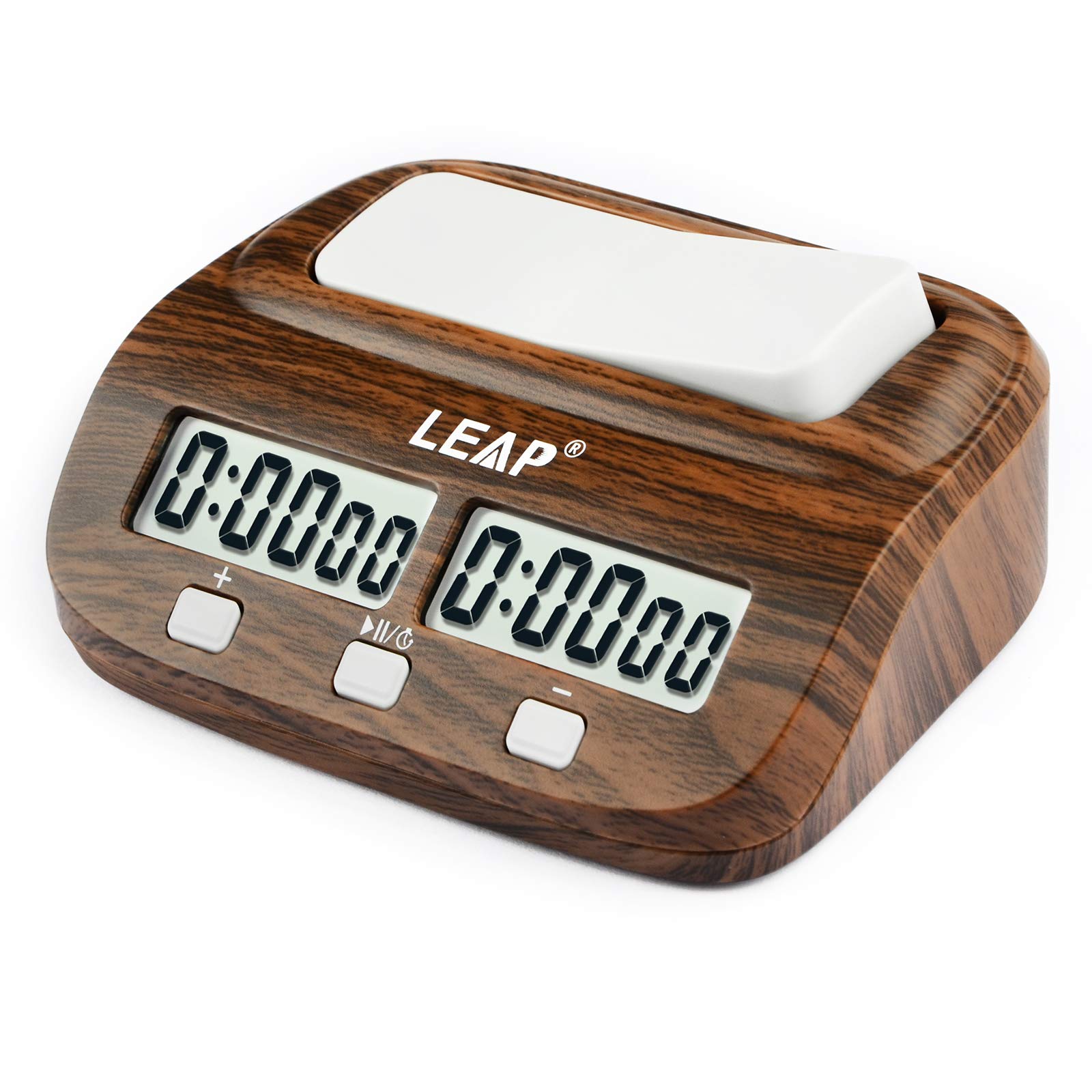
The LEAP Wood Appearance clock stands out visually with its faux-wood grain finish that pairs beautifully with a traditional wooden chess set. Behind the aesthetic lies a capable digital timer that handles countdown and count-up modes up to ten hours, plus bonus (increment) and delay functions. The alarm is adjustable—you can turn it up or down to suit your environment.
Customer feedback highlights solid build quality and responsive buttons, though the instructions are universally described as confusing. A trick that worked for most users: after a power cycle, hold the play/pause button for three seconds to enter time-setting mode, then use the +/- keys to adjust. Once set, another power cycle and a tap on play/pause starts the timer. This is not a plug-and-play experience for the impatient.
The clock runs on a single AA battery (not included) and weighs about 249 grams, making it one of the lighter portable options. It lacks the deep preset library of the Xflyee, but for casual players who want a timer that matches their board’s aesthetic and supports basic increment and delay, this LEAP model delivers reliable performance without overwhelming complexity.
Why it’s great
- Attractive wood-look design complements classic sets
- Count-up mode great for casual or teaching games
Good to know
- Setup requires a unintuitive power-cycle sequence
- Only one preset slot — less flexible for tournament players
3. A&A Digital Chess Clock
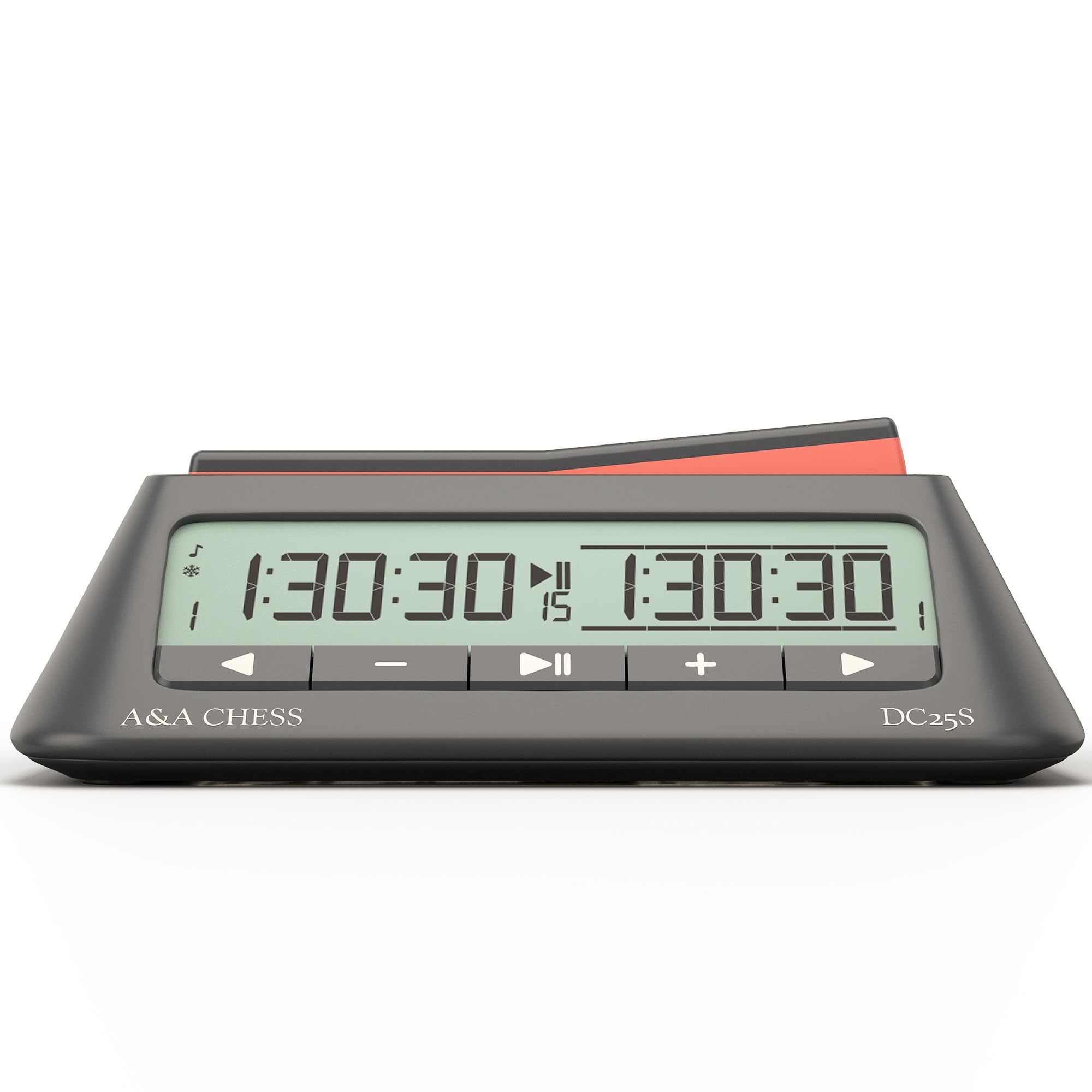
The A&A Digital Chess Clock redefines battery longevity with a claimed 4,000+ hours of use from two AAA batteries. This clock is built for the player who wants to set it and forget it—no battery anxiety during a weekend tournament. The 36 pre-set timing modes cover professional formats, and a quick-reset feature (double-press the ON/OFF button) restarts your last game instantly, a lifesaver in blitz matches.
Its large high-contrast LCD shows time, move count, and active status flags like “Freeze” or “Bonus” simultaneously. The premium rocker switch delivers a smooth, jam-free action that reviewers confirm is responsive even during rapid play. An Arbiter Mode and Forced Move Counter enforce strict competition rules, making this clock suitable for both casual home use and sanctioned club events.
The minimalist design is available in Classic White or Elegant Black, with a matte finish that resists fingerprints. At 7.2 ounces, it’s highly portable, though no carrying case is included. The only notable omission is a user-programmable slot—you’re limited to the 36 built-in presets. For the vast majority of players, however, those 36 modes cover everything from 3+0 bullet to G/90+30 classical.
Why it’s great
- 4000+ hour battery life is best-in-class
- Quick-reset function perfect for blitz sessions
- Arbiter Mode for strict tournament enforcement
Good to know
- No user-programmable slot — reliant on 36 presets only
- Requires 2 AAA batteries (not included)
4. LEAP Upgraded Model Chess Clock

The LEAP Upgraded Model focuses on core functionality without gimmicks. It supports time, bonus (Fischer increment), delay (Bronstein), move counting, countdown, and count-up modes. The seesaw rocker has been tested for thousands of presses, and users confirm it holds up well in club and school environments. The compact dimensions (1 x 3 x 2 inches) make it one of the most pocket-friendly options here.
A unique point from customer reviews: one user repurposed the count-up feature as a focus tracker, using the clock to log on-task vs. distracted time—a testament to the device’s broader utility beyond chess. The clock supports two-player games including chess, Chinese chess, and I-Go, expanding its reach for families or teachers with diverse game collections.
However, there are clear limitations: you cannot set different delay or bonus times for each side, which rules out some advanced training drills. The instructions are passable but not detailed, and the ABS plastic shell, while durable, looks and feels budget-tier. This clock is excellent choice for schools, clubs, and casual home play where simplicity and durability matter more than deep programmability.
Why it’s great
- Ultra-compact and easy to carry anywhere
- Tested rocker switch withstands heavy use
- Supports chess, Chinese chess, and I-Go
Good to know
- Cannot set different bonus/delay times per side
- No preset library — you must manually set each time control
5. Balana Advanced Digital Chess Clock

The Balana Advanced Digital Chess Clock positions itself as a direct, more affordable alternative to the industry-standard DGT North American. It offers 42 timing rules across 8 categories (single/multiple countdown, reward/bonus, time limit, delay, seconds, and forward/count-up timing). Each rule’s parameters can be modified and saved, and the clock retains the last-used settings even after power loss—a critical tournament feature.
Users report that the large 16.1-centimeter screen displays large, easy-to-read numbers, and the blue housing with a red top button gives it a distinct, modern look. The seesaw button provides a satisfying thump rather than a loud click, which some players prefer for quieter play environments. One reviewer noted that the rocker switch on the DGT broke after 30 days while this Balana unit continued working flawlessly, highlighting its surprising durability.
The only real shortcoming is the absence of a default setting for common time controls like G/10 (game in 10 minutes) or 5+2. You’ll need to input those manually. Additionally, the plastic construction, while functional, doesn’t match the denser feel of premium European clocks. For players who want 42 presets and a DGT-like experience at a fraction of the price, the Balana is a confident recommendation.
Why it’s great
- 42 presets cover almost every common time control
- Retains settings after power loss
- Durable rocker switch — outperformed a DGT in user testing
Good to know
- No preset for G/10 or 5+2 — manual input required
- Plastic build feels less dense than premium competitors
FAQ
What is the difference between bonus (Fischer) and delay (Bronstein) timing?
Can I use a chess clock for games other than chess?
How important is battery life when choosing a tournament clock?
Final Thoughts: The Verdict
For most users, the best chess clock winner is the Xflyee Digital Chess Clock because it delivers 42 professional timing rules plus a user-programmable slot at an economy price that outperforms many mid-range competitors. If you want exceptional battery life and a minimalist design for casual and blitz play, grab the A&A Digital Chess Clock. And for a durable DGT alternative with 42 presets and reliable memory retention, nothing beats the Balana Advanced Digital Chess Clock.

Mo Maruf
I created WellFizz to bridge the gap between vague wellness advice and actionable solutions. My mission is simple: to decode the research and give you practical tools you can actually use.
Beyond the data, I am a passionate traveler. I believe that stepping away from the screen to explore new environments is essential for mental clarity and physical vitality.