Our readers keep the lights on and my smoothie glass nicely filled. As an Amazon Associate, I earn from qualifying purchases.
Weeds are relentless — they push through cracks in your driveway, choke out your flower beds, and turn a manicured lawn into a patchy mess within weeks. The difference between a weekend spent re-spraying and a season of clear, weed-free surfaces comes down to one thing: picking the right active ingredient and concentration for the specific weed and location you’re targeting.
I’m Mohammad Maruf — the founder and writer behind WellFizz. I’ve spent countless hours analyzing herbicide labels, active ingredient profiles, mix ratios, and real-world user results to deliver a guide built on data, not marketing hype.
Whether you need to clear a gravel path, eliminate poison ivy from a fence line, or selectively remove crabgrass from your centipede lawn without killing the grass, finding the right chemical to kill weeds starts with understanding the specific formula that matches your exact use case.
How To Choose The Best Chemical To Kill Weeds
Not all weed killers are created equal. The wrong active ingredient can leave your lawn scorched or fail to kill deep-rooted perennials. Focus on these three factors before buying.
Active Ingredient Matching
Diquat dibromide delivers rapid, non-selective knockdown — visible damage within hours — but does not translocate to roots, making it ideal for annual weeds on driveways and patios. Mesotrione is a selective pre- and post-emergent that bleaches foliage white over 2-3 weeks and is safe on many cool-season turfgrasses. Triclopyr targets woody brush, poison ivy, and hard-to-kill perennials by moving through the plant’s vascular system.
Concentrate vs Ready-to-Use
Concentrates require mixing with water in a tank sprayer but treat hundreds to thousands of square feet per bottle, saving money on large properties. Ready-to-use formulas are convenient for spot-treating small areas but cost significantly more per ounce of active ingredient.
Selective vs Non-Selective
Selective herbicides like mesotrione or the 2,4-D/dicamba blend in Fertilome Weed Free Zone kill broadleaf weeds without harming lawn grasses when used correctly. Non-selective formulas like Spectracide (diquat) kill any vegetation they contact, so they are best for paving stones, gravel, and bare soil.
Quick Comparison
On smaller screens, swipe sideways to see the full table.
| Model | Category | Best For | Key Spec | Amazon |
|---|---|---|---|---|
| Ferti-lome Weed Free Zone | Selective | Lawn-safe broadleaf control | Dicamba-based, 80+ weeds | Amazon |
| Liquid Harvest Mesotrione | Selective | Crabgrass & clover in turf | Mesotrione 8 oz concentrate | Amazon |
| Roundup Poison Ivy Plus | Non-selective | Woody brush & poison ivy | Triclopyr + diquat blend | Amazon |
| Ortho GroundClear Super Concentrate | Non-selective | General tough weeds & grasses | 32 oz, treats 1,120 sq ft | Amazon |
| Spectracide Weed & Grass Killer | Non-selective | Fast visible results on hardscapes | Diquat dibromide, 3-hour action | Amazon |
In‑Depth Reviews
1. Fertilome Weed Free Zone
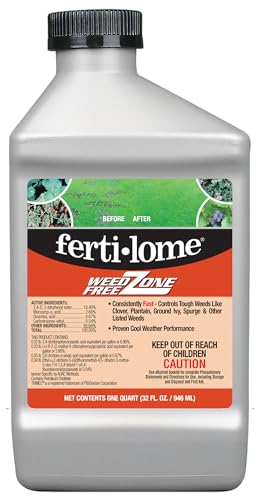
Ferti-lome Weed Free Zone has earned a reputation among homeowners and lawn professionals as the definitive answer for creeping Charlie, clover, spurge, and thistle. Its dicamba-based formula delivers visible injury within hours of application, and users consistently report that it kills stubborn broadleaf perennials that other products fail to touch. The concentrate mixes at a low rate — meaning a single bottle handles large lawns — though many experienced users find they need to double the labeled concentration for tough weeds like creeping Charlie.
It is explicitly safe on Kentucky bluegrass, Bermuda, Bahia, and zoysia when applied according to the label, giving you selective control without torching your turf. The biggest complaint is the price per ounce, which runs higher than general-purpose non-selective killers. Users also recommend adding a drop of dish soap as a surfactant to improve leaf adhesion, especially on waxy-leaved weeds.
For any homeowner fighting a broadleaf invasion while trying to preserve a healthy lawn, this concentrate delivers the broadest spectrum of selective control available in a consumer-grade bottle.
Why it’s great
- Kills creeping Charlie and clover when others fail
- Safe on multiple common lawn grass species
- Rapid visible wilting within hours
Good to know
- Requires roughly double the recommended dose for some weeds
- Higher cost per ounce than non-selective alternatives
2. Liquid Harvest Mesotrione

Liquid Harvest Mesotrione is the consumer-bottle version of the professional active ingredient Tenacity, and it is the rare selective herbicide that works both pre-emergently (stopping crabgrass seeds from germinating) and post-emergently (killing existing crabgrass, clover, dandelion, and 46 other species). The mode of action — inhibiting photosynthesis — causes affected weeds to turn white before dying over a 2–3 week window.
It is safe on centipede grass, tall fescue, Kentucky bluegrass, and St. Augustine grass (sod only), but it will damage Bermuda, zoysia, and bentgrass if applied during active growth. Users consistently report that a single application at the low rate of 1 teaspoon per 2 gallons of water killed heavy crabgrass and wild violet without harming centipede turf. The slow, bleached die-off can be unnerving if you expect rapid browning, but the long-term control is excellent.
Because the concentrate is extremely potent, a tank sprayer with a dye indicator is strongly recommended to avoid overlapping and over-application, which can temporarily stunt the desirable grass itself.
Why it’s great
- One bottle handles both pre-emergent and post-emergent control
- Safe on centipede and St. Augustine when used correctly
- Highly concentrated — low rate goes a long way
Good to know
- Kills weeds slowly over 2-3 weeks; white bleaching can alarm new users
- Will damage Bermuda and zoysia if applied to active turf
3. Roundup Poison Ivy Plus Tough Brush Killer

Roundup Poison Ivy Plus Tough Brush Killer is specifically formulated for the worst woody invaders — poison ivy, poison oak, poison sumac, wild blackberry, and kudzu — that laugh at standard glyphosate or diquat-only sprays. The three-active-ingredient blend (triclopyr, fluazifop, and diquat dibromide) delivers both rapid top-kill and systemic root translocation, ensuring that thick, woody vines don’t simply regrow from underground rhizomes a week later.
Users clearing overgrown fence lines, trails, and building perimeters report visible curling and browning within hours and complete vine death within a week. The “hack and squirt” method — cutting into the stem and spraying directly into the wound — is a common high-efficiency technique for mature poison ivy trunks. Be warned that this is a potent non-selective formula; any drift onto desirable shrubs, flowers, or lawn grass will kill them too. A respirator and full skin coverage are strongly advised during mixing and spraying.
The rainfast window is a tight 30 minutes, which is excellent for unpredictable weather, and the concentrate covers roughly 1,500 square feet per bottle when mixed at the standard rate.
Why it’s great
- Kills deep-rooted brush and poison ivy that resist standard herbicides
- Rainproof in only 30 minutes
- Visible results in hours
Good to know
- Highly non-selective — will kill any plant it touches
- Requires proper PPE including respirator for safe application
4. Ortho GroundClear Super Concentrate
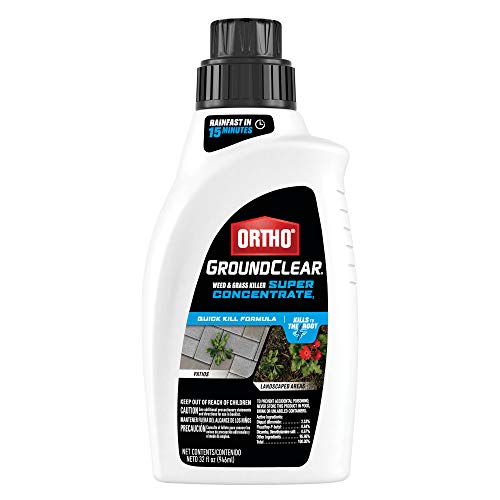
Ortho GroundClear Super Concentrate is a reliable, no-fuss non-selective killer that targets tough weeds and grasses including crabgrass, dandelion, clover, and chickweed down to the root. The formula starts working immediately upon contact and becomes rainfast in only 15 minutes, making it one of the fastest rain-safe options on the market. Users mixing it at the label rate report that knee-high grass along fence lines is visibly dying within 3–4 days and completely gone within a week.
At 32 ounces treating up to 1,120 square feet, it offers strong value per square foot compared to ready-to-use spray bottles. A common user tip is to add a bit more concentrate than recommended for especially thick or mature weeds — though doing so will reduce the total coverage per bottle. It works best when air temperatures are above 60°F and weeds are actively growing, so spring and early summer applications deliver the fastest results. The main limitation is that it is entirely non-selective, so it should never be applied over lawn grass or near desirable ornamentals.
For clearing large patches of gravel, driveway cracks, and pathways without breaking the bank, this concentrate is a solid workhorse.
Why it’s great
- Fast rainfast time of 15 minutes
- Good coverage area per bottle at a reasonable cost
- Works on a wide range of tough grasses and broadleaf weeds
Good to know
- Non-selective — cannot be used directly on lawn turf
- Some users need stronger mix for thick, established weeds
5. Spectracide Weed and Grass Killer Concentrate
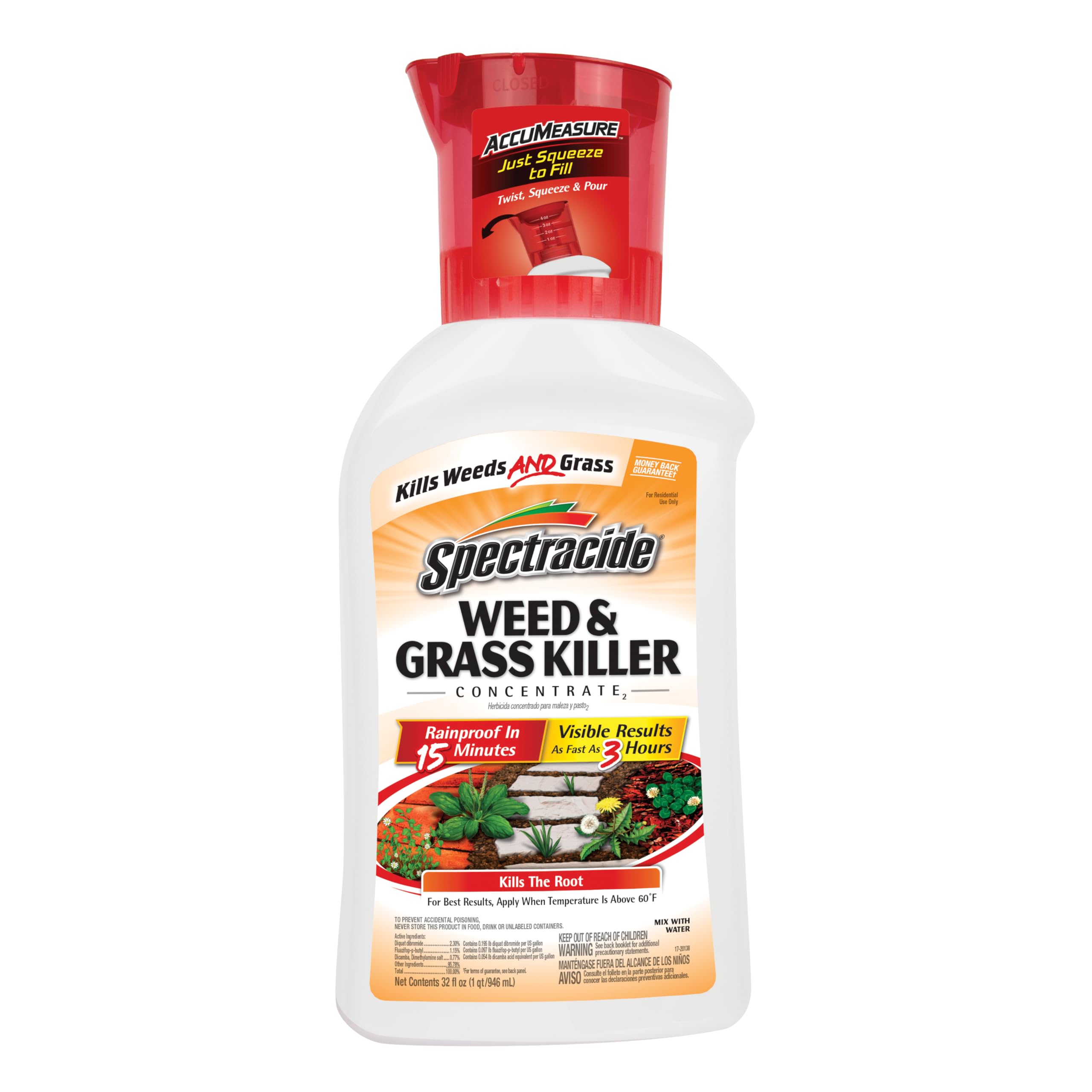
Spectracide Weed and Grass Killer Concentrate is built around diquat dibromide, a contact herbicide that desiccates leaf tissue on contact — users see wilting and browning within 3 hours on sunny days. It is strictly non-selective and does not move into the root system, which means it is ideal for cleaning up annual weeds and grasses along curbs, driveways, walkways, and around flower beds where you want to replant the same weekend. The root-kill claim on the label refers to top-growth starvation, not systemic translocation.
The Accumeasure cap system lets you squeeze the bottle to fill an integrated measuring chamber, then pour directly into your sprayer without a separate measuring cup. While some users find this cap flimsy or prone to clogging, many appreciate the convenience. The formula is rainfast after just 15 minutes. At roughly 1,350 square feet per 32-ounce bottle, it provides excellent coverage for the price point, making it one of the most budget-conscious options for large hardscape areas.
Keep in mind that any overspray hitting desirable plants will damage them, and because diquat does not travel through roots, deep-rooted perennials like dandelions may regrow from the taproot within a week or two after the top dies back.
Why it’s great
- Extremely fast visible results — often the same day
- Rainfast after only 15 minutes
- Large coverage area for the bottle size
Good to know
- Does not kill roots; perennial weeds may regrow
- Accumeasure cap sometimes leaks or breaks
FAQ
Can I use a selective weed killer on my vegetable garden?
How long after spraying can I let my dog on the lawn?
What does “rainfast in 15 minutes” actually mean?
Final Thoughts: The Verdict
For most users, the chemical to kill weeds winner is the Ferti-lome Weed Free Zone because it tackles the widest variety of tough broadleaf weeds — including creeping Charlie — while being safe on common lawn grasses when applied correctly. If you need a selective post-emergent that works on crabgrass without harming centipede or St. Augustine, grab the Liquid Harvest Mesotrione. And for clearing poison ivy, blackberry, and woody brush from property edges, nothing beats the Roundup Poison Ivy Plus Tough Brush Killer.

Mo Maruf
I created WellFizz to bridge the gap between vague wellness advice and actionable solutions. My mission is simple: to decode the research and give you practical tools you can actually use.
Beyond the data, I am a passionate traveler. I believe that stepping away from the screen to explore new environments is essential for mental clarity and physical vitality.