Our readers keep the lights on and my smoothie glass nicely filled. As an Amazon Associate, I earn from qualifying purchases.
If you are handling harsh chemicals, the wrong glove can mean a painful chemical burn, a ruined task, or wasted money on gear that fails after a single use. The real challenge is that “chemical resistant” on a label covers everything from light cleaning to full solvent immersion, and the right pair for you depends on exactly what you are touching and how far up your arm the splash risk goes. This guide cuts through the confusion by comparing five distinct options — from heavy-duty PVC sleeves to precision nitrile disposables — so you know which material and design actually protects against your specific job.
I’m Mohammad Maruf — the co-founder and writer behind WellFizz. This guide is built by comparing the manufacturers’ published specifications and the patterns across verified customer reviews, so you get each pick’s real strengths and trade-offs instead of marketing spin.
Whether you are dealing with pool chemicals, lacquer thinner, engine oil, or caustic cleaning agents, the right best chemical resistant gloves keep you safe, comfortable, and productive without tearing after a few uses.
How To Choose The Best Chemical Resistant Gloves
Three decisions separate a comfortable, lasting protective glove from one that leaves you exposed or frustrated. Focus on material, length, and thickness first — everything else is secondary.
Pick the Right Material for the Chemical
Nitrile is the go-to choice for oils, fuels, solvents, and many acids because it resists punctures and does not cause latex allergies. PVC (polyvinyl chloride) is a strong choice for alkalis, acids, and caustic chemicals, and it stays flexible even after long exposure to harsh substances without hardening. If you are handling petroleum products, nitrile generally wins; if you are working with strong pool chemicals or alkalis, PVC is often the better fit.
Match the Length to Your Exposure
Glove length is measured from the fingertip to the cuff, and it determines what part of your arm stays dry and safe. A 13-inch gauntlet covers your wrist and lower forearm — enough for most cleaning and mechanical work where splashes stay low. A 26-inch elbow-length glove adds protection all the way past your elbow, which you want when immersing your arms into drums, deep tanks, or chemical baths. The gap between these two lengths is a full 13 inches, so do not guess — measure the depth of your risk.
Consider Thickness and Liner for Comfort and Durability
Thickness is measured in mils (one mil equals one-thousandth of an inch). An 8-mil disposable glove offers moderate protection for short-term handling and fine dexterity. A 15-mil unsupported nitrile glove is noticeably heavier and stands up to repeated use and aggressive solvents. Gloves with a cotton liner pull on more easily and wick some sweat, but the liner can shed or absorb chemicals over time. Unlined gloves are easier to clean inside and last longer in tough chemical environments.
Quick Comparison
On smaller screens, swipe sideways to see the full table.
| Model | Category | Best For | Key Spec | Amazon |
|---|---|---|---|---|
| Atlas 772 26-inch Nitrile | Premium | Full-arm chemical immersion & poison ivy removal | 26-inch elbow-length nitrile | Amazon |
| SHOWA 727 Unsupported Nitrile | Premium | Heavy-duty lab, auto & food-safe chemical work | 15-mil thick, CE Cat III rated | Amazon |
| PACIFIC PPE 26″ PVC | Mid-Range | Alkalis, caustics & deep-sink scrubbing | 26-inch PVC with cotton liner | Amazon |
| LANON Black Nitrile Disposable | Mid-Range | Mechanic work, grilling & short-term chemical handling | EN ISO 374 rated, textured grip | Amazon |
| PACIFIC PPE 8 Mil Nitrile Disposable | Budget | High-volume shop work & everyday chemical resistance | 8-mil thick, 100-count box | Amazon |
In‑Depth Reviews
1. Atlas 772 26-inch Nitrile X-Large Elbow Length Yellow Gloves

26 inches of continuous nitrile from fingertip to past the elbow, with no leak-prone seam, makes the Atlas 772 the top pick for anyone who needs to submerge their entire forearm in chemicals, oils, or water. Its nitrile construction resists oils, fuels, and acids without causing allergic reactions, and the sleeve stretches a full 13 inches longer than the SHOWA 727’s gauntlet. Buyers report it as “the first pair of arm gloves that didn’t tear after less than 3 uses,” and reviewers specifically note it works flawlessly for clearing two acres of poison ivy and for fish pond maintenance where your arms stay submerged in cold water; the elastic in the upper sleeve keeps the glove in place so you do not lose protection when reaching upward or bending your arm.
These gloves do not breathe well — reviewers mention they get sweaty in high humidity — but for tasks where uninterrupted elbow-length chemical protection is non-negotiable, the Atlas 772 delivers a dependable, comfortable seal that cheaper gloves simply cannot match.
For full-arm chemical protection without leaks, the Atlas 772 is the definitive choice.
Why it’s great
- Full 26-inch elbow length protects entire arm without gaps
- Nitrile stays flexible and resists a wide range of chemicals
- Elastic upper sleeve keeps the glove from slipping down
- No seams that can wick chemicals inside
Good to know
- Can feel hot and sweaty in humid conditions above 75°F
- Cotton liner may absorb moisture over time
2. SHOWA 727 Chemical Resistant Gloves, 15-mil Unsupported Nitrile
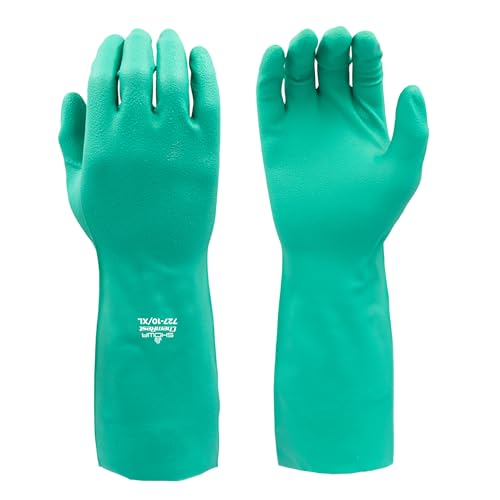
The SHOWA 727 beats the top-pick Atlas 772 on sheer certified chemical protection — it carries a CE Cat III rating (the highest safety category for “irreversible hazard” chemicals) and a Type A rating against solvents, oils, and animal fats, whereas the Atlas 772 is rated Cat II. At 15-mil thick (a mil is one-thousandth of an inch; 15 mils is almost twice as thick as standard disposable gloves), it is a noticeably heavier, more robust barrier than the 8-mil disposable options below, and it has no liner, so there is no fabric to absorb chemicals and no liner to shed inside the glove. That means your skin stays safer in the long run because nothing traps chemical residue against it.
The bisque grip surface provides superior traction on oily or wet tools, making it a favorite in pharmaceutical labs and automotive shops where precision handling of slippery parts is routine. One reviewer noted they last “10x longer than store gloves” and have been using the same pairs daily since November 2020 without holes — a testament to the durability of the 15-mil unsupported nitrile. If your priority is certified, heavy-duty chemical defense rather than full-arm immersion, this is the glove to reach for.
Choose the SHOWA 727 over the top pick when your work demands the highest certified chemical barrier against solvents, oils, and animal fats, and you prefer a liner-free design that eliminates chemical absorption and residue against your skin.
Where it shines
- CE Cat III and EN ISO 374 Type A certified for serious solvents and acids
- 15-mil unlined nitrile resists punctures and chemicals without liner degradation
- Bisque texture provides excellent grip on oily and wet surfaces
- Pack of 12 offers good value for repeated heavy use
Worth noting
- 13-inch length is shorter than elbow-length options for deep immersion tasks
- Sizing runs slightly large; you may need to size down
- No liner means less insulation against heat or cold
3. PACIFIC PPE 26″ Rubber Chemical Resistant Gloves, PVC Reusable

If your work involves pool chemicals, industrial alkalis, or caustic cleaning agents, this PVC glove from PACIFIC PPE is made for exactly that world. One buyer says flatly: “I use these when dispensing particularly caustic chemicals in my pool” — a real-world scenario where the PVC (polyvinyl chloride) material resists the alkali attack that would degrade many nitrile gloves over time. Like the Atlas 772, it gives you 26-inch elbow-length coverage, but it uses a non-slip sandy textured palm that achieves the highest level 4 abrasion resistance (meaning it withstands at least 8,000 cycles on a sanding machine) to handle gritty, grinding tasks. That helps you grab rough concrete or sharp metal without wearing through the glove.
The 13-gauge seamless cotton liner makes these easy to pull on for long periods without discomfort, but owners mention a trade-off: the “liner strips” and “absorbs grime,” meaning you will need to wash these gloves more frequently than unlined options. On the plus side, the PVC material maintains over 90% of its mechanical strength after 96 hours of continuous operation at 158°F — so it does not soften or fail under heat like some rubber blends. If you need alkali protection at elbow depth and have sensitive skin, these are a solid choice because they are latex-free.
That PVC maintains over 90% of its mechanical strength after 96 hours at 158°F — a heat-and-chemical endurance that few rubber blends can match.
What stands out
- 26-inch PVC construction excels against alkalis, caustics, and acids
- Level 4 abrasion resistance handles rough, gritty work without wearing through
- Cotton liner makes them comfortable for extended wear and easy to pull on
- Latex-free for users with sensitive skin or allergies
The trade-offs
- Cotton liner sheds lint and absorbs chemicals, requiring regular cleaning
- Can feel warm inside during high-temperature work or summer conditions
- PVC is less flexible than nitrile in cold weather
4. LANON Black Nitrile Disposable Gloves, EN ISO 374 Chemical Resistant

The single number that matters most in the disposable glove category is the EN ISO 374 certification standard — it tells you the glove has been independently tested against specific chemicals. The LANON Black Nitrile gloves carry this rating, which immediately places them above unbranded nitrile gloves that only claim “chemical resistant” without any certified backing. That means you can trust it for short-term contact with oils, fuels, and diluted acids during mechanic work or grilling.
The catch you accept is that these are disposable-grade (not meant for prolonged immersion in concentrated solvents). One reviewer who uses them for mechanic work says they are “oil and fuel resistant for short term handling,” and the textured fingertips give you a useful grip on tools without feeling like a slippery medical glove. The black color also hides grease and grime, so they look clean longer during garage or shop sessions. If EN ISO 374 protection matters to you but a reusable glove does not suit your workflow (say you only need splash defense for a few tasks a day), this is the certified, mid-range pick that fills that gap.
For the price, you get certified chemical resistance in a disposable format that outspecs basic nitrile options, making it a solid value if you need verified protection without the cost of a heavy-duty reusable glove.
The upsides
- EN ISO 374 chemical resistance certification for tested protection
- Textured fingertips improve grip on oily and wet parts
- Black color hides dirt and stains during messy work
- Latex-free and reusable several times if not heavily contaminated
Keep in mind
- Disposable thickness limits long-term heavy chemical exposure
- Not ideal for strong solvents like 70% IPA according to some users
5. PACIFIC PPE 8 Mil Heavy-Duty Strength Nitrile Gloves, 100-Count
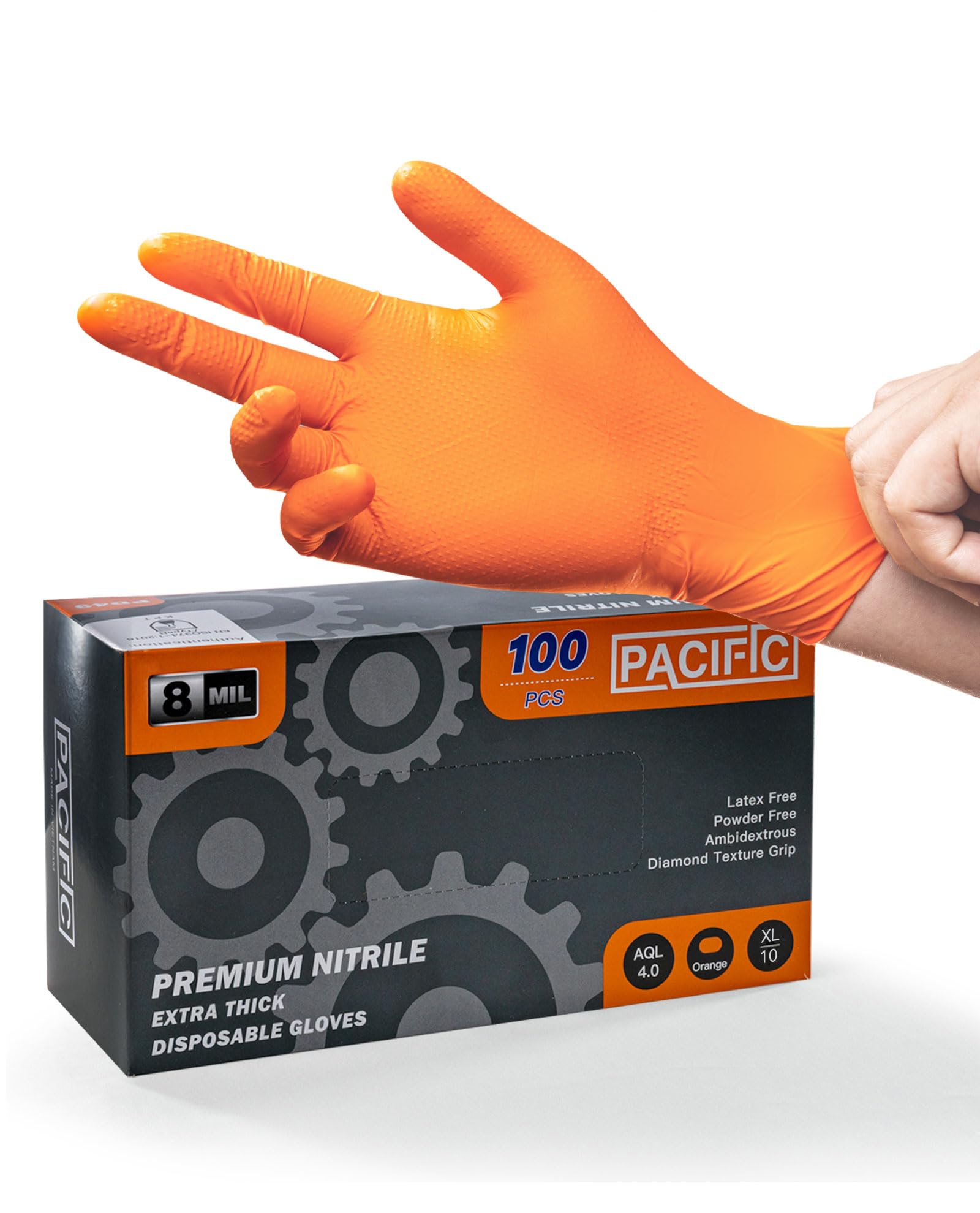
What you actually get at this lower price is a 100-count box of 8-mil-thick nitrile disposables that are noticeably thicker than standard exam-grade gloves (typically 3–5 mils), giving you a durable barrier for high-volume shop work without the premium cost. One buyer reports they “hold up to lacquer thinner longer than any others,” which speaks to the material quality in real-world use.
What you give up is official chemical certification: these gloves meet FDA 21 CFR for food contact and have an AQL of 4.0 for pinhole resistance (meaning up to 4% of gloves in a batch may have a tiny pinhole), but they lack an EN ISO 374 rating, so you rely on user reports rather than third-party tested chemical resistance data. The diamond texture provides good grip and touch-screen compatibility, but the ambidextrous design means no left/right anatomical curve, so they feel slightly looser than form-fit gloves.
If your budget is tight and you need bulk supply for everyday chemical handling, oil, and grime — but you are not submerging in concentrated acids — this 100-count box is the exact value-driven answer for the budget buyer who wants sturdy disposables without paying for certifications they do not need.
Why we’d pick it
- 8-mil thickness is noticeably stronger than standard disposable nitrile
- 100-count box in a dispenser keeps your workspace stocked and organized
- Diamond texture provides solid grip and touch-screen compatibility
- Holds up to lacquer thinner better than other disposables, per buyer reports
A few caveats
- No EN ISO 374 chemical resistance certification, so limits are unknown
- Ambidextrous fit is less ergonomic than shaped gloves
- A few users found the dispenser box opening tricky
Understanding the Specs
Glove Length (Inches)
The most overlooked spec. A 13-inch glove covers your hand and forearm to mid-arm — fine for washing dishes, light chemistry, or automotive work. A 26-inch glove extends past your elbow, which you need when reaching into drums, fish ponds, or chemical baths. The difference is not minor: 13 extra inches of protection mean your skin stays dry even when your whole arm is submerged.
Thickness (Mils)
A mil is one-thousandth of an inch. Standard disposable nitrile runs 3-5 mils; 8-mil gloves are noticeably tougher and resist punctures better. Heavy-duty gloves jump to 15 mils, which changes the feel — you lose some fingertip sensitivity but gain real protection against aggressive chemicals and mechanical abrasion. Thicker is not always better if you need fine motor control, but for raw chemical defense, thicker wins.
Material — Nitrile vs PVC vs Latex
Nitrile resists oils, fuels, and solvents without causing the allergic reactions that latex triggers. It also stands up to punctures better than latex. PVC excels against alkalis, acids, and caustics — think pool chemicals and industrial cleaners — and stays flexible even after long chemical exposure. Latex offers good elasticity but is useless for anyone with a latex allergy and degrades faster in contact with oils. Always match the material to your specific chemical.
Certification — EN ISO 374, CE Cat III, FDA
EN ISO 374 means the glove has been laboratory-tested against a defined list of chemicals (Type A, B, or C depending on how many it resists). CE Cat III is the strictest European safety category, reserved for gloves protecting against “irreversible” hazards — it is the gold standard for serious chemical work. FDA compliance means the glove is safe for incidental food contact. Without these marks, the “chemical resistant” claim is unverified.
FAQ
Can I reuse chemical resistant disposable nitrile gloves?
What is the difference between 13-inch and 26-inch glove length?
Does “8 mil” thickness mean a glove is chemical resistant?
How do I know which chemical resistant glove is right for my specific solvent or acid?
Why do some chemical resistant gloves have a cotton liner and others do not?
Final Thoughts: The Verdict
Across the board, the best chemical resistant gloves winner is the Atlas 772 26-inch Nitrile because it provides the longest arm coverage with dependable nitrile protection that actually lasts beyond a few uses. If you want certified heavy-duty chemical resistance with an unlined design and a CE Cat III rating, grab the SHOWA 727 Unsupported Nitrile. And for bulk disposable chemical resistance on a budget, the standout is the PACIFIC PPE 8 Mil Nitrile 100-Count for value.

Mo Maruf
I created WellFizz to bridge the gap between vague wellness advice and actionable solutions. My mission is simple: to decode the research and give you practical tools you can actually use.
Beyond the data, I am a passionate traveler. I believe that stepping away from the screen to explore new environments is essential for mental clarity and physical vitality.