Our readers keep the lights on and my smoothie glass nicely filled. As an Amazon Associate, I earn from qualifying purchases.
Specs are compiled from manufacturer listings and verified buyer reviews and can change over time — please confirm the key details on the product page before buying.
Scarring from breakouts leaves behind texture and discoloration that standard cleansers cannot touch. A chemical peel for acne scars resurfaces that damaged layer, speeding up cell turnover so fresh, even skin emerges. But the acid strength and formula type make the difference between a glow and a regret. You will find four real picks here, each matched to a different tolerance and scar depth — from a gentle enzyme blend to a professional-strength acid — so you can choose without guesswork.
I’m Mohammad Maruf — the founder and writer behind WellFizz. This guide is built by comparing the manufacturers’ published specifications and the patterns across verified customer reviews, so you get each pick’s real strengths and trade-offs instead of marketing spin.
Our Picks at a Glance

How To Choose The Best Chemical Peel For Acne Scars
Acne scars sit at different depths, so picking the right peel is about matching the acid’s penetration power to your scar type. A shallow boxcar scar needs a different approach than deep ice-pick marks. Here are the factors that separate a helpful peel from a painful mistake.
Acid Type and Strength
Glycolic acid (an AHA, or alpha hydroxy acid, which exfoliates the skin’s surface) penetrates deeper because its molecule is small, making it effective for surface scars and hyperpigmentation (dark marks left after a pimple). Salicylic acid (a BHA, or beta hydroxy acid, which is oil-soluble) travels into pores and clears the congestion that keeps scars inflamed. Enzyme peels use fruit acids like papaya and pineapple to digest dead skin cells more gently, ideal for beginners or sensitive skin. The percentage on the bottle tells you the concentration — 40% glycolic is professional-strength, while enzyme blends often stay milder.
pH Level and Contact Time
A lower pH means a more acidic solution and a stronger peel. For home use, a pH above 1.5 is safer for self-application. The time you leave the peel on your face directly controls its depth — even a strong acid can be safe if you start with one minute and build gradually. Most products recommend increasing contact time over several sessions as your skin builds tolerance.
Your Skin Tone and Sensitivity
Darker skin tones (Fitzpatrick 4, 5, and 6 — skin that tans easily and rarely burns) have a higher risk of post-inflammatory hyperpigmentation (dark patches after inflammation) from strong acids, especially resorcinol found in Jessner peels. If your skin burns easily or reacts to new products, an enzyme peel or a lower-concentration glycolic option lets you test the waters without risking long-term discoloration.
Quick Comparison
| Model | Best For | Acid Type | Strength | Size | Amazon |
|---|---|---|---|---|---|
| Pineapple Pumpkin Enzyme Skin Peel★ Best Overall | Sensitive skin, first-time users | Enzyme + AHA | Mild (enzyme-based) | 1 oz | Amazon |
| Glycolic Acid Peel 40% | Deep exfoliation, fading hyperpigmentation | Glycolic (AHA) | 40% | 1 oz | Amazon |
| Dermalure Jessner Solution 14% | Stubborn texture, boxcar scars | Jessner (Resorcinol + AHA) | 14% (pH 1.9) | 1 oz | Amazon |
| MedPeel Glycolic & Salicylic Set | Professional-grade dual-acid treatment | Glycolic + Salicylic (AHA + BHA) | 30% Glycolic / 10% Salicylic | 1 oz each | Amazon |
In‑Depth Reviews
1. Pineapple Pumpkin Enzyme Skin Peel 1 oz
Our pick — 4.5★ from 400+ verified ratings; the strongest balance of quality and price.
This enzyme-driven peel fades scars without a chemical burn — buyers report it delivers a controlled sting of only 1.5 out of 5.
You get gentle resurfacing from fruit enzymes (papain from papaya and bromelain from pineapple) that digest dead skin cells. The formula includes lactic acid (a milder AHA that is less abrasive than glycolic) and pumpkin extract to boost cell turnover. Owners mention that after starting at one minute and working up to 2.5 minutes, scars become less noticeable and sun spots fade. One owner noted that acne scars faded and sun spots on forearms lightened after a five-minute application. The 1-ounce bottle lasts multiple sessions, and reviewers repeatedly stress: use SPF afterward because new skin burns easily in the sun.
Compared to the 40% Glycolic Acid Peel below, this is significantly milder — buyers describe the glycolic as “pretty strong” while this earns “mild peel (sting 1.5/5)” ratings. If your skin is easily irritated, you get fading without the harsh downtime.
Gentle enzyme exfoliation
- Gentle enough for twice-weekly use — sensitive-skin customers note no injury after following instructions.
- Natural exfoliants (papaya, pineapple, pumpkin) brighten tone without the harshness of high-concentration acid.
- Visible scar and sun-spot fading reported within 2-3 sessions.
Mild for deep peels
- Milder formula means slower results for deep boxcar or ice-pick scars compared to higher-acid options.
- Some first-time users experience blotchy redness that lasts 2-3 days before peeling reveals clearer skin underneath.
Sensitive skin: your skin is easily irritated, you are new to at-home peels, or you want a weekly resurfacing option that doubles as a maintenance treatment.
Tough wrinkles: you need aggressive exfoliation for deep scarring and have experience handling high-concentration acids.
2. Glycolic Acid Peel 40% Professional Chemical Peel

At 40% glycolic acid, this is the strongest single-acid peel on the list — but it requires careful handling to avoid burning.
You get professional-strength exfoliation from glycolic acid (an AHA with a small molecule that penetrates deep into the skin). Over 5,000 buyers have weighed in, and effectiveness (868 mentions) is the top praise. The formula stimulates collagen production, and reviewers point out that old acne marks fade slowly with regular use once every couple of weeks. A reviewer in her late forties noted significant fading of dark spots and minimized scars. The bottle is compact (5.28 x 2.8 x 2.72 inches) and the 1 ounce lasts months when used sparingly.
This is not a set-and-forget product. You must dilute it to 20% for sensitive areas, use cotton pads, and keep contact time under one minute for the first session. One reviewer noted it caused burning on active acne and lips — a reminder to apply only on healed skin. Compared to the Pineapple Pumpkin Enzyme Peel, buyers describe this as “pretty strong” and “the real deal,” while the enzyme blend is “mild.” Speed of results comes at the cost of comfort.
Strongest acid strength
- Visible fading of dark spots, hyperpigmentation, and acne scars reported after weeks of consistent use.
- High concentration (40%) delivers faster, more dramatic exfoliation than enzyme or lower-strength AHAs.
- Much cheaper than professional clinic peels — buyers appreciate the value compared to in-office treatments.
Requires experience
- Requires careful dilution and neutralization — no special applicator included, so you must buy separately.
- Skin sensitivity (mentioned 297 times) is a real risk; a patch test is mandatory before full-face application.
Deep resurfacing: have experience with at-home peels, want faster scar fading, and can commit to a careful application routine with sunscreen.
First-time users: have sensitive skin, active breakouts, or are unwilling to do a patch test and follow strict timing.
3. Dermalure Jessner Solution Acid Peel 14% 1oz

This layered triple-acid peel targets stubborn boxcar scars — but the pain can hit 8.5/10, and darker skin tones face extra risk.
You get a classic dermatological combination of resorcinol (a strong exfoliant that can lighten skin), lactic acid, and salicylic acid. At 14% with a pH of 1.9 (very acidic, so it penetrates deep), this is a level 2 peel that demands experience. The effectiveness praise (85 mentions) comes from owners who know how to layer — one reviewer used 2 layers applied 5 minutes apart to tackle boxcar scars and large pores. One owner who did 4 passes on their back described the burning as 8.5/10 pain, requiring a cool shower and baking soda neutralization. The upside: major peeling in sheets revealed flawless skin underneath.
The manufacturer explicitly warns that darker skin tones (Fitzpatrick types 4, 5, and 6 — skin that tans easily) face increased risk of post-inflammatory hyperpigmentation from resorcinol. The bottle is the smallest in footprint (3.94 x 1.97 x 1.18 inches) but packs serious power. This is for those who understand acid layering and can manage redness lasting 3-5 days.
Balanced acid blend
- Triple-acid formula attacks scarring, texture, and pigmentation simultaneously for comprehensive resurfacing.
- Layering allows customized depth — the owner can control intensity by adding or subtracting passes.
- Significant peeling results in sheets, revealing noticeably smoother, more even skin below.
Slow visible results
- Not for sensitive or darker skin tones — resorcinol carries real risk of hyperpigmentation for Fitzpatrick types 4-6.
- Pain level can spike quickly; several owners describe the sensation as intense and recommend having a neutralizer ready.
Even skin tone: you have experience with strong peels, understand layering technique, and want to tackle boxcar scars and uneven texture aggressively.
Quick fixes: you have darker skin, sensitive skin, or are new to chemical peels — start with the enzyme or lower-glycolic option first.
4. MedPeel Glycolic Acid Peel Set
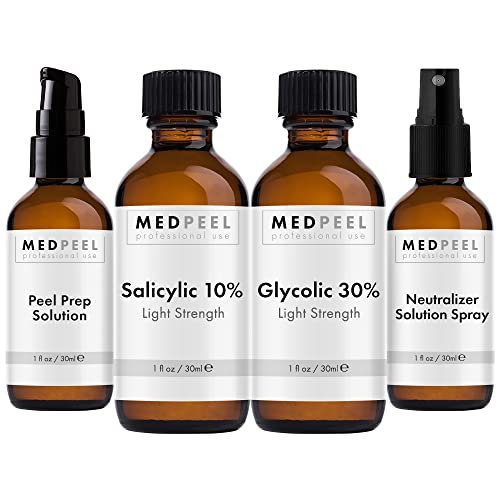
This professional dual-acid system uses a BHA pre-treatment before the AHA — a licensed esthetician of 20 years calls it “the best of the best.”
You get two separate bottles: 10% salicylic acid (a BHA that penetrates oil-filled pores) applied first, followed by 30% glycolic acid (an AHA for deeper resurfacing). The logic is that salicylic clears pore congestion so glycolic reaches deeper into scar tissue. With a 4.4 rating, it ranks highly among buyers, including a licensed esthetician of 20 years who recommends it above other brands. The set addresses fine lines, large pores, and discoloration, and the dual approach makes it appropriate for oily, combination, dry, and normal skin types.
Shoppers say that peeling is present but not unbearable — start with two applications and expect flaking rather than dramatic sheet peeling. The manufacturer recommends a series of 6-8 peels every 2-3 weeks for full results. The set weighs 1.3 pounds (heavier due to two 1-ounce bottles), and the value lies in having both acids in one purchase. Compared to the single-bottle Glycolic Acid Peel 40%, this trades a higher single-acid concentration (40% vs 30%) for the strategic advantage of BHA pre-treatment — ideal if your scars come with persistent blackheads or oily skin.
Complete peel system
- Two-step system (BHA then AHA) targets surface scars and pore congestion in one treatment, boosting overall effectiveness.
- Professional endorsement — an esthetician with two decades of experience recommends it above other brands.
- Made in the USA and cruelty-free, with manufacturing standards that match clinic-grade quality.
Higher upfront cost
- Fewer total reviews (over 100 ratings) compared to the more popular glycolic 40% option, so the long-term experience pool is smaller.
- Requires strict adherence to the 2-3 week schedule and series of 6-8 peels for full results, which demands patience.
Full treatment: you want a professional-grade dual-acid system, have oily or combination skin with blackheads, and are willing to commit to a multi-session plan.
Single use: you prefer a single-step peel or are looking for the simplest routine with the fewest products.
Understanding the Specs
Acid Concentration and pH
The percentage on the bottle (like 40% glycolic or 14% Jessner) tells you how much of the active acid is in the solution — higher percentages generally mean stronger, faster exfoliation. But pH matters just as much: a lower pH number (more acidic) means the acid is more active and penetrates deeper. A 40% glycolic at a high pH could be milder than a 10% formula at a very low pH. For home use, peels with a pH above 1.5 are safer, since anything lower requires professional supervision to avoid chemical burns.
Enzyme vs Acid Peels
Enzyme peels use fruit-derived proteins (papain from papaya, bromelain from pineapple) to digest the bonds between dead skin cells. They are gentler because the reaction stops when the enzymes are neutralized by the skin’s natural pH. Acid peels (glycolic, salicylic, lactic) work by dissolving the “glue” holding dead cells together and can penetrate deeper by lowering the skin’s pH. Enzyme peels are better for maintenance and sensitive skin, while acid peels are more effective for visible scarring and pigmentation.
FAQ
How long does it take for a chemical peel to fade acne scars?
Can I use a chemical peel if I have active acne breakouts?
What is the difference between a Jessner peel and a glycolic peel?
Can darker skin tones use these peels safely?
How often should I use a chemical peel for acne scars?
Do I need to neutralize a chemical peel at home?
Will a chemical peel make my scars worse before they get better?
What sunscreen should I use after a chemical peel?
Final Thoughts: The Verdict
For most people shopping for a chemical peel for acne scars, the Pineapple Pumpkin Enzyme Skin Peel earns the top spot because it balances visible results with a gentle enough formula for weekly use — no harsh downtime, just gradual fading of scars and brightening. If your scars are deeper and you want faster results, the Glycolic Acid Peel 40% delivers serious exfoliation power but demands careful handling. And for textured boxcar scars that resist single-acid treatments, the Dermalure Jessner Solution offers the aggressive layering approach that experienced peel users need.
How We Picked
We do not accept paid placement. Every pick is matched to a real buyer and a real use-case; we do not hands-on test units.
Sources & Methodology
Specifications: manufacturer listings and product documentation. Review insights: verified customer reviews, as of July 2026. Pricing: not shown on this page (it changes often); check the current price via the retailer link.
As an Amazon Associate, WellFizz earns from qualifying purchases. This does not affect which products we feature.
Related Guides

Mo Maruf
I created WellFizz to bridge the gap between vague wellness advice and actionable solutions. My mission is simple: to decode the research and give you practical tools you can actually use.
Beyond the data, I am a passionate traveler. I believe that stepping away from the screen to explore new environments is essential for mental clarity and physical vitality.