Our readers keep the lights on and my smoothie glass nicely filled. As an Amazon Associate, I earn from qualifying purchases.
Specs are compiled from manufacturer listings and verified buyer reviews and can change over time — please confirm the key details on the product page before buying.
You want a chef’s knife that stays sharp and feels balanced, but you do not want to spend a fortune. One clean slice through a tomato without crushing it is the test — and the blade should still pass that test six months later. This guide covers seven knives all under that budget, so you see exactly where your money goes.
I’m Mohammad Maruf — the founder and writer behind WellFizz. This guide is built by comparing the manufacturers’ published specifications and the patterns across verified customer reviews, so you get each pick’s real strengths and trade-offs instead of marketing spin.
Each knife here was chosen because it delivers real cutting performance and durability at its price point, helping you confidently choose the right chef’s knife under 100 dollars.
Our Picks at a Glance

How To Choose The Best Chef’s Knife Under 100
Picking an 8-inch chef’s knife on a budget depends on three main factors: the type of steel, how the blade is made, and the handle’s grip. Nail these, and you will get years of reliable use without needing to sharpen every week.
Blade Construction: Forged vs Stamped
A forged blade is cut from a single bar of steel, heated, and hammered into shape, which makes the steel denser and gives it a better edge — but it costs more to produce. A stamped blade is cut from a pre-rolled sheet of steel, then ground and sharpened. Stamped blades are lighter, thinner, and cheaper, and excellent modern stamped knives like the Victorinox Fibrox Pro prove that a stamped knife can still outperform many cheap forged options.
Steel Type and Edge Retention
High-carbon German stainless steel (common in brands like WÜSTHOF and HENCKELS) resists rust well and is relatively easy to sharpen. Japanese VG10 steel (used by KYOKU and KAWAHIRO) gets harder — around 58 to 62 HRC (a hardness scale for steel) — so the edge stays sharp much longer but can be more brittle if you twist the blade on a bone. For under 100 dollars, VG10 offers the best edge retention, while German steel gives you a tougher, more forgiving blade.
Handle Material and Comfort
You will grip this knife for long prep sessions, so the handle matters a lot. Santoprene and Fibrox (both are synthetic rubber-like polymers) give excellent non-slip grip even when wet. Wood handles like rosewood or maple look premium and feel warm, but they need occasional oiling and cannot go in the dishwasher. POM (a hard plastic) handles are sturdy and water-resistant but can feel slick with wet hands. Pick based on whether you prioritize grip security or looks.
Quick Comparison
| Model | Best For | Blade Length | Construction | Weight | Amazon |
|---|---|---|---|---|---|
| Mercer Culinary Millennia★ Best Overall | Budget Performance | 7.9 Inches | Stamped | 0.29 lbs | Amazon |
| KAWAHIRO GyutoAlso Great | Premium Value | 8.24 Inches | Forged | 6.72 oz | Amazon |
| Victorinox Fibrox Pro | Best All-Rounder | 8 Inches | Stamped | — | Amazon |
| WÜSTHOF Gourmet | German Precision | 8 Inches | Stamped | 240 g | Amazon |
| HENCKELS Forged Synergy | Forged Durability | 8 Inches | Forged | 11.2 oz | Amazon |
| KYOKU Shogun | Japanese Aesthetics | 8 Inches | Forged | 1.4 lbs | Amazon |
| Victorinox Wood | Classic Look | 8 Inches | Forged | 0.1 kg | Amazon |
In‑Depth Reviews
1. Mercer Culinary M18000 Millennia Black Handle, 8-Inch
The line cook’s secret weapon that delivers Japanese steel performance for a song.
The Mercer Culinary Millennia is a stamped blade made from high-carbon Japanese steel, and it punches way above its price point. The blade is hollow ground (a specific grind that creates a concave edge, which is very sharp), and the Santoprene and polypropylene handle (a combination of rubber for comfort and plastic for durability) gives you a secure grip with textured finger points and even a protective finger guard. It weighs 0.29 pounds, giving it a substantial feel and good momentum for chopping.
Buyers also note that the knife keeps a good edge and is “easy to sharpen with little effort,” though some mention the stamp on the blade slowly disappears, which is a minor cosmetic issue. The Japanese steel allows for rapid sharpening, so you can bring the edge back quickly with a honing rod. At this price, you get a knife that could easily cost double if it had a more premium brand name on it. It is the ideal starter knife for someone who wants performance on a tight budget.
Why It Wins on Value
- High-carbon Japanese steel blade for easy maintenance and rapid sharpening
- Textured Santoprene handle with finger guard for excellent grip and safety
- Hollow ground edge cuts with very little resistance
The Compromise
- At 0.29 lbs, it is noticeably heavier than the top pick Victorinox Fibrox Pro
- Stamped construction and plastic handle feel less premium than forged knives
Ideal for beginners and budget-conscious cooks: you get Japanese steel and a comfortable grip for the lowest price in this lineup.
pass on it if: you can stretch your budget to get a forged blade or a lighter, more nimble stamped knife.
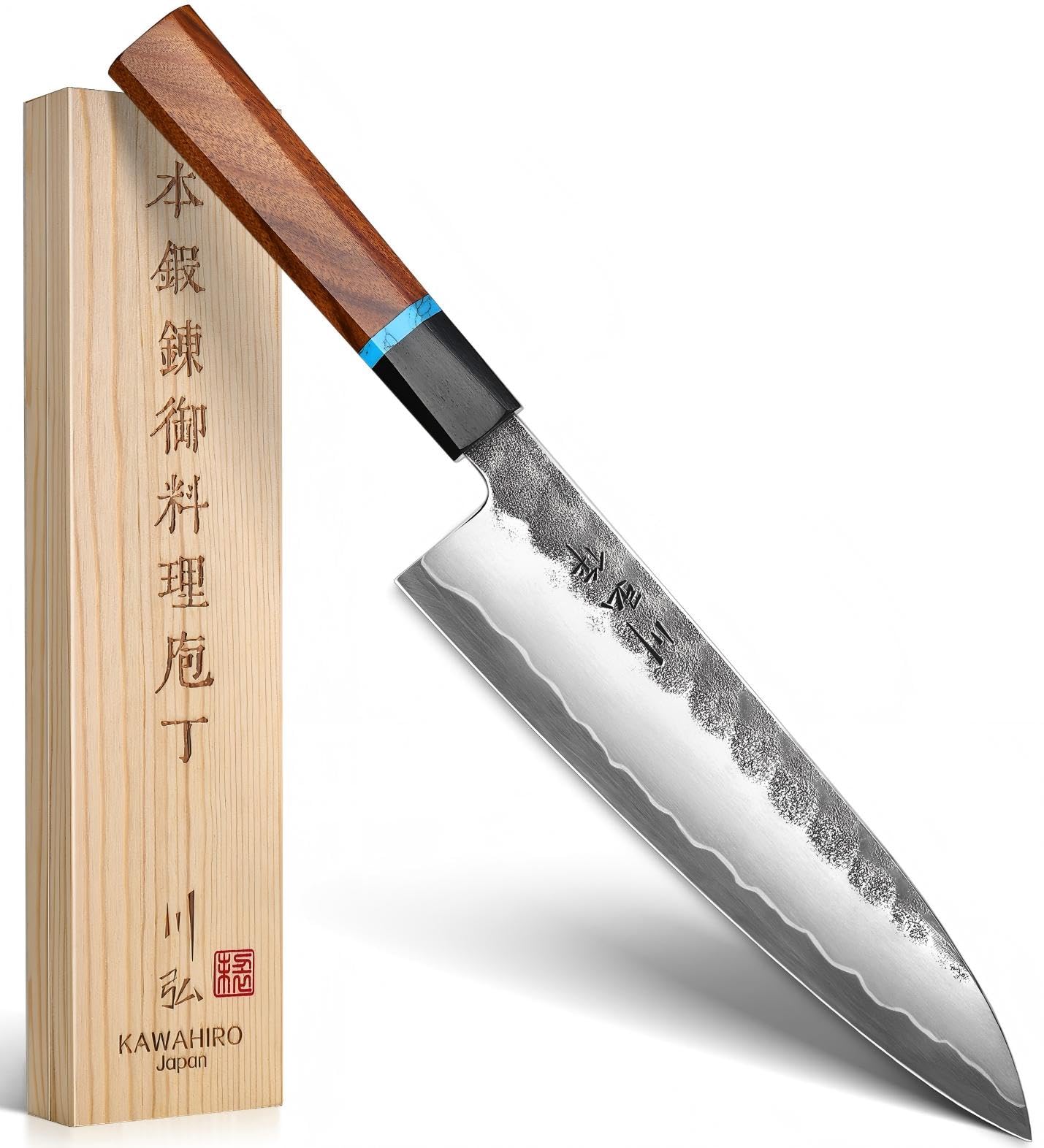
2. KAWAHIRO Japanese Chef Knife, 8 Inch
The near-premium blade that slips under the budget ceiling without cutting corners on steel.
The KAWAHIRO is built around a VG10 stainless steel core clad in a 3-layer composite, which means a very hard core (the maker rates it above 62 HRC) that holds a razor edge for a long stretch. You get a blade length of 8.24 inches, giving you a touch more reach than the standard 8-inch competition. The octagonal handle made from premium ruby wood, turquoise, and ebony is not just for looks — it guides your fingers into a pinch grip naturally and reduces fatigue during long prep sessions. Buyers report it cuts through vegetables and meat easily, and the included wooden gift box makes this a strong candidate if you are also shopping for someone else.
Unlike the lighter Victorinox Fibrox Pro (0.05 lbs vs 6.72 oz), the KAWAHIRO has a more substantial, balanced heft that feels deliberate in the hand. One reviewer noted minor edge chipping after six months of daily use but said it was easily fixed with a quick honing, which is a fair trade-off for the level of sharpness this VG10 core delivers. If you want a knife that looks like a work of art and cuts like a pro tool, this is your pick.
Why It Leads
- VG10 steel core with 62+ HRC rating for long-lasting sharpness
- Beautiful octagonal handle made from ruby wood, turquoise, and ebony
- 8.24-inch blade gives extra cutting length over standard 8-inch knives
One Trade-Off
- Hard steel can micro-chip if twisted on bones or hard squash
- Hand wash only — wood handle will not survive the dishwasher
Best for the discerning home cook: this knife rewards anyone who values edge retention and aesthetics over dishwasher convenience.
skip it if: you want a tougher blade you can abuse on bones or a handle that never needs oiling.
3. Victorinox Fibrox Pro Chef’s Knife, 8 Inch
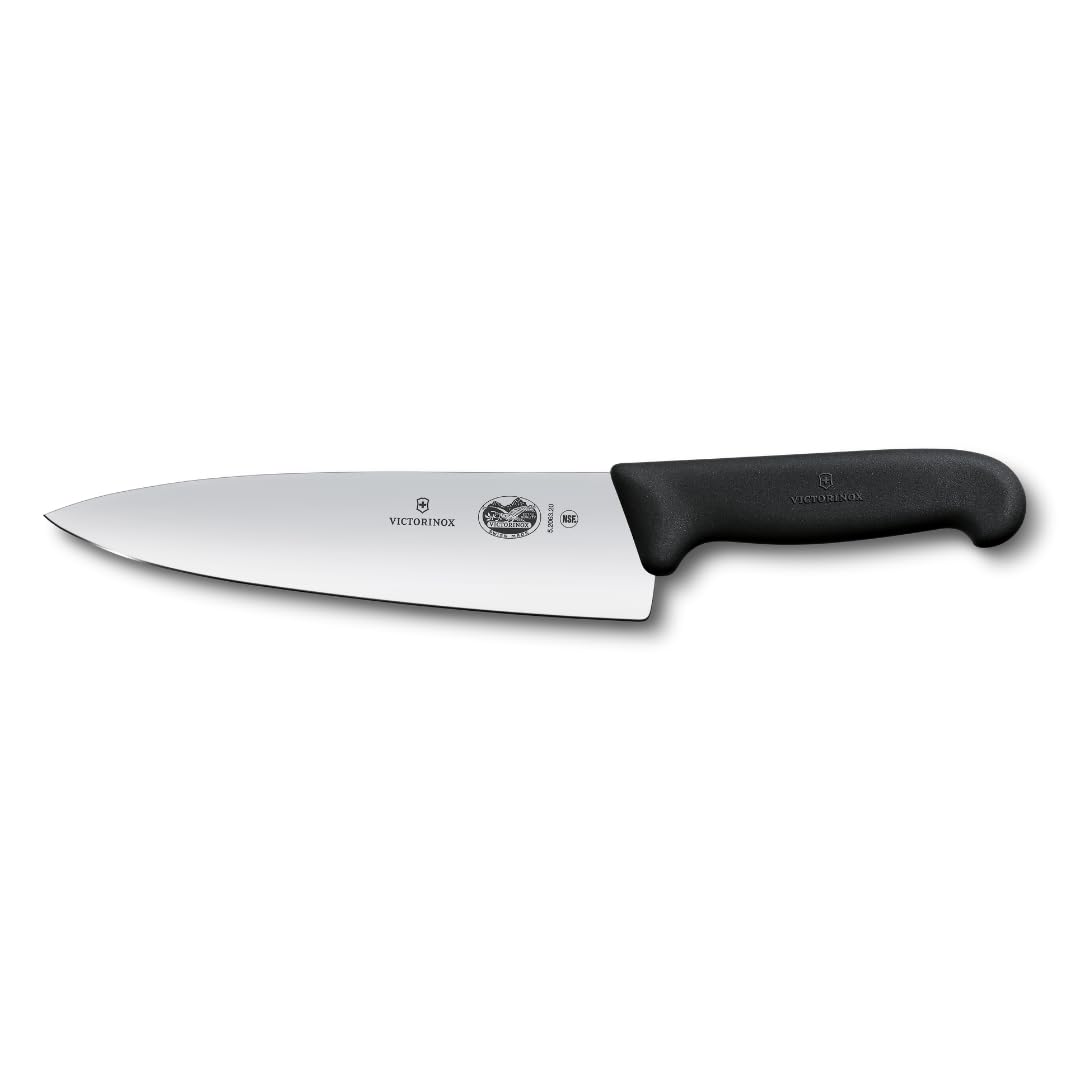
The America’s Test Kitchen champion that proves a stamped blade can out-cut most forged knives.
The Victorinox Fibrox Pro is remarkably lightweight, and that is actually a strength — less hand fatigue when you are prepping for a big meal or a long shift. The 7.9-inch blade is made from high-carbon stainless steel and is sharpened with a laser-tested edge that buyers consistently describe as “scalpel-sharp” right from the start. The Fibrox handle (a thermoplastic elastomer, which is a rubber-like plastic) gives you a non-slip grip even when your hands are wet or oily, which is a huge plus for safety.
One buyer mentioned having the knife for almost two months with daily use, including preparing an entire Thanksgiving dinner, and it performed flawlessly. The Fibrox Pro is noticeably lighter than the Mercer Culinary Millennia, so if you have smaller hands or suffer from wrist strain, this is the gentler choice. It is also dishwasher safe, though hand washing is always recommended to keep the edge longer. This knife is the benchmark for value — it simply works, consistently, for everyone.
The Core Strength
- Extremely lightweight (0.05 lbs) makes it easy on the wrist for long prep sessions
- Non-slip Fibrox handle stays secure even when wet
- Laser-tested blade is razor-sharp right from the start
The Short Side
- Stamped blade feels less substantial than forged options
- Handle design is functional but not visually premium
Reach for this if: you want a proven, no-nonsense performer that professional kitchens trust and your budget will thank you for.
Look elsewhere if: you want the heavier, more traditional feel of a forged knife or prefer a wood handle.
4. WÜSTHOF 8″ Gourmet Chef’s Knife, Black

A heritage name in your hand with an 8-inch high-carbon blade that resists dulling shift after shift.
The WÜSTHOF Gourmet is a stamped blade, but from a maker based in Solingen, Germany — a city known for premium cutlery for over 200 years. The blade is high-carbon stainless steel that is crafted to resist corrosion and dulling, and the POM (polyoxymethylene, a hard-wearing plastic) handle is very durable and water-resistant. At 240 grams, it feels substantial without being heavy, and owners mention the balance is “great making it easy to use.” One long-time home cook reported that after over a month of daily use, the knife retained its edge well and did not need constant resharpening.
Unlike the KAWAHIRO which uses VG10 steel for extreme edge retention, the WÜSTHOF uses a slightly softer German stainless steel that is tougher and less prone to chipping, making it a safer bet if you tend to cut through tougher items. The trade-off is you may need to hone it more often. Reviewers consistently praise how it “transformed” their meal prep routine and note that it feels lightweight but still very sturdy. This is a classic workhorse that does exactly what you expect — no surprises, just reliable cutting.
The Upside
- High-carbon stainless steel resists corrosion and dulling well
- Great balance and comfortable POM handle for long use
- Brand heritage from Solingen, Germany with lifetime warranty
The Downside
- Stamped construction and POM handle feel less premium than forged knives with wood handles
- Edge retention is good but not exceptional compared to VG10 steel
Ideal for the traditionalist: this knife gives you a trusted German brand name with solid, predictable performance for everyday cooking.
Pass on it if: you absolutely want a forged blade or a more exotic handle material for the same money.
5. HENCKELS Forged Synergy 8-inch Chef’s Knife

The forged blade with a full bolster that gives you professional heft without the professional price tag.
The HENCKELS Forged Synergy is a fully forged blade made from German stainless steel, and at 11.2 ounces, it has a substantial, authoritative weight. The full bolster (the thick metal band between the blade and handle) adds weight and provides a safety barrier that keeps your fingers from slipping onto the edge. The molded POM handle with a full rat-tail tang (the metal extends all the way through the handle) gives it excellent balance. A professional chef who uses it daily reported it holds an edge decently well and has great balance and weight.
This is a stark contrast to the lighter Victorinox Fibrox Pro, which needs more frequent honing due to its thinner stamped blade. Buyers also mention the knife handles heavy restaurant use well (13+ hours a day, 6 days a week), so it is clearly built for abuse. If you want the durability and feel of a forged knife and the weight to power through dense vegetables and meat, this is a strong mid-range contender.
Why It Wins
- Fully forged construction with full bolster provides durability and safety
- Substantial 11.2 oz weight powers through tough ingredients
- Holds edge well with regular honing, no professional sharpening needed
The Catch
- Heavier weight may be tiring for people with smaller hands or wrist issues
- Some customers note it benefits from an initial sharpening from the start
Choose this if: you want a true forged, heavy-duty knife that can take restaurant-level daily abuse while staying affordable.
Avoid it if: you prefer a lighter, more nimble blade for quick, delicate work or have small hands.
6. KYOKU Chef Knife – 8″ Shogun Series

A 67-layer Damascus blade that looks like a museum piece but cuts like a competition knife.
The KYOKU Shogun is a visual stunner — a 67-layer Damascus pattern blade forged from VG10 steel, with a hardness rating of 58-60 HRC. That means you get very good edge retention combined with a corrosion-resistant surface. The blade is sharpened to an 8-to-12 degree edge using the traditional 3-step Honbazuke method (a Japanese sharpening technique), which makes for incredibly precise cuts through meat, fish, and vegetables. It comes with both a protective sheath and a case, so storage and travel are sorted from day one. One owner reported that after a year of use, it became their go-to primary knife, even over their WÜSTHOF, because the heel of the blade comes to a point that makes certain cuts easier.
Where the KAWAHIRO leans toward minimalist Japanese elegance, the KYOKU goes full samurai — the hammered Damascus pattern and fiberglass G10 handle with a mosaic pin are unmistakable. At 1.4 pounds, it is significantly heavier than most knives here, including the Mercer (0.29 lbs) which is over 4.8 pounds lighter. That weight gives it authority for chopping but may be fatiguing for long sessions. Reviewers point out it is “very sharp” and a “big upgrade” from previous knives.
What Stands Out
- 67-layer Damascus VG10 steel blade for excellent edge retention and corrosion resistance
- Stunning visual design with hammered pattern and mosaic pin handle
- Includes both a protective sheath and a storage case
The Drawback
- At 1.4 pounds, it is the heaviest knife here — can cause hand fatigue
- Hard steel at 58-60 HRC can chip if used improperly on bones
Great for the show and go cook: if you want a knife that draws compliments and cuts beautifully, this is it — just keep it away from bones and the dishwasher.
Not for you if: you have a smaller frame or prefer an ultra-light knife for all-day prep work.
7. Victorinox Wood 8 Inch Chef’s Knife, Straight Edge

Swiss precision wrapped in a rosewood handle that feels as good as it looks.
The Victorinox Wood trades the synthetic Fibrox handle for a beautiful rosewood handle, which is not just for aesthetics — it gives you a warm, natural grip that gets better with age if you maintain it with a light coat of mineral oil. The blade is the same high-quality Swiss stainless steel that Victorinox is famous for, and it comes sharp from the start. One customer observed it is “extremely sharp, rivals Shun at lower price,” which is high praise. At 0.1 kilograms, it is lightweight and balanced, making it easy to handle for most tasks.
Unlike the Fibrox Pro, which is dishwasher safe, the Wood handle is not — you must hand-wash and dry it immediately to prevent the wood from cracking or staining. A reviewer noted the knife was “still sharp after a year” but mentioned it may need sharpening at that point, which is normal for a stainless steel blade. If you want the performance of Victorinox but prefer a more traditional, elegant look, this wood-handled version is the upgrade. It is a solid choice for someone who values both function and beauty.
The Appeal
- Attractive rosewood handle offers a warm, comfortable grip
- Lightweight and well-balanced for easy all-day use
- Same sharp Swiss stainless steel blade as the iconic Fibrox Pro
The Care Needed
- Wood handle requires hand washing and periodic mineral oiling
- Not dishwasher safe — a step back in convenience from the Fibrox Pro
Best for the home cook who appreciates tradition: you get Victorinox reliability with a handle that looks and feels classic.
Pass it by if: you want the no-fuss, dishwasher-safe convenience of the Fibrox Pro handle.
Understanding the Specs
Blade Steel and Hardness (HRC)
The type of steel determines how long the edge stays sharp and how tough the blade is. VG10 steel (found in the KAWAHIRO and KYOKU) is very hard (58 to 62+ HRC), so the edge lasts a long time but can be brittle. German stainless steel (HENCKELS, WÜSTHOF, Victorinox) is slightly softer, making the blade tougher and less likely to chip, but you will need to hone it more often. Harder is not always better — if you cut through bones or squash often, a tougher German steel is safer.
Forged vs Stamped Construction
A forged blade is heated and hammered into shape, giving it a denser, more durable edge and a heavier feel. A stamped blade is cut from a steel sheet and then sharpened — it is lighter, thinner, and cheaper. The Victorinox Fibrox Pro proves stamped blades can be just as sharp, but forged knives like the HENCKELS Forged Synergy offer a more traditional feel and greater durability for heavy use. Choose forged for longevity and feel; choose stamped for lightness and value.
FAQ
Is an 8-inch chef’s knife the best size for most people?
What does HRC mean and why does it matter?
Can I put these knives in the dishwasher?
What is the difference between a forged and a stamped blade?
How often should I sharpen a chef’s knife?
What is a hollow ground edge and is it better?
Is a heavier knife better for chopping?
Can a left-handed person use these chef’s knives?
Which knife holds its edge the longest?
What is the best way to store a chef’s knife?
Final Thoughts: The Verdict
If you want one dependable pick, the winner for the best chef’s knife under 100 dollars is the KAWAHIRO Japanese Chef Knife because it pairs a premium VG10 steel core with a stunning octagonal wood handle, giving you professional-level edge retention and balance for the price. If you want the lightweight, proven workhorse that home cooks and professionals alike swear by, grab the Victorinox Fibrox Pro. And for a forged German blade that can handle heavy daily abuse without complaint, the HENCKELS Forged Synergy is a fantastic pick.
How We Picked
We do not accept paid placement. Every pick is matched to a real buyer and a real use-case; we do not hands-on test units.
Sources & Methodology
Specifications: manufacturer listings and product documentation. Review insights: verified customer reviews, as of July 2026. Pricing: not shown on this page (it changes often); check the current price via the retailer link.
As an Amazon Associate, WellFizz earns from qualifying purchases. This does not affect which products we feature.
Related Guides

Mo Maruf
I created WellFizz to bridge the gap between vague wellness advice and actionable solutions. My mission is simple: to decode the research and give you practical tools you can actually use.
Beyond the data, I am a passionate traveler. I believe that stepping away from the screen to explore new environments is essential for mental clarity and physical vitality.