Our readers keep the lights on and my smoothie glass nicely filled. As an Amazon Associate, I earn from qualifying purchases.
A dull chef’s knife turns prep work into a frustrating battle of smashed tomatoes and torn herbs. The right sharpener doesn’t just restore an edge—it changes how a blade feels through an onion or a bell pepper, delivering that satisfying, effortless glide that defines a pro-grade kitchen.
I’m Mohammad Maruf — the founder and writer behind WellFizz. I’ve spent countless hours dissecting abrasive materials, angle geometries, and feedback from home and professional kitchens to separate real sharpening performance from marketing noise.
Whether you prefer the speed of diamonds or the precision of a water stone, this guide takes you through the five best sharpeners on the market to help you find your ideal best chef’s knife sharpener.
How To Choose The Best Chef’s Knife Sharpener
Not every sharpener treats a knife the same way. Some aggressively remove metal to fix damaged edges, while others polish an already keen blade to a mirror finish. Understanding the core differences helps you pick the tool that matches your knife steel and your skill comfort level.
Abrasive Type and Grit Progression
Diamond abrasives cut the fastest and handle high-hardness steels like those found in many Japanese knives. Ceramic and tungsten carbide options produce fine edges but may wear differently over time. A two-stage system—coarse for reshaping and fine for honing—lets you maintain a sharp edge longer without over-grinding the blade.
Sharpening Angle and Guide Systems
Most Western knives arrive with a 20-degree edge, prized for durability under heavy chopping. Many Japanese blades favor a 15-degree angle for extreme slicing sharpness. The best sharpeners offer preset magnetic or spring-loaded guides that lock in your angle, removing guesswork and ensuring consistent results pass after pass.
Form Factor: Manual vs Electric
Manual sharpeners—rolling, pull-through, or whetstone-based—give you full control over material removal and edge finish, and they operate quietly without cords. Electric sharpeners like diamond-stage systems deliver speed and repeatability, ideal for busy kitchens that need a razor edge in under a minute, but they remove more metal per session.
Quick Comparison
On smaller screens, swipe sideways to see the full table.
| Model | Category | Best For | Key Spec | Amazon |
|---|---|---|---|---|
| Bogoni Rolling Sharpener | Rolling Manual | Fast razor edge with no guesswork | 400/3000 grit diamond & ceramic discs | Amazon |
| Work Sharp Benchtop Whetstone | Water Stone | Precision honing with traditional feel | 1000/6000 grit corundum stone | Amazon |
| Grihot VN3 Sailboat | Pull-Through Manual | Heavy-duty repair & serrated blades | Tungsten carbide & 304 stainless steel | Amazon |
| Global Stage 2 Sharpener | Ceramic Wheel | Japanese & Global knife owners | Coarse, fine & superfine ceramic wheels | Amazon |
| Chef’sChoice 15XV Electric | Electric | Fastest daily sharpening for busy kitchens | 3-stage diamond abrasives, metal housing | Amazon |
In‑Depth Reviews
1. Bogoni Rolling Knife Sharpener

The Bogoni Rolling Sharpener stands out with its dual-disc system: a 400-grit diamond disc for fast edge reshaping and a 3000-grit ceramic disc for a polished, razor-sharp finish. The rolling mechanism glides smoothly along the blade, requiring no advanced technique to achieve consistent results in under two minutes.
Six N52 neodymium magnets lock the knife firmly in place while the 15° and 20° magnetic angle guides snap on instantly, eliminating any wobble or angle drift. The included leather strop provides a final micro-polishing step that refines the edge beyond what most pull-through sharpeners can achieve.
Professional chefs with hand fatigue have reported effortless sharpening without wrist strain, and the compact wood construction looks handsome enough to leave on the counter. The replaceable discs ensure the tool lasts through years of weekly sharpening.
Why it’s great
- Dual abrasive system reshapes and polishes in one tool
- Magnetic guides lock in precise 15° or 20° angles
- Gentle on wrists—no pulling force required
Good to know
- Limited to straight edge blades only
- Requires flat counter space for stable rolling motion
2. Work Sharp Benchtop Whetstone Sharpener

Work Sharp brings the whetstone tradition into a guided format with a 1000/6000-grit corundum water stone that only needs a five-minute soak. The 15° and 17° angle guides attach magnetically to the blade, giving novice sharpeners the consistency of a jig with the feedback of a natural stone.
The water control base keeps the stone stable and collects runoff, reducing the typical mess associated with freehand sharpening. At just under 2.5 pounds, the unit stays planted during use, and the anti-skid mat underneath prevents sliding on wet countertops.
Carbon steel and stainless steel knives both benefit from the dual grits—the 1000 side sets a new edge quickly, and the 6000 side refines it to a mirror polish. Backed by a limited lifetime warranty from a family-owned Oregon company, this is a set-and-forget tool for cooks who prefer a traditional edge.
Why it’s great
- Genuine water stone experience with magnetic guides
- Dual grit progression reshapes and polishes effectively
- Lifetime warranty from a respected sharpening brand
Good to know
- Stone must be soaked before each use
- Base construction feels lighter than premium competitors
3. Grihot VN3 Professional Knife Sharpener
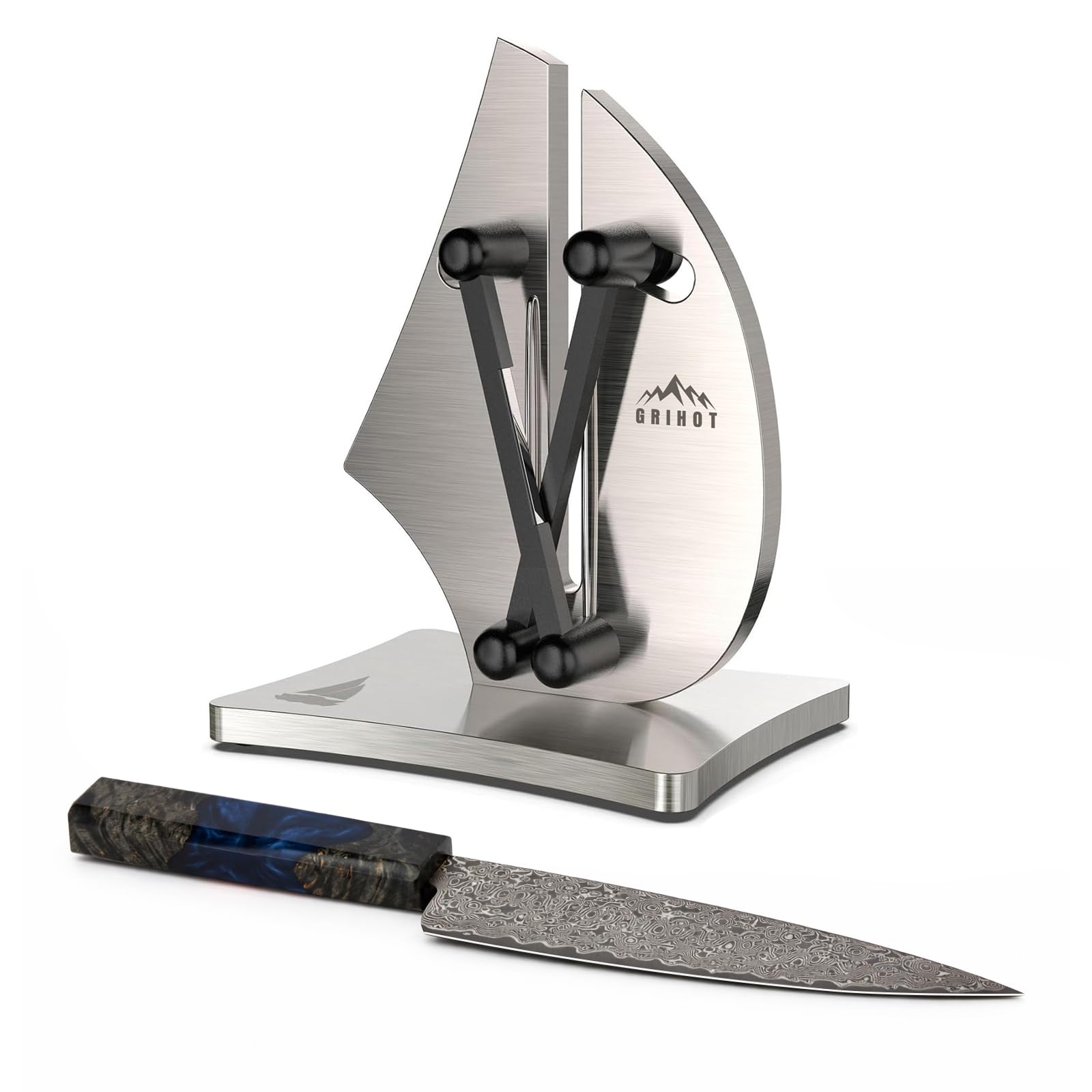
Grihot’s VN3 Sailboat sharpener is a heavy-duty machine built from solid 304 stainless steel and Himalayan tungsten carbide. It weighs nearly two pounds and feels substantial in the hand, designed to tackle the most neglected blades including serrated edges that many sharpeners cannot handle.
The three-action system separates repair, restoration, and sharpening into distinct ports. Tungsten carbide spring arms automatically adjust to the blade’s existing edge angle, removing the need for preset guides. Professional users have reported reviving severely dull knives in under thirty seconds per blade.
With a 60-month warranty and over 196 hours of manufacturing polishing per unit, this sharpener is built to outlast multiple kitchen renovations. It functions equally well on Western chef’s knives and thinner Japanese blades, though a light touch is recommended to avoid removing more metal than necessary on high-hardness steels.
Why it’s great
- Excellent for serrated and heavily damaged edges
- All-metal construction provides long-term durability
- Self-adjusting angle system removes guesswork
Good to know
- Learning curve to avoid over-grinding soft steel
- Design is better suited for counter display than drawer storage
4. Global Stage 2 Sharpener
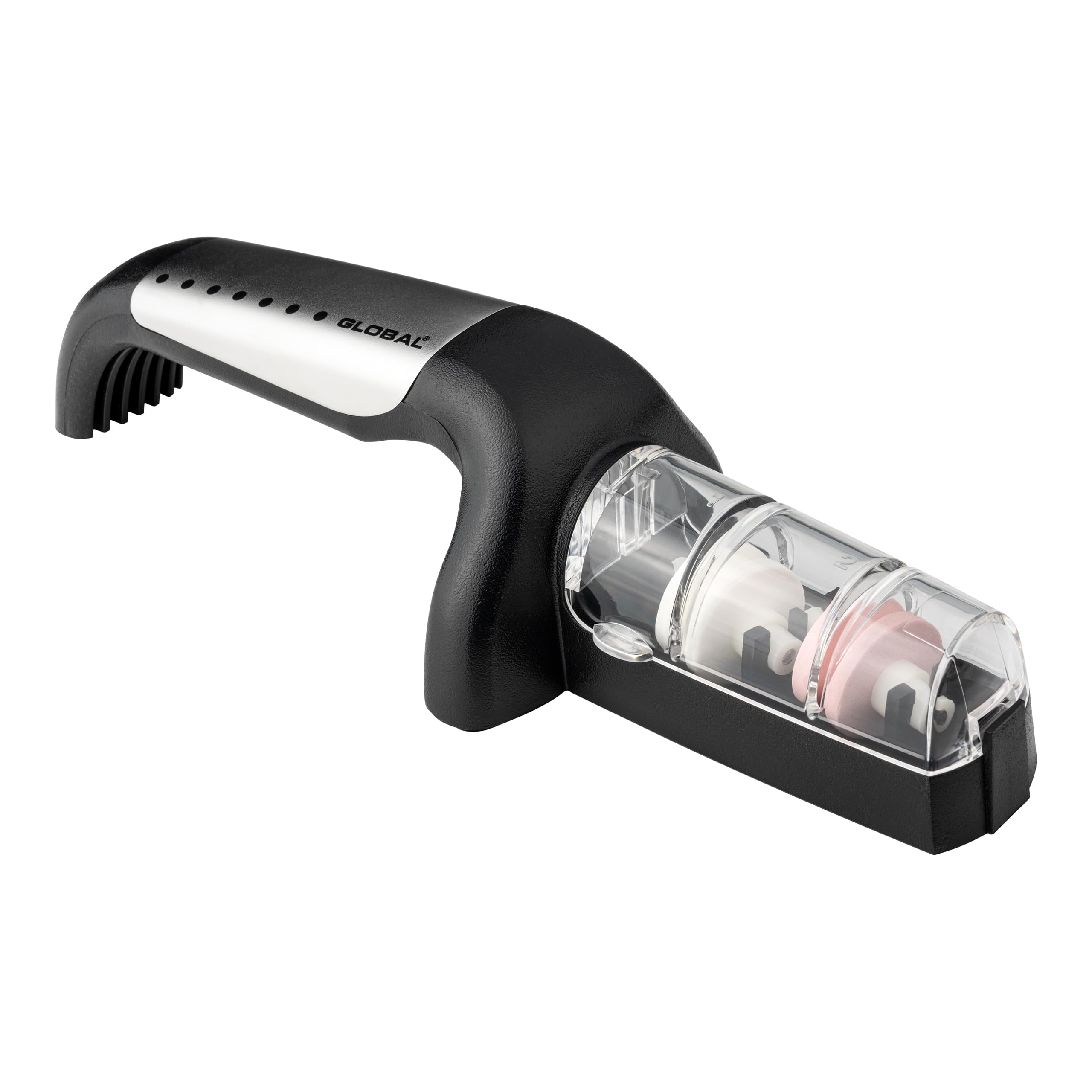
Global designed this two-stage sharpener specifically for its own knife edge geometry, which features a unique acute angle that standard sharpeners often fail to maintain. A white coarse wheel sets the initial bevel, a pink fine wheel hones it, and a final superfine ceramic wheel polishes the edge to its factory sharpness.
The rubberized base grips wet surfaces securely, and the water-filled reservoir provides cooling lubrication during sharpening, reducing heat buildup that can damage thin Japanese blades. At only 180 grams, it is the lightest unit in this roundup but remains stable thanks to its low profile.
While optimized for Global knives, the sharpener works competently on most thin-profile cutlery brands. Owners of thicker German-style blades may find the slot too narrow, but for anyone invested in Japanese steel, this is the most faithful way to maintain the original edge without sending knives out for professional service.
Why it’s great
- Matches the unique edge profile of Global knives perfectly
- Water-filled reservoir prevents blade overheating
- Three ceramic wheel stages produce a polished factory edge
Good to know
- Narrow slots not ideal for thick Western blades
- Designed primarily for Global and similar Japanese knives
5. Chef’sChoice 15XV Electric Sharpener

The Chef’sChoice 15XV is the only electric model in this lineup, and it earns its place by delivering a 15-degree Trizor XV edge in roughly one minute during initial sharpening and just ten seconds for touch-ups. The brushed metal housing houses 100-percent diamond abrasives across three distinct stages—two for sharpening and one for polishing.
Flexible spring guides automatically adjust to the blade’s thickness, making it possible to sharpen straight-edge and serrated knives without manual angle setting. The five-pound unit sits solidly on any counter and produces a measured noise level between 65 and 75 decibels, quieter than most coffee grinders.
Long-term users report consistent performance over five years of heavy weekly use, and the diamond stages show minimal wear even after hundreds of sharpening cycles. The 15XV works best for converting standard 20-degree edges to the sharper 15-degree profile, which yields noticeable improvement in slicing performance across vegetables, meats, and fish.
Why it’s great
- Fastest sharpening cycle—under a minute for a fresh edge
- 100-percent diamond abrasives last through heavy use
- Converts factory 20° edges to sharper 15° performance
Good to know
- Removes more metal per session than manual options
- Heavier and bulkier—needs dedicated counter space
FAQ
Can I use a chef’s knife sharpener on serrated bread knives?
How often should I sharpen my chef’s knife at home?
Will a cheap pull-through sharpener ruin my Japanese knife?
Final Thoughts: The Verdict
For most users, the best chef’s knife sharpener winner is the Bogoni Rolling Sharpener because it combines diamond speed, ceramic polish, magnetic angle precision, and wrist-friendly rolling action into one compact wood-bodied kit. If you want a traditional water stone experience with guided precision, grab the Work Sharp Benchtop Whetstone. And for the fastest daily sharpening in a busy kitchen, nothing beats the Chef’sChoice 15XV Electric.

Mo Maruf
I created WellFizz to bridge the gap between vague wellness advice and actionable solutions. My mission is simple: to decode the research and give you practical tools you can actually use.
Beyond the data, I am a passionate traveler. I believe that stepping away from the screen to explore new environments is essential for mental clarity and physical vitality.