Our readers keep the lights on and my smoothie glass nicely filled. As an Amazon Associate, I earn from qualifying purchases.
Specs are compiled from manufacturer listings and verified buyer reviews and can change over time — please confirm the key details on the product page before buying.
You reach for your chef knife every single time you cook — chopping onions, slicing chicken, mincing garlic. The wrong one makes you work harder, smashes ripe tomatoes, and can slip on tough veggies. This guide finds the sharpest, most reliable chef knife under 100 dollars that holds its edge, fits your hand, and handles daily prep without frustration.
I’m Mohammad Maruf — the founder and writer behind WellFizz. This guide is built by comparing the manufacturers’ published specifications and the patterns across verified customer reviews, so you get each pick’s real strengths and trade-offs instead of marketing spin.
Finding the right chef knife under 100 means balancing edge sharpness, blade steel, handle comfort, and durability — all without blowing your budget.
Quick Picks
- Victorinox Fibrox Pro Chef’s Knife, 8 Inch — Best Overall
- WÜSTHOF 8″ Gourmet Chef’s Knife — Premium Build
- KAWAHIRO Japanese Chef Knife, 8 Inch Gyuto — Japanese Beauty
- KYOKU Shogun Series Chef Knife, 8 Inch — Damascus Value
- Sunnecko 8 Inch Chef Knife — Best Value
- KEEMAKE Chef Knife, 8 Inch — Budget Champion
How To Choose The Best Chef Knife Under 100
A great chef knife under 100 is about three things: the steel’s ability to stay sharp, the edge angle that determines how it cuts, and the handle shape that keeps your hand from cramping. Get these right and you will reach for this knife every single day.
Blade Steel and Construction
High carbon stainless steel is the standard for a reason — it resists rust better than pure carbon steel while holding a sharp edge longer than basic stainless. Forged blades, where the steel is heated and hammered into shape, are generally denser and tougher than stamped blades (cut from a sheet of steel). But a good stamped blade from a trusted brand can still outperform a cheap forged one.
Edge Angle
The edge angle — measured in degrees per side — determines how easily the knife passes through food. A narrower angle (around 8 to 12 degrees) delivers razor-sharp slicing ideal for vegetables and fish, but it can be more delicate. Wider angles (15 degrees and up) offer more durability for heavy chopping. Most chef knives under 100 land between 8 and 15 degrees, which is a solid balance for everyday home cooking.
Handle Material and Balance
The handle is where you feel the knife every minute you are prepping. Materials like Pakkawood (layered hardwood with resin) offer a classic look and comfortable grip. Fibrox (thermoplastic elastomer) provides a non-slip feel even when wet. The knife’s balance — where the weight sits between blade and handle — determines how natural the knife feels during a pinch grip (pinching the blade just above the handle for control). A well-balanced knife reduces wrist strain noticeably.
Quick Comparison
| Model | Best For | Blade Steel | Edge Angle | Handle Material | Amazon |
|---|---|---|---|---|---|
| Victorinox Fibrox Pro | All-Around Reliability | High Carbon Stainless | Laser-tested | Fibrox (TPE) | Amazon |
| WÜSTHOF Gourmet | Premium German Build | High Carbon Stainless | Precision edge | Polypropylene | Amazon |
| KAWAHIRO Gyuto | Japanese Craftsmanship | VG10 Stainless | Razor-sharp | Ebony/Turquoise/Ruby Wood | Amazon |
| KYOKU Shogun | Damascus Performance | VG10 Core / 67 Layer | 8–12 degrees | Fiberglass (G10) | Amazon |
| Sunnecko 8 Inch | Value Sharpness | High Carbon Stainless | 12–15 degrees | Pakkawood | Amazon |
| KEEMAKE 8 Inch | Budget Everyday Prep | 1.4116 High Carbon | 8–12 degrees | Pakkawood | Amazon |
In‑Depth Reviews
1. Victorinox Fibrox Pro Chef’s Knife, 8 Inch
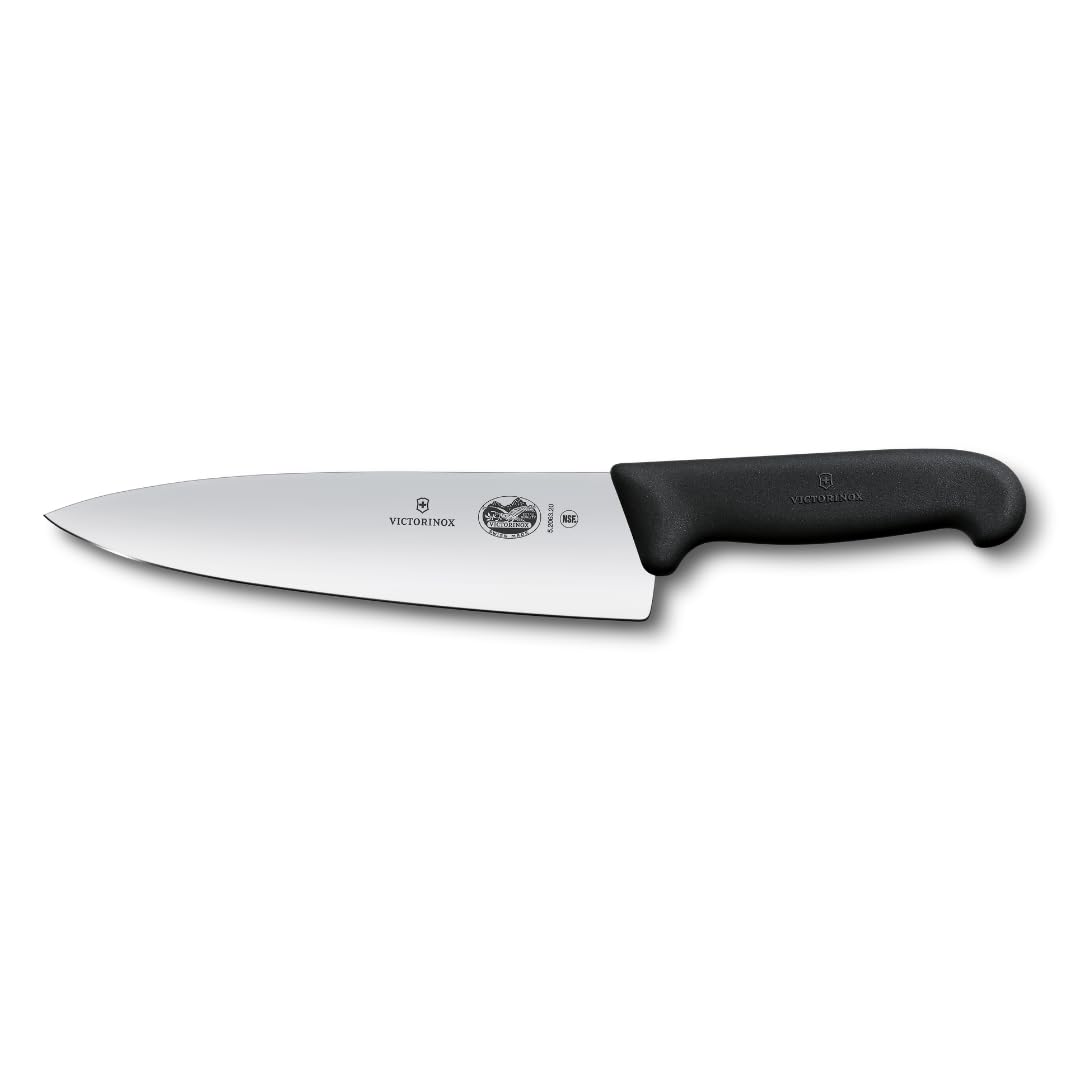
The no-frills workhorse that pro kitchens and home cooks both swear by.
This knife earned the top spot because it combines a proven design, a non-slip grip, and a razor-sharp edge that stays sharp for months — all while leaving room in your budget for a sharpening stone. America’s Test Kitchen has repeatedly rated it as the top 8-inch chef’s knife under 100. The 8-inch high carbon stainless steel blade arrives laser-tested and razor sharp. Buyers report it “cuts like a scalpel with almost no effort.” At about 5.7 ounces, it is lighter than the Sunnecko (which is about 7 ounces), so your hand feels less fatigue chopping through a pile of vegetables or thick cantaloupe.
The Fibrox handle (a thermoplastic elastomer, or TPE) provides a non-slip grip even when your hands are wet — a real safety advantage during busy meal prep. One reviewer noted the edge held well for over 2.5 months without honing (realigning the edge on a steel rod). One caveat: the edge angle is steeper than some Asian-style knives, so you will need a specific sharpener (like an Asian blade sharpener) to maintain that scalpel-like performance. It is dishwasher safe per the manufacturer, but experienced owners agree hand washing preserves the edge much longer.
The catch is the blade length — at 13.4 inches overall, some buyers find it slightly too large for smaller hands. And unlike the forged Sunnecko, the Victorinox uses a stamped construction (cut from a sheet of steel), which some knife purists feel is less durable over decades of heavy use. But the lifetime warranty from Swiss maker Victorinox (since 1884) offers solid confidence for a knife priced in the mid-range tier.
The pro’s weapon: Out-of-box sharpness lasts months — one buyer mentioned 2.5+ months without honing — and the non-slip handle makes it a daily driver for almost any task.
Reach for this if: You want a proven, balanced knife that professional chefs and home cooks both trust — and you value a light, fatigue-free grip during long prep sessions.
Look elsewhere if: You prefer a heavier forged blade or need a knife that fits very small hands comfortably.
2. WÜSTHOF 8″ Gourmet Chef’s Knife

German precision from a family that has been forging blades for over 200 years.
WÜSTHOF’s Gourmet series uses a laser-cut stamped blade made of high carbon stainless steel — a precise edge that stays sharp longer than basic stainless. At 240 grams (about 8.5 ounces), it feels mid-weight and substantial in hand without being cumbersome, giving it more heft than the 5.7-ounce Victorinox for those who like a little momentum. Owners mention it “slices tomatoes and minces garlic easily” straight from the start, and one owner reported the edge held well after over a month of daily use. The synthetic polypropylene handle resists fading, heat, and impact, though it is not the grippy rubberized feel you get from the Victorinox.
What sets this apart from the Sunnecko or KEEMAKE is the brand’s pedigree — WÜSTHOF has been making knives in Solingen, Germany since 1814, and the Gourmet series carries a limited lifetime warranty. The 8-inch blade handles heavy-duty tasks like cutting thicker vegetables and meats with confident weight and balance. Unlike the KAWAHIRO’s delicate Japanese edge, this is a sturdier everyday knife built to withstand regular home use without chipping.
The honest trade-off: it is not dishwasher safe (the manufacturer warns against it), and at a premium price point, it competes directly with Japanese options like the KYOKU that offer harder VG10 steel. But if you want a German workhorse with a trusted name and excellent balance — and you are willing to hand-wash it — this is a strong mid-range contender.
What stands out
- Razor-sharp out of box with excellent edge retention for a month of daily use
- Ergonomic, non-slip handle that feels comfortable for both large and small items
The fine print
- Hand wash only to preserve edge and handle
- Laser-cut stamped steel — not as dense as forged blades from the KYOKU
Who it clicks with: Cooks who want a premium German brand with a balanced, mid-weight feel and a razor edge that lasts — without crossing the 100 mark.
Who might pass: If you prefer a lighter knife or need one that is dishwasher safe, the Victorinox or KEEMAKE are better fits.
3. KAWAHIRO Japanese Chef Knife, 8 Inch Gyuto
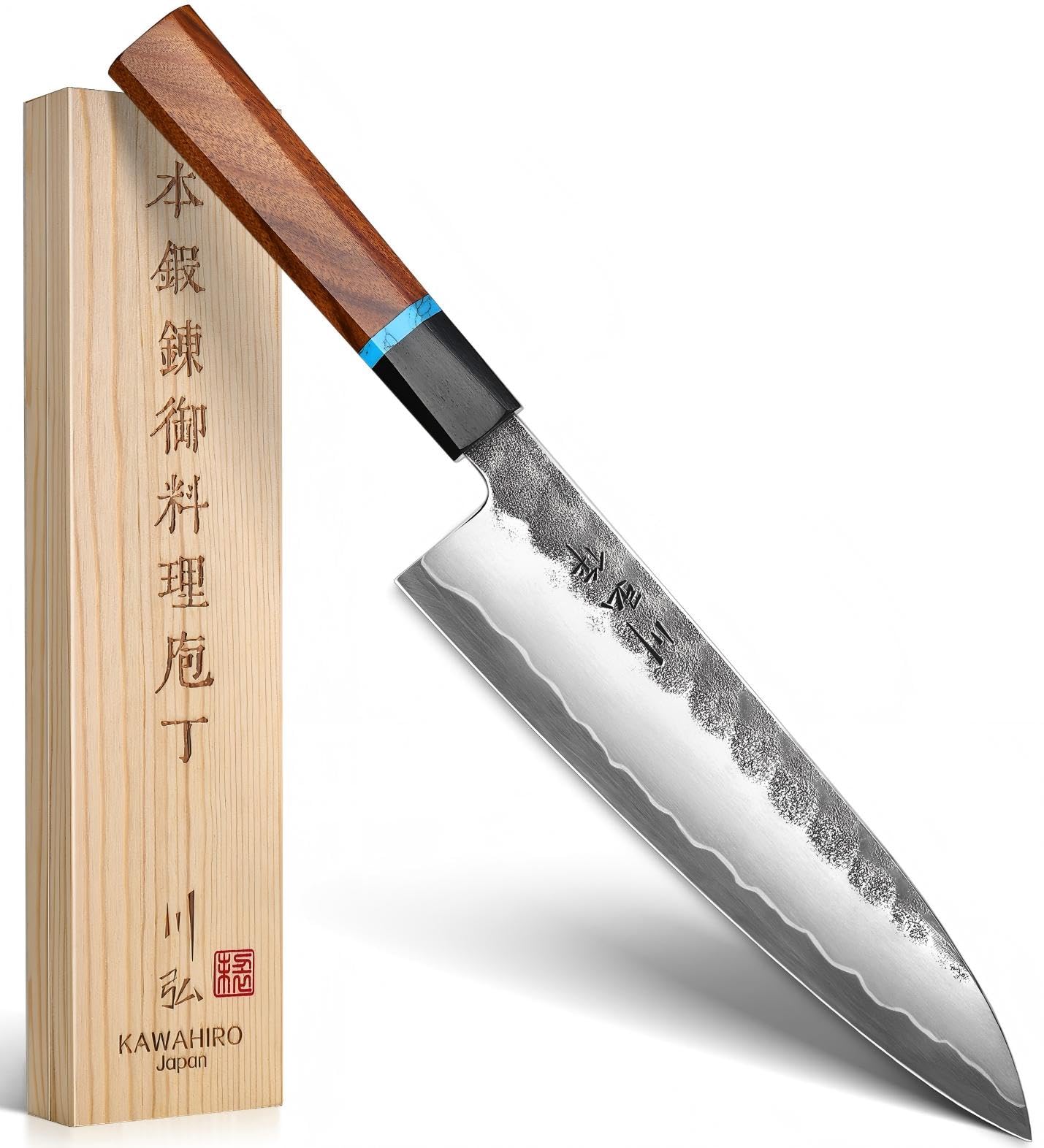
Hand-forged VG10 steel that glides through ingredients like a true artisan tool.
This is the knife you choose when you are ready to upgrade from basic stainless to real Japanese craftsmanship. The blade is forged from 3-layer composite steel with a Japanese VG10 stainless steel core — a hard steel (estimated at 62-plus HRC on the Rockwell scale, which measures hardness) known for exceptional edge retention. The 8.24-inch blade has a black forged finish and is sharpened to a razor edge. Customers note it “cuts through onions like they’re nothing” and “slices through vegetables, meat, and herbs with almost no effort.” One sushi chef noted it is his first knife for professional work, praising the “sharpness edge so good.”
The handle is where this knife really stands apart from the rest of the list. Made from premium ruby wood, turquoise, and ebony, it feels luxurious in hand and features an octagonal (8-sided) Japanese wa-style design that contours naturally to your palm. At 0.42 pounds (about 6.7 ounces), it feels balanced and solid. The packaging alone is elaborate — a wooden gift box with a certificate of authenticity — making it a strong contender for a serious gift.
The honest catch: after 6 months of near daily use, one reviewer experienced small edge chipping, which is typical of very hard Japanese steel (it is more brittle compared to German steel). A few strokes on a 5,000-grit ceramic whetstone restored the edge easily. This is not a dishwasher-safe knife, and it needs careful maintenance using ceramic whetstones or diamond plates. If you want a rugged workhorse you can beat on, the Victorinox is more forgiving. But if you want a razor-sharp slicer that feels like an extension of your hand, this is the one.
The craftsman’s pick: At the top end of the budget, you get a VG10 core steel, a stunning ruby wood/turquoise/ebony handle, and a balanced blade that makes daily prep feel easy — just be ready to hand-wash and sharpen with care.
Grab it if: You value Japanese precision, want a hard steel that holds a razor edge for months, and appreciate beautiful craftsmanship with an octagonal handle.
skip it if: You need a rugged, low-maintenance knife that can go in the dishwasher or handle heavy-duty hacking through bones.
4. KYOKU Shogun Series Chef Knife, 8 Inch

67 layers of Damascus steel with a cryogenically treated VG10 core that stays sharp — and it undercuts the KAWAHIRO in price.
The KYOKU Shogun brings Damascus styling and real VG10 performance at a price that sits below the KAWAHIRO. The blade features a Japanese 67-layer Damascus VG-10 steel core that has been cryogenically treated — a process that hardens the steel for better edge retention. Sharpened to an 8 to 12 degree edge using the traditional 3-step Honbazuke method, it delivers precise cuts through meat, fish, and vegetables with minimal resistance. At 1.39 pounds, it is noticeably heavier than the Victorinox (about 5.7 ounces) and even heavier than the 8.5-ounce WÜSTHOF, giving it a substantial, solid feel that some cooks prefer for heavy chopping.
The handle is fiberglass-reinforced (G10 material) with a signature mosaic pin, designed to withstand cold, heat, corrosion, and moisture. Unlike the KAWAHIRO’s natural wood, this is a more durable synthetic that resists warping. The knife comes with both a protective sheath and a case. Buyers call it “very sharp and high quality,” with one noting it “cuts through tomatoes without getting juice everywhere.” A year-long user described it as “beautiful, perfectly balanced, sharp enough to cut paper.”
The main trade-off: one reviewer pointed out the Damascus pattern is laser-etched and nearly invisible on some units, which is disappointing if you want the dramatic visual effect. Also, the heavier weight (1.39 pounds) may cause more hand fatigue during long sessions compared to lighter options like the Victorinox. But for a forged Damascus knife with a VG10 core at this price point, the performance-to-dollar ratio is tough to top.
What it delivers
- Cryogenically treated VG10 core for excellent edge retention and corrosion resistance
- Includes protective sheath and case; sturdy fiberglass handle resists moisture and heat
What to consider
- At 1.39 pounds, it is heavier than most 8-inch chef knives — expect more wrist fatigue during long prep
- Laser-etched Damascus pattern may appear faint; not a true forged pattern
Choose this for: A forged Damascus blade with a real VG10 core and a durable G10 handle — at a mid-range price that undercuts the KAWAHIRO.
Pass if: Weight is a concern; the Victorinox or KEEMAKE are lighter and easier on the wrist during long prep.
5. Sunnecko 8 Inch Chef Knife
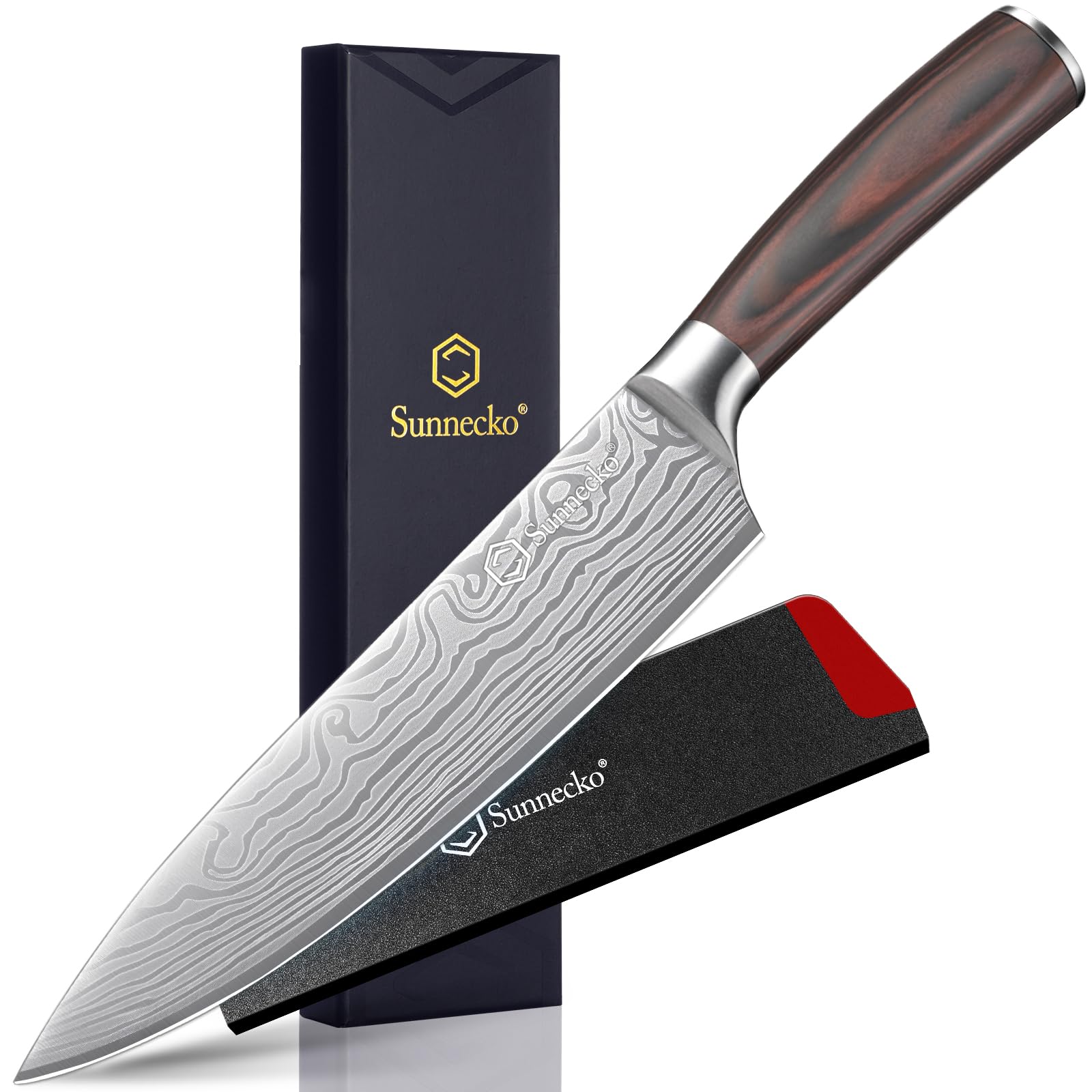
An ultra-sharp blade and a handsome Pakkawood handle at a budget-friendly price.
The Sunnecko punches well above its price tier with a hand-sharpened 12-15 degree edge per side — a narrower angle than many budget knives, so it glides through tomatoes and meats without crushing them. The blade is forged from high carbon stainless steel, offering better rust resistance than carbon steel and good edge retention for everyday use. Reviewers point out it is “extremely sharp out of box; cuts paper/hair.” One reviewer even admitted, “I immediately sliced my finger when cleaning it. It is definitely sharp, so be careful!”
The Pakkawood handle (layered hardwood with resin) feels higher quality than the plastic handles on many knives at this price point, and the full-tang construction (the blade steel runs through the entire handle) provides solid balance and durability. It comes with a PVC knife sheath for safe storage. Unlike the Victorinox, which is stamped, this is a forged blade, which some cooks prefer for density and toughness.
The catch: at 0.2 kilograms (about 7 ounces), it is slightly heavier than the 5.7-ounce Victorinox, which could lead to a bit more wrist strain during marathon prep sessions. The laser-etched pattern on the blade is cosmetic and not a true Damascus lamination. And while the edge is sharp out of box, the high carbon stainless steel may not hold that edge as long as the VG10 steel found in the KAWAHIRO or KYOKU. But for a budget-friendly entry into a quality chef knife under 100, this is an impressive starter.
The gateway knife: A forged high carbon stainless blade with a 12-15 degree edge and a quality Pakkawood handle — all at a price that leaves room in your budget for a sharpening stone.
Ideal for: Home cooks who want a sharp, good-looking forged knife without spending a lot — and who are willing to hand-wash to preserve the Pakkawood handle.
Not for: Those who need a lighter blade for all-day prep or want a knife that holds its edge for months without honing.
6. KEEMAKE Chef Knife, 8 Inch
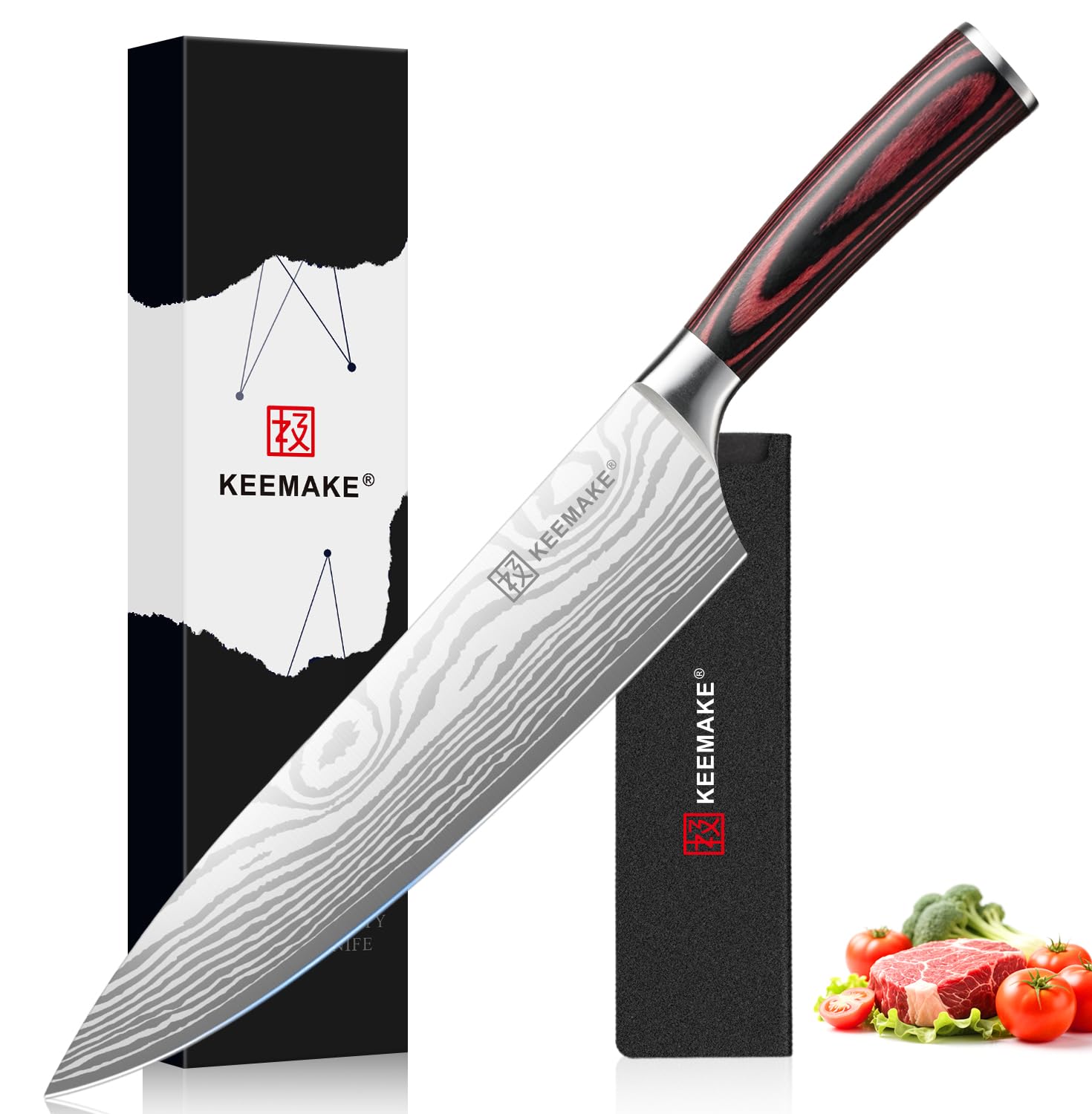
A razor-sharp 8–12 degree edge and a comfortable handle — without draining your wallet.
The KEEMAKE uses 1.4116 high carbon stainless steel with a hardness rating of 58±2 HRC (Rockwell Hardness — higher numbers mean harder steel that resists dulling). That is a solid figure for a budget-friendly knife, putting it closer to mid-range steels than soft supermarket knives. The blade is hand-sharpened to a very narrow 8–12 degree edge on each side, which is narrower than the Sunnecko’s 12–15 degrees — meaning it can slice through ripe tomatoes without crushing them and handle delicate tasks like fish fillets and cold butter. Shoppers say it “cuts tomato skin like butter, chops easily,” and one customer observed, “this is a badass knife for its price… I purchased another one exactly like it because I was so impressed.”
The Pakkawood handle has a curved design and sloped bolster (the thick ridge where the blade meets the handle) that promotes a secure pinch grip — the technique where you pinch the blade just above the handle for control. At 8.48 ounces, it is slightly heavier than the 7-ounce Sunnecko and the 5.7-ounce Victorinox, but still manageable for daily use. It comes in an elegant gift box with a protective sheath, making it a thoughtful present for a cooking enthusiast.
The one drawback: some buyers report the Damascus-like pattern on the blade is laser-etched, not a true forged Damascus pattern. That is purely cosmetic and does not affect performance, but if you want an authentic hand-forged look, you might prefer the KYOKU or KAWAHIRO. Also, at this entry-level price, edge retention may not match the VG10 knives on this list. But for an 8–12 degree razor edge at a budget-friendly price, the KEEMAKE delivers surprising performance.
Why it impresses
- Hand-sharpened to an 8–12 degree edge — narrower than most budget knives for easy slicing
- Comfortable Pakkawood handle with sloped bolster for a secure pinch grip
What to note
- Laser-etched pattern is cosmetic only; not a true Damascus blade
- Heavier than the Victorinox, which may cause fatigue during longer prep
Buy it for: A budget-friendly knife with a genuinely sharp 8–12 degree edge and a comfortable Pakkawood handle — perfect for cooks who want pro-level slicing without spending a lot.
Think twice if: You need a lighter blade or you prefer a knife with a true forged Damascus pattern.
Understanding the Specs
Edge Angle (Degrees Per Side)
The edge angle determines how easily the blade passes through food. A narrower angle (8 to 12 degrees) feels razor-sharp and glides through soft items like tomatoes and fish with negligible resistance — but it can be more fragile and prone to chipping on hard surfaces. A wider angle (12 to 15 degrees) trades some initial sharpness for durability, making it better for heavy chopping through thick vegetables or meats. Most chef knives under 100 land between 8 and 15 degrees, which is ideal for everyday home cooking.
Steel Hardness (HRC)
Rockwell Hardness (HRC) measures how hard the steel is — harder steel (58+ HRC) holds a sharp edge longer but is more brittle and harder to sharpen at home. Softer steel (52–56 HRC) dulls faster but is easier to re-sharpen and less likely to chip. The KEEMAKE uses 58±2 HRC steel, while Japanese VG10 steel (found in the KAWAHIRO and KYOKU) typically reaches 60–62 HRC. For a chef knife under 100, 58+ HRC is a strong sign of decent edge retention.
Forged vs Stamped Construction
Forged blades are created by heating a single piece of steel and hammering it into shape, resulting in a denser, tougher blade with a full tang (the metal extends through the handle). Stamped blades are cut from a sheet of steel, then heat-treated and sharpened — they are lighter and cheaper but may not be as durable over decades of heavy use. That said, a well-made stamped blade (like the Victorinox) can outperform a poorly-made forged blade. Both options exist in the chef knife under 100 range.
Handle Materials
The handle material affects grip, comfort, and longevity. Pakkawood is layers of hardwood soaked in resin, giving a warm, classic look that is moisture-resistant. Fibrox (a thermoplastic elastomer) provides a non-slip grip even when wet — a favorite in professional kitchens. Polypropylene (used by WÜSTHOF) is durable and resists heat and impact but is less grippy. G10 (fiberglass resin) is extremely durable and resistant to moisture and temperature changes. Choose based on whether you prioritize grip texture, aesthetics, or durability.
FAQ
How long does an 8-inch chef knife under 100 stay sharp?
What is the difference between Pakkawood and Fibrox handles?
Is a forged chef knife better than a stamped one under 100?
What steel type holds an edge best for a chef knife under 100?
Can I put my chef knife in the dishwasher?
What edge angle is best for a home cook?
How do I sharpen a chef knife under 100?
Is a heavier or lighter chef knife better for home cooking?
What does “full tang” mean and why does it matter?
What is the difference between a chef knife and a santoku?
Final Thoughts: The Verdict
Across the board, the chef knife under 100 winner is the Victorinox Fibrox Pro because it combines proven professional performance, a non-slip handle, and a razor-sharp edge at a price that leaves room for a sharpening stone. If you want German engineering and a balanced, mid-weight feel, grab the WÜSTHOF Gourmet. And for Japanese VG10 craftsmanship with a stunning handle, the KAWAHIRO Gyuto is the top premium pick.
How We Picked
We do not accept paid placement. Every pick is matched to a real buyer and a real use-case; we do not hands-on test units.
Sources & Methodology
Specifications: manufacturer listings and product documentation. Review insights: verified customer reviews, as of July 2026. Pricing: not shown on this page (it changes often); check the current price via the retailer link.
As an Amazon Associate, WellFizz earns from qualifying purchases. This does not affect which products we feature.

Mo Maruf
I created WellFizz to bridge the gap between vague wellness advice and actionable solutions. My mission is simple: to decode the research and give you practical tools you can actually use.
Beyond the data, I am a passionate traveler. I believe that stepping away from the screen to explore new environments is essential for mental clarity and physical vitality.