Our readers keep the lights on and my smoothie glass nicely filled. As an Amazon Associate, I earn from qualifying purchases.
A chef’s cutting board is the foundation of every meal prepared. The right one provides a stable, knife-friendly surface that resists deep scarring, prevents bacterial growth, and adds natural beauty to your workspace. With options ranging from lightweight acacia to dense maple and luxurious black walnut, the decision often comes down to wood type, grain structure, and thickness.
I’m Mohammad Maruf — the founder and writer behind WellFizz. I’ve spent countless hours researching the material science of hardwood, the differences between end-grain and edge-grain construction, and the quality control standards that separate a kitchen workhorse from a decorative tray.
This guide breaks down the top contenders based on wood hardness, board thickness, and craftsmanship so you can find the best chef cutting board for your daily prep routine.
How To Choose The Best Chef Cutting Board
The ideal chef cutting board balances three factors: the wood species’ hardness, the grain orientation of the board, and its dimensional stability over time. Softer woods like acacia absorb knife marks more readily but are gentler on blade edges, while harder species like maple and walnut resist deep gouging and offer longer surface life. Thickness also plays a role — boards under 1 inch tend to warp in humid conditions, while a 1.5-inch or thicker slab stays flat under heavy cleaver work.
Wood Species and Janka Hardness
The Janka hardness test measures how resistant a wood is to denting and wear. Hard maple scores around 1,450 lbf, making it one of the most durable options for daily chopping. Black walnut sits lower at about 1,010 lbf, but its tighter grain structure still holds up well while being noticeably easier on knife edges. Acacia, often marketed for its water resistance, ranks between 1,200 and 1,700 lbf depending on the growth conditions, but its porous nature means it can absorb liquids if not sealed properly.
Grain Structure: End Grain vs. Edge Grain
End-grain boards are constructed by gluing together blocks of wood with the grain running vertically. This arrangement allows knife blades to slide between the wood fibers rather than cutting across them, keeping edges sharp longer and making the board “self-healing” as marks close after use. Edge-grain boards are built with long strips glued side by side, which gives a cleaner look and better resistance to moisture penetration but tends to show knife scars more clearly. For a chef who preps several hours each day, end-grain is the superior choice despite the higher price.
Thickness, Weight, and Counter Stability
A board that slides or rocks during use creates both a safety hazard and an inconsistent cutting surface. Boards weighing 10 pounds or more, with a thickness of at least 1.5 inches, provide the mass needed to stay planted on the counter. Rubber or silicone feet further improve grip, especially on smooth granite or quartz surfaces. Lightweight boards under 1 inch thick often require a damp towel underneath to stay in place — a workaround that becomes tedious in a busy kitchen.
Quick Comparison
On smaller screens, swipe sideways to see the full table.
| Model | Category | Best For | Key Spec | Amazon |
|---|---|---|---|---|
| BABILONIA Black Walnut | End-Grain | Knife preservation, heavy prep | 1.7″ end-grain, rubber feet | Amazon |
| WoodForChef Maple | Edge-Grain | All-purpose daily chopping | 1.5″ hard maple, FSC certified | Amazon |
| Winco WCB-1824 | Edge-Grain | High-volume commercial use | 1.75″ thick, 17.8 lbs | Amazon |
| FANICHI Acacia | Edge-Grain | Multi-use serving & chopping | 1.5″ thick, reversible | Amazon |
| GAOMON Acacia | Edge-Grain | Extra-large surface, stove cover | 24″x18″x1.2″, light weight | Amazon |
In‑Depth Reviews
1. BABILONIA American Black Walnut Cutting Board
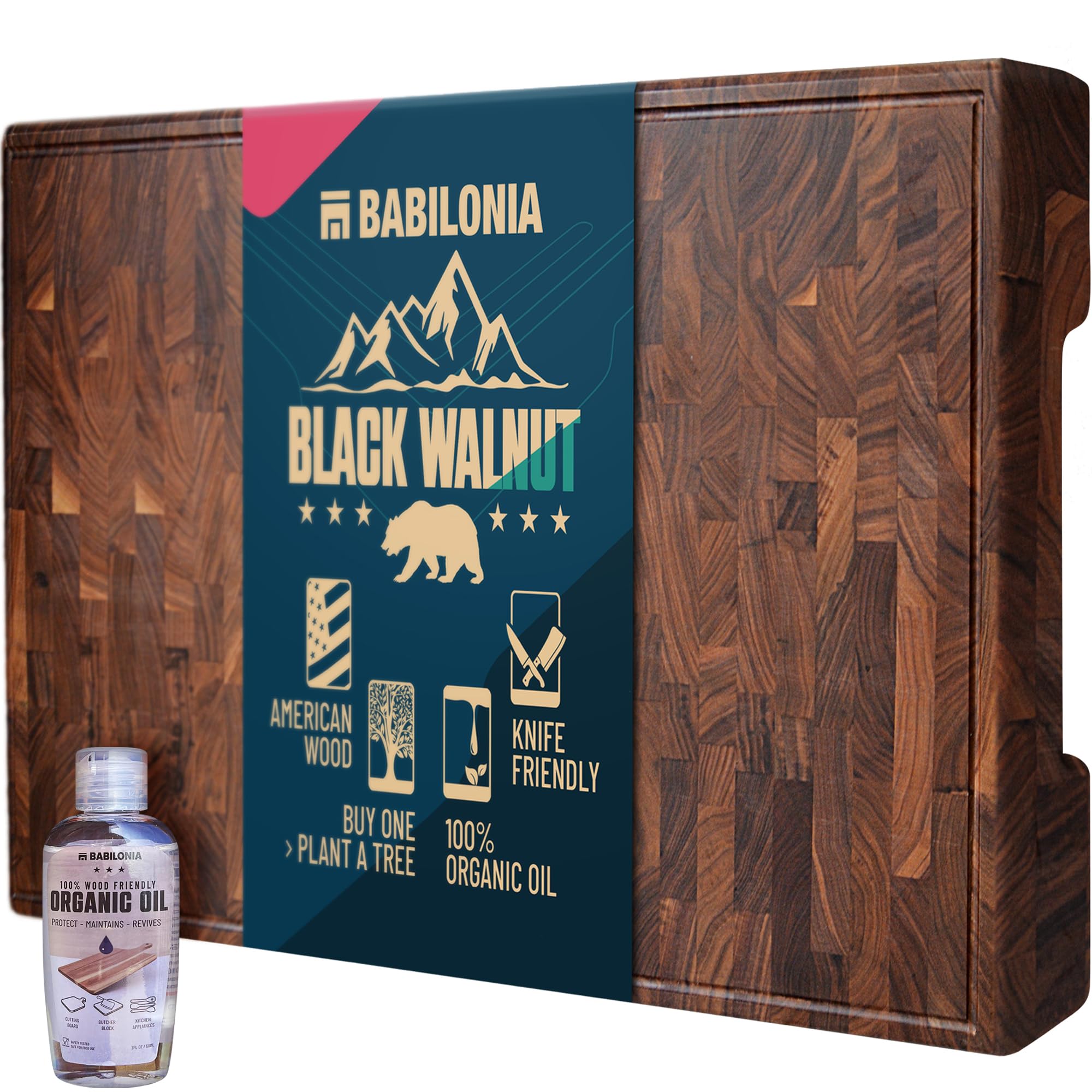
The BABILONIA cutting board is built with 100% American black walnut using the end-grain technique, meaning the wood fibers run vertically to absorb knife blades without dulling them. At 1.7 inches thick and 19.7 by 12.2 inches, it provides a heavy, non-slip surface that stays planted during aggressive chopping. The included rubber feet add further grip, and the hidden handle and plate slot allow for easy transfer of chopped ingredients directly into a bowl or pan without lifting the board.
Customer feedback consistently highlights the self-healing nature of the end-grain surface — knife marks close up after cleaning, keeping the board looking new for months. The board arrives pre-seasoned with organic mineral oil, and an extra bottle is included for monthly maintenance. Reviewers note that the walnut’s natural antimicrobial properties and tight grain make it ideal for both raw meat prep and charcuterie presentation.
The only concern reported by a small number of users involves potential splitting after extended use if the board is not regularly oiled. The manufacturer offers a 2-year warranty and responsive customer service to address any quality issues. For a chef who values edge retention and board longevity, this walnut slab is a top-tier investment.
Why it’s great
- End-grain construction is gentle on knife edges and self-heals
- Includes rubber feet, plate slot, and oil for immediate use
- Premium black walnut with a 2-year manufacturer warranty
Good to know
- Requires monthly oiling to prevent drying or splitting
- Width of 12.2 inches may feel narrow for very large roasts
2. WoodForChef Large Maple Cutting Board

The WoodForChef board is crafted from North American hard maple and carries FSC certification, ensuring the wood is responsibly harvested. Measuring 20 by 16 inches with a 1.5-inch thickness, it offers a spacious work surface that still fits comfortably under standard cabinets. The edge-grain construction provides a flat, durable surface that resists moisture absorption, while the deep juice groove around the perimeter directs runoff away from the prep area.
Users praise the board’s balanced weight of 12.5 pounds — heavy enough to stay stable but manageable enough to lift and store. The maple’s high Janka rating of 1,450 lbf means it resists deep gouging even under cleaver work, though it does show light surface scratches over time. The board arrives pre-seasoned with mineral oil and beeswax, so it is ready for immediate use without any initial treatment.
A few reviews note that the board felt dry on arrival and required an additional coat of oil before first use. This is normal for maple, which has a closed grain that absorbs oil slowly. Hand washing and monthly conditioning will keep this board flat and smooth for years. It is an excellent choice for any cook who wants a sustainably sourced, no-nonsense hardwood board at a mid-range price point.
Why it’s great
- FSC-certified hard maple resists warping and deep cuts
- Large 20″x16″ surface with a functional juice groove
- Comes pre-seasoned and ready to use out of the box
Good to know
- May need additional oiling before first heavy use
- Edge-grain shows light scratches more visibly than end-grain
3. Winco WCB-1824 Wooden Cutting Board

The Winco WCB-1824 is a commercial-grade board made from natural hardwood — specifically rubberwood — with an 18-by-24-inch surface that is 1.75 inches thick. At 17.8 pounds, this is the heaviest board in this lineup, and that mass translates directly into stability. There is zero sliding or rocking even during heavy-duty cleaver hacking, making it a favorite for restaurant kitchens and serious home cooks who process large quantities of meat or vegetables.
The recessed handholds on both long edges make carrying this slab manageable despite its weight. Rubberwood is an eco-friendly material harvested from latex-producing trees after they stop yielding sap, and it offers a Janka hardness around 1,000 lbf — similar to walnut. Users note that the natural finish and light tan color show cut marks more visibly than darker woods, but the board does not warp, split, or crack under consistent use.
Shipping damage on the corners is the most common complaint, as the board’s weight can cause it to shift inside the box. The manufacturer includes a 1-year warranty against workmanship defects, and most buyers report that the board arrives intact with proper packaging. For anyone who needs a massive, stable surface for high-volume prep, this Winco board delivers unbeatable value per square inch.
Why it’s great
- Ultra-heavy 17.8 lb design stays firmly in place
- Large 18″x24″ surface handles large roasts and dough
- Eco-friendly rubberwood resists warping and cracking
Good to know
- Light tan color shows knife marks and stains easily
- Fragile corners during shipping; inspect upon delivery
4. FANICHI XL Acacia Wood Cutting Board
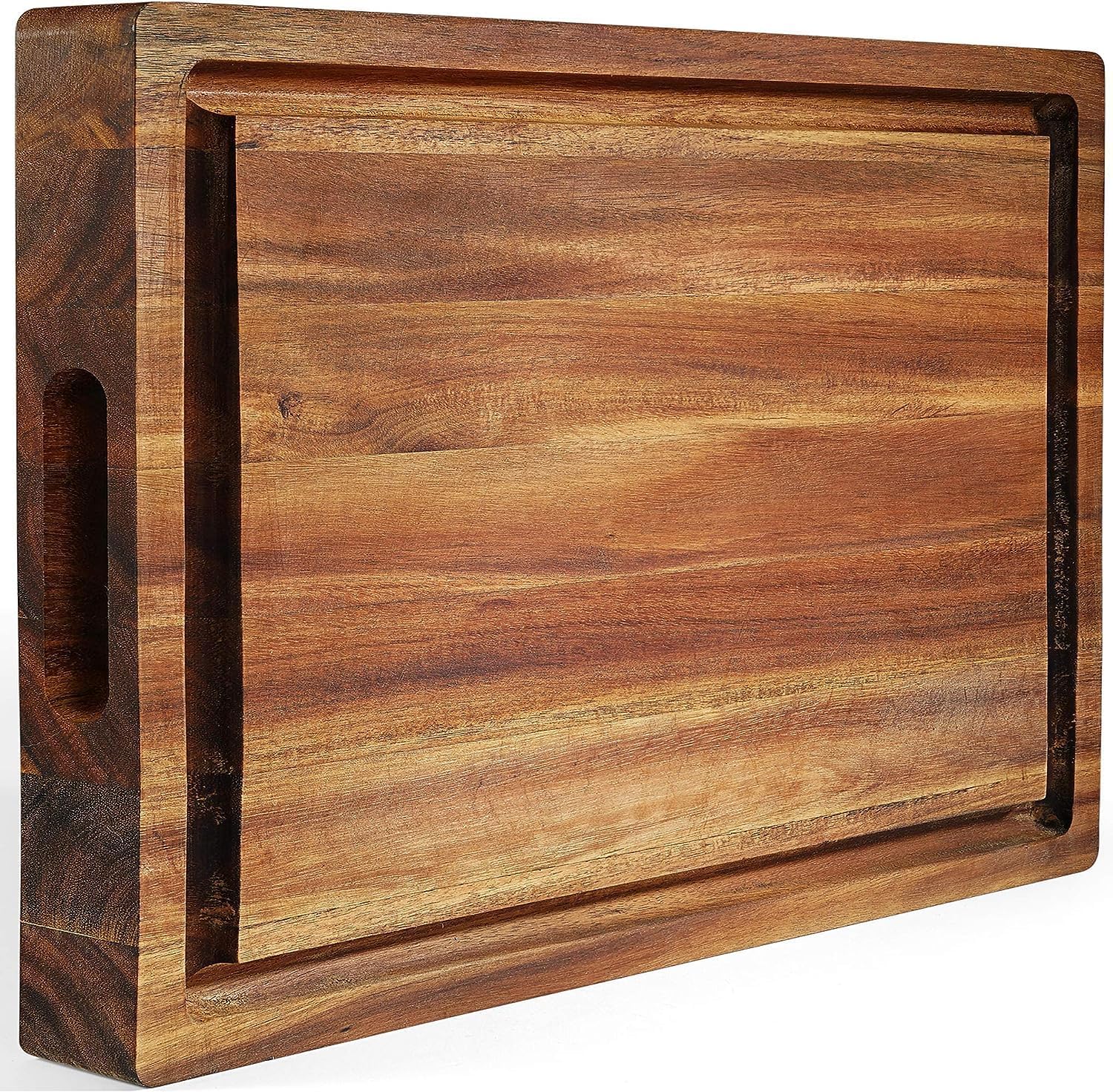
The FANICHI cutting board is a 20-by-15-inch acacia board that is 1.5 inches thick, giving it a substantial feel without the extreme weight of a maple or walnut slab. Acacia wood is naturally dense and water-resistant, making this board well-suited for both chopping and serving. The reversible design features a juice groove on one side for carving meats and a long cracker or bread holder on the reverse side for cheese and charcuterie presentations.
Buyers consistently praise the board’s visual appeal — the natural acacia grain varies from golden brown to deep amber, and the dark wood hides knife marks better than lighter species. The inner side handles make it easy to lift and move the board even when loaded with food. At just under 8.6 pounds, it is light enough to store vertically in a cabinet slot but heavy enough to stay put on the counter during normal prep work.
Some users note that the board arrived slightly dry and required an initial oiling to bring out the grain. Acacia’s open pores can absorb liquids more readily than maple, so consistent conditioning is important to prevent staining. For those who want a single board that transitions from prep station to serving platter without sacrificing durability, the FANICHI acacia board is a smart mid-range option.
Why it’s great
- Reversible with juice groove and bread/cracker holder
- Water-resistant acacia wood hides knife marks well
- Inner handles make transport easy during multi-tasking
Good to know
- Acacia’s open grain requires regular oiling to prevent stains
- Some boards may feel slightly unbalanced on flat counters
5. GAOMON 24 x 18 In Acacia Cutting Board

The GAOMON acacia board offers the largest surface area in this comparison at 24 by 18 inches, yet it weighs only about 9 pounds thanks to its 1.1-inch thickness. This board is ideal for cooks who need a temporary countertop extension — it fits perfectly over a standard gas stove, doubling as a noodle board or a landing zone for large baking projects. The recessed handholds on two sides make lifting and repositioning straightforward despite the board’s size.
The acacia wood has a warm, dark finish with visible grain lines, and the built-in juice groove along one edge catches liquids during meat carving. Users note that the wood is noticeably softer than maple or walnut, which means the surface shows cut marks quickly, but that same softness reduces the frequency of knife sharpening. The board is reversible, offering a clean side for vegetables and a seasoned side for meats to reduce cross-contamination during meal prep.
Because the board is thinner than the other options, it may cup or warp if exposed to standing water or high humidity. It is best used on a dry counter or stovetop and should never be submerged. For budget-conscious cooks who prioritize sheer board size and multi-functionality over extreme durability, the GAOMON board delivers excellent value — just keep it dry and well-oiled.
Why it’s great
- Massive 24″x18″ surface fits over most stovetops
- Lightweight at 9 lbs for easy handling and storage
- Soft wood is gentle on knife edges, reducing sharpening
Good to know
- Thinner 1.1″ design is prone to warping if left wet
- Soft acacia wood shows visible cut marks quickly
FAQ
How often should I oil my wood cutting board?
Is end-grain really better for knife edges?
Final Thoughts: The Verdict
For most users, the best chef cutting board winner is the BABILONIA Black Walnut board because its end-grain construction extends knife sharpness significantly while the included accessories make maintenance easy from day one. If you want a sustainably sourced, FSC-certified board with a spacious surface, grab the WoodForChef Maple board. And for high-volume, commercial-grade prep where size and weight are paramount, nothing beats the Winco WCB-1824.

Mo Maruf
I created WellFizz to bridge the gap between vague wellness advice and actionable solutions. My mission is simple: to decode the research and give you practical tools you can actually use.
Beyond the data, I am a passionate traveler. I believe that stepping away from the screen to explore new environments is essential for mental clarity and physical vitality.