Active Daily Care Eat Smart Health Hacks Recommended
About Contact The Library

5 Best Check Scanner For Deposits | No More Rejected Deposits

Our readers keep the lights on and my smoothie glass nicely filled. As an Amazon Associate, I earn from qualifying purchases.

Specs are compiled from manufacturer listings and verified buyer reviews and can change over time — please confirm the key details on the product page before buying.

A check scanner that misreads the MICR line (the magnetic ink numbers at the bottom of a check) does not just waste time. It bounces your deposit back to you. For a business that runs on cash flow, a rejected check means lost momentum. You need a scanner that reads every character cleanly, moves fast enough to keep up with your workflow, and works with your bank software without a fight.

I’m Mohammad Maruf — the founder and writer behind WellFizz. This guide is built by comparing the manufacturers’ published specifications and the patterns across verified customer reviews, so you get each pick’s real strengths and trade-offs instead of marketing spin.

check scanner for deposits picks focus on speed, resolution, sheet capacity, and the real-world reliability that keeps your deposits moving without a hitch.

Our Picks at a Glance

Digital Check TS240-50IJ Check Scanner with Inkjet
Best OverallDigital Check TS240-50IJ Check Scanner with Inkjet4.3★29 ratingsIt stamps your endorsement while it scans — one less step for busy desks.Check Price on Amazon
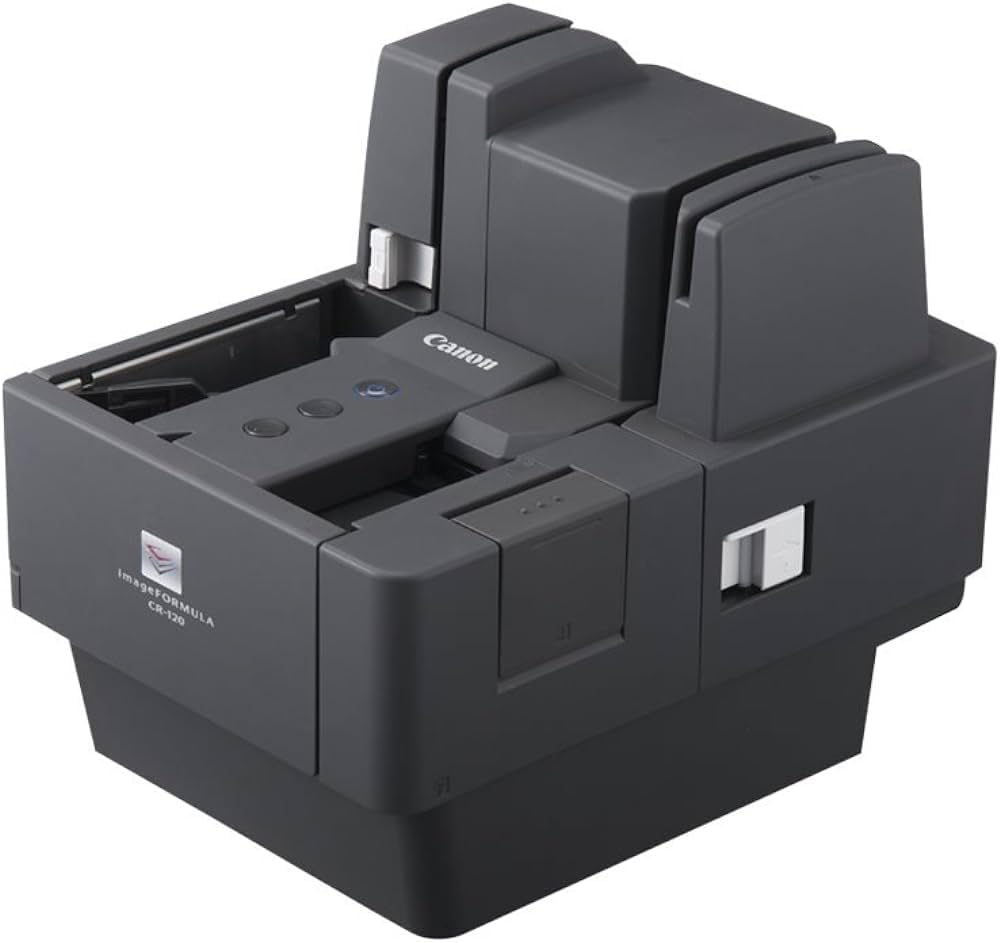
Canon CR-120 Check Scanner
Also GreatCanon CR-120 Check Scanner4.0★15 ratingsThe speed demon that mows through a stack before you refill your coffee. You get a scanning speed of 120 DPM (documents per minute) — more than double what most office models offer.Check Price on Amazon

How To Choose The Best Check Scanner For Deposits

Before you buy, understand that a check scanner’s real job is to get your deposit accepted by the bank on the first try. Every spec — speed, resolution, sheet capacity — serves that goal. Here are the benchmarks that separate a capable machine from a frequent source of errors.

MICR Read Accuracy is Non-Negotiable

The MICR (magnetic ink character recognition) line — that string of numbers at the bottom of a check — is what the bank reads to process your deposit. A scanner that misreads this line triggers a reject. Look for models with dual-sided scanning heads that capture the MICR line on the first pass, and check reviews for “reads reliably” rather than just “fast.”

Speed vs. Sheet Capacity: Which Matters More?

Speed is measured in DPM (documents per minute). A 50 DPM scanner processes a single check per second. But if you have to hand-feed every check one at a time, that speed means nothing because you spend your time loading. A 50-sheet hopper lets you stack a batch and walk away — that is the real productivity gain for anyone processing more than a few checks a day.

Resolution and Color Depth for Bank Acceptance

Banks require images at 200 DPI (dots per inch) at minimum, and most prefer 300 DPI. Color depth — measured in bpp (bits per pixel) — determines how many shades of color the scanner sees. 8 bpp gives you 256 grayscale shades, while 24 bpp delivers millions of colors. For most check deposits, 8 bpp is sufficient for bank acceptance, but 24 bpp makes endorsements and signatures clearer if a dispute ever arises.

Quick Comparison

Model Best For Speed Sheet Capacity Resolution Amazon
Digital Check TS240-50IJ★ Best Overall Built-in inkjet endorsement 50 DPM 50 sheets 300 DPI Amazon
Canon CR-120Also Great High-speed batch processing 120 DPM 600 DPI Amazon
Panini Vision X VX5050NJ Batch reliability and image quality 50 DPM 50 sheets 600 DPI Amazon
Canon imageFORMULA CR-L1 Compact desktop with sharp images 1 sheet 300 DPI Amazon
Digital Check CheXpress CX30 Affordable entry-level with wide OS support 1 sheet 600 DPI Amazon

In‑Depth Reviews

★ Best Overall

1. Digital Check TS240-50IJ Check Scanner with Inkjet

Our pick — over 4★ from 20+ verified ratings; the strongest balance of quality and price.

50-Sheet HopperBuilt-in Inkjet Printer

It stamps your endorsement while it scans — one less step for busy desks.

Unlike any other scanner in this roundup, the TS240-50IJ has a built-in inkjet printer that stamps an endorsement — like “For deposit only” plus the date and your account number — directly onto the check as it passes through. For a property manager or a high-volume accounts receivable desk, that auto-endorsement closes a legal gap and saves you from manually stamping each check after scanning.

The 50-sheet auto feeder and 50 DPM speed match the Panini VX5050NJ sheet-for-sheet, so you get the same batch convenience. However, the resolution sits at 300 DPI — half the pixel density of the Panini’s 600 DPI — which is still bank-acceptable for most institutions but leaves less headroom if your bank requires sharper images for large-dollar deposits. The color depth is 24 bpp (bits per pixel), giving millions of colors compared to the CheXpress CX30’s 8 bpp — a 3.0x gap in color richness — so endorsements and handwritten notes are more readable.

Buyers with high-volume workflows note that the inkjet cartridge needs periodic replacement, but the time saved from not hand-stamping makes that a minor cost. At 4 pounds, it is light enough to move between desks, though the inkjet mechanism adds a slight bulk compared to a pure scanner like the Canon CR-120.

Unique Edge

  • Built-in inkjet automatically endorses each check during scanning
  • 50-sheet auto feeder for hands-off batch processing
  • 24 bpp color depth for vivid, readable images

Resolution Trade-off

  • 300 DPI is half the resolution of the Panini VX5050NJ and Canon CR-120
  • Ongoing inkjet cartridge replacement cost

Ideal for: offices that need automatic endorsement — property managers, credit unions, or any desk where every check must be stamped “for deposit only.”

Consider the Panini VX5050NJ if: you can hand-stamp and prefer the sharper 600 DPI image for high-dollar deposits.

2. Canon CR-120 Check Scanner

120 DPM SpeedCCD Optical Sensor

The speed demon that mows through a stack before you refill your coffee.

You get a scanning speed of 120 DPM (documents per minute) — more than double what most office models offer. For a business where checks pile up, that pace turns a 15-minute chore into a quick drop-and-go. The 600 DPI (dots per inch) resolution means every endorsement, signature, and bank stamp comes through crisp, so the bank does not kick back a blurry image.

This model uses a CCD (charge-coupled device) optical sensor — the same sensor tech found in high-end flatbed scanners — so the image stays sharp across the whole check, not just the center. It runs on USB power, so you do not need a separate outlet. The compact footprint (it replaces the older Canon CR-50) fits neatly beside a keyboard. The trade-off is that it lacks a multi-sheet feeder, so you feed each check individually. That means your actual throughput depends on how fast you can swap checks.

Buyers report that the Canon CR-120 works straight from the start with most remote deposit capture software. Several mention it handles folded or wrinkled checks without jamming — a real stress-saver when a customer hands you a crumpled deposit.

What Makes It Fly

  • 120 DPM scanning speed — fastest in this lineup
  • 600 DPI resolution for clear, bank-ready images
  • CCD optical sensor for consistent image quality edge-to-edge
  • USB-powered so no extra power cord clutter

The One Real Limitation

  • No automatic document feeder — you feed each check one at a time

Reach for this if: speed is your top priority and you do not mind manual feeding — the 120 DPM rate will still outrun any multi-sheet feeder’s per-check average.

Look elsewhere if: you regularly batch-process 20+ checks at once — the single-sheet feed will bottleneck you compared to a hopper-fed model like the Panini VX5050NJ.

Batch Champion

3. Panini Vision X VX5050NJ Bank Check and Document Scanner

50-Sheet Feeder600 DPI

Drop a stack and walk away — the 50-sheet hopper does the rest.

Where the Canon CR-120 wins on raw speed, the Panini VX5050NJ wins on workflow. You load up to 50 sheets into the hopper — the same 50-sheet capacity as the Digital Check TS240-50IJ — and the scanner feeds them automatically at 50 DPM. When you process a pile of daily deposits, that batch mode saves you from standing at the machine feeding one envelope at a time.

The 600 DPI resolution matches the Canon CR-120’s sharpness, so number plates stay readable at night. Panini’s reputation in the banking industry means this scanner’s MICR read accuracy is drilled specifically for financial check processing. One reviewer noted that the MICR reject rate was practically zero compared to previous consumer-grade scanners they used. It also handles mixed document types — you can scan a check and a deposit slip together without adjusting settings, which is handy for a retail or property management office.

The price sits at the premium end of this lineup, and that investment buys reliability. Owners mention it runs for years without needing recalibration, and Panini support is responsive. The catch is that the 50 DPM speed means a full 50-sheet batch takes about a minute — fast, but not as snappy as the manual-feed 120 DPM of the Canon CR-120.

Batch Workflow Verdict: The 50-sheet hopper transforms how you work. Load once, walk away, come back to a done stack.

Speed Trade-off: At 50 DPM per check, it sacrifices per-check pace for hands-off convenience compared to the Canon CR-120’s 120 DPM manual feed.

Compact Clarity

4. Canon imageFORMULA CR-L1 Sheetfed Scanner

24 bpp Color300 DPI Optical

A space-saving design that punches above its weight on image quality.

At just 2.1 kilograms (about 4.6 pounds) and measuring 7.4 inches deep by 8.8 inches wide, this Canon fits into the tightest desk corner. The trade-off is a single-sheet feeder — you feed checks manually one at a time — which limits raw throughput. But where it makes up ground is image quality: the 24 bpp (bits per pixel) color depth captures 256 shades per color channel, giving you millions of colors compared to the Digital Check CheXpress’s 8 bpp — a 3.0x gap in color depth that makes handwritten endorsements and signature lines much clearer.

The 300 DPI (dots per inch) optical resolution is the standard for bank acceptance, and Canon’s CCD (charge-coupled device) sensor delivers “sharper images with less distortion,” as the manufacturer states. For a small office that processes a handful of checks daily and values archival-quality scans for reconciliation, this balance of image fidelity and size makes it a practical choice. The LED light source lasts longer than cold-cathode lamps and warms up instantly, so you do not wait for the scanner to be ready.

One buyer mentioned that the CR-L1’s small footprint means it does not block monitor space, and the USB connection keeps the setup cable-free. The catch is that you cannot batch-scan — every check is a single feed, so your daily volume is limited by your patience.

Image-First Approach: The 24 bpp color depth versus the CheXpress’s 8 bpp, making image quality the standout reason to pick this model.

The Volume Ceiling: Manual single-sheet feeding caps you at maybe a dozen checks before it feels tedious — pick the Panini VX5050NJ if you process 50+ checks daily.

Budget Champion

5. Digital Check CheXpress Scanner CX30 (Without Inkjet Printer)

Dual CCD HeadsWide OS Compatibility

The entry-level machine that keeps costs low and bank requirements met.

For a startup, a small church, or a volunteer-run association, the CheXpress CX30 is the most affordable way to start remote deposit capture. It uses dual 300 DPI CCD (charge-coupled device) scan heads — two separate image sensors — to capture both sides of a check in a single pass, so the MICR line is read on the first try. The 8 bpp (bits per pixel) color depth is half the depth of the 24 bpp models above, but for routine check deposits, grayscale images with 256 shades are sufficient for bank acceptance. The 600 DPI (dots per inch) resolution also beats the TS240-50IJ’s 300 DPI by a 2.0x margin, so the image itself is sharp even if the color depth is modest.

The standout feature here is OS compatibility: this scanner works with Windows 11, 10, 8.1, Mac OS, and Linux OS — no other scanner in this list supports Linux, which matters if your office runs custom financial software on open-source systems. It is also one of the lowest-cost duplex (two-sided), MICR-enabled check scanners on the market, as the manufacturer notes.

The 1-sheet feeder means you hand-load every check. At a heavier 4 pounds, it is not especially portable, but for a fixed desk that processes a few checks per day, it is tough to top on cost. One owner reported that the driver setup was straightforward on Windows 10, and the scanner was recognized immediately by their bank’s remote deposit app.

Budget Highlights

  • Dual 300 DPI CCD heads for reliable two-sided scanning
  • Supports Windows, Mac, and Linux — class-leading OS flexibility
  • 600 DPI resolution beats the TS240’s 300 DPI (2.0x sharper)

The Trade-offs

  • Single-sheet manual feed — no batch scanning like the Panini VX5050NJ
  • 8 bpp color depth is basic compared to 24 bpp models like the Canon CR-L1

Best for: a tight budget and a light daily volume — the dual CCD heads and Linux support make it uniquely versatile at the lowest price point.

Consider the Canon CR-120 if: you process more than 15-20 checks per day or need vibrant full-color images for audit trails.

Understanding the Specs

Bits Per Pixel (bpp) — Color Depth

This spec tells you how many shades of color the scanner captures per pixel. 8 bpp gives you 256 grayscale shades — enough for a readable check image that a bank will accept. 24 bpp delivers 16.7 million colors, which makes handwritten endorsements, signature lines, and small stamp impressions noticeably clearer. If your bank ever flags an image for being too washed out, 24 bpp gives you the margin to fight that rejection.

Documents Per Minute (DPM) vs. Sheet Capacity

DPM (documents per minute) measures how fast the scanner moves a single check through its rollers. The Canon CR-120 runs at 120 DPM — two checks per second — but because it lacks a hopper, your real speed depends on your hands. A 50-sheet hopper, as found on the Panini VX5050NJ and Digital Check TS240-50IJ, lets you load once and walk away. For a batch of 50 checks, the hopper-fed scanner processes them in about a minute of total time — slower per check, but faster overall because you are not standing there feeding.

FAQ

Will a check scanner work with my bank’s remote deposit software?
Most scanners support standard image formats (TIFF, JPEG) that banks accept. However, some banks use proprietary software that only works with specific certified scanner models. Check your bank’s approved hardware list before buying — the Canon CR-120 and Digital Check models are widely supported, but Panini is more common in commercial banking.
What resolution do I need for bank acceptance?
Most banks require a minimum of 200 DPI (dots per inch) for both front and back images. 300 DPI is the standard, giving your bank clearer details of the MICR line and any endorsements. The Panini VX5050NJ and Canon CR-120 offer 600 DPI, which exceeds any bank requirement and ensures the image holds up if the check is ever enlarged for a dispute.
Can I scan checks on both sides with these scanners?
Yes — every scanner in this roundup supports duplex scanning (scanning front and back in one pass). The Digital Check CX30 uses two separate CCD (charge-coupled device) heads to read both sides simultaneously, so the MICR line on the bottom of the front and any endorsements on the back are captured without flipping the check.
What does MICR stand for and why does it matter?
MICR stands for Magnetic Ink Character Recognition — the string of numbers printed in magnetic ink at the bottom of every check. A check scanner reads these numbers to route the deposit. If the scanner misreads even one digit, the bank rejects the entire batch. Look for scanners with dual MICR heads or CCD sensors that have a reputation for high read accuracy.
How many checks can I scan per day with a single-sheet feeder?
With a single-sheet feeder like the Canon CR-L1 or Digital Check CX30, your comfort zone is roughly 20-30 checks per day. Beyond that, the manual feeding becomes tedious and your wrist may tire. For high volume (50+ checks daily), a 50-sheet hopper like the Panini VX5050NJ or Digital Check TS240-50IJ is a better fit.
Do these scanners work with a Mac or Linux computer?
The Digital Check CheXpress CX30 explicitly supports Windows 11, 10, 8.1, Mac OS, and Linux OS. The Canon CR-120 and Panini VX5050NJ list only Windows 7 as a minimum requirement — they may work on newer Windows or Mac with generic drivers, but their official support is Windows-focused. If you run Linux, the CX30 is your safest bet.
What is the difference between 8 bpp and 24 bpp in practice?
8 bpp (bits per pixel) captures 256 shades of gray — it is enough for the serial numbers, amounts, and bank routing info. 24 bpp captures 16.7 million colors. For check scanning, the practical difference shows up in handwritten signatures and colored endorsements: 24 bpp makes the ink color pop, which helps if a signature is questioned. For daily deposits, 8 bpp usually passes bank review without issue.
How do I clean a check scanner’s rollers?
Most manufacturers recommend a cleaning card or a lint-free cloth lightly dampened with isopropyl alcohol (70% or higher). Run the card through the feed path, or open the scanner door (if accessible) and wipe the rollers by hand. Dust and paper residue cause jams and misfeeds — clean the rollers every 500-1000 checks, or monthly for a high-volume office.
What does a built-in inkjet endorser do?
The Digital Check TS240-50IJ has a small inkjet printer inside that stamps the back of each check with a customizable endorsement — typically “For deposit only” plus your account number and the date. This saves you from hand-stamping each check after scanning. The inkjet cartridge needs periodic replacement, but the automation is worth it for high-volume desks.
Is a brighter light source better for check scanning?
All modern check scanners use LED light sources, which warm up instantly and last tens of thousands of hours. The Canon CR-L1 and Digital Check CX30 both use LEDs. Brighter is not necessarily better — consistency matters more, because a consistent light source ensures every check is illuminated the same way, reducing shadows or washed-out spots that could make the MICR line harder to read.

Final Thoughts: The Verdict

For the majority of shoppers, the check scanner for deposits winner is the Canon CR-120 because its 120 DPM speed and 600 DPI resolution give you the clearest, fastest manual-feed experience for daily deposit processing. If you want batch-feed convenience that lets you walk away, grab the Panini Vision X VX5050NJ with its 50-sheet hopper. And for automatic endorsement without a hand stamp, the standout is the Digital Check TS240-50IJ with its built-in inkjet.

How We Picked

We do not accept paid placement. Every pick is matched to a real buyer and a real use-case; we do not hands-on test units.

Sources & Methodology

Specifications: manufacturer listings and product documentation. Review insights: verified customer reviews, as of July 2026. Pricing: not shown on this page (it changes often); check the current price via the retailer link.

As an Amazon Associate, WellFizz earns from qualifying purchases. This does not affect which products we feature.

Related Guides

Mo Maruf
Founder & Lead Editor

Mo Maruf

I created WellFizz to bridge the gap between vague wellness advice and actionable solutions. My mission is simple: to decode the research and give you practical tools you can actually use.

Beyond the data, I am a passionate traveler. I believe that stepping away from the screen to explore new environments is essential for mental clarity and physical vitality.

Please use a real email you check. If it's fake or mistyped, your message won't reach us and we can't reply — wrong addresses are rejected automatically.