Our readers keep the lights on and my smoothie glass nicely filled. As an Amazon Associate, I earn from qualifying purchases.
A printer that costs more in ink refills over its first year than it did to buy is a trap. The real challenge in the budget aisle isn’t finding a machine that prints—it’s finding one that doesn’t lock you into expensive cartridges, jam on the second page, or refuse to connect to your Wi-Fi. The cheapest printer on the shelf rarely stays cheap once you factor in running costs, but a smart pick turns that math around.
I’m Mohammad Maruf — the founder and writer behind WellFizz. I’ve spent countless hours comparing print speeds, cartridge yields, connectivity reliability, and long-term ownership costs across dozens of entry-level all-in-one models to separate genuine value from hidden expense traps.
You’ll find the strongest candidates for a cheapest printer that actually delivers reliable text, decent photo output, and affordable replenishment—without the subscription anxiety.
How To Choose The Best Cheapest Printer
The lowest sticker price can be deceptive. A good budget printer balances upfront cost with reasonable operating expenses. Focus on these factors to avoid buyer’s remorse.
Ink Cost and Page Yield
The per-page cost of ink is the hidden subscription you didn’t sign up for. Check the yield of standard cartridges—many entry-level models ship with “starter” cartridges that hold half the ink of retail replacements. Look for printers with high-capacity XL cartridges or optional ink subscription programs if you print regularly.
Print Speed and Volume
Speed is measured in pages per minute (ppm) for black-and-white and color. Budget inkjets typically manage 7–10 ppm black and 4–7 ppm color. That’s fine for homework, forms, and occasional documents. If you need to churn out dozens of pages daily, consider a higher ppm rating or a monochrome laser model.
Connectivity and Setup
Wireless printing is table stakes. Ensure the model supports your devices—AirPrint for Apple users, Wi-Fi Direct for network-free setups, and a companion app that does not crash during installation. A color touchscreen can make navigation easier, but many budget units rely on a phone app for all advanced functions.
Paper Handling and Duplex
Automatic duplex printing halves paper usage and is a feature worth paying a little extra for. Tray capacity matters too: a 60-sheet tray is fine for light use, but a 100-sheet or 250-sheet tray reduces refill frequency. A document feeder (ADF) helps if you scan multi-page documents regularly.
Quick Comparison
On smaller screens, swipe sideways to see the full table.
| Model | Category | Best For | Key Spec | Amazon |
|---|---|---|---|---|
| Canon PIXMA TR4720 | Inkjet All-in-One | Budget home with auto duplex | 8.8 ppm B&W / 4.4 ppm color | Amazon |
| Epson Workforce WF-2930 | Inkjet All-in-One | Home office with ADF | 10 ppm B&W / 5 ppm color | Amazon |
| Epson Workforce Pro WF-3823 | Inkjet All-in-One | High-volume home/small biz | 21 ppm B&W / 11 ppm color | Amazon |
| Canon PIXMA TS7720 | Inkjet All-in-One | Compact home with touchscreen | 15 ppm B&W / 10 ppm color | Amazon |
| HP DeskJet 2755e | Inkjet All-in-One | Occasional home use | 7.5 ppm B&W / 5.5 ppm color | Amazon |
| HP Envy 6155 | Inkjet All-in-One | Home with AI page optimization | 10 ppm B&W / 7 ppm color | Amazon |
| MUNBYN Thermal Label | Thermal Label Printer | Shipping labels, no ink needed | 150 mm/s / 203 DPI | Amazon |
In‑Depth Reviews
1. Canon PIXMA TR4720

The Canon PIXMA TR4720 delivers the essential trifecta for budget buyers: automatic duplex printing, an auto document feeder, and no forced ink subscription. At 8.8 pages per minute black-and-white and 4.4 ppm color, it is not the fastest machine on the block, but its 4-in-1 functionality (print, copy, scan, fax) covers every home-office base. The 100-sheet input tray handles a typical week’s paperwork without constant refilling.
Connectivity is straightforward—wireless setup via the Canon PRINT app works reliably with iOS and Android, and the printer integrates with Alexa for smart reorders when ink runs low. The 1-year warranty adds a layer of reassurance that many sub-compacts skip. Reviewers consistently praise the easy cartridge replacement and the absence of HP-style lock-in tactics.
Photo quality is acceptable for casual use but not gallery-worthy; colors lean slightly muted compared to five-ink Canon models. The starter cartridges are deliberately low-yield, so budget for XL replacements early. Overall, this is the most balanced cheapest printer for a family that needs duplex, ADF, and decent reliability without monthly fees.
Why it’s great
- Automatic duplex printing saves paper
- Built-in ADF for multi-page scanning
- No ink subscription required
Good to know
- Starter cartridges run out quickly
- Paper tray protrudes when loaded
- Slow scanning speed
2. Epson Workforce Pro WF-3823

The Epson Workforce Pro WF-3823 shifts from basic inkjet territory into true productivity territory. Its PrecisionCore Heat-Free Technology prints black at 21 ppm and color at 11 ppm—more than double the speed of typical entry models. The 250-sheet paper tray means fewer interruptions, and the 35-page auto document feeder handles scanning stacks of documents without babysitting.
The 2.7-inch color touchscreen is a rarity at this price point and makes navigation far less tedious than phone-app-only alternatives. DURABrite Ultra pigment inks deliver professional-grade output that resists smudging and water damage. Setup is fully wireless via Bluetooth Low Energy (BLE) and the Epson Smart Panel app, which most users found smooth after the initial CD-free download.
Some users report the automatic document feeder occasionally pulls multiple pages, and genuine Epson ink is expensive if you do not enroll in the replacement program. The printer also uses firmware checks to block third-party cartridges, so you are locked into Epson supplies. For heavy workloads, though, the speed and paper capacity make this the best value for a small office.
Why it’s great
- Very fast print speed for its class
- Large 250-sheet paper capacity
- Color touchscreen simplifies operation
Good to know
- ADF can misfeed multiple pages
- Ink is expensive without subscription
- Blocks third-party cartridges
3. Epson Workforce WF-2930
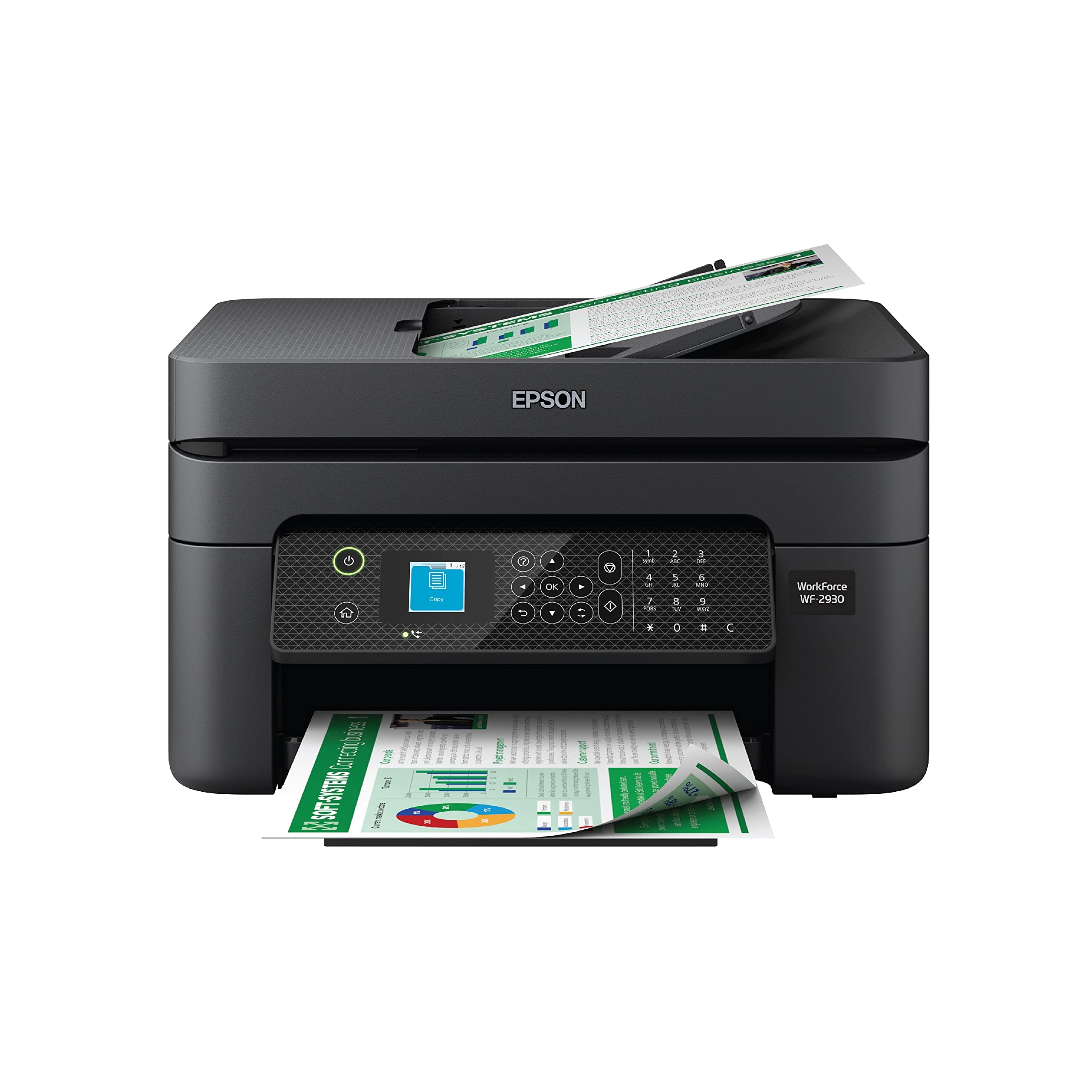
The Epson Workforce WF-2930 brings a color display and automatic duplex printing to the entry-level segment without a major price jump. Print speeds of 10 ppm black and 5 ppm color are adequate for mixed document loads. The integrated 1.4-inch color screen makes status checks and network selection easier than relying solely on flashing LEDs.
Heat-free technology and a permanent printhead are designed to last the printer’s lifetime, reducing long-term failure risk. Connectivity includes wireless, Wi-Fi Direct, and support for voice-activated printing via Alexa and Siri. The Epson Smart Panel app handles setup smoothly, and individual ink cartridges mean you only replace the color that runs out.
Build quality feels flimsy—reviewers noted excessive tape during unboxing and lightweight plastic chassis. The firmware can block third-party ink, forcing you into genuine Epson cartridges. For a home office on a tight budget that values a display and duplex, this is a solid entry point, but watch out for the ongoing ink costs.
Why it’s great
- Color display for easy navigation
- Auto duplex printing included
- Voice control via Alexa and Siri
Good to know
- Build quality feels cheap
- Firmware blocks third-party ink
- Starter cartridges are low-yield
4. Canon PIXMA TS7720

The Canon PIXMA TS7720 prioritizes small footprint and ease of use. Its 2.7-inch LCD touchscreen is the largest in this price tier, letting you initiate copies, adjust settings, and preview photos directly from the machine. Print speeds of 15 ppm black and 10 ppm color are competitive, and automatic duplex printing is standard.
Setup involves the Canon PRINT app, which most users completed within minutes on iOS and Android. The printer handles borderless 8.5×11 photos, and text output is crisp with no smudging. Two ink cartridges (PG-285 black, CL-286 color) keep replacement simple, though the color cartridge runs out faster than enthusiasts would like.
The bottom paper tray must be pulled out manually, and there is no auto document feeder—scanning multi-page jobs requires manual page flipping. Some users experienced persistent Wi-Fi connection drops with certain routers. For a small desk in a dorm or apartment where space is at a premium and photo printing is occasional, this is a fine candidate.
Why it’s great
- Large touchscreen for a budget model
- Fast print speeds for its class
- Very compact desktop footprint
Good to know
- No automatic document feeder
- Color cartridge drains quickly
- Paper tray requires manual pull-out
5. HP Envy 6155
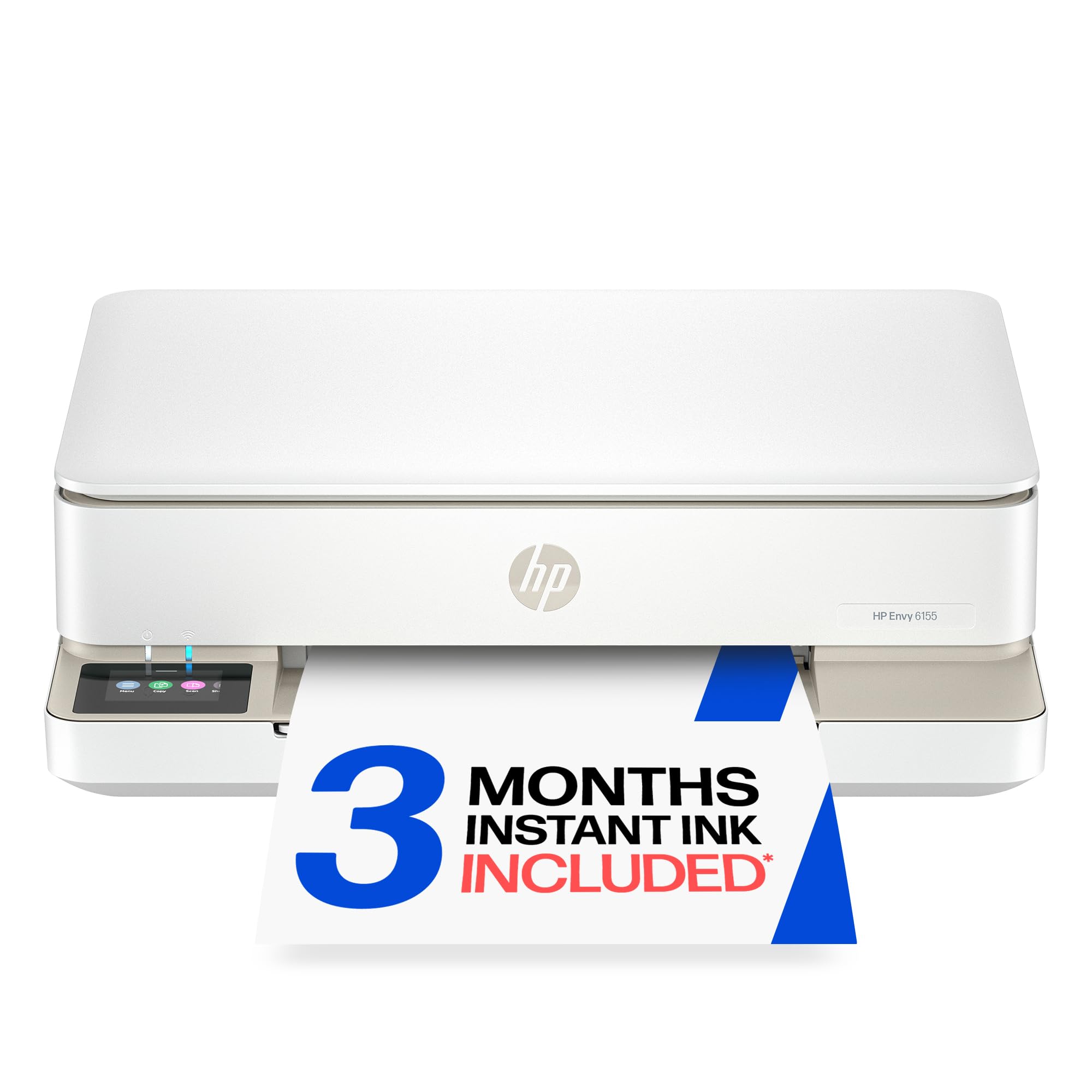
The HP Envy 6155 brings a 2.4-inch color touchscreen and AI-driven page reformatting that strips unwanted web content from printed articles—a genuinely useful feature for homework and recipes. Print speeds of 10 ppm black and 7 ppm color are solid for intermittent home use, and automatic duplex printing is included. The 100-sheet input tray is sufficient for light weekly printing.
The HP Smart app handles wireless setup and provides remote printing, scanning, and copying from a smartphone. The P3 color technology aims for vibrant photo output that matches screen colors. Reviewers praised the slim design and quick setup, with many reporting less than 15 minutes from unboxing to first print. The 3-month Instant Ink trial lets you test the subscription model without immediate commitment.
Starter cartridges yield only about 120 black and 75 color pages, so replacements come soon. The printer blocks non-HP cartridges via firmware, limiting your aftermarket options. Scanning from a computer is cumbersome—the device lacks a direct scan-to-PC feature, requiring cloud workarounds. For a well-rounded, AI-enhanced home printer, this is a strong contender.
Why it’s great
- AI reformats web pages before printing
- Auto duplex standard
- Quick wireless setup
Good to know
- Small starter cartridge yields
- Blocks third-party ink
- Scan-to-PC requires cloud workaround
6. HP DeskJet 2755e

The HP DeskJet 2755e is the quintessential entry-level inkjet: simple, small, and stripped of frills. Print speeds of 7.5 ppm black and 5.5 ppm color are serviceable for occasional homework and forms. It lacks automatic duplex, so two-sided printing requires manual page flipping. The 60-sheet input tray is the smallest in this lineup, suitable for low-volume households.
Dual-band Wi-Fi with self-reset helps maintain a stable connection, and the HP Smart app walks through setup step-by-step. The compact dimensions (17 x 13 x 6 inches) fit on a shallow desk or shelf. A 6-month Instant Ink trial is included, which can significantly reduce per-page costs if you print more than 50 pages per month.
Build quality is plasticky, and the lack of a display means all functions depend on the app or a computer. Some users report smeary output with the starter cartridges and finicky print head alignment. For absolute minimum spend and occasional monochrome documents, this works—but expect to upgrade cartridges quickly and live without duplex convenience.
Why it’s great
- Lowest upfront cost in the range
- Compact design for tight spaces
- Dual-band Wi-Fi with self-reset
Good to know
- Manual duplex only
- Starter ink yields are very low
- No display, app-dependent operation
7. MUNBYN Wireless Thermal Label Printer

The MUNBYN is a completely different category of cheapest printer—it uses thermal technology, meaning no ink, toner, or cartridges ever. It is purpose-built for shipping labels, address stickers, barcodes, and warehouse tags. Print speeds reach 150 mm/s (about 72 four-by-six labels per minute) at 203 DPI resolution, which is clear enough for barcode scanning.
AirPrint support means direct printing from iPhones, iPads, and Macs without extra drivers. The printer connects to dual-band Wi-Fi and can handle up to ten devices simultaneously. It works with all major shipping platforms (Amazon, Shopify, eBay, Etsy, UPS, FedEx). Customer support is responsive via phone, chat, and remote desktop, which is unusual at this price point.
It prints only in monochrome, does not handle standard paper, and the 203 DPI resolution is noticeably lower than inkjet output for fine graphics. Some users report the print quality fades after a few weeks of heavy use unless print density settings are adjusted. This is not a replacement for a document printer—but for small businesses shipping products daily, it eliminates the recurring ink expense entirely.
Why it’s great
- Zero ink cost, thermal printing
- Very fast label output
- AirPrint compatible with Apple devices
Good to know
- Only prints labels, not documents
- 203 DPI is low for photo-quality graphics
- Fading can occur without density adjustment
FAQ
Will a cheap printer force me into a subscription for ink?
How many pages should I expect from starter ink cartridges?
What is the cheapest printer to run over one year?
Final Thoughts: The Verdict
For most users, the cheapest printer winner is the Canon PIXMA TR4720 because it combines automatic duplex, an auto document feeder, and no subscription demands at a price that keeps the total cost low. If you want higher speed and a massive paper tray, grab the Epson Workforce Pro WF-3823. And for label-only workflows that eliminate ink entirely, nothing beats the MUNBYN Thermal Label Printer.

Mo Maruf
I created WellFizz to bridge the gap between vague wellness advice and actionable solutions. My mission is simple: to decode the research and give you practical tools you can actually use.
Beyond the data, I am a passionate traveler. I believe that stepping away from the screen to explore new environments is essential for mental clarity and physical vitality.