Our readers keep the lights on and my smoothie glass nicely filled. As an Amazon Associate, I earn from qualifying purchases.
Specs are compiled from manufacturer listings and verified buyer reviews and can change over time — please confirm the key details on the product page before buying.
You don’t need a fortune to spot a hawk’s feathers from 100 yards or catch every play at a ballgame. The secret to finding cheap binoculars that work is knowing which specs to trust and which marketing numbers to ignore. — because a 20x magnification (the “zoom” number that makes objects look 20 times closer) stamped on a box means nothing if the glass inside is murky. This guide cuts through the noise to find five pairs of cheap binoculars that deliver crisp, usable views without emptying your wallet.
I’m Mohammad Maruf — the founder and writer behind WellFizz. This guide is built by comparing the manufacturers’ published specifications and the patterns across verified customer reviews, so you get each pick’s real strengths and trade-offs instead of marketing spin.
Whether birdwatching from the deck, scouting trails, or catching a concert stage, the right binoculars turn a frustrating blur into a clear, memorable view. That is why we sorted through dozens of affordable options to bring you this list of the best cheapest binoculars that actually perform well in the real world.
Our Picks at a Glance

How To Choose The Best Cheapest Binoculars
The budget market for binoculars is crowded with flashy numbers and cheap plastic. To find a genuinely good pair, you need to ignore the marketing hype and focus on three things: honest magnification (the first number that tells you how much closer an object appears), prism quality, and the size of the objective lens (the front lens that gathers light). The magnification number (the first number in “10×25”) is often inflated — reviews for several budget models reveal the real power is frequently lower than what is printed on the box. You are usually getting a reliable 8x to 10x zoom, which is perfectly fine for birding, sports, and concerts, but knowing the truth helps you set the right expectations.
Prism Type: Bak-4 vs. BK-7
The prism (the internal glass piece that flips the image right-side up) is the heart of the optics. Bak-4 prisms are made from higher-quality glass that produces a perfectly round exit pupil — the tiny circle of light that reaches your eye. This means a brighter, sharper image. BK-7 prisms are cheaper and produce a slightly clipped or square-shaped exit pupil, which dims the image a bit. For the best cheapest binoculars, look for “Bak-4” in the specs; it is the biggest indicator you are getting decent glass on a budget. Picks in this list that use Bak-4 prisms consistently deliver the brightest and most satisfying views.
Objective Lens Diameter
The second number in the binoculars’ name (like the “50” in “20×50” or the “25” in “10×25”) is the diameter of the objective lens (the front lens that captures light) in millimeters. A larger objective lens gathers more light, which means a brighter image, especially in low-light conditions like dusk or a shaded forest. A 50mm lens will be noticeably brighter than a 25mm lens, but it also adds weight and bulk. You have to decide: do you want the brightest possible view for hunting or stargazing, or portability for hiking and travel? The 50mm models on this list are heavy but bright, while the 25mm models are pocketable but less powerful in dim light.
Quick Comparison
| Model | Best For | Magnification | Objective Lens | Eye Relief | Amazon |
|---|---|---|---|---|---|
| Wulakeo 20×50★ Best Overall | Long-range viewing / Hunting | 20x | 50mm | 26mm | Amazon |
| Hontry 10×25Best Value | General purpose / Travel | 10x | 25mm | 10mm | Amazon |
| Rodcirant 20×25 | Ultra-light travel / Day hikes | 20x | 25mm | — | Amazon |
| OPAITA 20×32 | Concerts / Glasses wearers | 20x | 32mm | 13mm | Amazon |
| Occer 15×30 | Wildlife / Sharp detail | 15x | 30mm | 16mm | Amazon |
In-Depth Reviews
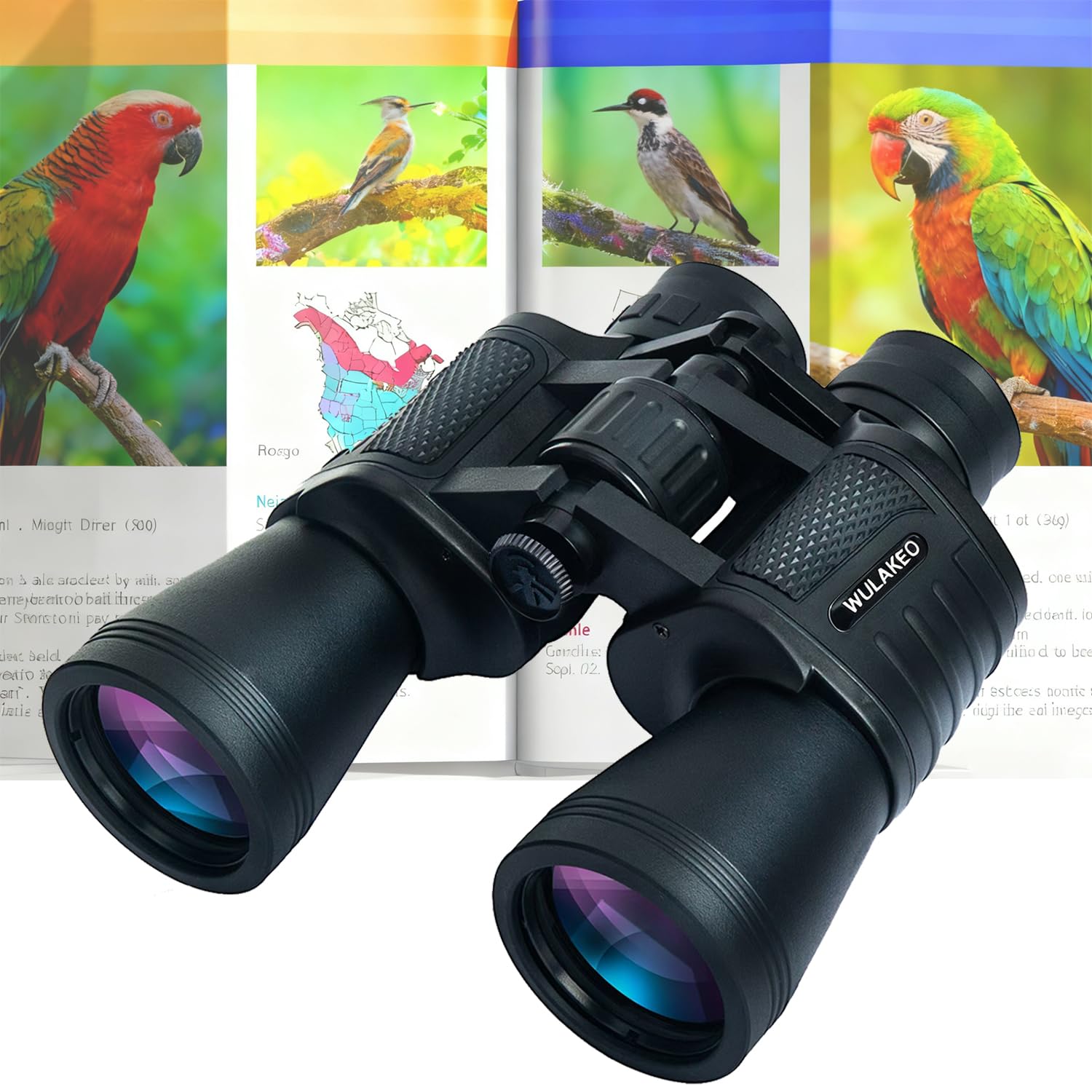
1. Wulakeo 20×50 High Powered Binoculars
The heavyweight champ brings far-away targets shockingly close without costing a fortune.
If your priority is raw reach — seeing a target at 500 feet with clarity — this is the pair that delivers. The 20x magnification and massive 50mm objective lens (the front lens that captures light) combine to pull in an immense amount of light, making distant objects appear right in front of you. Reviewers report they spotted a 12-inch target clearly at 500 feet, a feat most compact budget binoculars cannot manage. It is sharper at long range than the pocket-sized Hontry 10×25 because its larger lens gathers far more light.
The trade-off is size and heft. At 7.09 inches long and with a body reinforced by rubber coating for impact resistance, this is not a set you slip into a jacket pocket. The review feedback points out the focus wheel can feel stiff and finicky at first, and the included case and lanyard feel cheap. For a dedicated spotting tool you keep in a vehicle or a hunting pack, that is a fair compromise. What keeps it at the top is its value: for around the same price as a tiny 10×25 pair, you essentially get a tripod-in-your-hands field of view that punches well above its weight class. Hunters and stargazers on a tight budget who need max magnification should pick this one; hikers needing a pocketable binocular for quick glances should skip it.
The Massive Reach
- Powerful 20x magnification pulls distant targets in close.
- Large 50mm objective lens gives bright, clear views even in low light.
- Generous 26mm eye relief works great for glasses wearers.
- BAK4 Porro prism and FMC film deliver a sharp, high-contrast image.
The Size Reality
- Heavier and bulkier than compact models — not pocket-friendly.
- Focus wheel can feel stiff and finicky to adjust smoothly.
- Accessories like the case and lanyard are low quality.
Your long-range companion: Perfect for hunters, stargazers, and anyone who wants max magnification on a tight budget.
Who should pass: Hikers or travelers wanting a lightweight, pocketable binocular for quick glances.
2. Hontry 10×25 Compact Binoculars
The pocket pal that disappears into a jacket and still shows you the show.
When buyers report these binoculars are “super light and small enough to fit in my jacket pocket,” they are not exaggerating — at 0.6 pounds with a 10x magnification and 25mm objective lens (the front lens that gathers light), the Hontry strikes the ideal balance between portability and everyday usefulness. The crowd favorite by an enormous margin (over 24,000 ratings speak to its popularity), it uses Bak-4 prisms and fully multi-coated lenses to deliver bright, rich images that feel like a much more expensive pair. The 10x magnification is a balance: strong enough to bring birds and stage actors into clear view but steady enough to hold without a tripod. Unlike the huge Wulakeo 20×50, this one fits in a coat pocket for daily walks or family outings.
The thing everyone raves about is the compact size — it measures just 4.13 inches long, and the adjustable interpupillary distance (the space between the lenses, from 60mm to 75mm) means both kids and adults can share them comfortably. The 362-foot field of view at 1000 yards feels spacious. The honest trade-off is the eye relief (the distance from your eye to the eyepiece to see the full image): at 10mm, it is the shortest on this list, so if you wear glasses you will need to hold them close or fold the eyecups to get the full picture. If you wear glasses, you are better off with the Wulakeo’s 26mm eye relief. But for a universal, grab-and-go binocular that costs about the same as a nice lunch, the Hontry is tough to top for sheer daily utility.
The Everyday Essential
- Incredibly compact and lightweight — truly pocketable for hikes and concerts.
- Bak-4 prisms and fully multi-coated lenses deliver sharp, bright images.
- Excellent value with a huge positive consensus from thousands of owners.
- Adjustable IPD fits both kids and most adults comfortably.
The Glasses Trade-off
- 10mm eye relief may be too short for glasses wearers to see the full field.
- Not ideal for low-light conditions or long-range target spotting.
Your grab-and-go companion: Ideal for casual birdwatching, hiking, concerts, and family outings where size matters.
Look elsewhere if: You need to wear glasses while viewing or demand maximum brightness at dusk.
3. Rodcirant 20×25 Compact Binoculars

The featherweight that folds small enough for a suitcase corner and still surprises you with clarity.
At just 0.5 pounds and with a foldable design that shrinks to palm-size, the Rodcirant is the ultimate space-saver for travelers. Its 20x magnification and 25mm objective lens (the front lens that captures light) are packed into a body that also boasts IP67 waterproofing — a rating meaning it is fully sealed against dust and can survive immersion in 1 meter of fresh water for 30 minutes, so it won’t fog up if you drop it in a creek. Owners who took them on Alaskan cruises report they worked great for glacier viewing and took up “very little space in my suitcase.” The Bak-4 prism and fully multi-coated aspherical lenses claim a 99.68% light transmission rate, delivering bright, high-contrast images with no chromatic aberration (color fringing around edges). It is far more rugged than the Hontry because of its IP67 seal.
Here is the honest catch: the magnification is likely inflated. Some careful buyers compared the 20x model against name-brand 8x and 10x binoculars and found the real power is closer to 8x or 10x. That aligns with the pattern across budget optics — the marketing number overpromises, but the lens quality still delivers a clear, usable view. For the price, the glass is excellent, and the portability is class-leading. The 25mm objective lens means it needs good daylight to perform its best. Travelers who prioritize waterproof, packable optics will love this one; anyone who needs true high-power magnification for dusk viewing should skip it.
The Traveler’s Friend
- Ultra-light at 0.5 pounds with a foldable, palm-size design.
- IP67 waterproof rating keeps dust and moisture out.
- Bak-4 prism and fully multi-coated aspherical lenses deliver high-contrast, clear images.
- Includes a durable case for safe storage.
The Magnification Reality
- Advertised 20x power is likely closer to 8x or 10x based on user comparisons.
- 25mm objective lens needs good light for the brightest views.
Your cruise-ship and day-trip essential: Best for travelers who want a reliable, waterproof binocular that barely takes up space.
skip it if: You need true high-power magnification or regularly glass at dusk or dawn.
4. OPAITA 20×32 Compact Binoculars

The compact that splits the difference — bigger lens than pocket models, smaller body than full-size beasts.
With a 20x magnification and a 32mm objective lens (the front lens that gathers light), the OPAITA occupies a smart middle ground: more light-gathering power than a 25mm compact (providing 30% wider field of view according to the listing) but less weight than a 50mm giant. It is built around fully multi-coated Bak-4 prisms, which owners consistently describe as delivering “crisp, clear images” from long distances. The 13mm eye relief (distance from your eye to the eyepiece to see the full image) is a modest step up from the Hontry’s 10mm, making it slightly more workable for glasses wearers, though the eyepieces themselves are on the small side — you may need to hold them just off your glasses.
What makes this a premium budget pick is the perceived quality. It is one of the few that earned a strong positive rating across hundreds of reviews, with clarity ranking as the most-discussed strength after build quality. Travelers praise it for being “half the weight of full-size” binoculars yet delivering a wonderful outcome at concerts and on hikes. The plastic body feels solid rather than flimsy, and the included carrying bag and neck strap add real value. The main caveat is the lack of objective lens covers (caps for the front lenses), so you will want to store it in the bag to protect the glass. Birders and concert-goers who want brighter views than the Hontry offers without the bulk of the Wulakeo will find this the balance.
the balance Dimensions
- 20x magnification with 32mm objective lens for brighter views than tiny compacts.
- Bak-4 prisms and fully multi-coated lenses deliver crisp, sharp clarity.
- Compact and lightweight — about half the weight of full-size binoculars.
- Strong owner consensus on quality and value for the price.
The Small Quirks
- 13mm eye relief is tight for glasses wearers; small eyepieces can be a challenge.
- No objective lens covers included — must rely on the storage bag for protection.
The mid-power balance: Perfect for birders and concert-goers who want brighter images than a 25mm lens offers without the bulk of a 50mm.
Think twice if: You wear glasses and need long eye relief, or you demand a body with full metal construction.
5. Occer 15×30 Compact Binoculars

The detail-digger that fits a 15x claim into a frame small enough for one-handed operation.
The Occer 15×30 tries a different approach: a 15x magnification paired with a 30mm objective lens, plus a large 16mm eyepiece for an rich view. Owners are impressed by the “sharp, bright, crisp” optics and find the compact ergonomics exceptional — the focus dial is smooth enough to operate with one hand. At 12.8 ounces, it is light enough for extended use but not so tiny that you lose grip stability. The 16mm eye relief (the distance from your eye to the eyepiece to see the full image) is the second-best on this list, making it a strong candidate for glasses wearers who need breathing room between the eyepiece and their frames. It delivers more vivid color than the Rodcirant, according to owner reports.
The raw feedback reveals a familiar pattern in budget optics: the magnification is likely overstated. Some experienced users compared it against known 8x and 10x reference binoculars and estimated the real power is closer to 12x or less. The diopter adjustment (the ring that fine-tunes the right eyepiece for differences between your eyes) can also drift out of alignment during use. However, for the price, the build quality, wide field of view (368 feet at 1000 yards), and vivid color rendition make it a fantastic value for wildlife viewing and birdwatching. The green shell helps it blend into nature, and the included kit (bag, strap, cleaning cloth) is genuinely useful. Birders and hikers who want a light binocular with bright glass for daytime use will enjoy this one; if true 15x magnification is a deal-breaker, skip it.
The Optics & Comfort
- 16mm large eyepiece and wide field of view (368ft/1000yds) feel rich.
- Bak-4 prisms and FMC coating deliver 96.48% light transmission for bright, vivid color.
- Very compact and smooth one-hand operation for quick target acquisition.
- Easy to pack for hiking, hunting, and concerts.
The Honest Limits
- Real magnification likely lower than the advertised 15x.
- Diopter adjustment can drift with movement, requiring occasional re-calibration.
- Plastic body and included strap feel budget-grade.
Your detail spotter: Great for birders and hikers who want a light, easy-to-use binocular with bright, vivid glass for daytime wildlife spotting.
Pass on this if: True 15x magnification is a deal-breaker for you, or you need a rock-solid dipper that never drifts.
Understanding the Specs
Magnification (First Number)
This is the number that tells you how many times closer an object looks through the binoculars compared to your naked eye. A 10x binocular makes a 100-yard-away bird look like it is 10 yards away. Here is the crucial truth for budget buyers: many cheap binoculars inflate this number. A pair labeled “20x” may only deliver a true 10x or 12x zoom against a known reference. Do not obsess over the printed number; instead, look for clear reviews and honest brands. For general use like birding, concerts, or hiking, 8x to 10x is the most practical range because it is steady enough to hold by hand without a tripod (a three-legged stand that keeps things still).
Objective Lens Diameter (Second Number)
The number after the “x” is the diameter of the front lenses in millimeters — the part that faces your target. A larger objective lens, like 50mm, captures significantly more light than a 25mm lens, making the image brighter and more vibrant, especially during dawn, dusk, or in the shade of a forest. The trade-off is size and weight: a 50mm binocular is much bulkier than a 25mm model. If you are hiking a long trail, the extra brightness of a large lens may not be worth the extra weight. If you are hunting from a blind (a hidden spot where you watch animals) or stargazing from a backyard, the bigger lens is almost always the better choice.
Eye Relief
Eye relief is the distance in millimeters between your eye and the eyepiece (the part you look through) where you can still see the full image without dark edges. This is the most important spec for anyone who wears glasses. Because your glasses push your eye back from the binocular, you need at least 15mm to 16mm of eye relief to see the whole field comfortably without squishing the eyepieces against your lenses. On this list, the Wulakeo 20×50 with 26mm eye relief is a dream for glasses wearers, while the Hontry 10×25 with 10mm eye relief will force you to fold down the eyecups or hold them just so. If you wear glasses, do not skip this spec.
Prism Material: Bak-4 vs. BK-7
The prism (the internal glass piece that flips the image right-side up) inside the binocular body flips the image so it appears right-side up to your eye. Bak-4 prisms are made from higher-density, higher-quality optical glass. The result is a perfectly round, bright exit pupil — the little disc of light you see when you hold the binoculars at arm’s length. BK-7 prisms are cheaper and produce a slightly clipped, square-ish exit pupil, which loses some light and dims the image. For the cheapest binoculars, a “Bak-4” in the description is a green flag that the maker did not cut corners on the one part that directly affects image brightness. The running theme across the strongest picks in this guide is that they all use Bak-4 prisms.
Field of View (FOV)
This tells you how much of the world you can see side-to-side while looking through the binoculars, usually stated in “feet at 1,000 yards” (e.g., 362 feet). A wider field of view makes it easier to track moving objects like birds in flight or a player running across a football field. Compact binoculars often have a narrower FOV because the small internal prisms limit the angle. Larger objective lenses and better prism quality can widen the view. If you plan to follow fast-moving action, prioritize a wider FOV number. If you are focused on stationary targets like mountains or a stage, it matters less.
Waterproofing & Fog-proofing
Outdoor binoculars often claim to be “waterproof,” but the meaning varies widely. The industry standard for serious weather sealing is an IP67 rating, which means the unit is fully sealed against dust and can survive immersion in 1 meter of fresh water for 30 minutes. Fog-proofing means the binoculars are nitrogen-filled (filled with a dry gas) or use O-ring seals (rubber rings that block moisture) to prevent internal condensation when moving between hot and cold environments (e.g., stepping from an air-conditioned car into a humid forest). On a budget, an IP67 rating like the one on the Rodcirant 20×25 is a remarkable find. Others may only be “splash-proof” — fine for light rain, but not a dunk in a creek.
FAQ
How much should I spend on cheap binoculars?
What does the 10×25 or 20×50 number mean exactly?
Can I use cheap binoculars for stargazing?
What is the best cheap binocular for someone who wears glasses?
Are cheap binoculars waterproof?
Do cheap binoculars actually have 20x or 15x magnification?
What does “fully multi-coated” mean for binocular lenses?
How do I clean the lenses on my cheap binoculars?
Final Thoughts: The Verdict
The honest answer for anyone searching for the best cheapest binoculars is the Wulakeo 20×50 — it offers the widest real-world zoom and brightest image for the lowest price of any pick in this list, and its 26mm eye relief makes it usable for everyone. If you instead prioritize slipping a binocular into a jacket pocket for daily walks or family outings, the Hontry 10×25 is the proven legion of 20,000+ owners who will tell you the same thing. And for the traveler who needs rugged, packable optics that still deliver on clarity, the Occer 15×30 brings excellent color and detail without weighing down your carry-on. No matter which you choose, you walk away knowing you paid for good, honest glass, not inflated marketing hype.
How We Picked
We do not accept paid placement. Every pick is matched to a real buyer and a real use-case; we do not hands-on test units.
Sources & Methodology
Specifications: manufacturer listings and product documentation. Review insights: verified customer reviews, as of July 2026. Pricing: not shown on this page (it changes often); check the current price via the retailer link.
As an Amazon Associate, WellFizz earns from qualifying purchases. This does not affect which products we feature.
Related Guides

Mo Maruf
I created WellFizz to bridge the gap between vague wellness advice and actionable solutions. My mission is simple: to decode the research and give you practical tools you can actually use.
Beyond the data, I am a passionate traveler. I believe that stepping away from the screen to explore new environments is essential for mental clarity and physical vitality.